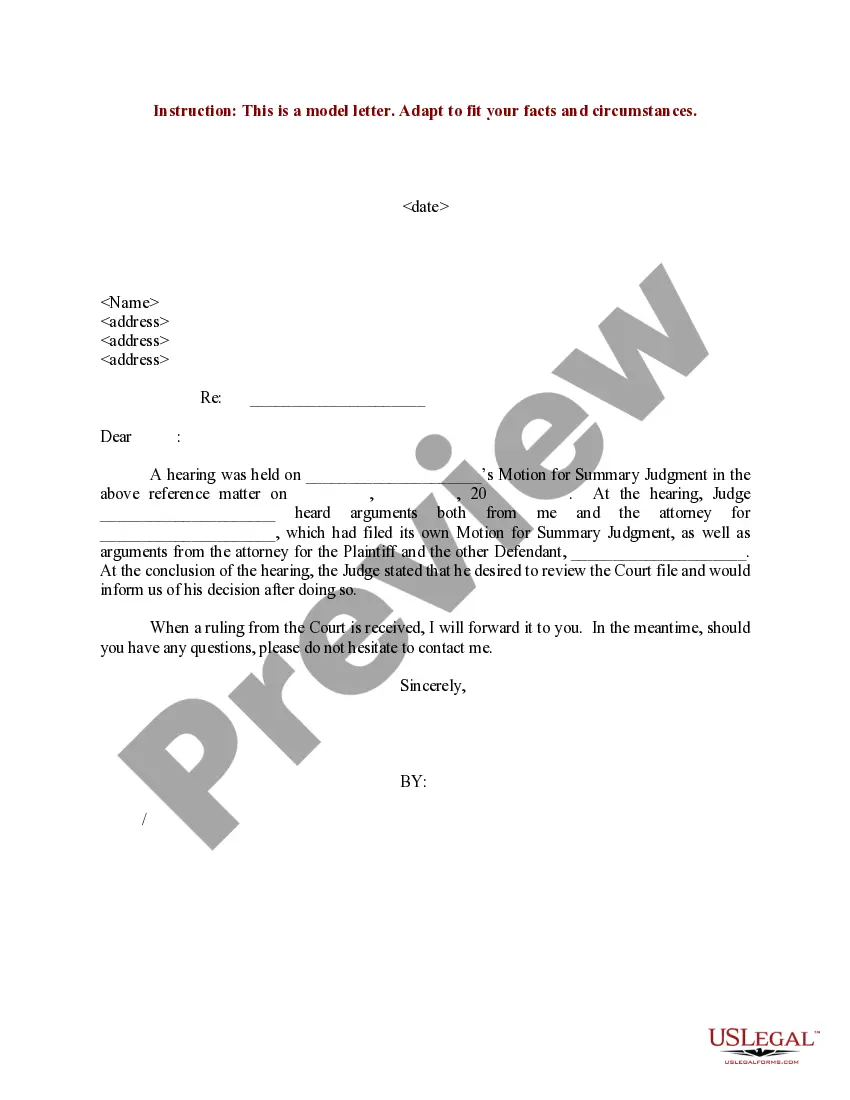
Sample Letter to Client concerning Hearing on Motion of Summary Judgment
What is this form?
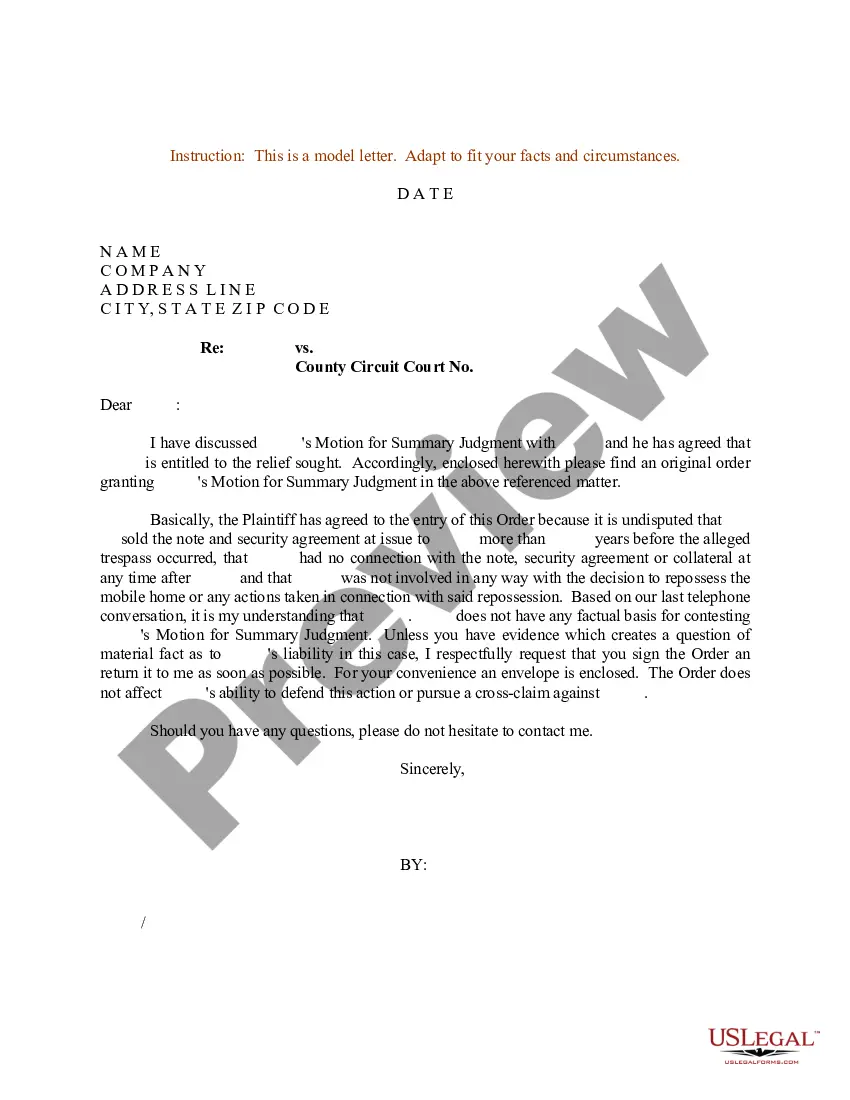
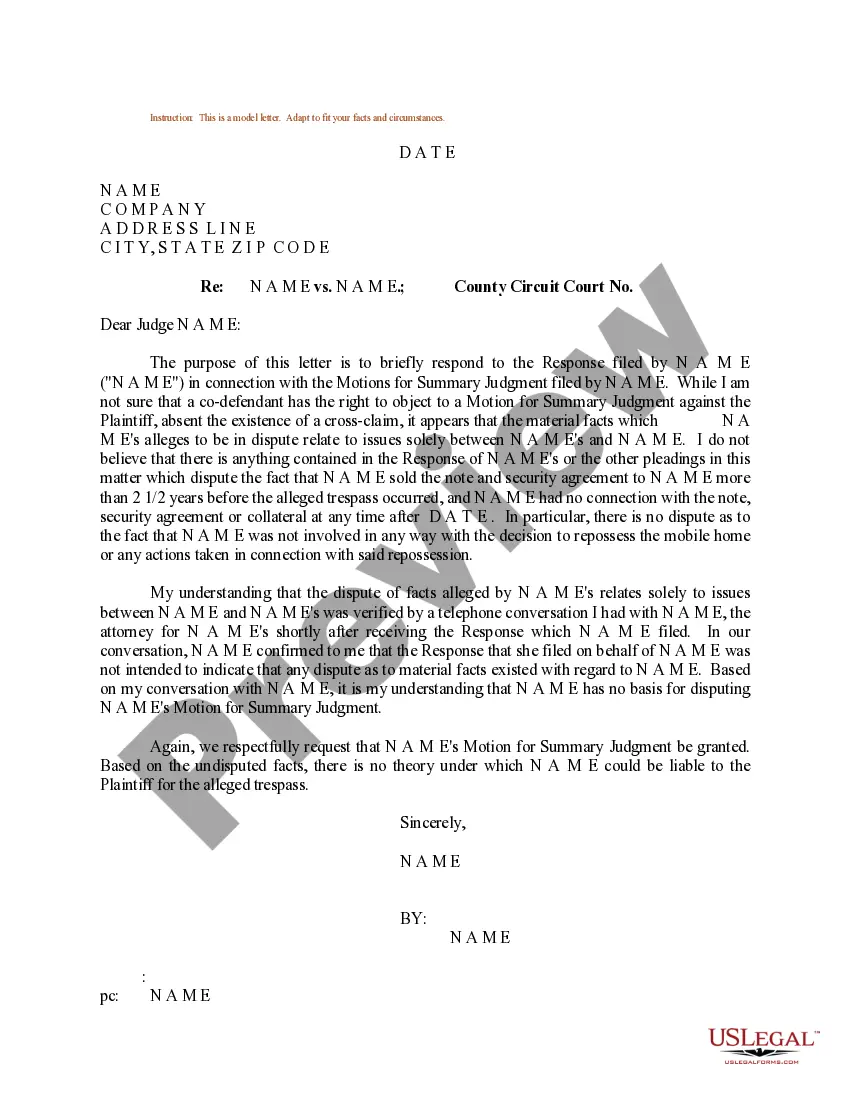
This form is a sample letter to a client regarding the hearing on a motion for summary judgment. The Sample Letter to Client concerning Hearing on Motion of Summary Judgment serves as a template that helps attorneys communicate important details to their clients about upcoming court proceedings. Unlike general letters, this form is specifically tailored to address issues related to summary judgment motions, ensuring clients are informed effectively.
Key components of this form
- Date of the letter
- Recipient's name and address
- Subject line indicating the purpose of the letter
- Details regarding the hearing on the motion
- Sign-off and signature line for the attorney
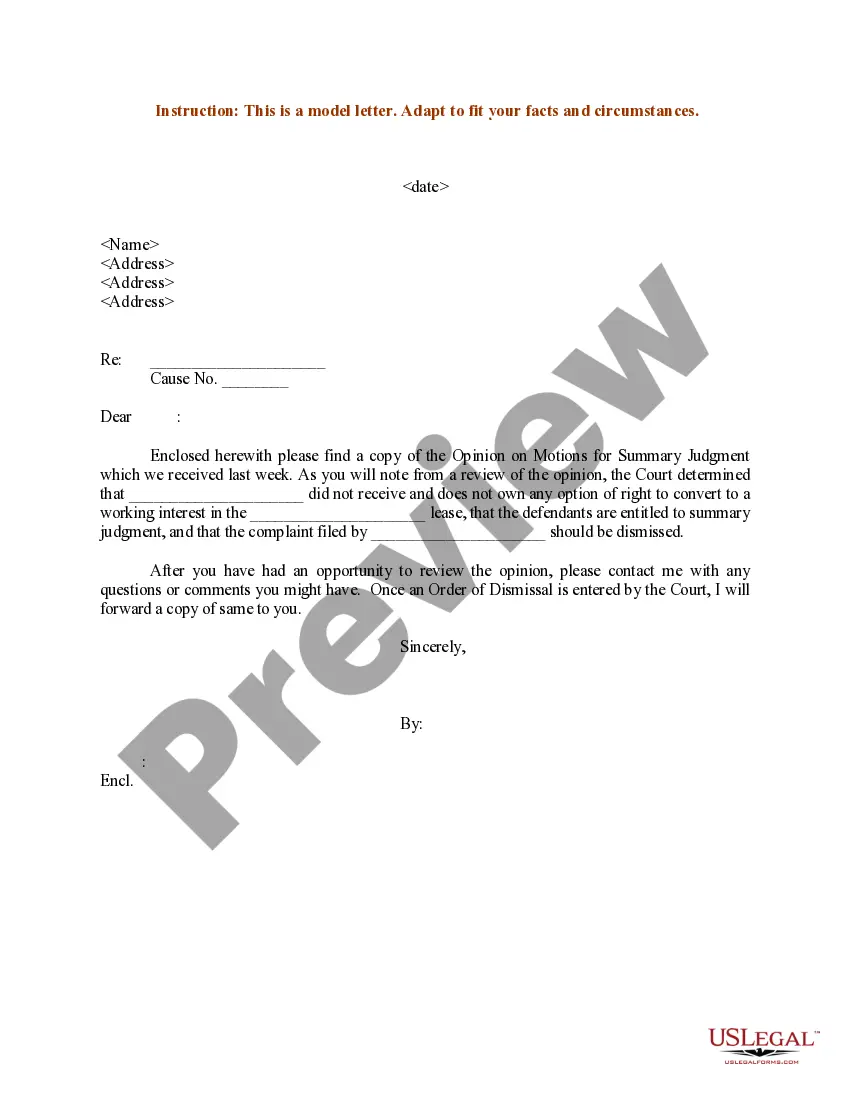
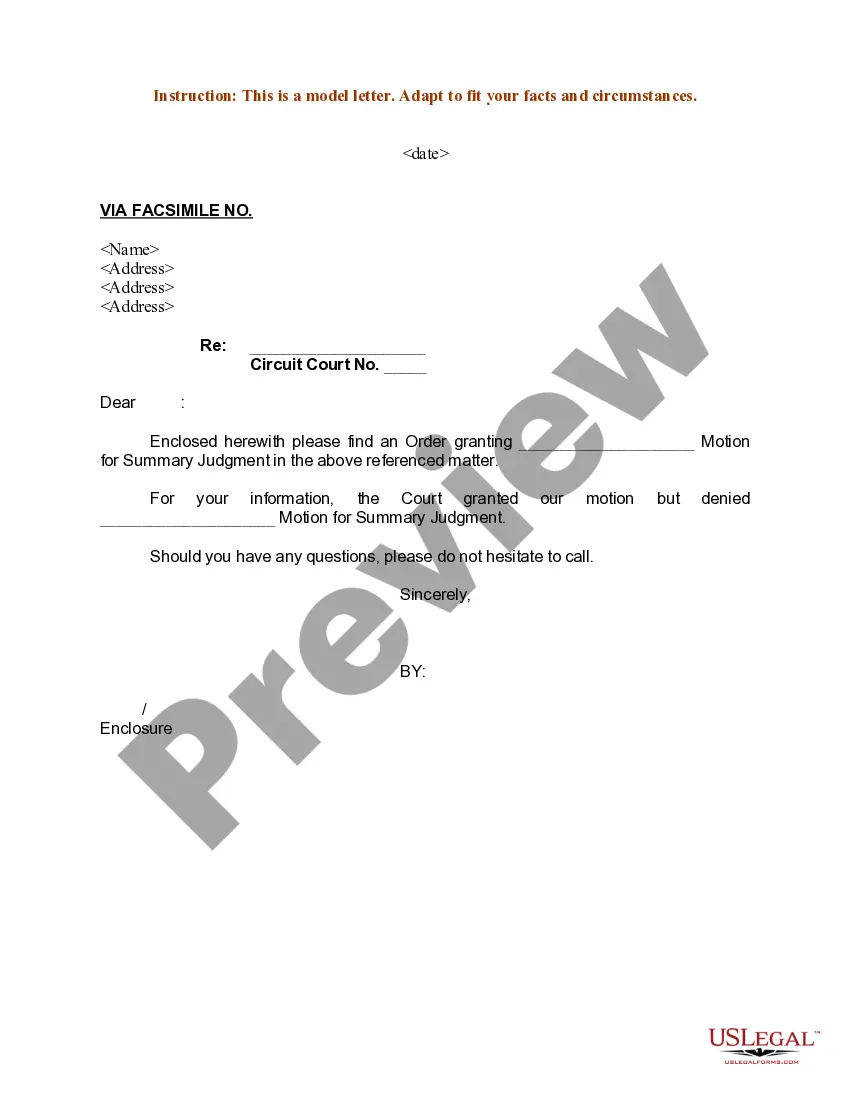
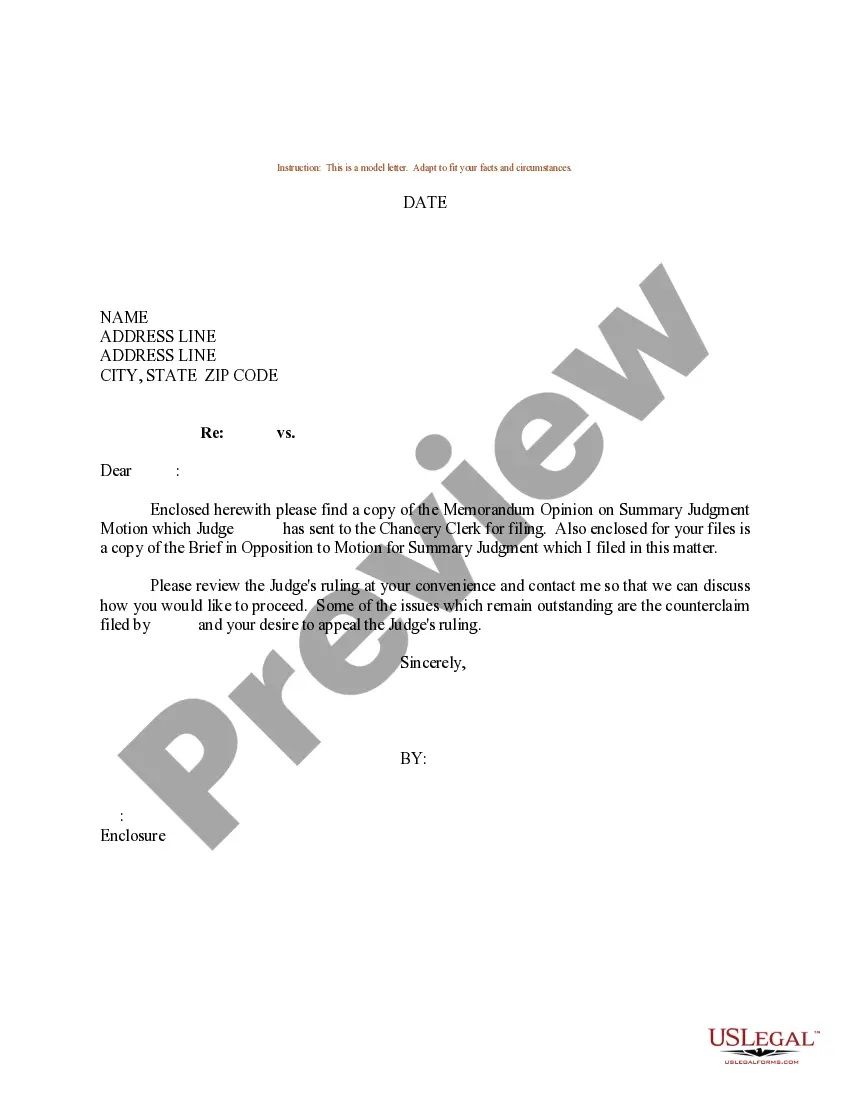
Common use cases
This form is useful when an attorney needs to formally notify a client about an upcoming hearing related to a motion for summary judgment. It helps to clarify the details of the hearing, what to expect, and any necessary preparations the client must undertake. Use this form to ensure your communication is professional and clear.
Intended users of this form
- Attorneys preparing for a hearing on a motion for summary judgment
- Law firms needing a template for client communication
- Legal professionals seeking to maintain clear communication with clients
Steps to complete this form
- Enter the date at the top of the letter.
- Fill in the recipient's name and address accurately.
- Specify the subject of the letter clearly as related to the hearing.
- Provide relevant details about the hearing, including dates and expectations.
- Sign off the letter formally and add the attorney's signature.
Does this form need to be notarized?
Notarization is generally not required for this form. However, certain states or situations might demand it. You can complete notarization online through US Legal Forms, powered by Notarize, using a verified video call available anytime.
Get your form ready online
Our built-in tools help you complete, sign, share, and store your documents in one place.
Make edits, fill in missing information, and update formatting in US Legal Forms—just like you would in MS Word.
Download a copy, print it, send it by email, or mail it via USPS—whatever works best for your next step.
Sign and collect signatures with our SignNow integration. Send to multiple recipients, set reminders, and more. Go Premium to unlock E-Sign.
If this form requires notarization, complete it online through a secure video call—no need to meet a notary in person or wait for an appointment.
We protect your documents and personal data by following strict security and privacy standards.

Make edits, fill in missing information, and update formatting in US Legal Forms—just like you would in MS Word.

Download a copy, print it, send it by email, or mail it via USPS—whatever works best for your next step.

Sign and collect signatures with our SignNow integration. Send to multiple recipients, set reminders, and more. Go Premium to unlock E-Sign.

If this form requires notarization, complete it online through a secure video call—no need to meet a notary in person or wait for an appointment.

We protect your documents and personal data by following strict security and privacy standards.
Avoid these common issues
- Failing to include the correct date of the hearing.
- Sending the notice too close to the hearing date, leaving insufficient time for client preparation.
- Neglecting to personalize the letter with the client's name.
Why complete this form online
- Easy to download and edit to fit specific needs.
- Convenient format allows for quick customization.
- Reliable structure ensures all necessary details are included.
Main things to remember
- This form is essential for communicating details about a summary judgment hearing to clients.
- Ensuring correct and complete information is vital for effective client management.
- Personalization of the letter is crucial for maintaining professional relationships.
Looking for another form?





Form popularity
FAQ
Filing an Opposition to a Motion for Summary Judgment A response must be in writing and include the same supporting documents as a motion for summary judgment. The opposition to the motion for summary judgment should also include a statement of facts showing the dispute and supporting documents.
A summary judgement occurs when, in a civil case, one party wants to move to a court decision without a trial.When a motion for summary judgement is granted, it indicates there is sufficient evidence to declare one party the clear winner.
The key to defeating a motion for summary judgment is to show the court that there are still facts in dispute. Summary judgment is only appropriate if none of the facts are disputed.
Stated different, to successfully defend against summary judgment the non-moving party (you) should seek to demonstrate that indeed there are material facts in dispute. Alternatively, the non-moving party (you) can argue that the undisputed facts support a judgment as a matter of law in your favor.
If a defendant refuses to produce documents or witnesses for depositions, you can oppose the summary-judgment motion by submitting your declaration and showing that facts essential to justify your opposition may exist but cannot for reasons stated be presented to the court.
General format - each motion generally consists of a case caption, a title that briefly identifies the relief sought, a series of numbered paragraphs that explains -- in a logical way -- why you are entitled to that relief, a prayer for relief, a signature block, a certification that a copy of the motion was sent to
If the motion is granted, the judgment on the issue or case is deemed to be a final judgment from which a party may seek an appeal. The court of appeal can reverse the grant of summary judgment and reinstate the claim in the lower court. However, this is rarely done and most summary judgments are upheld on appeal.
A response must be in writing and include the same supporting documents as a motion for summary judgment. The opposition to the motion for summary judgment should also include a statement of facts showing the dispute and supporting documents.
However, when a person is awaiting trial, writing a letter to the judge will not help. At best, the letter will go unread by the judge, and will be of no help. In a worst-case scenario, the letter will end up being used by the prosecution as evidence against that person.