Hawaii Revised Uniform Anatomical Gift Act Donation
Overview of this form
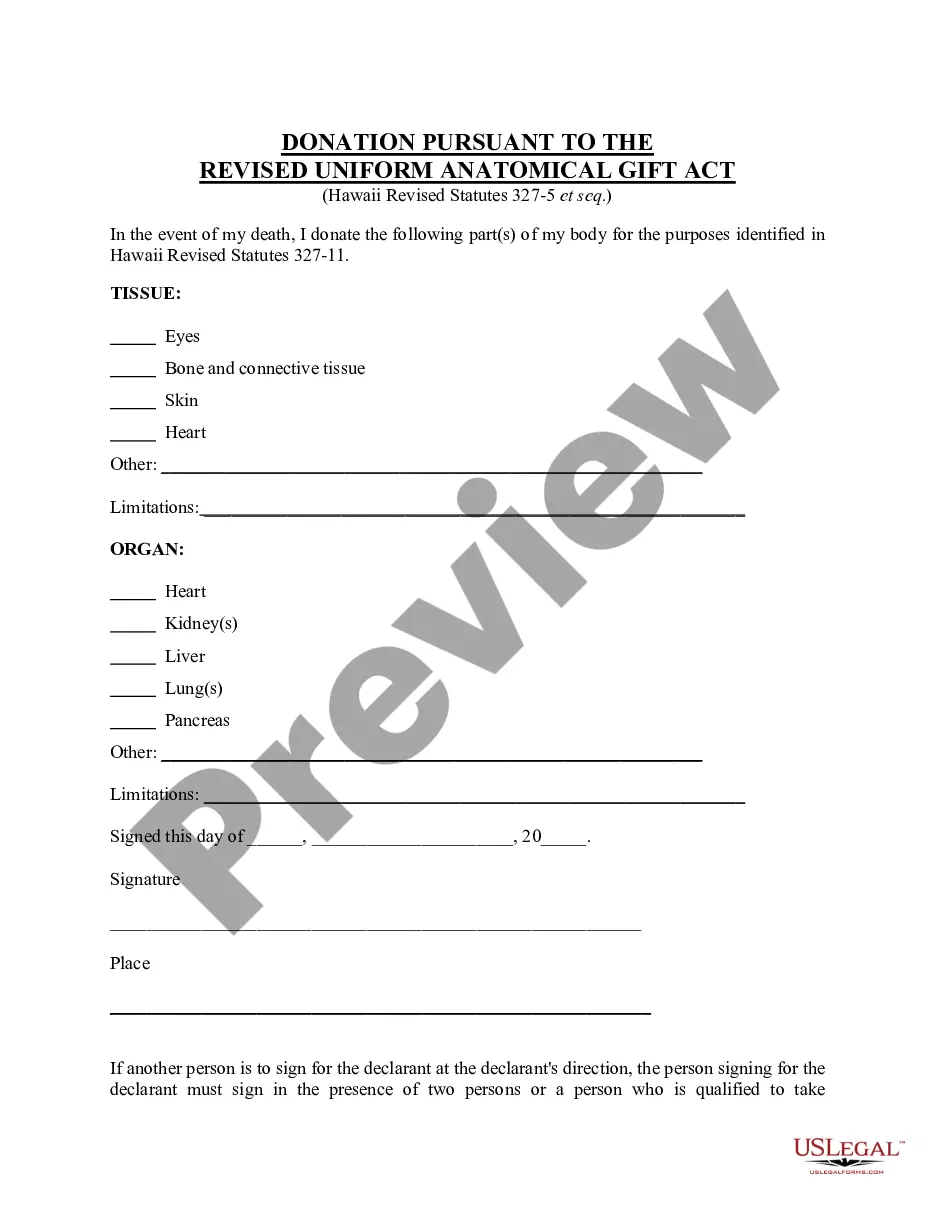
The Revised Uniform Anatomical Gift Act Donation form allows individuals to designate specific body parts and organs they wish to donate upon death. This form is essential for outlining your wishes regarding anatomical gifts and differs from other legal documents by focusing specifically on organ and tissue donation, ensuring that both your preferences and legal requirements are met.
Form components explained
- Section for detailing the specific parts or organs to be donated.
- Signature line for the donor, which must be witnessed and notarized.
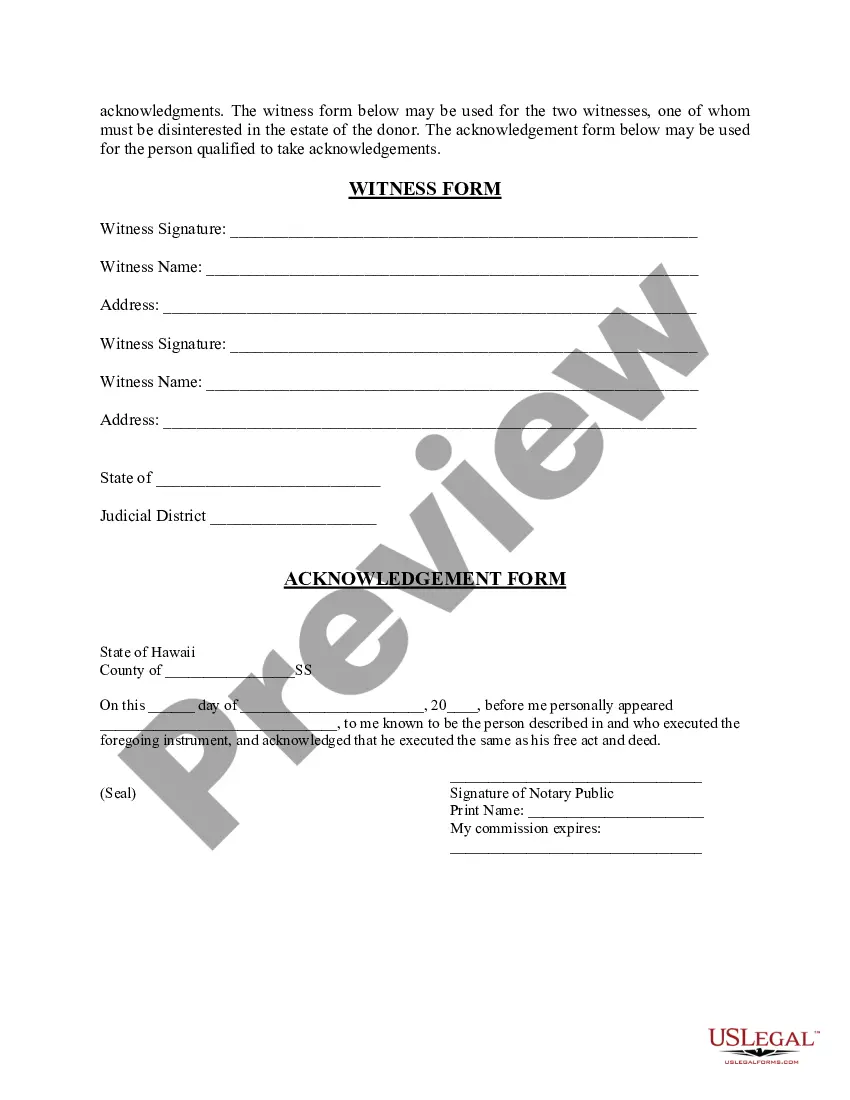
- Witnessing section requiring signatures from two disinterested witnesses.
- Acknowledgment section for the notary public to validate the signing.
Situations where this form applies
This form is used when an individual wishes to specify their intentions for organ and tissue donation at the time of death. It is particularly important for those who want to ensure their wishes are respected in medical emergencies and for families who need clarity during difficult times.
Who can use this document
- Any individual aged eighteen and older who wishes to make an anatomical gift.
- Individuals who have specific wishes regarding organ and tissue donation.
- Persons looking to aid medical research or assist others through organ transplantation.
Completing this form step by step
- Identify the specific body parts or organs you wish to donate.
- Sign the form in the presence of two witnesses or a notary public.
- Ensure that both witnesses sign the form and are disinterested parties.
- Complete the acknowledgment section with information from the notary.
- Keep a copy for your records and share it with family members.
Notarization requirements for this form
This form needs to be notarized to ensure legal validity. US Legal Forms provides secure online notarization powered by Notarize, allowing you to complete the process through a verified video call, available anytime.
Get your form ready online
Our built-in tools help you complete, sign, share, and store your documents in one place.
Make edits, fill in missing information, and update formatting in US Legal Forms—just like you would in MS Word.
Download a copy, print it, send it by email, or mail it via USPS—whatever works best for your next step.
Sign and collect signatures with our SignNow integration. Send to multiple recipients, set reminders, and more. Go Premium to unlock E-Sign.
If this form requires notarization, complete it online through a secure video call—no need to meet a notary in person or wait for an appointment.
We protect your documents and personal data by following strict security and privacy standards.

Make edits, fill in missing information, and update formatting in US Legal Forms—just like you would in MS Word.

Download a copy, print it, send it by email, or mail it via USPS—whatever works best for your next step.

Sign and collect signatures with our SignNow integration. Send to multiple recipients, set reminders, and more. Go Premium to unlock E-Sign.

If this form requires notarization, complete it online through a secure video call—no need to meet a notary in person or wait for an appointment.

We protect your documents and personal data by following strict security and privacy standards.
Common mistakes to avoid
- Failing to have the required witnesses present when signing the form.
- Not specifying which organs or tissues are being donated.
- Overlooking the notarization requirement, leading to an invalid document.
Why complete this form online
- Convenient access to the form anytime, anywhere.
- Editable format allows for easy customization of details.
- Reliable templates drafted by licensed attorneys to ensure legal compliance.
Looking for another form?

Form popularity
FAQ
Yes, organ donors can amend or revoke their gifts under the Hawaii Revised Uniform Anatomical Gift Act Donation. If you decide to change your mind regarding your donation, it's essential to follow the proper process to ensure your wishes are respected. You can update your decision by filling out the appropriate forms or by notifying the necessary authorities. Utilizing resources like USLegalForms can simplify this process and provide the guidance you need to make any changes effectively.
Yes, you can change your decision about organ donation at any time under the Hawaii Revised Uniform Anatomical Gift Act Donation. If you decide to revoke your organ donation consent, you can do so by completing a simple process, which might involve notifying relevant authorities or updating your registration. It is important to communicate your current wishes clearly to your family and keep documentation updated. USLegalForms provides the necessary tools and forms to help you manage your decision effectively.
Organ donation specifically refers to the transfer of organs from one person to another for transplant purposes. In contrast, an anatomical gift involves the donation of whole bodies or body parts for educational or research purposes. Both concepts fall under the Hawaii Revised Uniform Anatomical Gift Act Donation, but understanding their differences is crucial for making informed decisions about how you wish to contribute.
Completing organ donor registration is a straightforward process that often begins online or during your driver's license application. You can also register through various health organizations that participate in the Hawaii Revised Uniform Anatomical Gift Act Donation program. Ensure you provide accurate information and clearly express your intentions to make your wishes known.
Postmortem donation of organs is governed by the Uniform Anatomical Gift Act, which provides a legal framework for organ donation after death. This act outlines who can authorize the donation and ensures that the wishes of the deceased are respected. If you are considering the Hawaii Revised Uniform Anatomical Gift Act Donation, it is vital to communicate your wishes to your family and ensure they are documented.
The only organ that cannot be donated is the brain. Unlike other organs, the brain cannot function outside the body, making it impossible to use for transplantation. This aspect is important to consider when discussing the Hawaii Revised Uniform Anatomical Gift Act Donation. Understanding these limitations helps clarify what is possible during the donation process.
True. The Uniform Anatomical Gift Act regulates the process of organ donation in a structured manner. Specifically, the Hawaii Revised Uniform Anatomical Gift Act Donation aligns with this regulation, ensuring that donors’ wishes are honored. In addition to setting rules for donations, it clarifies the roles of healthcare providers and the responsibilities of donors and families.
The Revised Uniform Anatomical Gift Act is legislation that provides a framework for organ donation in the United States, including Hawaii. This Act allows individuals to donate their organs and tissues after death, promoting awareness and encouraging donation. By standardizing the process, the Act aims to simplify the decision-making for potential donors and their families. Understanding this Act is essential for anyone considering the Hawaii Revised Uniform Anatomical Gift Act Donation.
Under the Hawaii Revised Uniform Anatomical Gift Act Donation, the process for postmortem donation of organs is clearly defined. The Act allows individuals to designate their wishes regarding organ donation before they pass away. If a person has not made their wishes known, family members can often make the decision on their behalf. This ensures that the donation process is handled respectfully and in accordance with the individual's desires.