Connecticut Last Will for a Widow or Widower with no Children
What is this form?
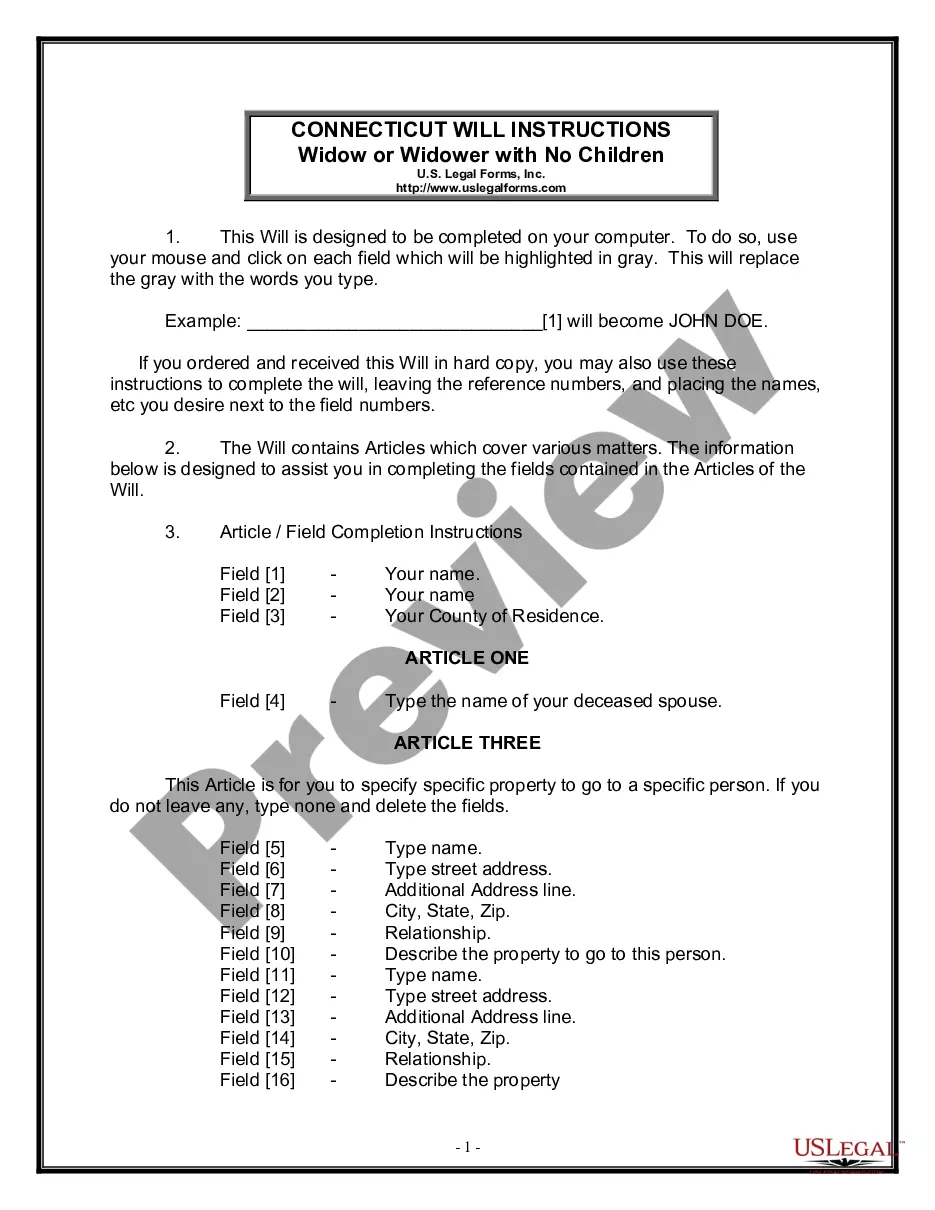
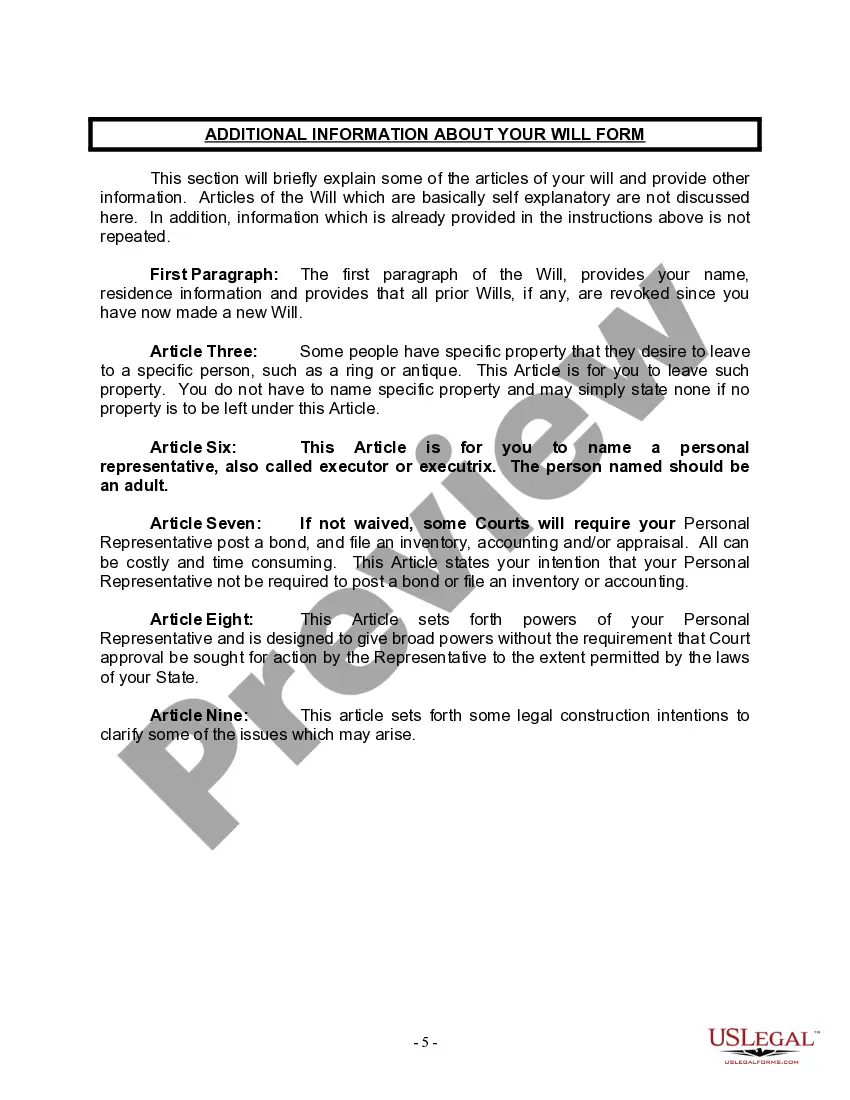
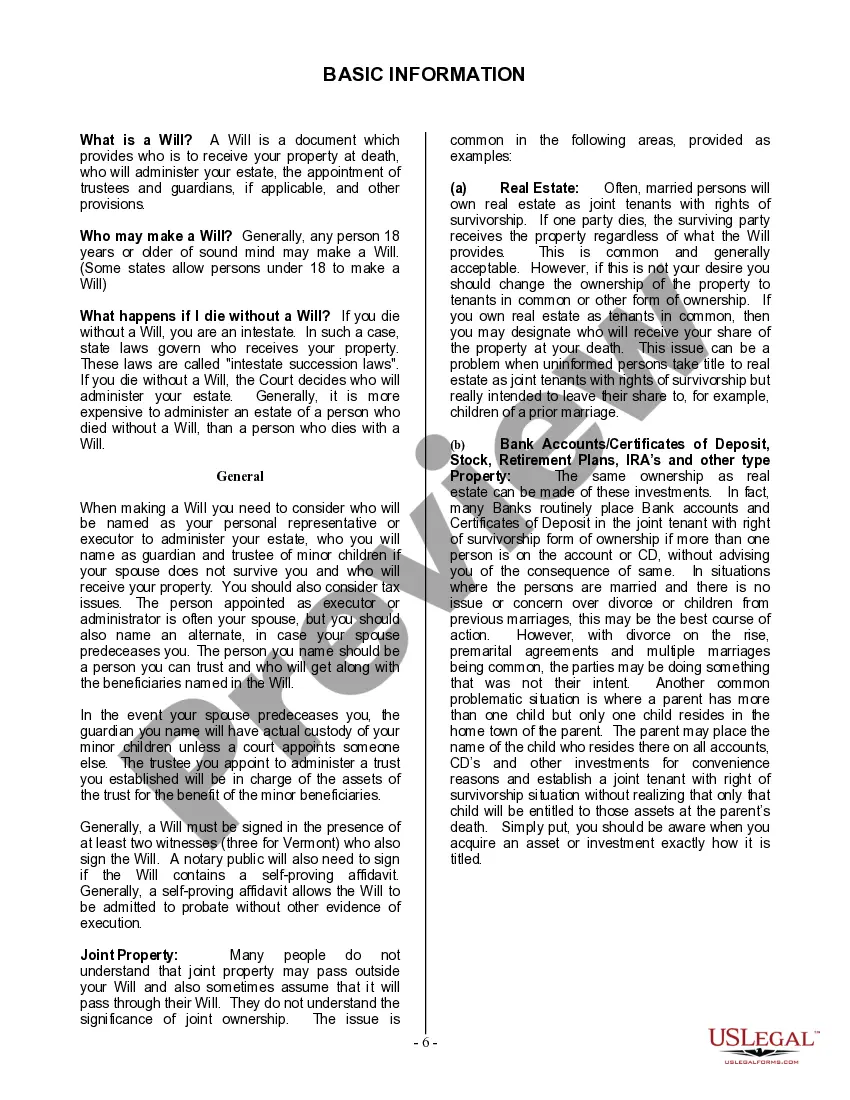
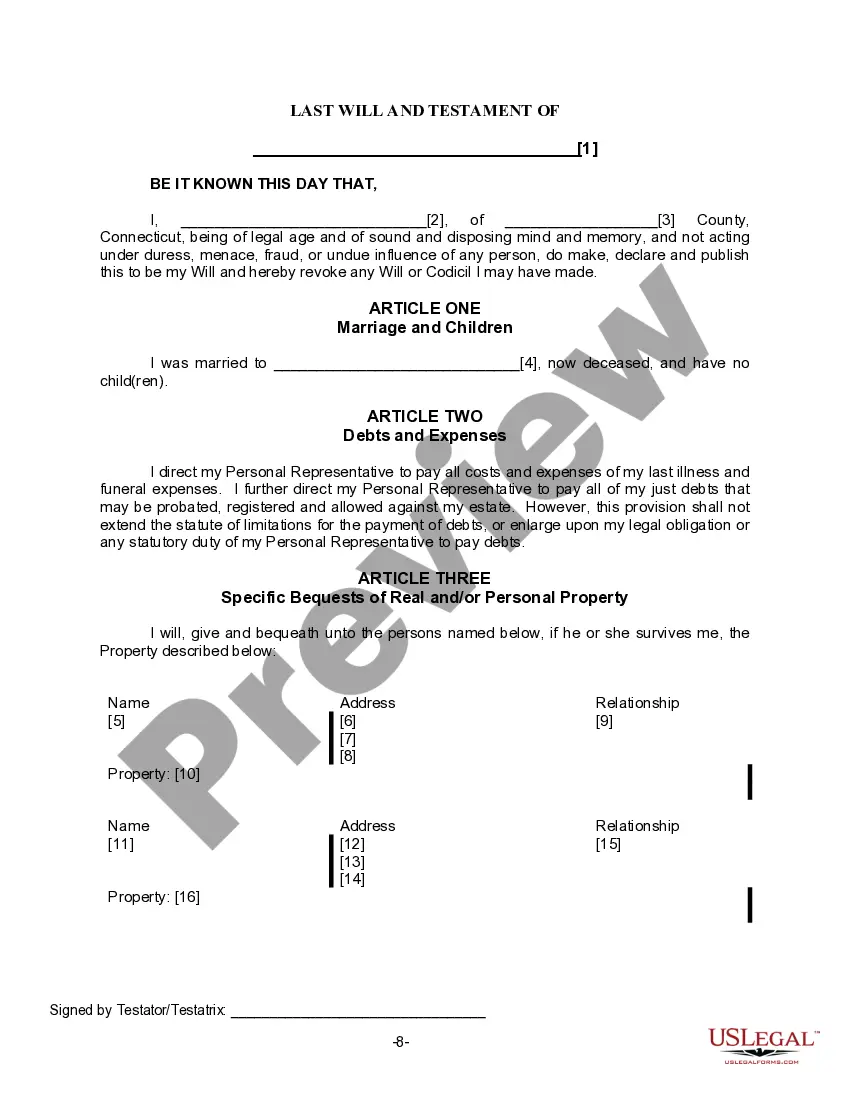
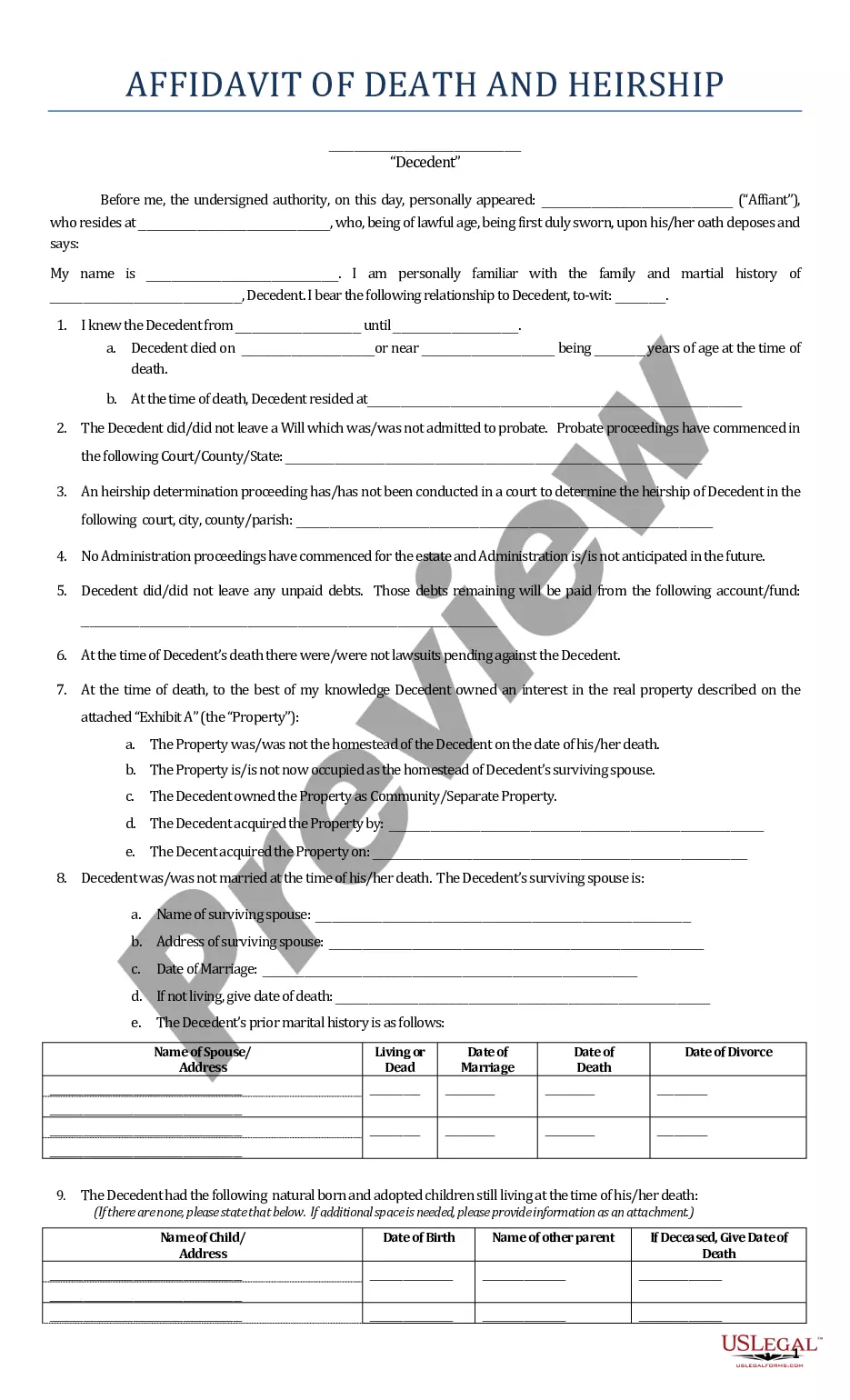
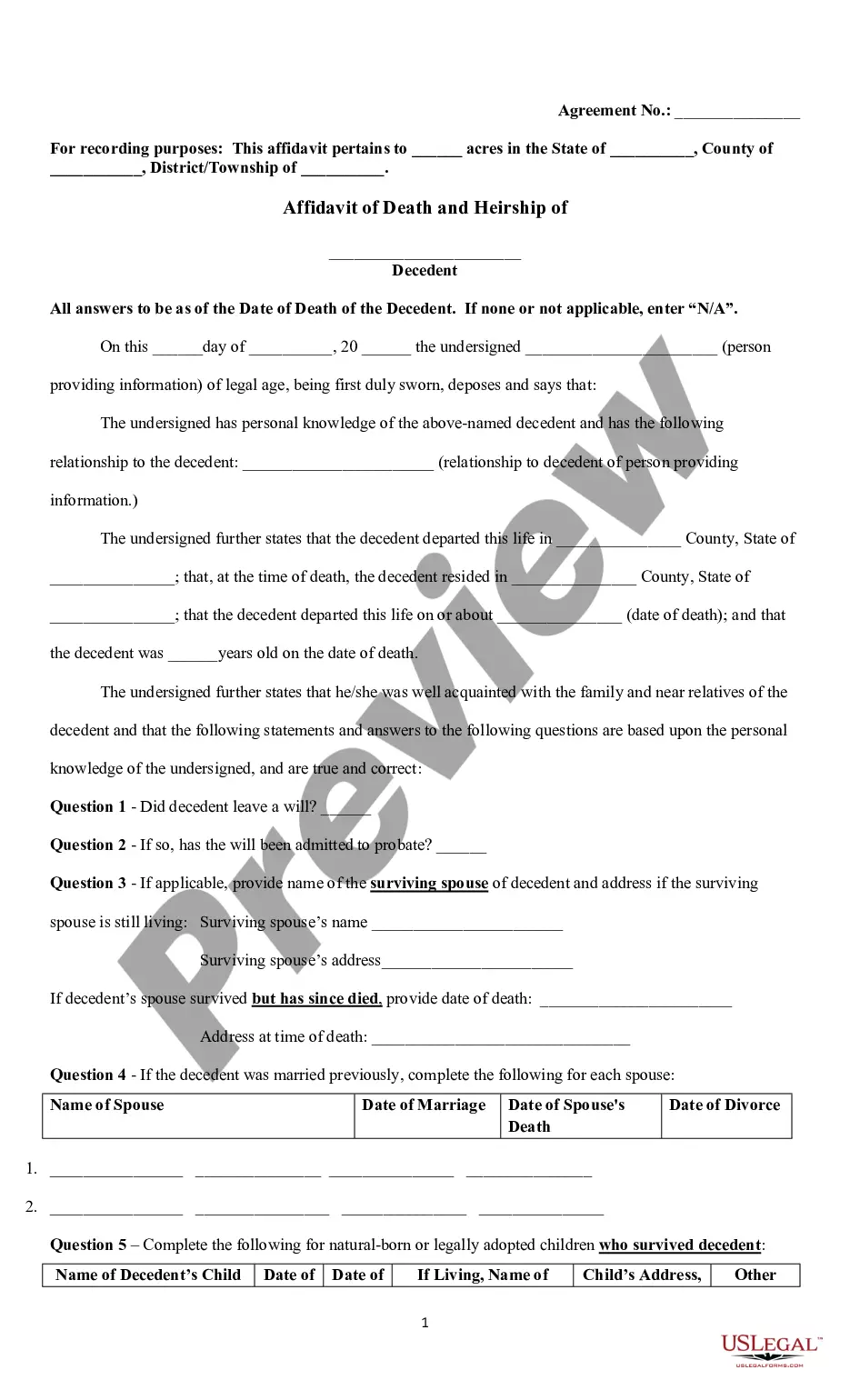
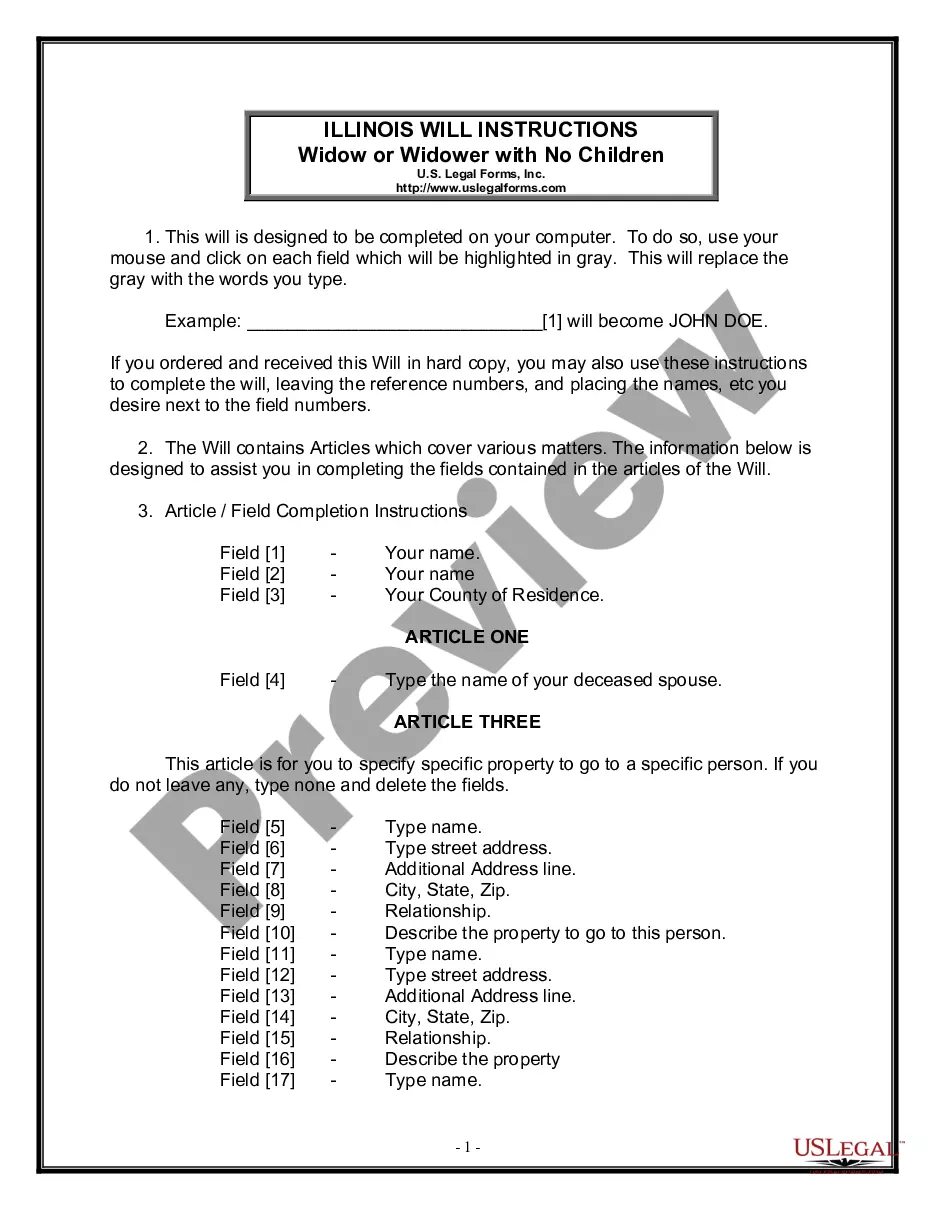
This Last Will for a Widow or Widower with No Children is a legal document that lets you articulate how your assets should be distributed after your death. Specifically designed for individuals who are widowed and do not have children, this will simplifies the estate planning process by detailing your wishes for property distribution and the appointment of an executor. Unlike general last wills that may include provisions for children, this form focuses solely on the needs of widowed individuals without descendants.
Main sections of this form
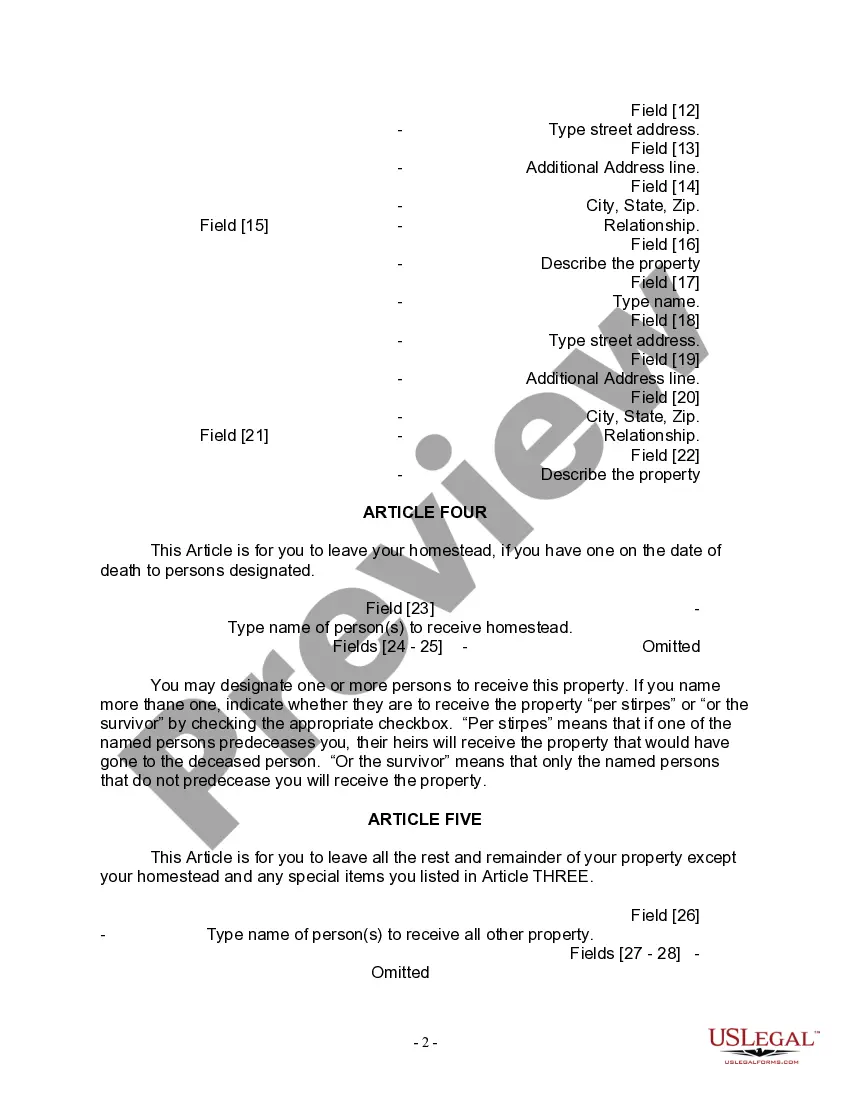
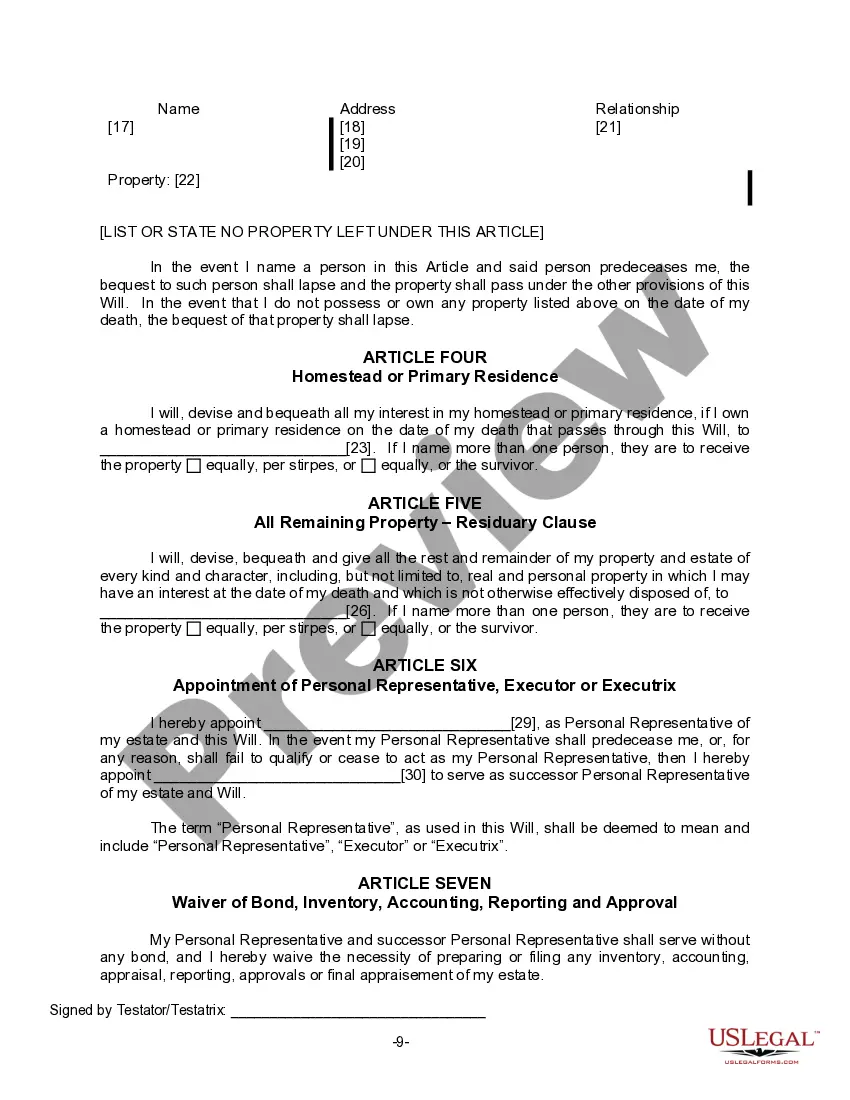
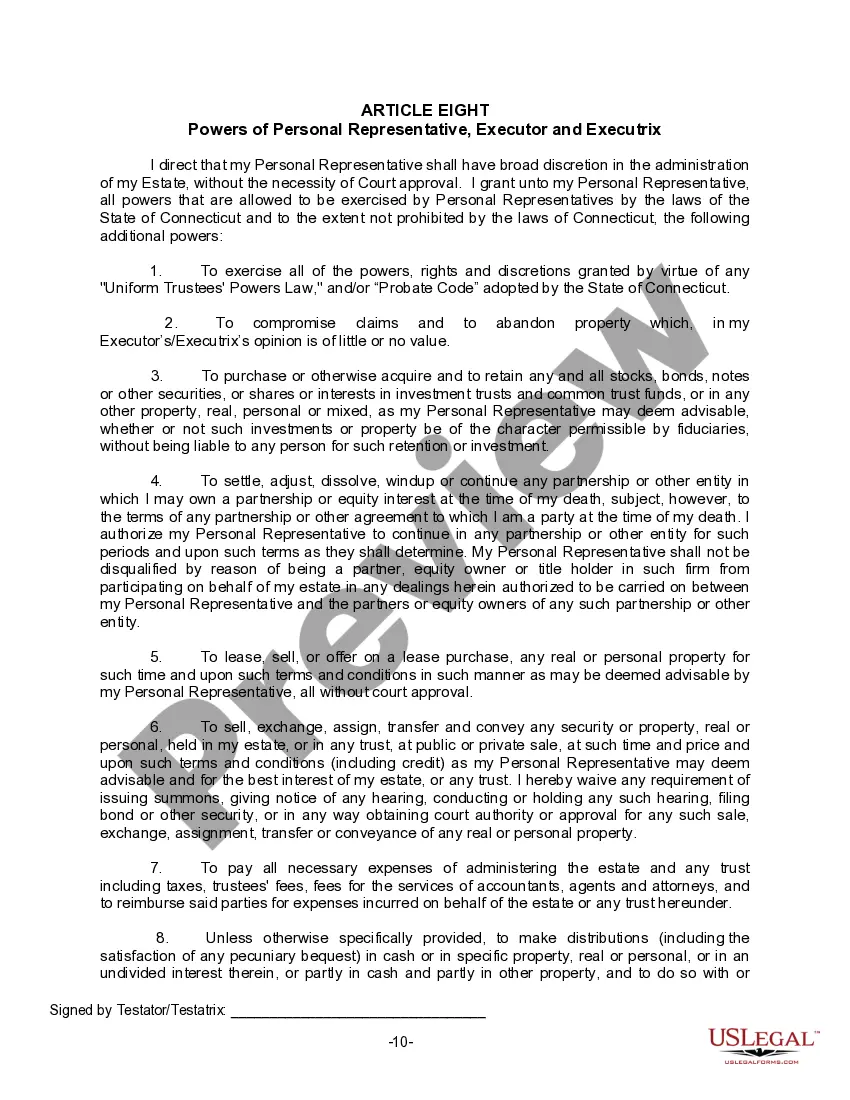
- Appointment of Personal Representative: Designates an individual to manage your estate.
- Distribution of Property: Specifies who will receive your assets and any special items.
- Homestead Provision: Allows you to designate who receives your primary residence.
- Residuary Clause: Addresses the distribution of any remaining property not specifically bequeathed.
- Self-Proving Affidavit: Provides a method for the will to be validated without additional witness testimony.



Situations where this form applies
This form should be used when a widow or widower without children wishes to legally document their final wishes regarding asset distribution after death. It is appropriate in circumstances where there is no immediate family to inherit, or when specific properties need to be allocated to friends or other relatives. Creating a will helps ensure that your assets are managed according to your preferences and can mitigate potential disputes among surviving relatives.
Intended users of this form
- Widows and widowers without children.
- Individuals seeking to organize their estate without the involvement of heirs.
- People who want to ensure their personal belongings are distributed as per their wishes.
Completing this form step by step
- Enter your full name and county of residence.
- Specify the name of your deceased spouse.
- Designate individuals or organizations to receive specific properties or assets.
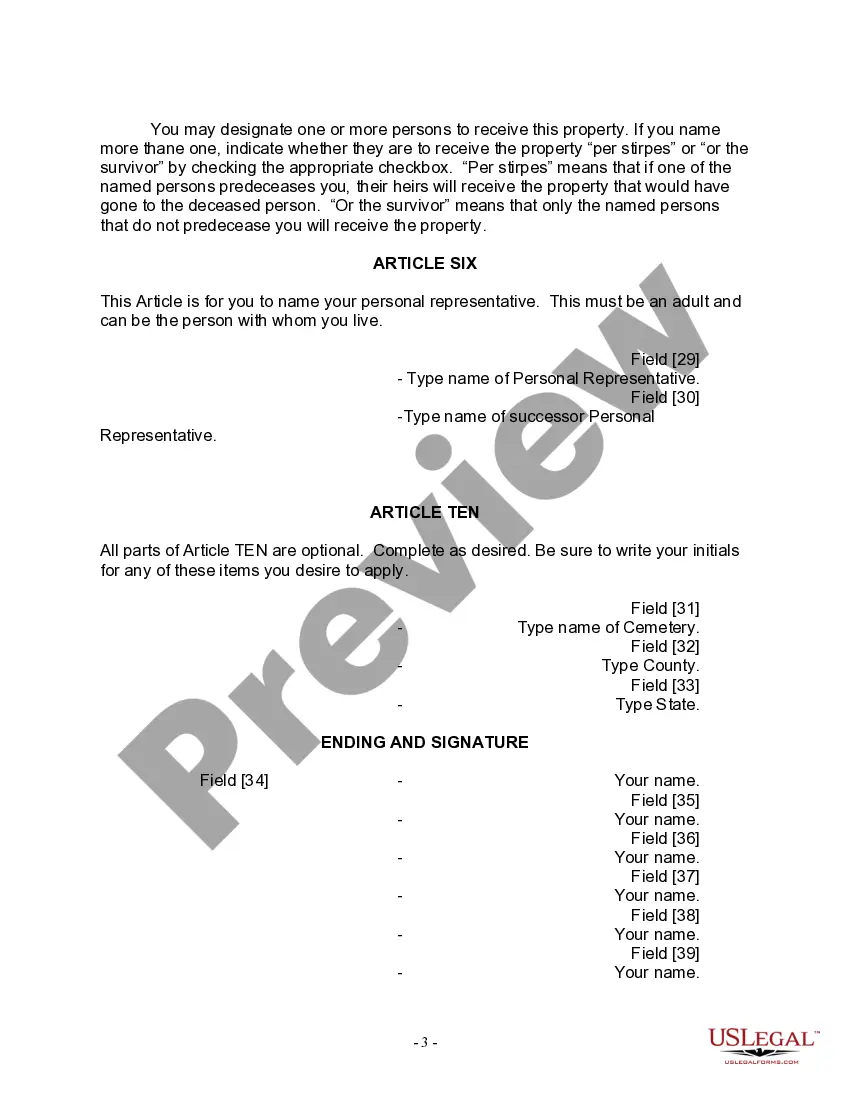
- Appoint a Personal Representative and a successor to manage your estate.
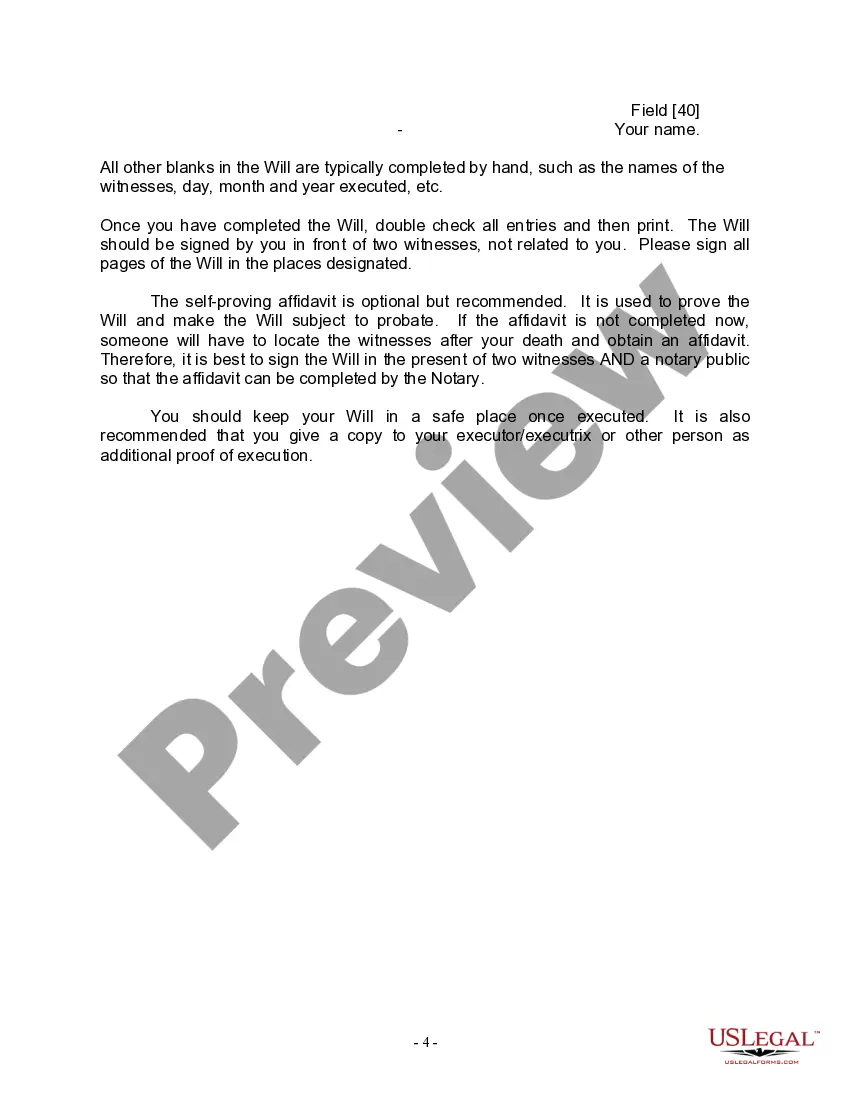
- Ensure the document is signed in front of two witnesses and, if applicable, notarized for validation.
Does this document require notarization?
Yes, this form must be notarized to be legally valid. It is essential to ensure that the will is signed in the presence of a notary public, particularly if the document contains a self-proving affidavit. US Legal Forms offers integrated online notarization services that are available 24/7, allowing you to comply with this requirement conveniently and securely.
Get your form ready online
Our built-in tools help you complete, sign, share, and store your documents in one place.
Make edits, fill in missing information, and update formatting in US Legal Forms—just like you would in MS Word.
Download a copy, print it, send it by email, or mail it via USPS—whatever works best for your next step.
Sign and collect signatures with our SignNow integration. Send to multiple recipients, set reminders, and more. Go Premium to unlock E-Sign.
If this form requires notarization, complete it online through a secure video call—no need to meet a notary in person or wait for an appointment.
We protect your documents and personal data by following strict security and privacy standards.

Make edits, fill in missing information, and update formatting in US Legal Forms—just like you would in MS Word.

Download a copy, print it, send it by email, or mail it via USPS—whatever works best for your next step.

Sign and collect signatures with our SignNow integration. Send to multiple recipients, set reminders, and more. Go Premium to unlock E-Sign.

If this form requires notarization, complete it online through a secure video call—no need to meet a notary in person or wait for an appointment.

We protect your documents and personal data by following strict security and privacy standards.
Avoid these common issues
- Failing to have the will signed in the presence of two witnesses.
- Omitting vital personal and property information.
- Not specifying how jointly owned property should be handled.
- Neglecting to check for compliance with local state laws and requirements.
- Skipping the notarization process when a self-proving affidavit is included.
Benefits of using this form online
- Convenience: Complete the form from home at your own pace.
- Editability: Easily modify the document as your wishes change.
- Access to legal templates: Utilize attorney-drafted templates for peace of mind.
Summary of main points
- This will is specifically designed for those who are widowed and without children.
- Ensure proper execution in the presence of required witnesses to avoid legal issues.
- Consider including a self-proving affidavit to streamline the probate process.
Looking for another form?

Form popularity
FAQ
The requirements for notarization of wills vary by state. While states like Florida and Louisiana require notarization, Connecticut does not impose such a necessity for wills. If you are exploring the creation of a Connecticut Last Will for a Widow or Widower with no Children, understanding these differences can help you navigate the process effectively. Utilizing resources like the US Legal Forms platform can simplify your journey.
written will, also known as a holographic will, can be valid in Connecticut if it meets certain conditions. It must be entirely in the handwriting of the person making the will and signed by them as well. If you are considering creating a Connecticut Last Will for a Widow or Widower with no Children, a handwritten will can be a straightforward option, but it’s advisable to seek legal advice to ensure its efficacy.
Yes, you can write your own will in Connecticut. However, it is vital to follow specific legal guidelines to ensure it’s valid and enforceable. A well-crafted Connecticut Last Will for a Widow or Widower with no Children can help you clarify your wishes and provide peace of mind. To make the process smoother, consider using the US Legal Forms platform for guidance and templates.
In Connecticut, a will does not necessarily need to be notarized to be valid. What’s essential is that the document is signed by the testator and witnessed by two individuals who are present at the same time. Nonetheless, if you are considering a Connecticut Last Will for a Widow or Widower with no Children, using notarization can simplify the probate process and reduce potential disputes.
In Connecticut, a living will does not need to be notarized to be valid. However, it’s crucial to ensure that you meet all other legal requirements, such as being of sound mind and at least 18 years old. While notarization is not required, it can provide extra assurance regarding the authenticity of your document, especially when creating a Connecticut Last Will for a Widow or Widower with no Children.
When one spouse passes away, the will becomes essential for determining the distribution of assets. The surviving spouse will typically inherit according to the terms of the Connecticut Last Will for a Widow or Widower with no Children. If the deceased spouse's will is valid, the court will honor its directives during the probate process. To ensure everything is clear, it's wise for the surviving spouse to consult with a legal expert to navigate the specifics and protect their interests.
The primary next of kin typically refers to the closest relatives, beginning with the spouse. If the spouse is deceased or cannot inherit, the order continues to children and then other relatives such as parents and siblings. Understanding who your primary next of kin is can greatly influence your estate planning, particularly when preparing a Connecticut Last Will for a Widow or Widower with no Children.
A spouse does not automatically inherit everything in Connecticut, but they do have significant entitlements. If there are no children, the spouse typically receives all assets. When drafting a Connecticut Last Will for a Widow or Widower with no Children, outlining specific wishes can help clarify the distribution of assets.
The order of next of kin in Connecticut starts with the spouse, followed by children, parents, siblings, and then grandparents. This hierarchy can impact how an estate is handled after death. Hence, when establishing a Connecticut Last Will for a Widow or Widower with no Children, it's important to be aware of this order to ensure proper asset distribution.
The legal next of kin in Connecticut is usually defined as the closest relative of the deceased. This typically begins with the spouse, followed by children, parents, siblings, and more distant relatives. Understanding the concept of next of kin is essential for anyone preparing a Connecticut Last Will for a Widow or Widower with no Children, as it determines inheritance rights.