Connecticut Warranty Deed to Separate Property of One Spouse to Both as Joint Tenants
Understanding this form
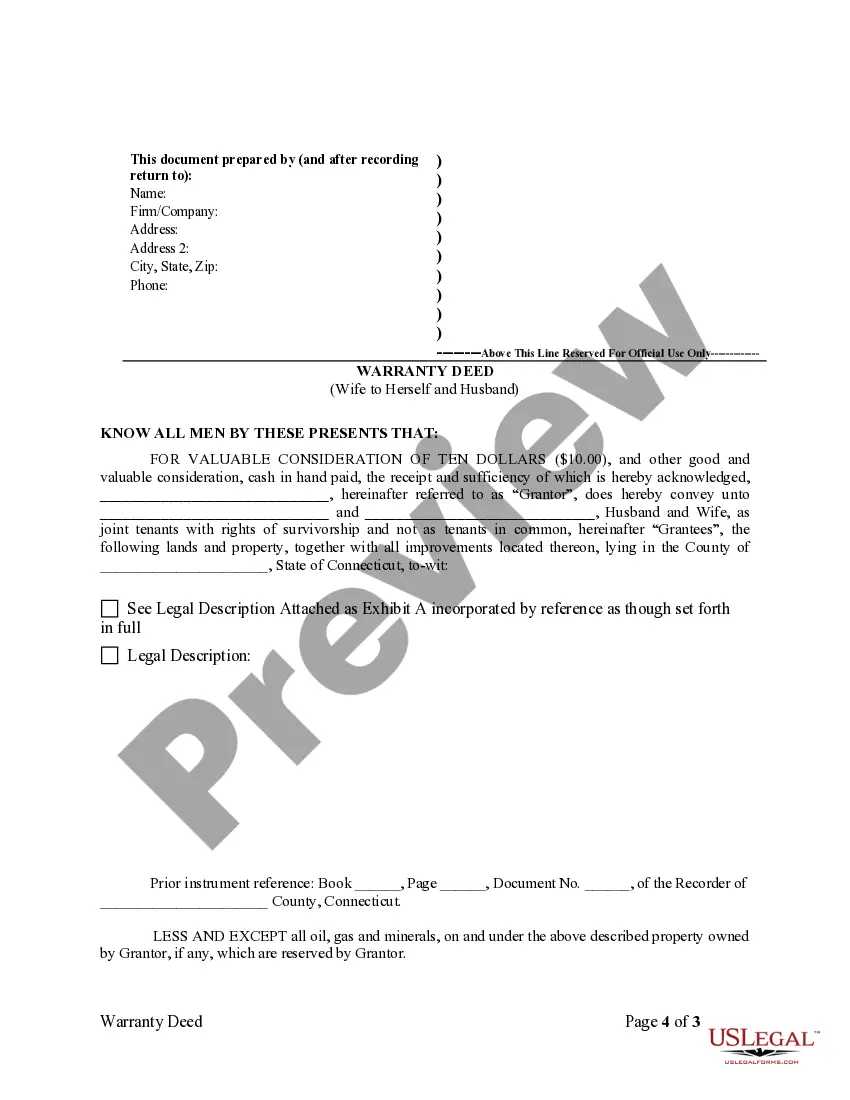
This Warranty Deed to Separate Property of One Spouse to Both as Joint Tenants is a legal document that transfers ownership of real estate from one spouse to both spouses as joint tenants. Unlike other types of deeds, this form specifically addresses the transfer of property that is considered separate property of one spouse, ensuring that both spouses have equal rights to the property as joint owners. This deed establishes a right of survivorship, allowing the surviving spouse to inherit the property outright should one spouse pass away.
Form components explained
- Identification of the Grantor (the spouse transferring the property).
- Identification of the Grantees (the spouses receiving the property).
- Description of the property being transferred.
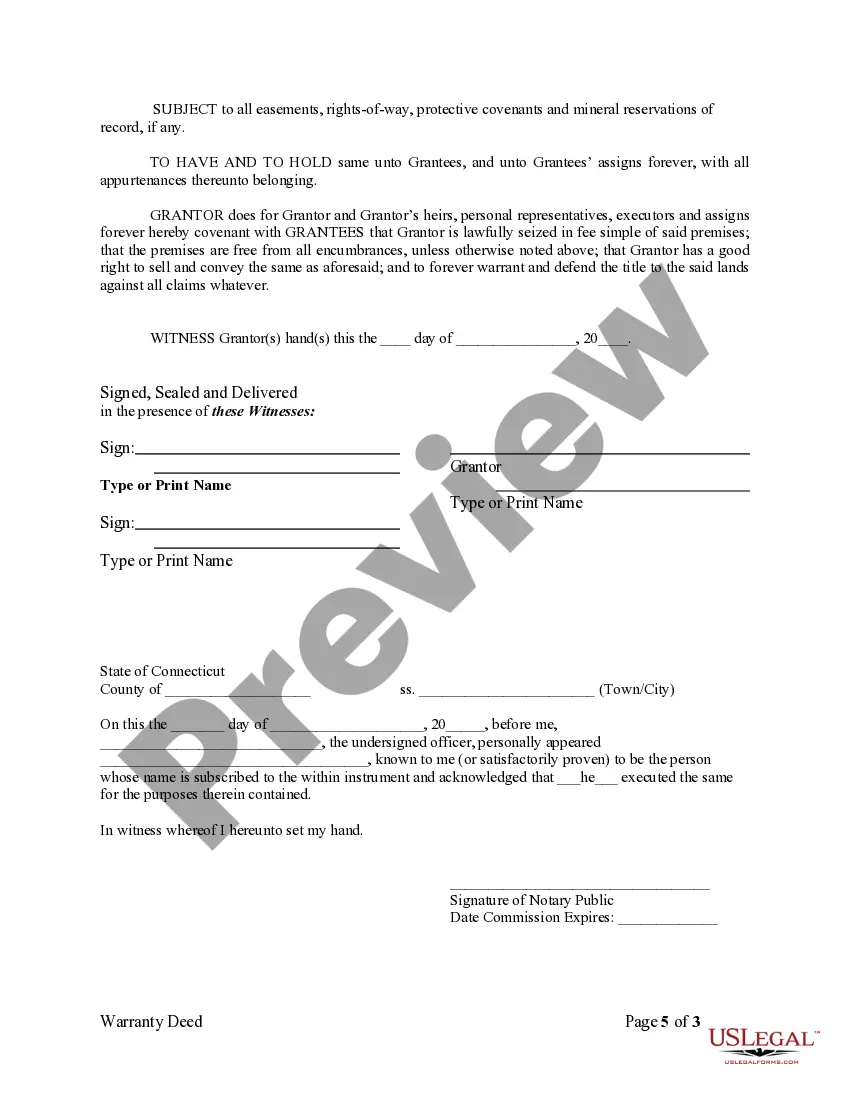
- Clauses stating the warranty of title and freedom from encumbrances.
- Signatures of the Grantor and necessary witnesses, if applicable.



Situations where this form applies
You may need to use this Warranty Deed when one spouse wants to formally transfer their separate property to both spouses as joint tenants. This situation commonly arises when a couple is married and wishes to ensure that both parties have equal ownership rights, or when one spouse wants to add the other as a co-owner for legal or estate planning purposes.
Intended users of this form
This form is suitable for:
- Married couples who wish to hold property jointly.
- The spouse who owns separate property and wants to transfer it to both spouses.
- Individuals seeking to simplify the transfer of property in an estate plan.
Steps to complete this form
- Identify the Grantor's full name and details as the current owner of the property.
- Enter the Grantees' names, ensuring both spouses are included as joint tenants.
- Provide a complete legal description of the property being conveyed.
- Include any specific conditions or exceptions related to the transfer.
- Sign and date the document in the presence of any required witnesses.
Does this document require notarization?
This form does not typically require notarization unless specified by local law. However, it is advisable to have the deed notarized to enhance its legal validity and verify the identities of the parties involved in the transaction.
Get your form ready online
Our built-in tools help you complete, sign, share, and store your documents in one place.
Make edits, fill in missing information, and update formatting in US Legal Forms—just like you would in MS Word.
Download a copy, print it, send it by email, or mail it via USPS—whatever works best for your next step.
Sign and collect signatures with our SignNow integration. Send to multiple recipients, set reminders, and more. Go Premium to unlock E-Sign.
If this form requires notarization, complete it online through a secure video call—no need to meet a notary in person or wait for an appointment.
We protect your documents and personal data by following strict security and privacy standards.

Make edits, fill in missing information, and update formatting in US Legal Forms—just like you would in MS Word.

Download a copy, print it, send it by email, or mail it via USPS—whatever works best for your next step.

Sign and collect signatures with our SignNow integration. Send to multiple recipients, set reminders, and more. Go Premium to unlock E-Sign.

If this form requires notarization, complete it online through a secure video call—no need to meet a notary in person or wait for an appointment.

We protect your documents and personal data by following strict security and privacy standards.
Mistakes to watch out for
- Failing to accurately describe the property being transferred.
- Not including both spouses' names as Grantees.
- Neglecting to have the document signed in front of a witness, if required.
Why complete this form online
- Convenience of accessing and completing the form online from anywhere.
- Editable fields that allow for easy customization to suit specific needs.
- Reliable templates drafted by licensed attorneys, ensuring legal compliance.
Looking for another form?
Form popularity
FAQ
A spouse might choose to use a quit claim deed to transfer ownership of property for various reasons. When considering a Connecticut Warranty Deed to Separate Property of One Spouse to Both as Joint Tenants, this approach can simplify the process of joint property ownership. It often serves to clarify the division of property in cases like divorce or to add a spouse to the title for shared ownership. By leveraging our platform, uslegalforms, individuals can access valuable resources and templates to ensure that their quit claim deed meets legal requirements.
Yes, joint tenants in Connecticut do indeed have the right of survivorship. This means that when one joint owner passes away, their share of the property immediately goes to the other owner without any delay. This legal feature protects the interests of both parties and is a fundamental benefit of executing a Connecticut Warranty Deed to Separate Property of One Spouse to Both as Joint Tenants.
The right of survivorship on a joint tenancy deed allows for automatic transfer of property ownership to the surviving joint tenant upon the death of one tenant. This eliminates the need for probate, streamlining the transfer process and providing peace of mind. Thus, having a Connecticut Warranty Deed to Separate Property of One Spouse to Both as Joint Tenants can simplify things for couples seeking joint ownership.
While joint tenancy with rights of survivorship offers clear benefits, it also has potential downsides. For instance, if one tenant incurs debt, creditors may be able to claim against the entire property, posing a risk to the other owner. Additionally, both parties must agree on any changes to the property and one party's decision can affect the other substantially. Thus, it is wise to consider using a Connecticut Warranty Deed to Separate Property of One Spouse to Both as Joint Tenants carefully.
Yes, in Connecticut, joint tenancy indeed includes a right of survivorship. This legal principle means that when one joint tenant dies, their interest in the property automatically transfers to the surviving tenant without going through probate. Therefore, a Connecticut Warranty Deed to Separate Property of One Spouse to Both as Joint Tenants is an effective tool for ensuring that both spouses are protected in their ownership of shared property.
Yes, two people can own property together and be listed on a warranty deed. This arrangement can establish joint tenancy, which includes the right of survivorship, ensuring that if one owner dies, their interest in the property passes to the surviving owner. A Connecticut Warranty Deed to Separate Property of One Spouse to Both as Joint Tenants is a practical option for couples looking to secure their shared home.
A warranty deed for joint tenants is a legal document that provides assurance of ownership rights between two or more parties. This type of deed guarantees that both tenants have equal rights to the property and includes a right of survivorship feature. Essentially, it protects both owners by ensuring that their interests are secure and outlines what happens upon the death of either owner. For your needs, consider using a Connecticut Warranty Deed to Separate Property of One Spouse to Both as Joint Tenants.
A survivorship deed, often known as a joint tenancy deed, allows both parties to share ownership and includes the right of survivorship. This means when one owner passes away, their share automatically transfers to the surviving owner. In contrast, a quitclaim deed simply transfers any interest one spouse may have in a property without confirming ownership rights. Understanding these differences helps when considering a Connecticut Warranty Deed to Separate Property of One Spouse to Both as Joint Tenants.
Yes, a joint tenancy warranty deed functions as a type of deed that creates joint tenancy between two or more parties. This deed includes the right of survivorship, which means that if one owner passes away, their interest automatically transfers to the surviving owner. When drafting a Connecticut Warranty Deed to Separate Property of One Spouse to Both as Joint Tenants, ensuring this clause is present is crucial. You may find comprehensive resources on USLegalForms to help you navigate joint tenancy options comfortably.
To write a Connecticut Warranty Deed to Separate Property of One Spouse to Both as Joint Tenants, you should include specific language that indicates the intent to create a joint tenancy. This entails using terms like 'joint tenants with right of survivorship' in the deed. Furthermore, make sure to identify the property clearly and provide details about both spouses. For added guidance, consider utilizing USLegalForms, where you can find templates and instructions to simplify this process.