Connecticut Certificate of Lien by Individual
What this document covers
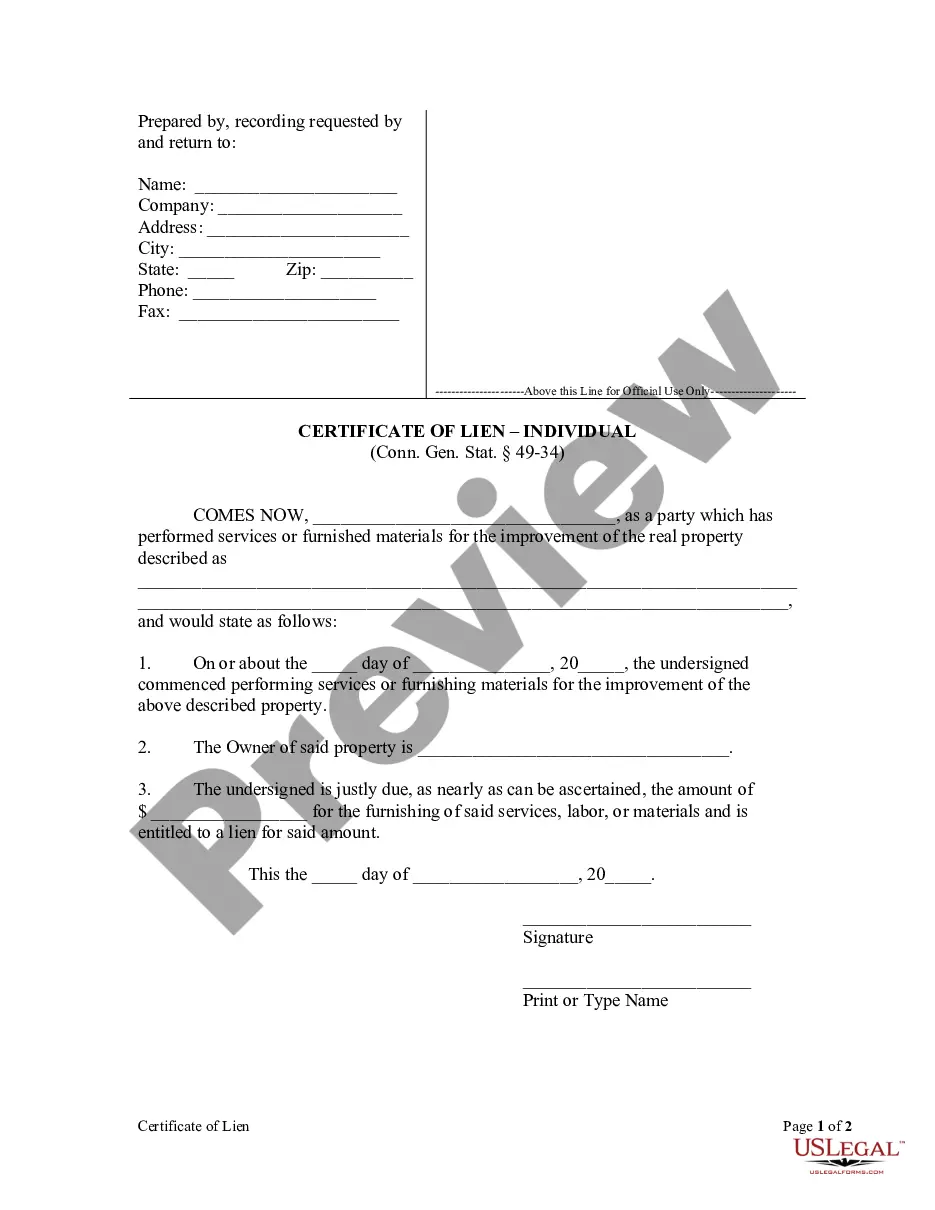
The Certificate of Lien by Individual is a legal document that allows individuals who have provided services or materials for property improvement to claim a lien against the property. This form is crucial for ensuring that mechanics' liens, which are used to secure payment for work done on real estate, are valid under Connecticut law. It sets forth the details of the services provided and establishes the lien claimant's rights if payment is not received.
Key components of this form
- Name and contact information of the lien claimant.
- Description of the property that received the improvements.
- Details of the work performed or materials supplied, including dates and amounts owed.
- Signature of the lien claimant, indicating the claim's authenticity.
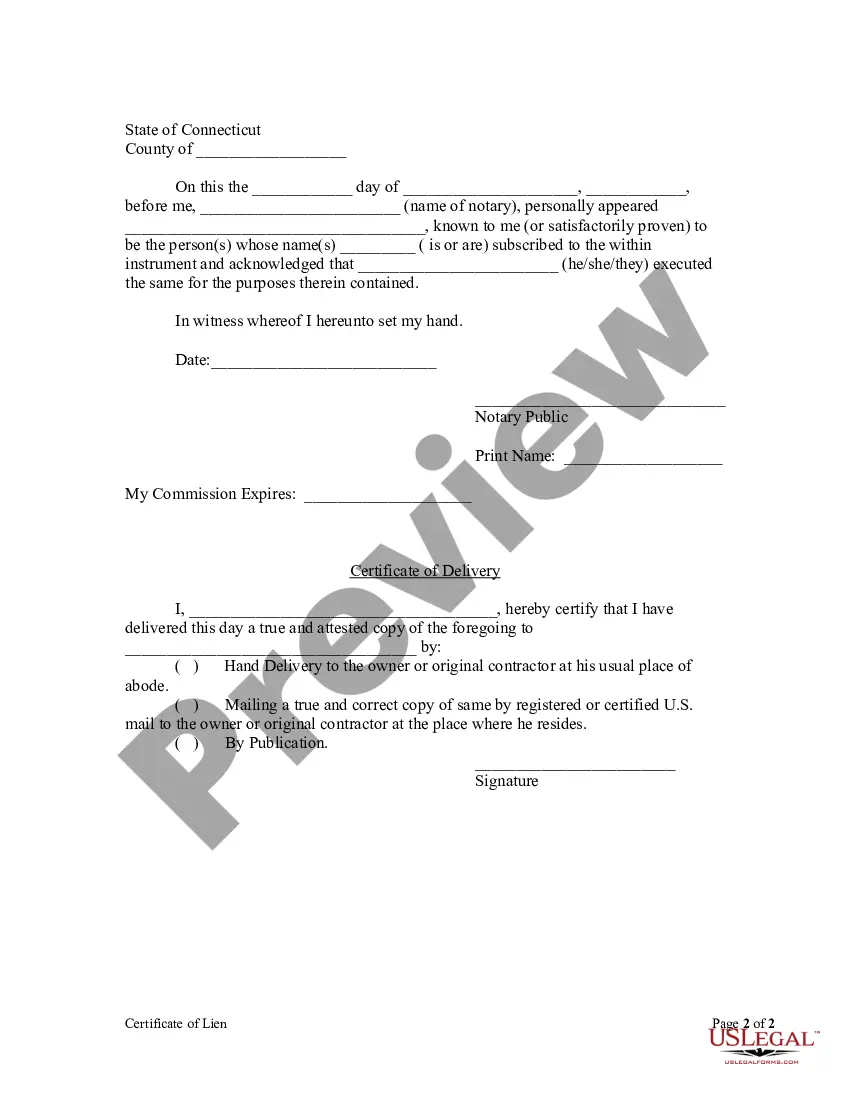
- Notary acknowledgment to validate the signing of the document.
- Certificate of Delivery ensuring the property owner received a copy of the lien.
When this form is needed
This form should be used when a contractor or individual has completed work on a property and has not been compensated within ninety days of the cessation of work. It must be filed with the town clerk to establish a legal claim for payment against the property, providing security for the unpaid services or materials provided.
Intended users of this form
- Individuals or contractors who have provided services or materials for real property improvement.
- Anyone seeking to establish a mechanics' lien to secure payment for work done.
- Property owners who may require a record of liens placed against property for financial or legal reasons.
Completing this form step by step
- Identify and complete the name and contact details of the lien claimant.
- Provide a detailed description of the property that received the improvements.
- Enter the date services commenced and the owner of the property.
- Specify the total amount due for the services or materials provided.
- Sign the form and have it notarized to validate the claim.
- Deliver a copy of the completed form to the property owner, ensuring to document the delivery method used.
Notarization guidance
Yes, this form must be notarized to be legally valid. It requires the signature of a notary public to affirm the identity of the signer and the authenticity of the document, thus reinforcing its legal standing.
Get your form ready online
Our built-in tools help you complete, sign, share, and store your documents in one place.
Make edits, fill in missing information, and update formatting in US Legal Forms—just like you would in MS Word.
Download a copy, print it, send it by email, or mail it via USPS—whatever works best for your next step.
Sign and collect signatures with our SignNow integration. Send to multiple recipients, set reminders, and more. Go Premium to unlock E-Sign.
If this form requires notarization, complete it online through a secure video call—no need to meet a notary in person or wait for an appointment.
We protect your documents and personal data by following strict security and privacy standards.

Make edits, fill in missing information, and update formatting in US Legal Forms—just like you would in MS Word.

Download a copy, print it, send it by email, or mail it via USPS—whatever works best for your next step.

Sign and collect signatures with our SignNow integration. Send to multiple recipients, set reminders, and more. Go Premium to unlock E-Sign.

If this form requires notarization, complete it online through a secure video call—no need to meet a notary in person or wait for an appointment.

We protect your documents and personal data by following strict security and privacy standards.
Common mistakes
- Failing to file the Certificate of Lien within the 90-day window after work cessation.
- Not properly including the property description, leading to potential claims disputes.
- Neglecting to have the document notarized, which is crucial for its legal validity.
- Failing to serve the property owner correctly per the outlined methods.
- Leaving out required signatures or entering incorrect amounts owed.
Advantages of online completion
- Convenience of accessing and completing the form from any location.
- Editability, allowing changes before submission for accuracy.
- Reliable templates drafted by licensed attorneys to ensure compliance.
- Efficient processing and quick access to necessary legal documents.
Summary of main points
- The Certificate of Lien by Individual is essential for securing payment for construction-related services.
- Filing must be done within ninety days post-work cessation.
- Accurate completion and notarization are crucial for the documentâs validity.
Looking for another form?
Form popularity
FAQ
Yes, property records in Connecticut are public and can be accessed by anyone interested. You can request these records at your local town or city clerk’s office, as well as online in many cases. When searching for liens, you might be looking for a Connecticut Certificate of Lien by Individual, which is also included in these public records. Utilizing tools and resources from platforms like US Legal Forms can enhance your ability to navigate these records efficiently.
To find out if there is a lien on a business, you can check with the Connecticut Secretary of State's office or conduct a search through county recording offices. It is wise to look specifically for a Connecticut Certificate of Lien by Individual, as this document might reveal any claims or encumbrances against the business. Using services like US Legal Forms can help simplify this process by providing access to relevant documents and resources.
In Connecticut, a lien typically remains on your property for 10 years if no further action is taken. This duration can be affected by factors such as payment plans or legal disputes. Understanding the implications of a Connecticut Certificate of Lien by Individual is crucial, as it may impact your property's marketability. Staying informed about this timeline helps you make better decisions regarding your property.
To find liens on property in Connecticut, you can start by searching public records at the local town or city clerk’s office. Many counties also offer online access to land records, making your search more convenient. You may want to look for a Connecticut Certificate of Lien by Individual, as this document helps identify any claims against the property. Additionally, consider using platforms like US Legal Forms to obtain necessary documents and streamline your search.
To obtain a copy of your car's title in Connecticut, you can request it through the DMV. You'll need to complete an application and provide verification of your identity and ownership. This process is straightforward, but allow some time for processing. If you want to ensure that no liens affect your title, consider acquiring a Connecticut Certificate of Lien by Individual.
Yes, a certificate of title is commonly referred to simply as a title. It serves as official documentation that conveys ownership of a vehicle. Therefore, when dealing with vehicles in Connecticut, the terms can be used interchangeably. However, if you have concerns about liens, obtaining a Connecticut Certificate of Lien by Individual can provide clarity.
In Connecticut, a certificate of title is a legal document that proves ownership of a vehicle. It contains vital details about the vehicle, including its make, model, and identification number. This document is essential when buying, selling, or transferring a vehicle. To further protect your interests, consider obtaining a Connecticut Certificate of Lien by Individual.
Connecticut operates as a lien state when it comes to property ownership and transfer. This means that liens take precedence over deeds in certain situations. Understanding this distinction is crucial for property buyers and owners to avoid potential legal issues. If you need to establish or question a lien, pursue a Connecticut Certificate of Lien by Individual for added assurance.
To look up liens in Connecticut, you can visit the Connecticut Secretary of the State's website. They provide an online searchable database for public records relating to liens. This resource will help you obtain important information on any existing liens against a property. Additionally, obtaining a Connecticut Certificate of Lien by Individual can give you clarity on your own standing.
You should not keep your certificate of title in the car. It's important to safeguard this document, as it proves your ownership. If you lose it or it gets stolen, replacing it can be a hassle. For comprehensive protection of your assets, consider obtaining a Connecticut Certificate of Lien by Individual to further secure your ownership.