Sample Letter to Proposed Client - Initial Appointment
Overview of this form
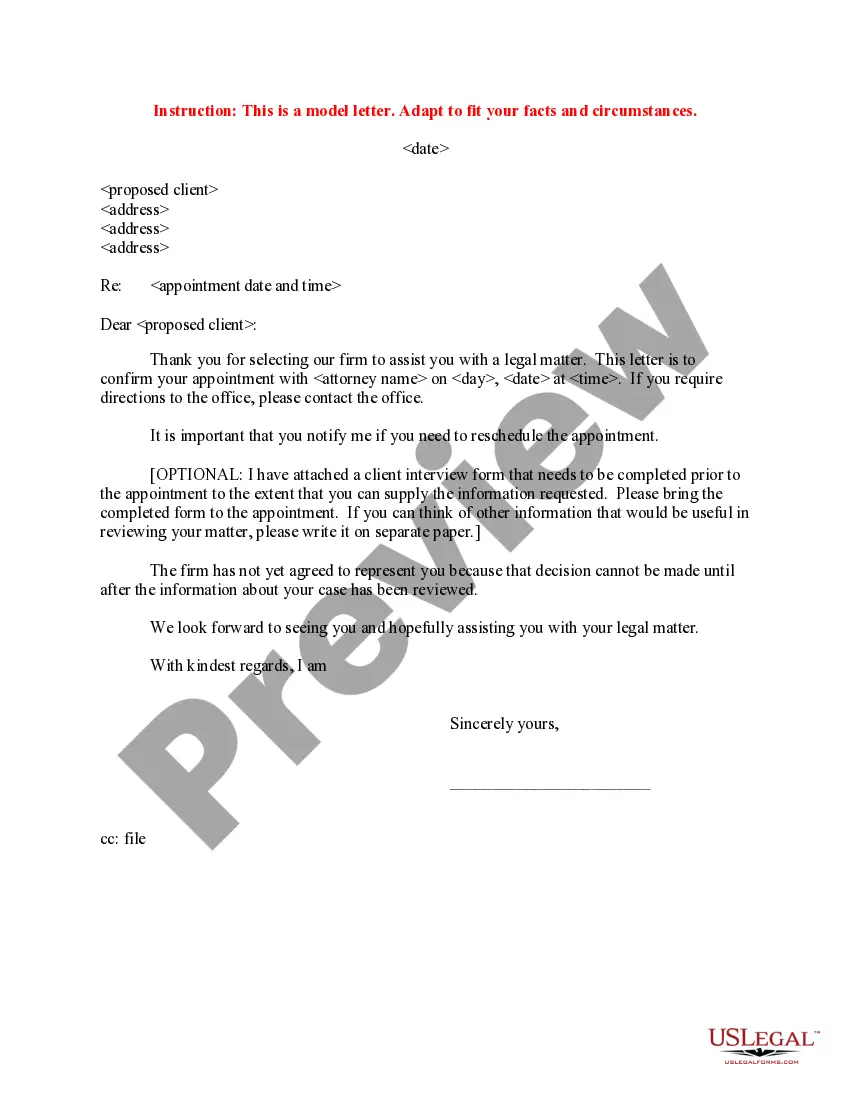
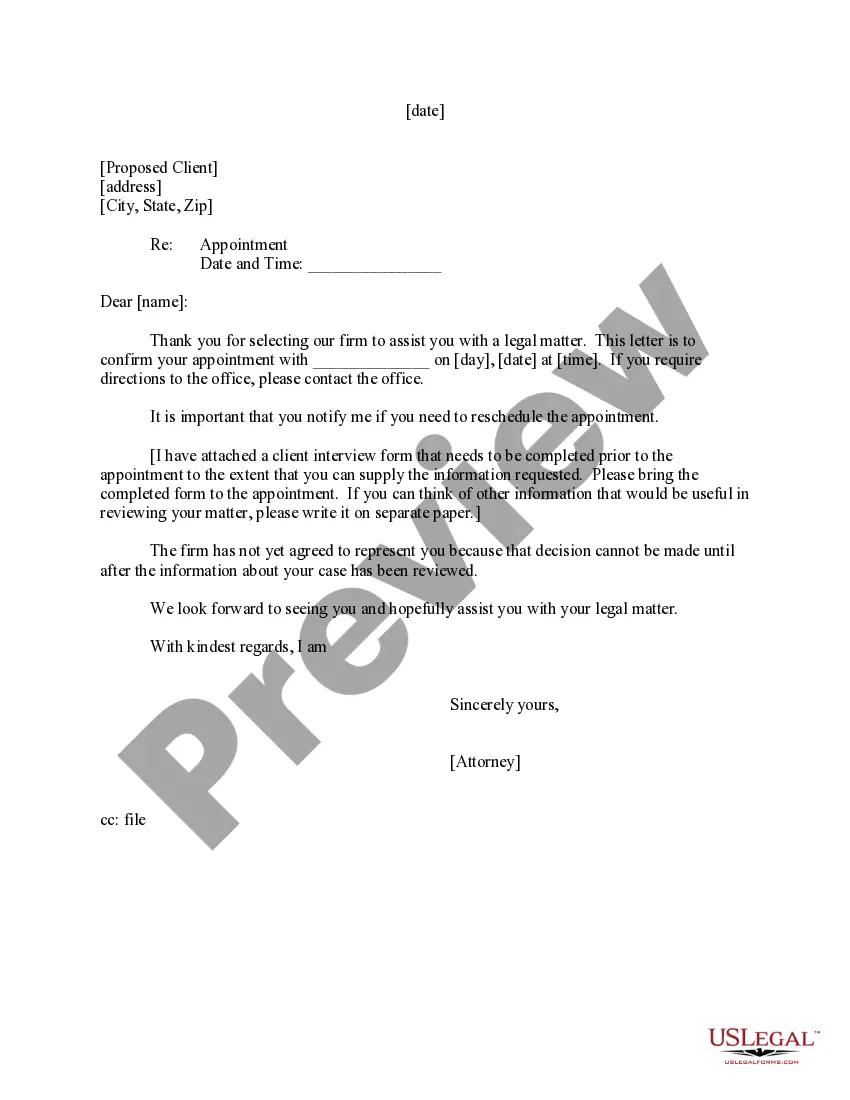
This Sample Letter to Proposed Client - Initial Appointment is a template designed to confirm an appointment between a law firm and a prospective client. It serves as a communication tool that notifies the client of their scheduled meeting with an attorney, making it distinct from other legal correspondence formats. This letter ensures clarity and professionalism in the initial stages of legal representation.
Main sections of this form
- Date of the appointment
- Client's name and address
- Attorney's name
- Appointment date and time
- Directions for contacting the office
- Information about a client interview form
Common use cases
You should use this sample letter when you have scheduled an initial appointment with a potential client and wish to formally confirm the meeting. This is important to ensure the client has all necessary details and understands the implications of the appointment, including the fact that the firm has not yet agreed to representation.
Who should use this form
- Law firms reaching out to prospective clients
- Attorneys needing a professional template for initial client appointments
- Administrative staff in legal offices managing initial client communications
Instructions for completing this form
- Enter the current date at the top of the letter.
- Fill in the proposed client's name and complete address.
- Insert the attorney's name and the specific appointment date and time.
- Provide a contact method for directions or questions regarding the appointment.
- Include an optional section for a client interview form, if applicable.
- Conclude with the attorney's signature and any other necessary details.
Does this form need to be notarized?
Notarization is generally not required for this form. However, certain states or situations might demand it. You can complete notarization online through US Legal Forms, powered by Notarize, using a verified video call available anytime.
Get your form ready online
Our built-in tools help you complete, sign, share, and store your documents in one place.
Make edits, fill in missing information, and update formatting in US Legal Forms—just like you would in MS Word.
Download a copy, print it, send it by email, or mail it via USPS—whatever works best for your next step.
Sign and collect signatures with our SignNow integration. Send to multiple recipients, set reminders, and more. Go Premium to unlock E-Sign.
If this form requires notarization, complete it online through a secure video call—no need to meet a notary in person or wait for an appointment.
We protect your documents and personal data by following strict security and privacy standards.

Make edits, fill in missing information, and update formatting in US Legal Forms—just like you would in MS Word.

Download a copy, print it, send it by email, or mail it via USPS—whatever works best for your next step.

Sign and collect signatures with our SignNow integration. Send to multiple recipients, set reminders, and more. Go Premium to unlock E-Sign.

If this form requires notarization, complete it online through a secure video call—no need to meet a notary in person or wait for an appointment.

We protect your documents and personal data by following strict security and privacy standards.
Avoid these common issues
- Forgetting to include the appointment date and time.
- Failing to mention that the firm has not yet agreed to representation.
- Neglecting to proofread for spelling and grammatical errors.
Why use this form online
- Easy customization to fit specific client and appointment details.
- Immediate access and download for convenience.
- Structured format helps maintain professional communication standards.
Quick recap
- This sample letter confirms the initial appointment with a prospective client.
- It is essential for creating a professional impression and ensuring clarity.
- Using this template helps law firms easily manage initial client interactions.
Looking for another form?
Form popularity
FAQ
Dear name of client, I'm your name, and I work in your position at your company. We're specialists in detail activities. Given that you're a leading role of prospect's company within our niche, I believe a collaboration would be in both our interests.
Write a clear subject line. A subject line should be concise, clear and include an interesting or personal detail to engage the recipient. Use a salutation. Introduce yourself (if necessary) Explain why you want to meet. Be flexible about time and place. Request a reply or confirmation. Send a reminder.
Offer value to the invitee. Explain the context of the meeting clearly or even include a brief agenda. Ask for a particular amount of time (like 15-20 minutes)
Asking for an appointment I would like to arrange an appointment to discuss2026. Please would you indicate a suitable time and place to meet? Would it be possible to meet on (date) at your / our offices to discuss2026? Can we meet (up) to talk about2026?
Introduction Start your email with introducing yourself if necessary especially if you are sending the request on behalf of your manager. State the reason for the meeting. Check for their availability. Propose a location for the meeting.
Dear (insert boss name here), I am writing to request a meeting appointment with you at your earliest convenience. I would like to discuss (insert issues here). I know you are very busy, but I would very much appreciate you taking the time to meet with me.
Use the company letterhead to write the letter. Add the date and four spaces down, add the employee-to-be or recipient's details. Two spaces down, add the salutation. State the purpose in a warm tone, as you would welcome guests to the house.
Make time for discovery. Always show confidence. Lead with a conversation. Ask for the appointment. Use appointment scheduling technology. Follow up to prevent no-shows.