Wyoming Revocation of Health Care Directive
What is this form?
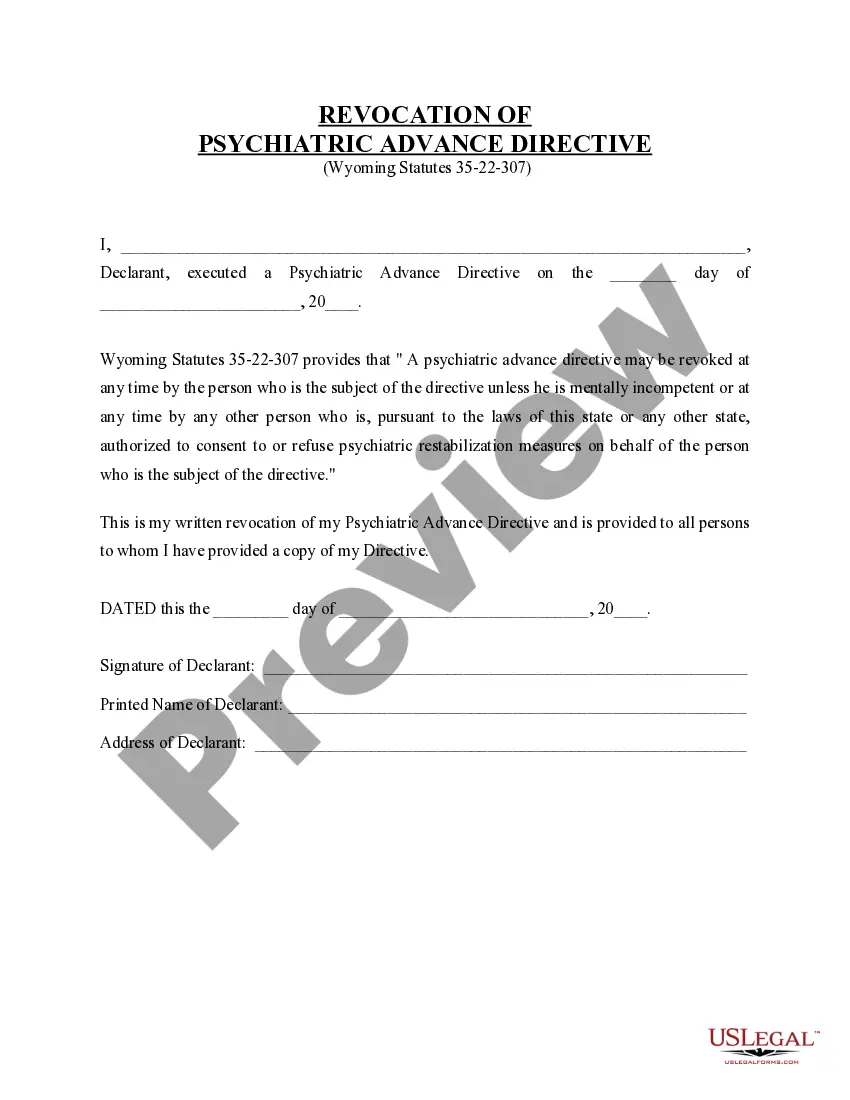
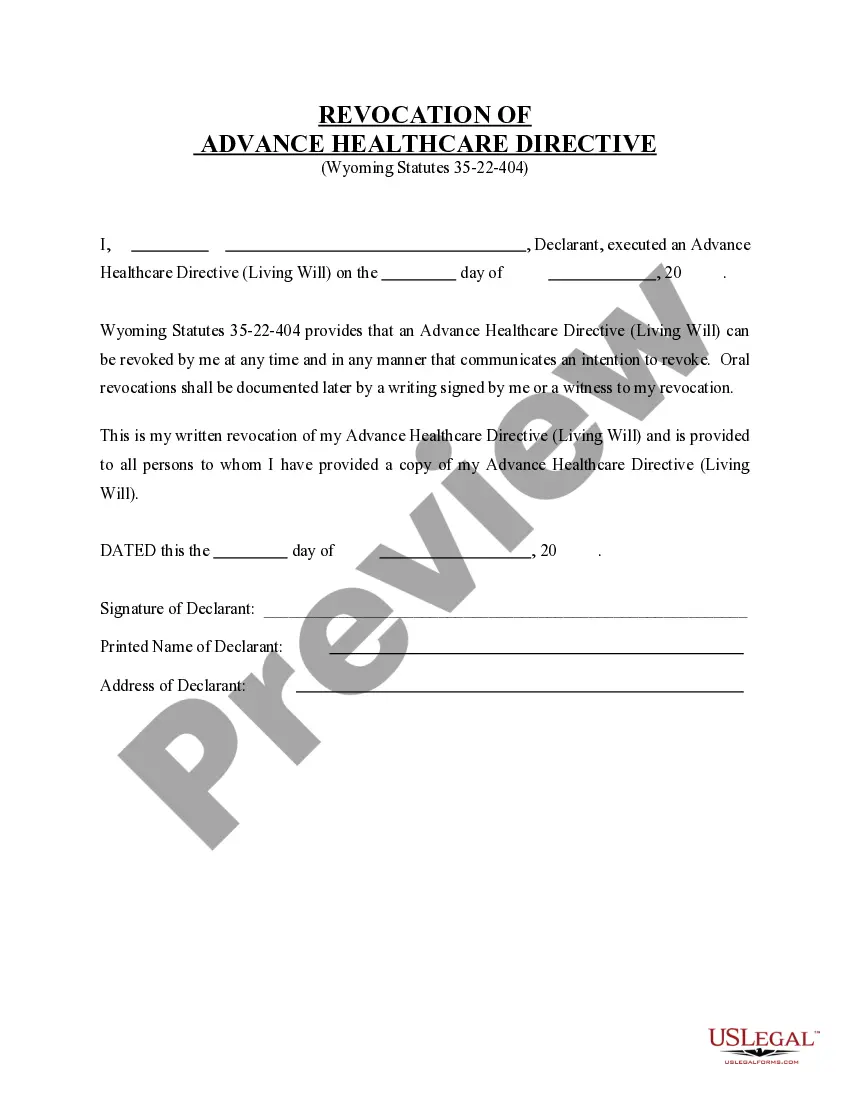
The Revocation of Health Care Directive is a legal document that allows individuals to revoke their previously made Psychiatric Advance Directive. This form is essential for expressing the decision to no longer consent to psychiatric restabilization measures. It complies with Wyoming statutory laws, specifically Wyoming Statute 35-22-307, and requires only the signature of the individual revoking the directive. Understanding this form is crucial for anyone who has made a Psychiatric Advance Directive and wishes to alter their mental health care preferences.
Main sections of this form
- Identification of the declarant who is revoking the directive.
- Reference to the original Psychiatric Advance Directive and the date it was executed.
- A clear statement revoking the previous directive.
- Signature line for the declarant, along with the printed name and address.
- Date on which the revocation is executed.
When to use this form
This form should be used when an individual decides to change their mental health treatment preferences as outlined in a previous Psychiatric Advance Directive. If circumstances have changed, or if the individual feels that psychiatric treatments should no longer be administered, this form provides a clear legal avenue to communicate that decision.
Who this form is for
- Individuals who have previously executed a Psychiatric Advance Directive.
- Individuals who wish to revoke their prior psychiatric treatment preferences.
- Authorized individuals acting on behalf of someone who is unable to revoke their directive due to mental incompetence.
Completing this form step by step
- Fill in your name as the declarant at the top of the form.
- Indicate the date on which you first executed the original Psychiatric Advance Directive.
- Clearly state your intention to revoke the directive.
- Sign the form and print your name beneath the signature line.
- Provide your current address in the designated space.
- Add the date on which you are completing the revocation form.
Does this form need to be notarized?
Notarization is not commonly needed for this form. However, certain documents or local rules may make it necessary. Our notarization service, powered by Notarize, allows you to finalize it securely online anytime, day or night.
Get your form ready online
Our built-in tools help you complete, sign, share, and store your documents in one place.
Make edits, fill in missing information, and update formatting in US Legal Forms—just like you would in MS Word.
Download a copy, print it, send it by email, or mail it via USPS—whatever works best for your next step.
Sign and collect signatures with our SignNow integration. Send to multiple recipients, set reminders, and more. Go Premium to unlock E-Sign.
If this form requires notarization, complete it online through a secure video call—no need to meet a notary in person or wait for an appointment.
We protect your documents and personal data by following strict security and privacy standards.

Make edits, fill in missing information, and update formatting in US Legal Forms—just like you would in MS Word.

Download a copy, print it, send it by email, or mail it via USPS—whatever works best for your next step.

Sign and collect signatures with our SignNow integration. Send to multiple recipients, set reminders, and more. Go Premium to unlock E-Sign.

If this form requires notarization, complete it online through a secure video call—no need to meet a notary in person or wait for an appointment.

We protect your documents and personal data by following strict security and privacy standards.
Avoid these common issues
- Failing to include your signature, which is necessary for the revocation to be valid.
- Not providing the correct date of the original Psychiatric Advance Directive.
- Omitting to distribute the revocation form to individuals who received the original directive.
Why complete this form online
- Convenience of completing the form from any location at any time.
- Editability allows users to make necessary adjustments easily.
- Access to reliable templates drafted by licensed attorneys.
Looking for another form?



Form popularity
FAQ
An advance directive, alone, may not be sufficient to stop all forms of life-saving treatment.You retain the right to override the decisions or your representative, change the terms of your living will or POA, or completely revoke an advance directive.
Reviewing and changing advance directives You can change your directives at any time. If you want to make changes, you must create a new form, distribute new copies and destroy all old copies. Specific requirements for changing directives may vary by state.
First, you can revoke the previous living will. A living will can be canceled or revoked at any time. You can cancel your living will by indicating, in writing, that it has been cancelled. Destroying your original living will may cancel the will, but revoking the will in writing is more formal.
Advance directives do not expire. An advance directive remains in effect until you change it. If you complete a new advance directive, it invalidates the previous one.
A person can also revoke their Advance Directive orally, by telling their healthcare provider that they no longer want either the entire document or any parts of it enforced.
Advance Directives are referred to by different names depending on the state where you reside: advance directive, living will, declaration, power of attorney, patient advocate designation, etc.If someone disputes the validity of your health care directive, it may be challenged in court.
The name and contact information of your healthcare agent/proxy. Answers to specific questions about your preferences for care if you become unable to speak for yourself. Names and signatures of individuals who witness your signing your advance directive, if required.
You can change your directives at any time. If you want to make changes, you must create a new form, distribute new copies and destroy all old copies. Specific requirements for changing directives may vary by state.
The name and contact information of your healthcare agent/proxy. Answers to specific questions about your preferences for care if you become unable to speak for yourself. Names and signatures of individuals who witness your signing your advance directive, if required.