- US Legal Forms
- Forms Catalog
- Landlord Tenant
-
Virginia Residential Rental Lease Agreement
Virginia Residential Rental Lease Agreement
-
No results found.
-
Virginia
-
Alabama
-
Alaska
-
Arizona
-
Arkansas
-
California
-
Colorado
-
Connecticut
-
Delaware
-
District of Columbia
-
Florida
-
Georgia
-
Hawaii
-
Idaho
-
Illinois
-
Indiana
-
Iowa
-
Kansas
-
Kentucky
-
Louisiana
-
Maine
-
Maryland
-
Massachusetts
-
Michigan
-
Minnesota
-
Mississippi
-
Missouri
-
Montana
-
Multi-State
-
Nebraska
-
Nevada
-
New Hampshire
-
New Jersey
-
New Mexico
-
New York
-
North Carolina
-
North Dakota
-
Ohio
-
Oklahoma
-
Oregon
-
Pennsylvania
-
Rhode Island
-
South Carolina
-
South Dakota
-
Tennessee
-
Texas
-
Utah
-
Vermont
-
Washington
-
West Virginia
-
Wisconsin
-
Wyoming
This form is part of a form package!
Get all related documents in one bundle, so you don’t have to search separately.
Overview of this form
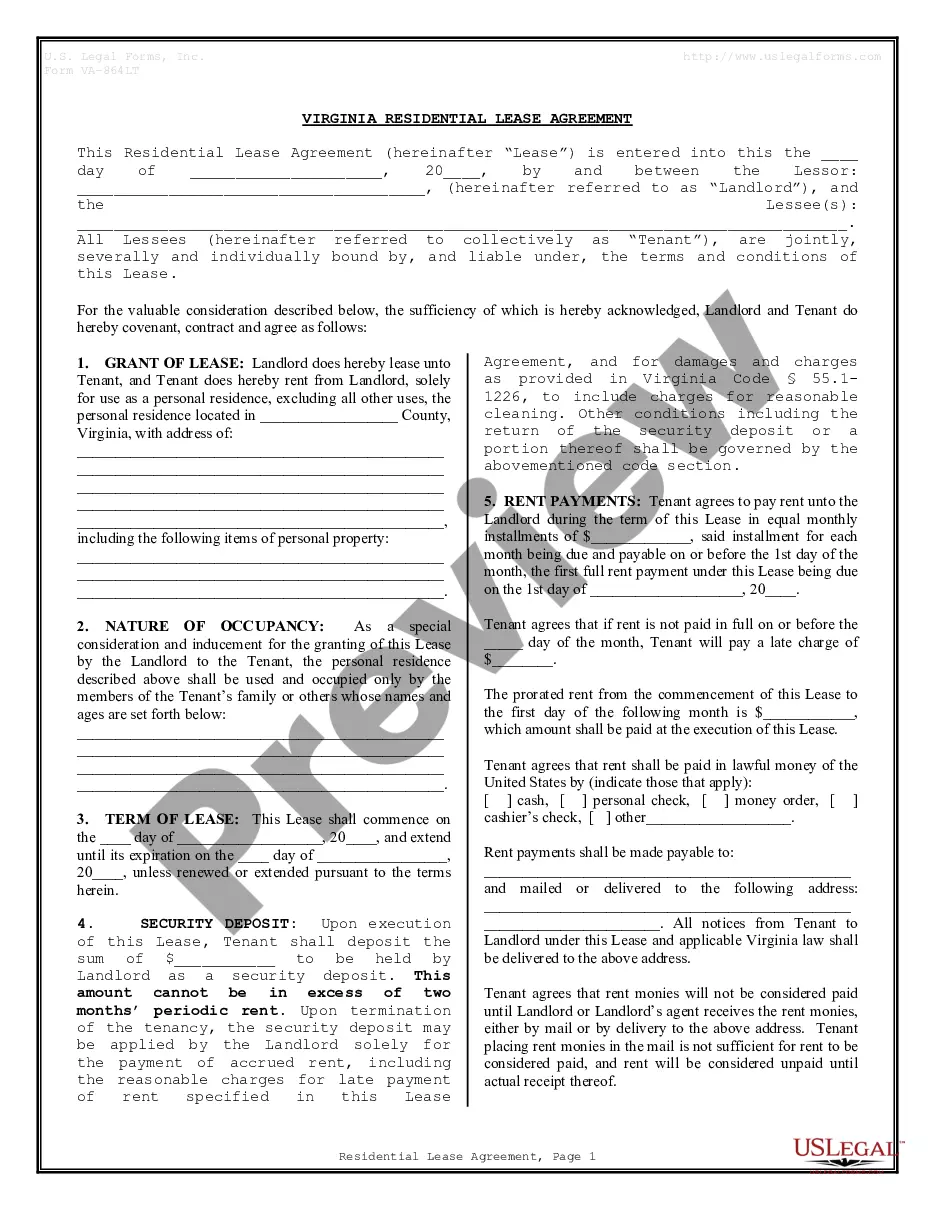
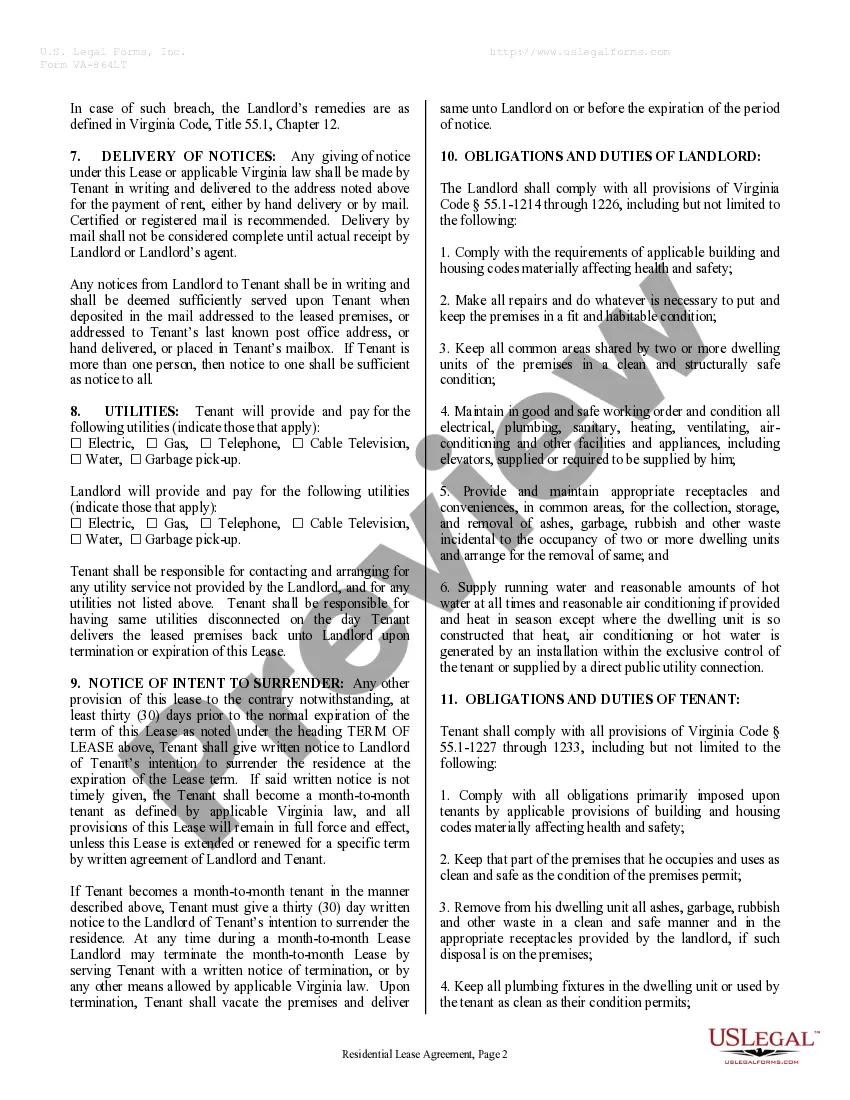
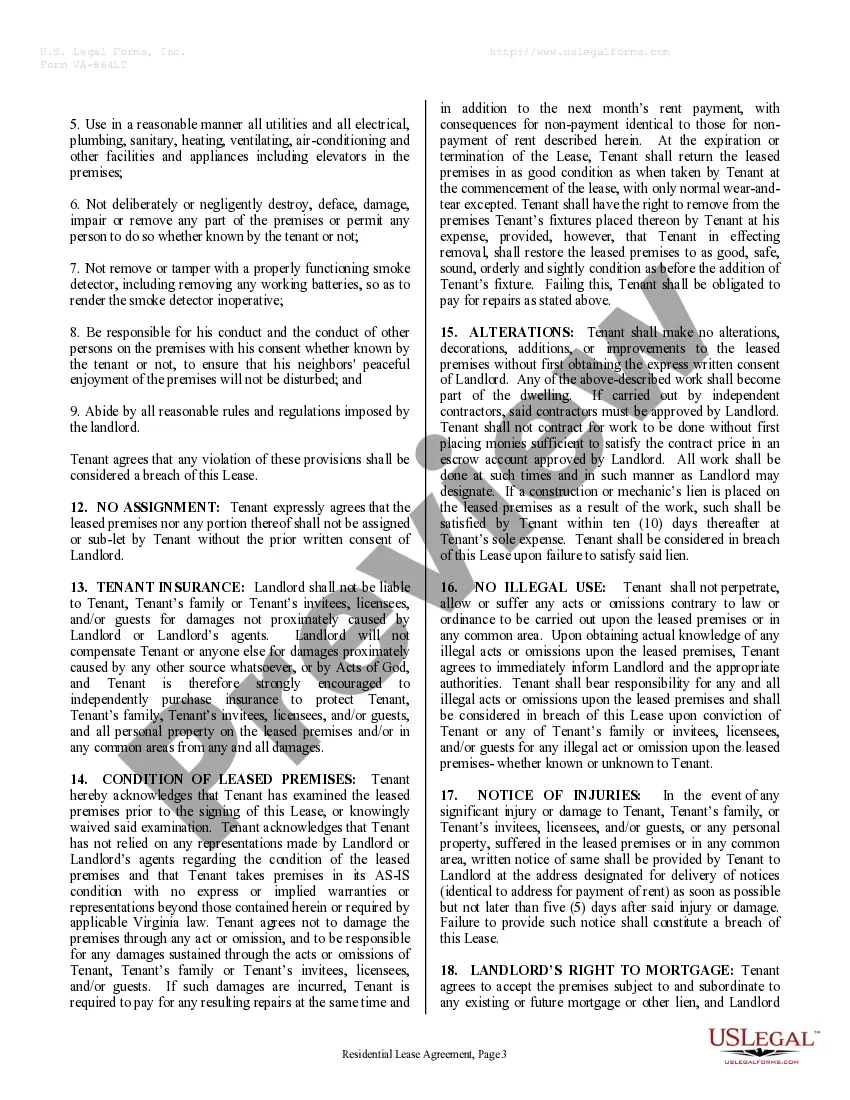
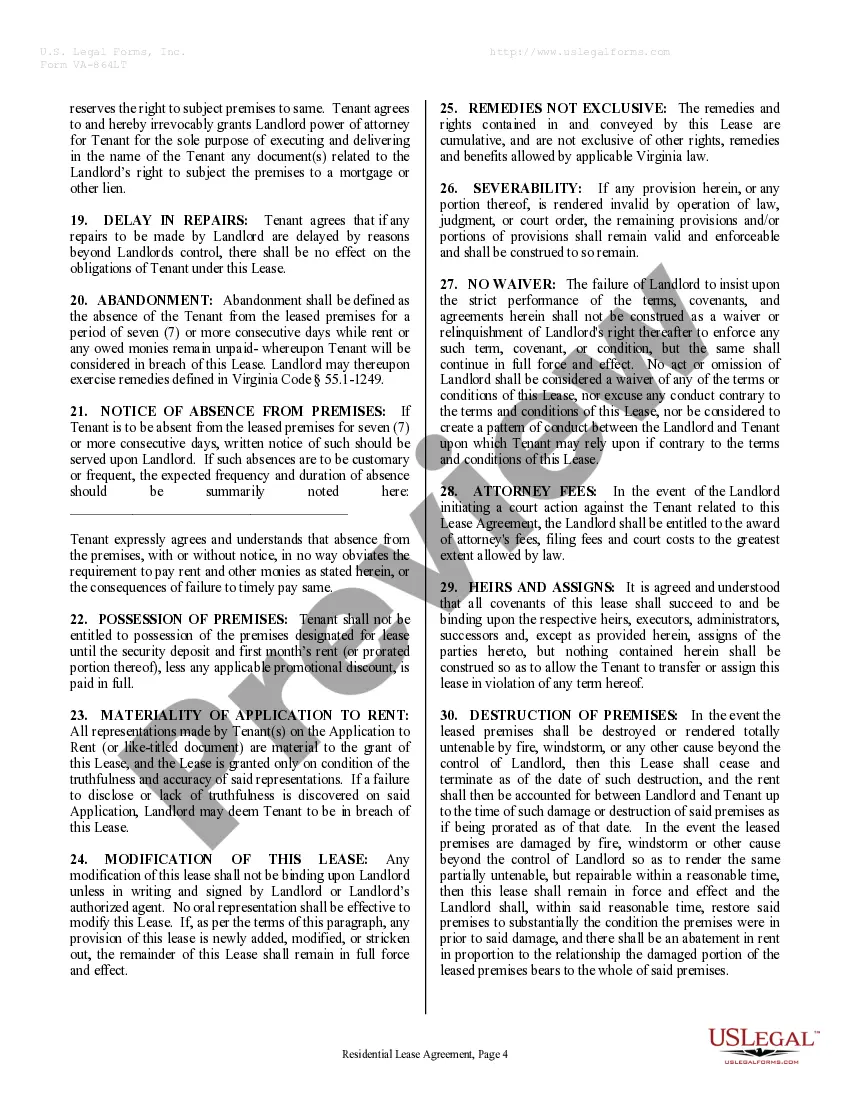
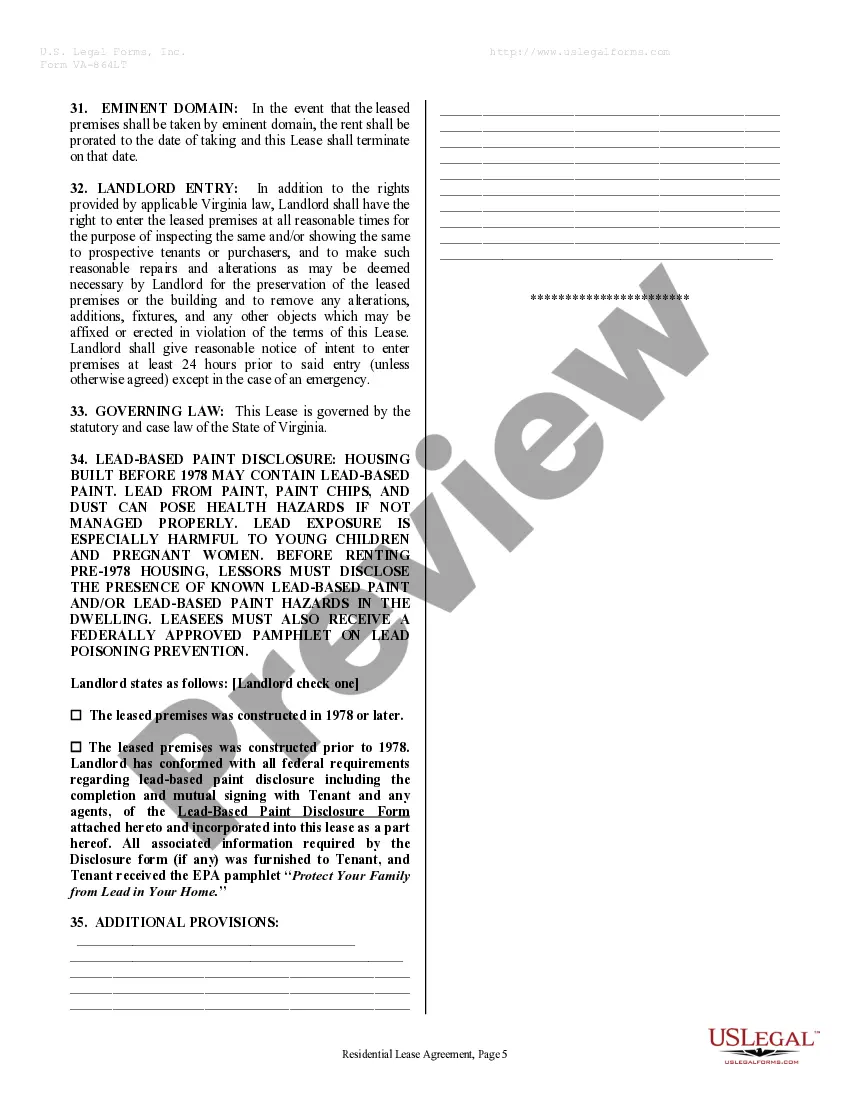
The Residential Rental Lease Agreement is a legal document that outlines the terms and conditions between a landlord and tenant for the rental of a residential property. This form is designed for a fixed-term lease, such as one year or six months, and includes provisions that can be customized to meet the specific needs of both parties. Unlike month-to-month rental agreements, this lease defines the length of occupancy and the responsibilities of both the landlord and tenant.
What’s included in this form
- Details of the landlord and tenant, including addresses and contact information.
- Description of the rental property being leased.
- Term of the lease, including start and end dates.
- Security deposit requirements and conditions for its return.
- Rent payment details, including amount and due dates.
- Obligations and duties of both the landlord and tenant regarding the property.
Related forms
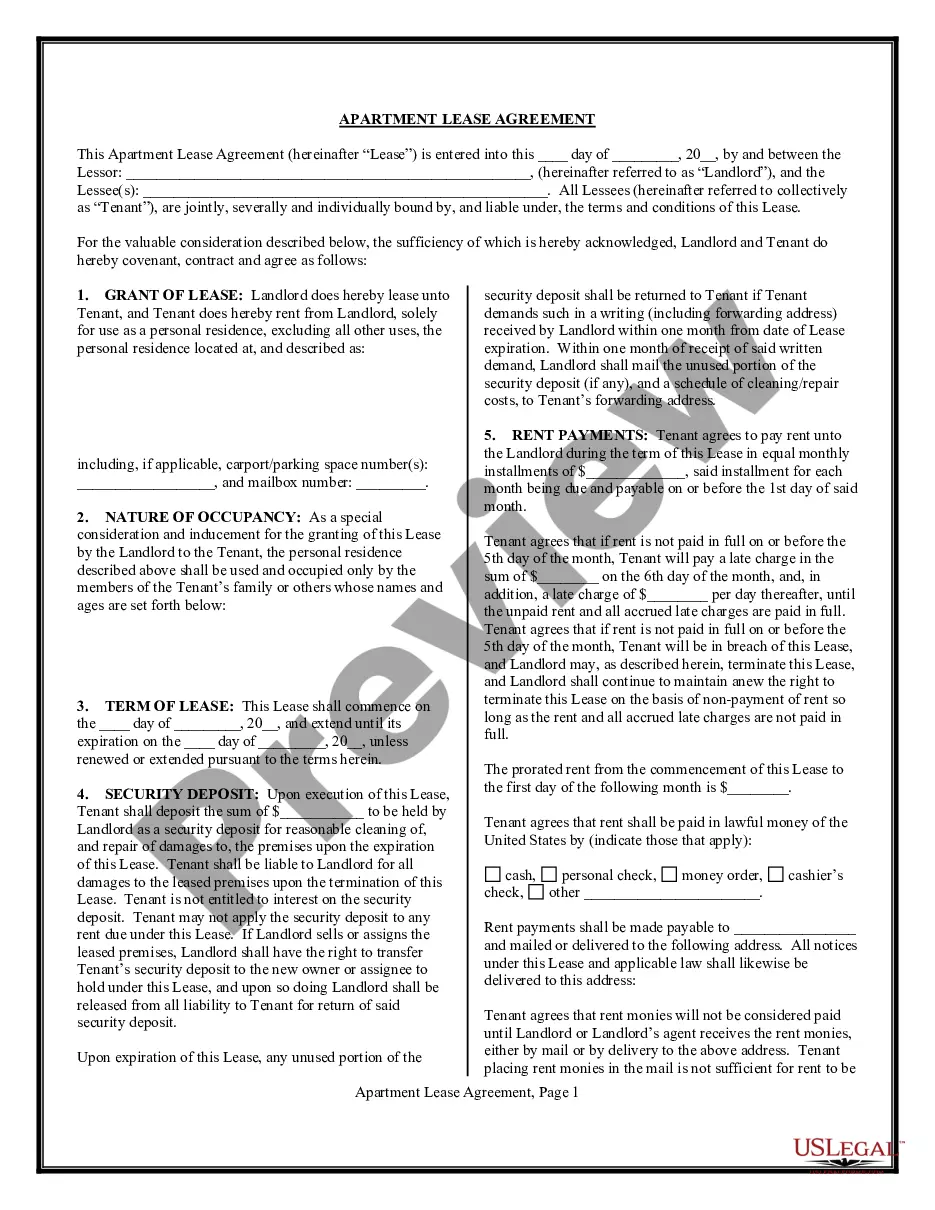
Apartment Lease Agreement
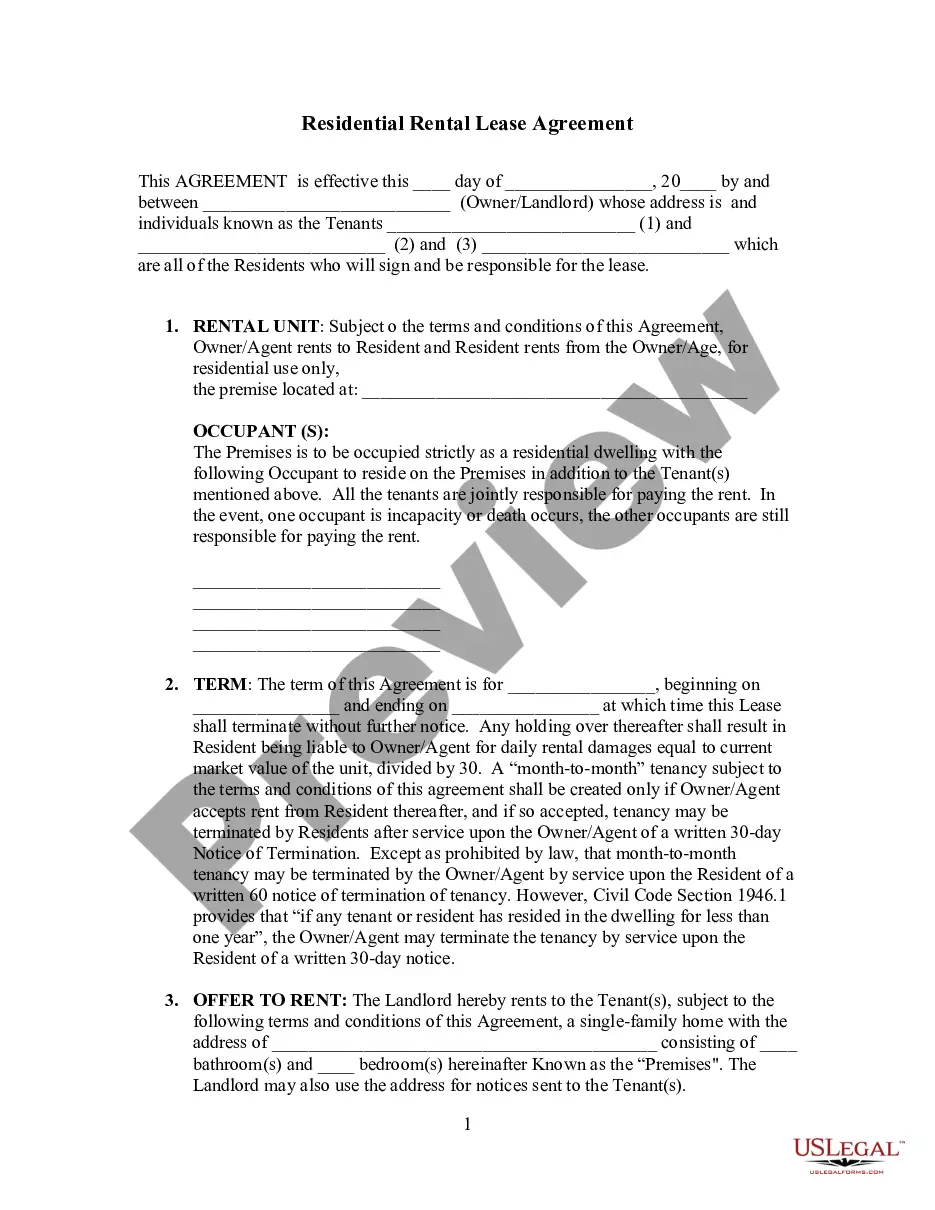
Residential Lease Agreement
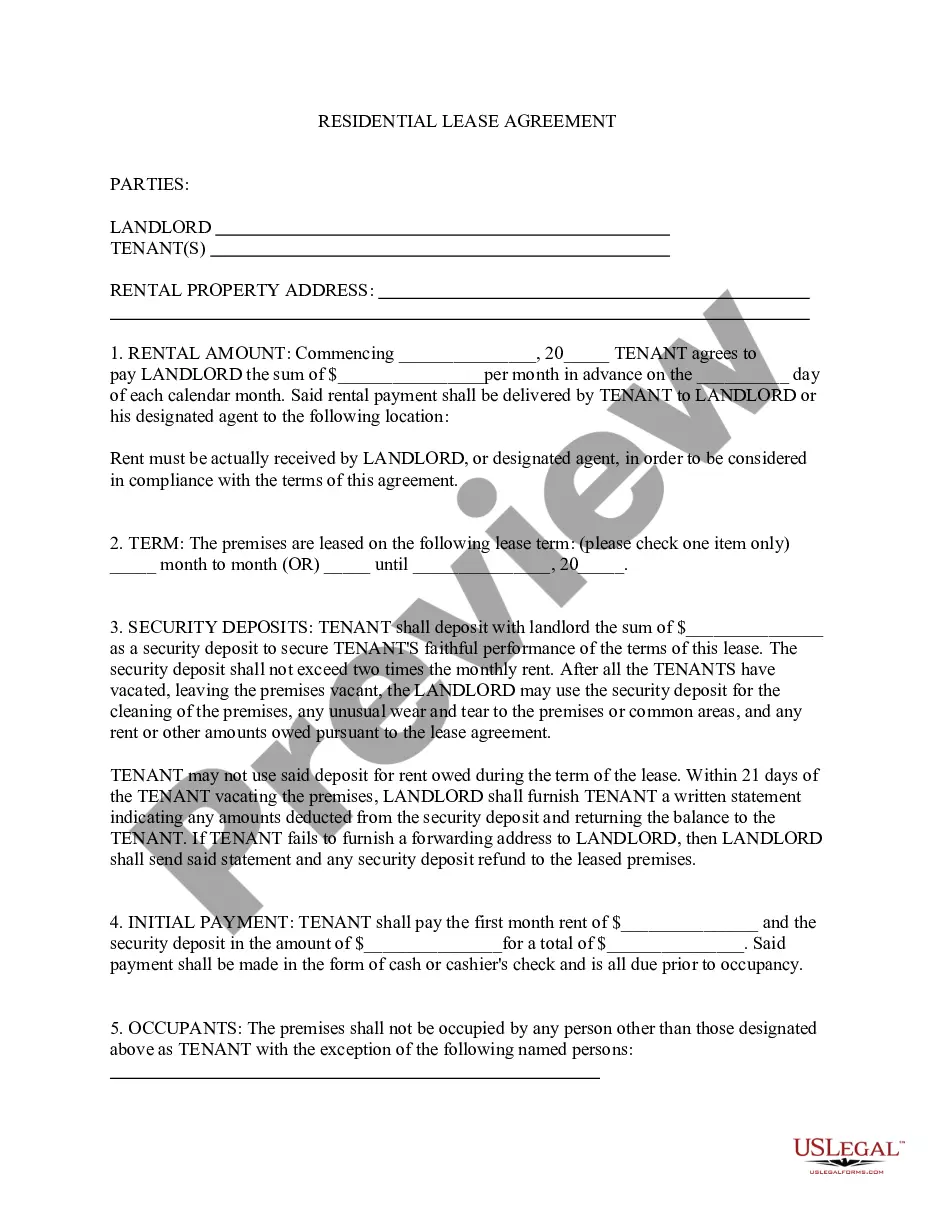
Residential Lease Agreement
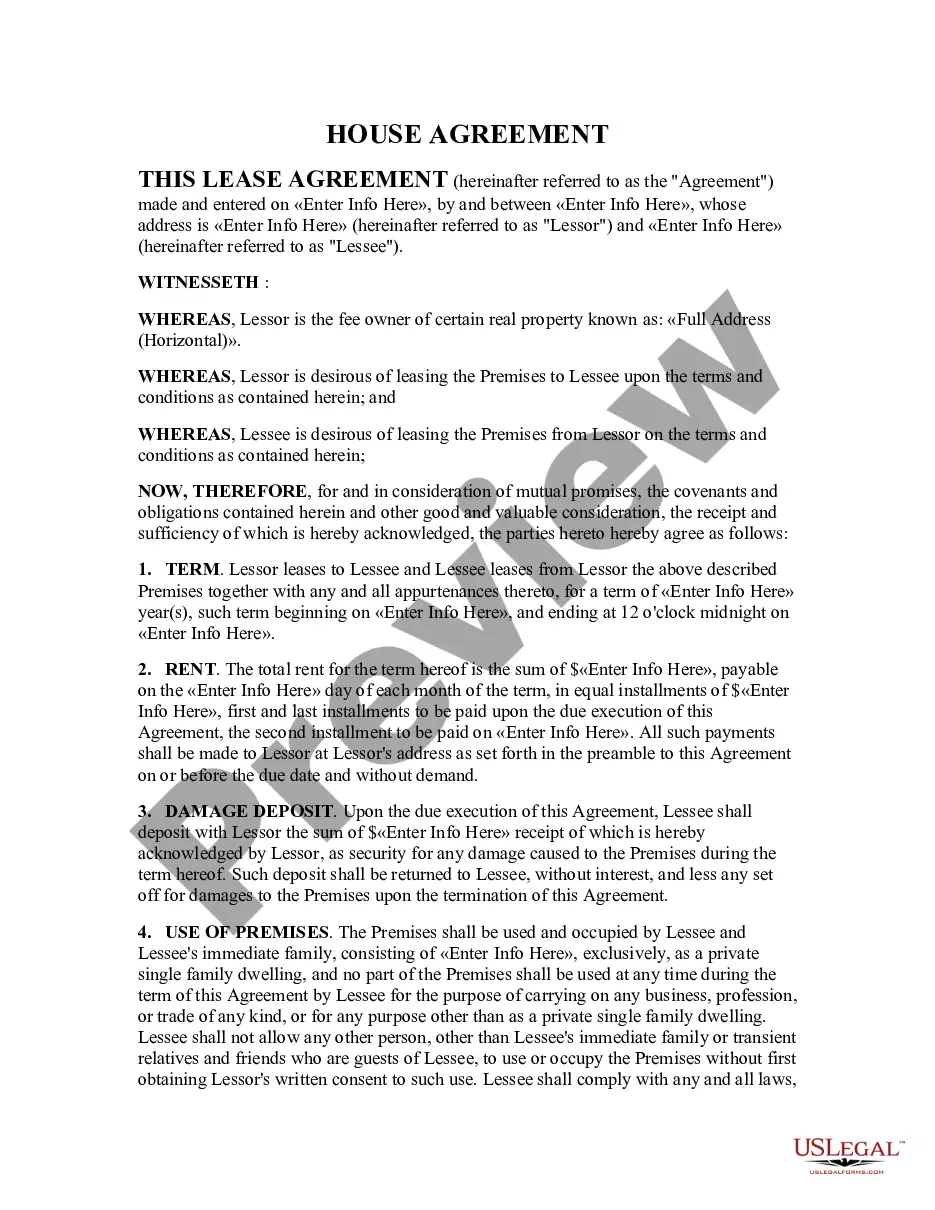
House Lease Agreement
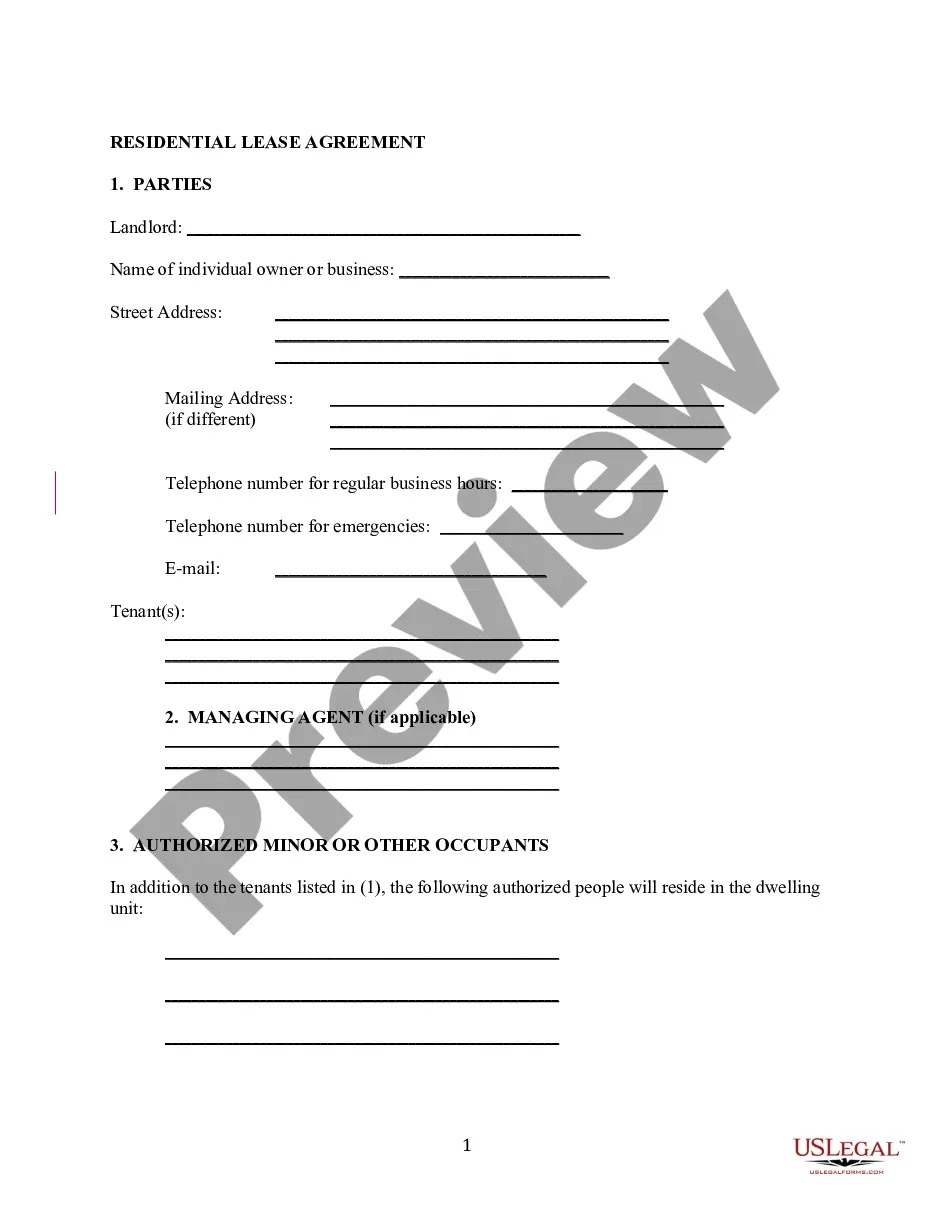
Residential Lease
When to use this form
This form is used when a landlord wants to establish a legal agreement for the rental of residential property for a specified term. It provides clarity on the expectations and responsibilities of both the landlord and tenant, which can help prevent disputes during the rental term.
Who should use this form
- Landlords who wish to lease their residential property.
- Tenants looking for a formal agreement outlining their rental terms.
- Both parties need to understand their rights and obligations under Virginia law.
How to prepare this document
- Identify the parties involved: List the landlord and tenant's full names and addresses.
- Specify the property: Include the complete address of the rental property.
- Enter dates: Fill in the start and end dates of the lease term.
- Detail the rent amount: Indicate the monthly rent and payment due date.
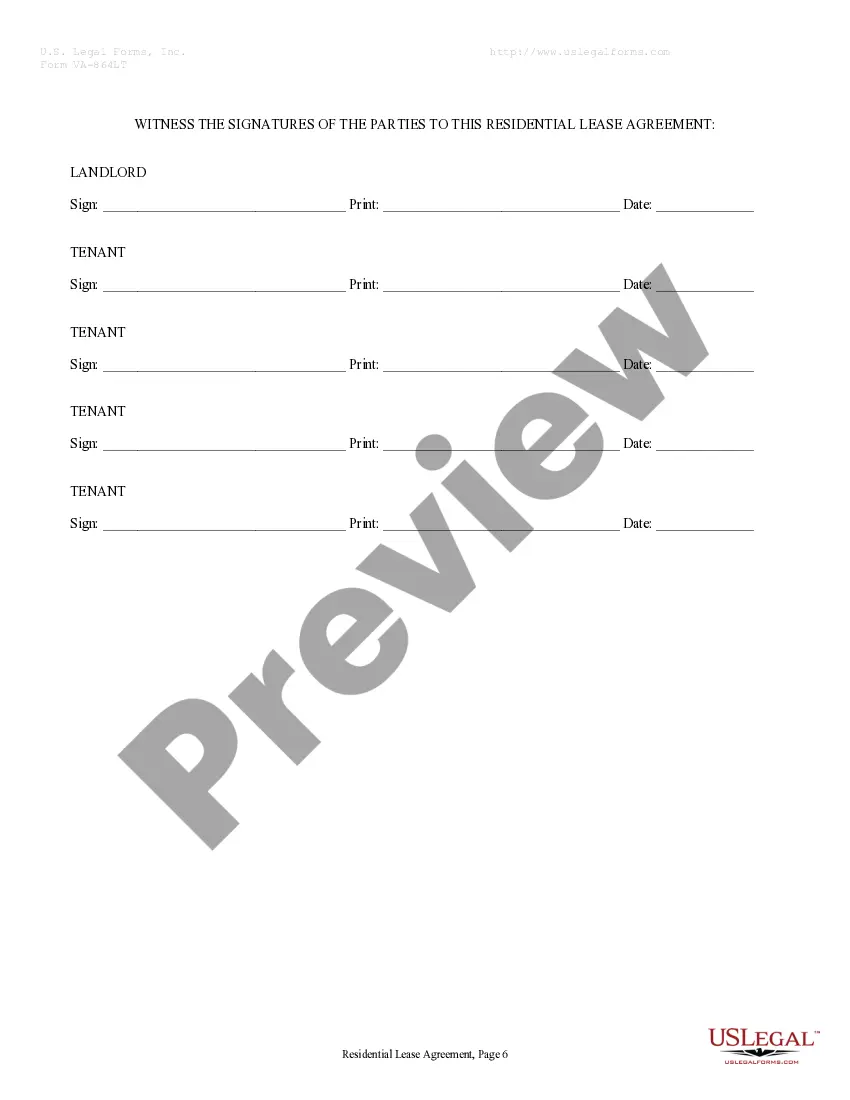
- Sign the agreement: Ensure all parties sign and date the lease to make it legally binding.
Notarization guidance
Notarization is not commonly needed for this form. However, certain documents or local rules may make it necessary. Our notarization service, powered by Notarize, allows you to finalize it securely online anytime, day or night.
Get your form ready online
Our built-in tools help you complete, sign, share, and store your documents in one place.
Make edits, fill in missing information, and update formatting in US Legal Forms—just like you would in MS Word.
Download a copy, print it, send it by email, or mail it via USPS—whatever works best for your next step.
Sign and collect signatures with our SignNow integration. Send to multiple recipients, set reminders, and more. Go Premium to unlock E-Sign.
If this form requires notarization, complete it online through a secure video call—no need to meet a notary in person or wait for an appointment.
We protect your documents and personal data by following strict security and privacy standards.

Make edits, fill in missing information, and update formatting in US Legal Forms—just like you would in MS Word.

Download a copy, print it, send it by email, or mail it via USPS—whatever works best for your next step.

Sign and collect signatures with our SignNow integration. Send to multiple recipients, set reminders, and more. Go Premium to unlock E-Sign.

If this form requires notarization, complete it online through a secure video call—no need to meet a notary in person or wait for an appointment.

We protect your documents and personal data by following strict security and privacy standards.
Avoid these common issues
- Failing to include all tenant occupants which may affect liability.
- Not specifying the due date for rent payments.
- Leaving out details regarding the security deposit and its conditions.
- Not signing by all parties involved in the lease.
- Neglecting to include important details about utility responsibilities.
Benefits of completing this form online
- Convenience of downloading and customizing the form from anywhere.
- Access to templates drafted by licensed attorneys, ensuring legal accuracy.
- Ability to edit the form to meet specific rental situation needs.
- Instant access to important legal documents without additional costs.
Legal use & context:
- The Residential Rental Lease Agreement is enforceable under Virginia law.
- It provides legal protection to both landlords and tenants, clarifying rights and duties.
- Failure to adhere to the terms outlined in this agreement can result in legal action.
Quick recap
- This form is essential for establishing a clear and legal rental agreement.
- It covers vital elements like security deposits, rent payments, and obligations.
- Utilizing this form can minimize potential disputes between landlords and tenants.
Key terms explained
- Lessor: The landlord or property owner leasing the property.
- Lessee: The tenant or individual renting the property.
- Security Deposit: A sum of money held by the landlord for damages or unpaid rent.
- Prorated Rent: A calculation of rent due based on the number of days of occupancy during the first month.
Looking for another form?
-
Alabama
-
Alaska
-
Arizona
-
Arkansas
-
California
-
Colorado
-
Connecticut
-
Delaware
-
District of Columbia
-
Florida
-
Georgia
-
Guam
-
Hawaii
-
Idaho
-
Illinois
-
Indiana
-
Iowa
-
Kansas
-
Kentucky
-
Louisiana
-
Maine
-
Maryland
-
Massachusetts
-
Michigan
-
Minnesota
-
Mississippi
-
Missouri
-
Montana
-
Nebraska
-
Nevada
-
New Hampshire
-
New Jersey
-
New Mexico
-
New York
-
North Carolina
-
North Dakota
-
Ohio
-
Oklahoma
-
Oregon
-
Pennsylvania
-
Puerto Rico
-
Rhode Island
-
South Carolina
-
South Dakota
-
Tennessee
-
Texas
-
Utah
-
Vermont
-
Virgin Islands
-
Virginia
-
Washington
-
West Virginia
-
Wisconsin
-
Wyoming
Viewed forms

North Dakota Aging Parent Package

Vermont Aging Parent Package
Letters

AOC Performance Management And Development Program
District of Columbia Electrical Contractor Package
Contempt

Wisconsin Contractors Forms Package
Reference Request Notice

Arizona Contractors Forms Package
Remand Commitment-Undertaking
Form popularity
FAQ
Yes. All owners do not need to sign. One owner can represent all the owners, just as a property manager represents the owner of the apartment complex or the property owners. The only time all owners would need to sign is if they were selling the property.
Typically, a rent agreement is prepared by the real estate agent hired by the landlord and the tenant. To validate the agreement, both the landlord and the tenant ought to sign the agreement in the presence of two people who are non-beneficiaries of the property and will sign on the agreement as witnesses.
The Lease Must be in Writing It does not matter if the lease is handwritten or typed.
No, standard residential lease agreements do not need to be notarized in Virginia. As long as the lease is signed by at least one party and meets the requirements to be legally binding, it is enforceable.
1. Names of Tenants. Every adult who lives in the rental unit, including both members of a married or unmarried couple, should sign the lease or rental agreement and be explicitly named as tenants.
No, standard residential lease agreements do not need to be notarized in Virginia. As long as the lease is signed by at least one party and meets the requirements to be legally binding, it is enforceable.
The difference between lease and rent is that a lease generally lasts for 12 months while a rental agreement generally lasts for 30 days.That means the landlord can't raise the rent without your written consent or evict you without cause, and you can't stop paying rent or break the lease without consequence.
When one person gives another permission to sign a legally significant document on his behalf, the signer is essentially acting as an authorized representative for the other person.This means that you cannot sign other documents on his behalf based on his permission to sign just the lease.
A lease can be written or verbal, but a verbal lease can be very difficult to enforce.Most leases are fairly standard and cover basic components such as rent amount, duration of lease term, resposiblities of each party and penalties for not following the terms.
Explore more forms
Letter from Tenant to Landlord for Failure of Landlord to Comply with Building Codes
Electronic Software Distribution Agreement
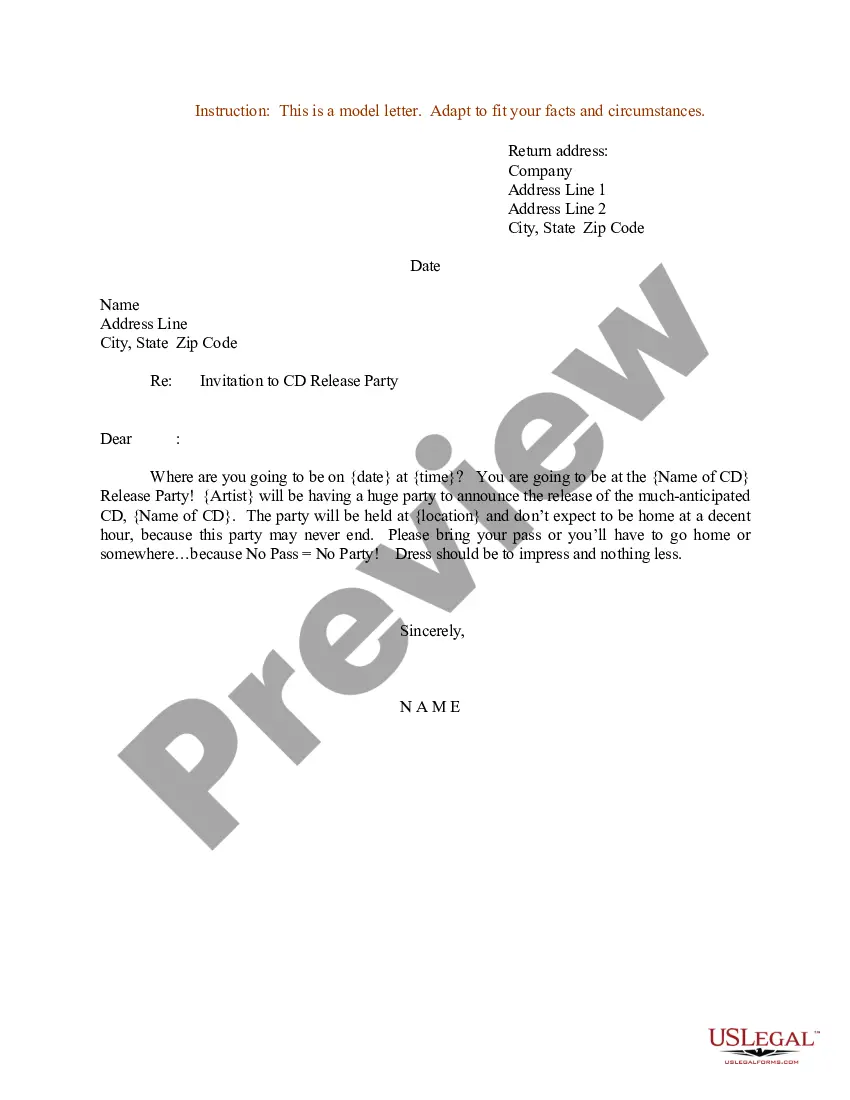
Sample Letter for Invitation to CD Release Party
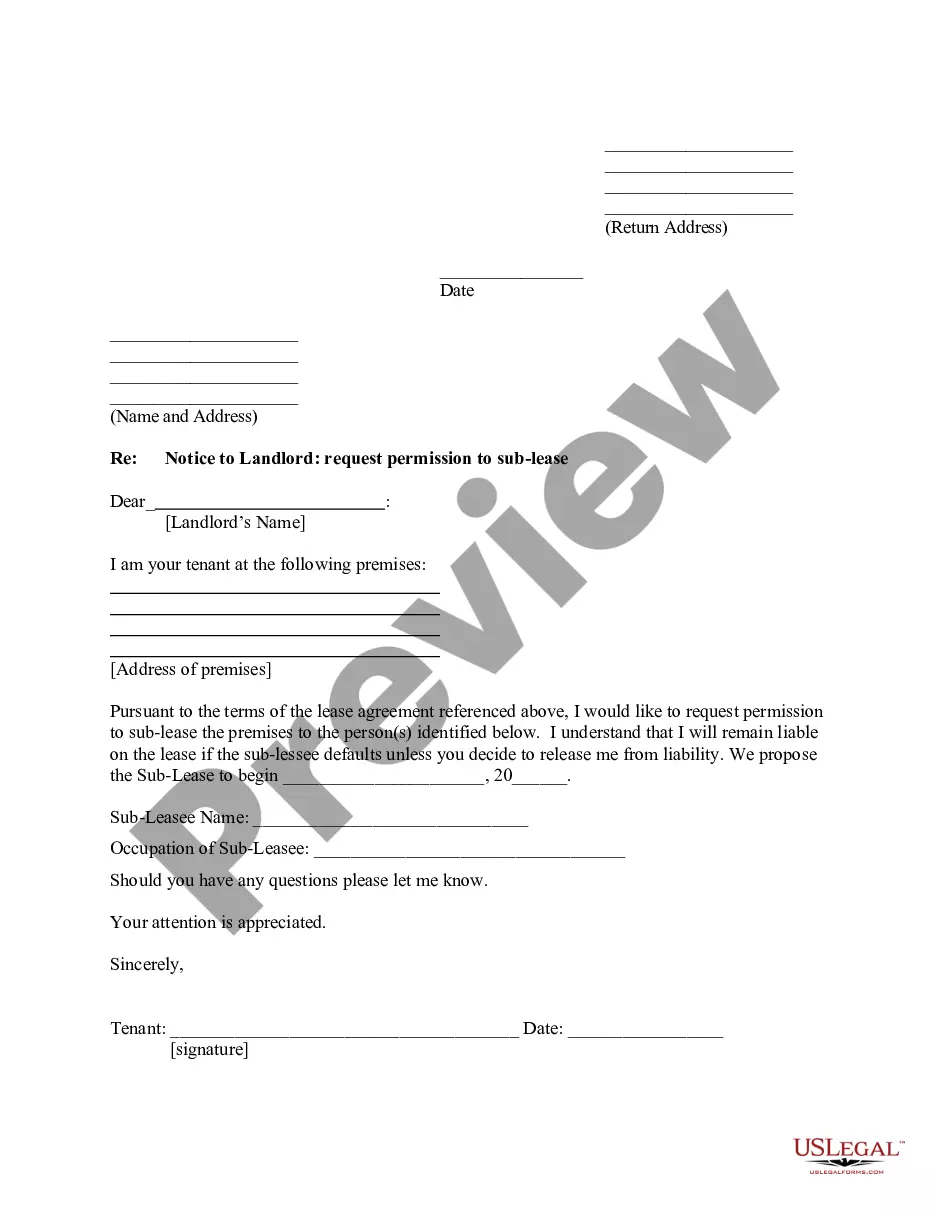
Letter from Tenant to Landlord Containing Request for Permission to Sublease
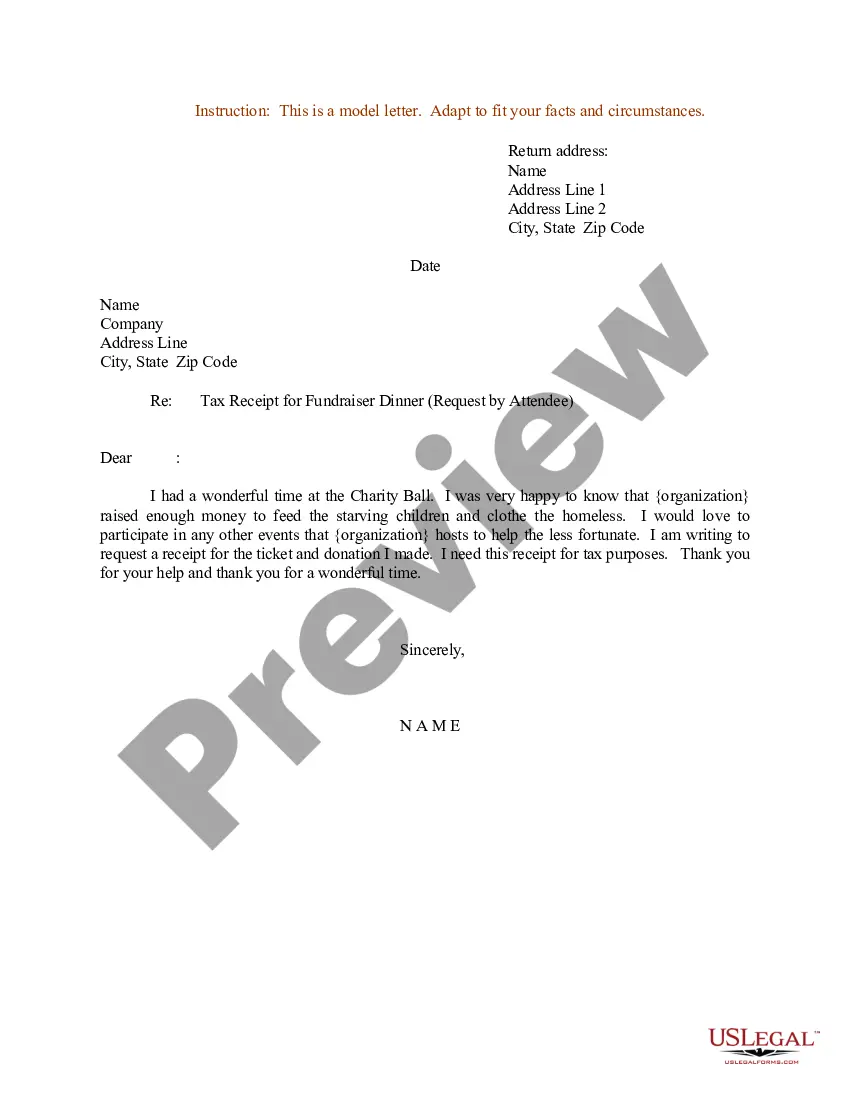
Sample Letter for Tax Receipt for Fundraiser Dinner - Request by Attendee
Trusted and secure by over 3 million people of the world’s leading companies
Title 55
PROPERTY AND CONVEYANCES.
Chapter 13.2 - Virginia Residential Landlord and Tenant Act
Short title.
This chapter may be cited as the "Virginia Residential Landlord and Tenant Act." (Chap. 13.2, § 55-248.2)
Purposes of chapter.
The purposes of this chapter are to simplify, clarify, modernize and revise the law governing the rental of dwelling units and the rights and obligations of landlords and tenants; to encourage landlords and tenants to maintain and improve the quality of housing; and to establish a single body of law relating to landlord and tenant relations throughout the Commonwealth; provided, however, that nothing in this chapter shall prohibit a county, city or town from establishing a commission, reconciliatory in nature only, or designating an existing agency, which upon mutual agreement of the parties may mediate conflicts which may arise out of the application of this chapter, nor shall anything herein be deemed to prohibit an ordinance designed to effect compliance with local property maintenance codes. This chapter shall supersede all other local, county, or municipal ordinances or regulations concerning landlord and tenant relations and the leasing of residential property. (Chap. 13.2, § 55-248.3)
Applicability of chapter.
This chapter shall apply to all rental agreements entered into on or after July 1, 1974, which are not exempted pursuant to § 55-248.5. (Chap. 13.2, § 55-248.3:1)
Definitions.
When used in this chapter, unless expressly stated otherwise:
"Action" means recoupment, counterclaim, set off, or other civil suit and any other proceeding in which rights are determined, including without limitation actions for possession, rent, unlawful detainer, unlawful entry, and distress for rent.
"Application fee" means any deposit of money, however denominated, including all money intended to be used as a security deposit under a rental agreement, or property, which is paid by a tenant to a landlord, lessor, or agent of a landlord for the purpose of being considered as a tenant for a dwelling unit.
"Assignment" means the transfer by any tenant of all interests created by a rental agreement.
"Building or housing code" means any law, ordinance or governmental regulation concerning fitness for habitation, or the construction, maintenance, operation, occupancy, use or appearance of any structure or that part of a structure that is used as a home, residence or sleeping place by one person who maintains a household or by two or more persons who maintain a common household.
"Dwelling unit" means a structure or part of a structure that is used as a home or residence by one or more persons who maintain a household, including, but not limited to, a manufactured home.
"Facility" means something that is built, constructed, installed or established to perform some particular function.
"Good faith" means honesty in fact in the conduct of the transaction concerned.
"Guest or invitee" means a person, other than the tenant or person authorized by the landlord to occupy the premises, who has the permission of the tenant to visit but not to occupy the premises.
"Landlord" means the owner, lessor or sublessor of the dwelling unit or the building of which such dwelling unit is a part. "Landlord" also includes a managing agent of the premises who fails to disclose the name of such owner, lessor or sublessor. Such managing agent shall be subject to the provisions of § 16.1-88.03.
"Managing agent" means a person authorized by the landlord to act on behalf of the landlord under a management agreement.
"Natural person," wherever the chapter refers to an owner as a "natural person," includes co-owners who are natural persons, either as tenants in common, joint tenants, tenants in partnership, tenants by the entirety, trustees or beneficiaries of a trust, general partnerships, limited liability partnerships, registered limited liability partnerships or limited liability companies, or any lawful combination of natural persons permitted by law.
"Organization" means a corporation, government, governmental subdivision or agency, business trust, estate, trust, partnership or association, two or more persons having a joint or common interest, or any combination thereof, and any other legal or commercial entity.
"Owner" means one or more persons, jointly or severally, in whom is vested:
1. All or part of the legal title to the property, or
2. All or part of the beneficial ownership and a right to present use and enjoyment of the premises, and the term includes a mortgagee in possession.
"Person" means any individual, group of individuals, corporation, partnership, business trust, association or other legal entity, or any combination thereof.
"Premises" means a dwelling unit and the structure of which it is a part and facilities and appurtenances therein and grounds, areas and facilities held out for the use of tenants generally or whose use is promised to the tenant.
"Rent" means all money or property, other than a security deposit, owed to the landlord under the rental agreement.
"Rental agreement" means all agreements, written or oral, and valid rules and regulations adopted under § 55-248.17 embodying the terms and conditions concerning the use and occupancy of a dwelling unit and premises.
"Roomer" means a person occupying a dwelling unit that lacks a major bathroom or kitchen facility, in a structure where one or more major facilities are used in common by occupants of the dwelling unit and other dwelling units. Major facility in the case of a bathroom means toilet, and either a bath or shower, and in the case of a kitchen means refrigerator, stove or sink.
"Security deposit" means any deposit of money or property, whether termed security deposit or "prepaid rent," however denominated, which is furnished by a tenant to a landlord to secure the performance of any part of a written or oral rental agreement, as a security for damages to the leased premises, or as a pet deposit. However, such money or property shall be deemed an application fee until the effective date of the rental agreement.
"Single-family residence" means a structure, other than a multi-family residential structure, maintained and used as a single dwelling unit or any dwelling unit which has direct access to a street or thoroughfare and shares neither heating facilities, hot water equipment nor any other essential facility or service with any other dwelling unit.
"Sublease" means the transfer by any tenant of any but not all interests created by a rental agreement.
"Tenant" means a person entitled under a rental agreement to occupy a dwelling unit to the exclusion of others and shall include roomer.
"Utility" means a service such as light, power, electricity, gas, or water provided by a public service corporation. (Chap. 13.2, § 55-248.4)
Exemptions; exception to exemption.
A. Except as specifically made applicable by § 55-248.21:1, the following conditions are not governed by this chapter:
1. Residence at a public or private institution, if incidental to detention or the provision of medical, geriatric, educational, counseling, religious or similar services;
2. Occupancy under a contract of sale of a dwelling unit or the property of which it is a part, if the occupant is the purchaser or a person who succeeds to his interest;
3. Occupancy by a member of a fraternal or social organization in the portion of a structure operated for the benefit of the organization;
4. Occupancy in a hotel, motel, vacation cottage, boardinghouse or similar lodging held out for transients, unless let continuously to one occupant for more than thirty days, including occupancy in a lodging subject to taxation as provided in § 58.1-3819;
5. Occupancy by an employee of a landlord whose right to occupancy is conditioned upon employment in and about the premises or an ex-employee whose occupancy continues less than sixty days;
6. Occupancy by an owner of a condominium unit or a holder of a proprietary lease in a cooperative;
7. Occupancy under a rental agreement covering premises used by the occupant primarily in connection with business, commercial or agricultural purposes;
8. Occupancy in a public housing unit or other housing unit subject to regulation by the Department of Housing and Urban Development where such regulation is inconsistent with this chapter;
9. Occupancy by a tenant who pays no rent; and
10. Occupancy in single-family residences where the owner(s) are natural persons or their estates who own in their own name no more than ten single-family residences subject to a rental agreement; or in the case of condominium units or single-family residences located in any city or in any county having either the urban county executive form or county manager plan of government, no more than four.
B. Notwithstanding the provisions of subsection A, the landlord may specifically provide for the applicability of the provisions of this chapter in the rental agreement. (Chap. 13.2, § 55-248.5)
Notice.
A. A person shall be deemed to have notice of a fact if he has actual knowledge of it; he has received a notice or notification of it; or, from all the facts and circumstances known to him at the time in question he has reason to know that it exists.
B. A person "notifies" or "gives" a notice or notification to another by taking steps reasonably calculated to inform another person whether or not the other person actually comes to know of it. A person "receives" a notice or notification when it:
1. Comes to his attention;
2. Is served upon the recipient by regular mail, postage prepaid, and there is sufficient proof of mailing which may be either a United States postal certificate of mailing or a certificate of service confirming such mailing prepared by the sender; or
3. Is served upon the recipient by hand delivery in accordance with Chapter 8 (§ 8.01-285 et seq.) of Title 8.01, which provides for personal or substituted service, with the exception that the sender, whether landlord, tenant or sender's agent, may serve notices hereunder, when the sender retains a certificate of mailing prepared by him.
C. In the case of the landlord, notice is served on the landlord at his place of business where the rental agreement was made, or at any place held out by the landlord as the place for receipt of the communication.
D. In the case of the tenant, notice is served at the tenant's last known place of residence, which may be the dwelling unit.
E. Notice, knowledge or a notice or notification received by an organization is effective for a particular transaction from the time it is brought to the attention of the person conducting that transaction, or from the time it would have been brought to his attention if the organization had exercised reasonable diligence.
F. No notice of termination of tenancy served upon a tenant by a public housing authority organized under the Housing Authorities Law (§ 36-1 et seq.) of Title 36 shall be effective unless it contains on its first page, in type no smaller or less legible than that otherwise used in the body of the notice, the name, address and telephone number of the legal services program, if any, serving the jurisdiction wherein the premises are located. (Chap. 13.2, § 55-248.6)
Application fees.
Any landlord may require an application fee. If the applicant fails to rent the unit applied for and the application fee exceeds twenty dollars, the landlord shall refund to the applicant within twenty days after the applicant's failure to rent the unit or the landlord's rejection of the application all sums in excess of the landlord's actual expenses and damages together with an itemized list of said expenses and damages. If, however, the application fee or deposit was made by cash, certified check, cashier's check, or postal money order, such refund shall be made within ten days of the applicant's failure to rent the unit if the failure to rent is due to the landlord's rejection of the application. If the landlord fails to comply with this section, the applicant may recover as damages suffered by him that portion of the fee wrongfully withheld and reasonable attorney's fees. (Chap. 13.2, § 55-248.6:1)
Terms and conditions of rental agreement; copy for tenant.
A. A landlord and tenant may include in a rental agreement, terms and conditions not prohibited by this chapter or other rule of law, including rent, charges for late payment of rent, term of the agreement and other provisions governing the rights and obligations of the parties.
B. In the absence of a rental agreement, the tenant shall pay as rent the fair rental value for the use and occupancy of the dwelling unit.
C. Rent shall be payable without demand or notice at the time and place agreed upon by the parties. Unless otherwise agreed, rent is payable at the place designated by the landlord and periodic rent is payable at the beginning of any term of one month or less and otherwise in equal installments at the beginning of each month.
D. Unless the rental agreement fixes a definite term, the tenancy shall be week to week in case of a roomer who pays weekly rent, and in all other cases month to month.
E. If the rental agreement contains any provision whereby the landlord may approve or disapprove a sublessee or assignee of the tenant, the landlord shall within ten business days of receipt by him of the written application of the prospective sublessee or assignee on a form to be provided by the landlord, approve or disapprove the sublessee or assignee. Failure of the landlord to act within ten business days shall be deemed evidence of his approval.
F. A copy of any written rental agreement signed by both the tenant and the landlord shall be provided to the tenant within one month of the effective date of the written rental agreement. The failure of the landlord to deliver such a rental agreement shall not affect the validity of the agreement.
G. No unilateral change in the terms of a rental agreement by a landlord or tenant shall be valid unless (i) notice of the change is given in accordance with the terms of the rental agreement or as otherwise required by law and (ii) both parties consent in writing to the change. (Chap. 13.2, § 55-248.7)
Effect of unsigned or undelivered rental agreement.
If the landlord does not sign and deliver a written rental agreement signed and delivered to him by the tenant, acceptance of rent without reservation by the landlord gives the rental agreement the same effect as if it had been signed and delivered by the landlord. If the tenant does not sign and deliver a written rental agreement signed and delivered to him by the landlord, acceptance of possession or payment of rent without reservation gives the rental agreement the same effect as if it had been signed and delivered by the tenant. If a rental agreement, given effect by the operation of this section, provides for a term longer than one year, it is effective for only one year. (Chap. 13.2, § 55-248.8)
Prohibited provisions in rental agreements.
A. A rental agreement shall not contain provisions that the tenant:
1. Agrees to waive or forego rights or remedies under this chapter;
2. Agrees to waive or forego rights or remedies pertaining to the 120-day conversion or rehabilitation notice required in the Condominium Act (§ 55-79.39 et seq.), the Virginia Real Estate Cooperative Act (§ 55-424 et seq.) or Chapter 13 (§ 55-217 et seq.) of this title;
3. Authorizes any person to confess judgment on a claim arising out of the rental agreement;
4. Agrees to pay the landlord's attorney's fees except as provided in this chapter;
5. Agrees to the exculpation or limitation of any liability of the landlord to the tenant arising under law or to indemnify the landlord for that liability or the costs connected therewith; or
6. Agrees as a condition of tenancy in public housing to a prohibition or restriction of any lawful possession of a firearm within individual dwelling units unless required by federal law or regulation.
B. A provision prohibited by subsection A included in a rental agreement is unenforceable. If a landlord brings an action to enforce any of the prohibited provisions, the tenant may recover actual damages sustained by him and reasonable attorney's fees. (Chap. 13.2, § 55-248.9)
Confidentiality of tenant records.
No landlord or managing agent shall release financial information about a tenant or prospective tenant, other than a tenant's rent payment record and the amount of the tenant's periodic rental payment, to a third party without the prior written consent of the tenant or prospective tenant. However, a contract purchaser of property subject to a rental agreement may inspect all information pertaining to tenants or prospective tenants in the possession of the landlord without the necessity of obtaining a tenant's consent.
In all other circumstances, all information in the possession of the landlord pertaining to tenants or prospective tenants shall be deemed confidential and made available only with a tenant's or prospective tenant's prior written consent or upon service on the landlord of a subpoena for the production of records. Nothing in this section, however, shall preclude a landlord from releasing information pertaining to a tenant or prospective tenant in the event of an emergency.
This section shall not apply where the tenant is in default of the payment provisions of the rental agreement. (Chap. 13.2, § 55-248.9:1)
Landlord and tenant remedies for abuse of access.
If the tenant refuses to allow lawful access, the landlord may obtain injunctive relief to compel access, or terminate the rental agreement. In either case, the landlord may recover actual damages and reasonable attorney's fees. If the landlord makes an unlawful entry or a lawful entry in an unreasonable manner or makes repeated demands for entry otherwise lawful but which have the effect of unreasonably harassing the tenant, the tenant may obtain injunctive relief to prevent the recurrence of the conduct, or terminate the rental agreement. In either case, the tenant may recover actual damages and reasonable attorney's fees. (Chap. 13.2, § 55-248.10:1)
Inspection of premises.
The landlord shall, within five days after occupancy of a dwelling unit, submit a written report to the tenant, for his safekeeping, itemizing damages to the dwelling unit existing at the time of occupancy, which record shall be deemed correct unless the tenant objects thereto in writing within five days after receipt thereof. The landlord may adopt a written policy allowing the tenant to prepare the written report of the move-in inspection, in which case the tenant shall submit a copy to the landlord, which record shall be deemed correct unless the landlord objects thereto in writing within five days after receipt thereof. Such written policy adopted by the landlord may also provide for the landlord and the tenant to prepare the written report of the move-in inspection jointly, in which case both the landlord and the tenant shall sign the written report and receive a copy thereof, at which time the inspection record shall be deemed correct. (Chap. 13.2, § 55-248.11:1)
Disclosure.
A. The landlord or any person authorized to enter into a rental agreement on his behalf shall disclose to the tenant in writing at or before the commencement of the tenancy the name and address of:
1. The person or persons authorized to manage the premises; and
2. An owner of the premises or any other person authorized to act for and on behalf of the owner, for the purposes of service of process and receiving and receipting for notices and demands.
B. In the event of the sale of the premises, the landlord shall notify the tenant of such sale and disclose to the tenant the name and address of the purchaser and a telephone number at which such purchaser can be located.
C. If an application for registration of the rental property as a condominium or cooperative has been filed with the Real Estate Board, or if there is within six months an existing plan for tenant displacement resulting from (i) demolition or substantial rehabilitation of the property or (ii) conversion of the rental property to office, hotel or motel use or planned unit development, then the landlord or any person authorized to enter into a rental agreement on his behalf shall disclose that information in writing to any prospective tenant.
D. The information required to be furnished by this section shall be kept current and this section extends to and is enforceable against any successor landlord or owner. A person who fails to comply with this section becomes an agent of each person who is a landlord for the purposes of service of process and receiving and receipting for notices and demands. (Chap. 13.2, § 55-248.12)
Landlord to maintain fit premises.
A. The landlord shall:
1. Comply with the requirements of applicable building and housing codes materially affecting health and safety;
2. Make all repairs and do whatever is necessary to put and keep the premises in a fit and habitable condition;
3. Keep all common areas shared by two or more dwelling units of the premises in a clean and structurally safe condition;
4. Maintain in good and safe working order and condition all electrical, plumbing, sanitary, heating, ventilating, air-conditioning and other facilities and appliances, including elevators, supplied or required to be supplied by him;
5. Provide and maintain appropriate receptacles and conveniences, in common areas, for the collection, storage, and removal of ashes, garbage, rubbish and other waste incidental to the occupancy of two or more dwelling units and arrange for the removal of same; and
6. Supply running water and reasonable amounts of hot water at all times and reasonable air conditioning if provided and heat in season except where the dwelling unit is so constructed that heat, air conditioning or hot water is generated by an installation within the exclusive control of the tenant or supplied by a direct public utility connection.
B. If the duty imposed by subdivision 1 of subsection A is greater than any duty imposed by any other subdivision of that subsection, the landlord's duty shall be determined by reference to subdivision 1.
C. The landlord and tenant may agree in writing that the tenant perform the landlord's duties specified in subdivisions 3, 5 and 6 of subsection A and also specified repairs, maintenance tasks, alterations and remodeling, but only if the transaction is entered into in good faith and not for the purpose of evading the obligations of the landlord, and if the agreement does not diminish or affect the obligation of the landlord to other tenants in the premises. (Chap. 13.2, § 55-248.13)
Landlord to provide locks and peepholes.
The governing body of any county, city or town may require by ordinance that any landlord who rents five or more dwelling units in any one building shall install:
1. Dead-bolt locks which meet the requirements of the Uniform Statewide Building Code (§ 36-97 et seq.) for new multi-family construction and peepholes in any exterior swinging entrance door to any such unit; however, any door having a glass panel shall not require a peephole.
2. Manufacturer's locks which meet the requirements of the Uniform Statewide Building Code and removable metal pins or charlie bars in accordance with the Uniform Statewide Building Code on exterior sliding glass doors located in a building at any level or levels designated in the ordinance.
3. Locking devices which meet the requirements of the Uniform Statewide Building Code on all exterior windows.
Any ordinance adopted pursuant to this section shall further provide that any landlord subject to the ordinance shall have a reasonable time as determined by the governing body in which to comply with the requirements of the ordinance. (Chap. 13.2, § 55-248.13:1)
(Effective until July 1, 2001) Access of tenant to cable, satellite and other television facilities.
No landlord shall demand or accept payment of any fee, charge or other thing of value from any provider of cable television service, satellite master antenna television service, direct broadcast satellite television service, subscription television service or service of any other television programming system in exchange for giving the tenants of such landlord access to such service; and no landlord shall demand or accept any such payment from any tenants in exchange therefor unless the landlord is itself the provider of the service. Nor shall any landlord discriminate in rental charges between tenants who receive any such service and those who do not. Nothing contained herein shall prohibit a landlord from requiring that the provider of such service and the tenant bear the entire cost of the installation, operation or removal of the facilities incident thereto, or prohibit a landlord from demanding or accepting reasonable indemnity or security for any damages caused by such installation, operation or removal. (Chap. 13.2, § 55-248.13:2)
(Effective July 1, 2001) Access of tenant to cable, satellite and other television facilities
No landlord shall demand or accept payment of any fee, charge or other thing of value from any provider of cable television service, satellite master antenna television service, direct broadcast satellite television service, subscription television service or service of any other television programming system in exchange for merely granting a television service provider access to the landlord's tenants or giving the tenants of such landlord access to such service. A landlord may be compensated by such television service provider for the use and occupancy of the landlord's property and for any services rendered to that provider by the landlord in amounts reasonably related to the values of that property and those services rendered, including without limitation, physical occupation of the property, services provided to the provider by the landlord, costs imposed on the landlord, and benefits obtained by the provider.
No landlord shall demand or accept any such payment from any tenants in exchange therefor unless the landlord is itself the provider of the service. Nor shall any landlord discriminate in rental charges between tenants who receive any such service and those who do not. Nothing contained herein shall prohibit a landlord from requiring that the provider of such service and the tenant bear the entire cost of the installation, operation or removal of the facilities incident thereto, or prohibit a landlord from demanding or accepting reasonable indemnity or security for any damages caused by such installation, operation or removal. (Chap. 13, § 55-248.13:2)
Notice to tenants for pesticide use.
A. The landlord shall give written notice to the tenant no less than forty-eight hours prior to his application of a pesticide in the tenant's dwelling unit unless the tenant agrees to a shorter notification period. If a tenant requests the application of the pesticide, the forty-eight-hour notice is not required. Tenants who have concerns about specific pesticides shall notify the landlord in writing no less than twenty-four hours before the scheduled pesticide application.
B. In addition, the landlord shall post notice of all pesticide applications in or upon the premises, excluding the dwelling units. Such notice shall consist of conspicuous signs placed in or upon such premises where the pesticide will be applied at least forty-eight hours prior to the application. (Chap. 13.2, § 55-248.13:3)
Limitation of liability.
Unless otherwise agreed, a landlord who conveys premises that include a dwelling unit subject to a rental agreement in a good faith sale to a bona fide purchaser is relieved of liability under the rental agreement and this chapter as to events occurring subsequent to notice to the tenant of the conveyance. Unless otherwise agreed, a managing agent of premises that include a dwelling unit is relieved of liability under the rental agreement and this chapter as to events occurring after written notice to the tenant of the termination of his management. (Chap. 13, § 55-248.14)
Tenancy at will; effect of notice of change of terms or provisions of tenancy.
A notice of any change by a landlord or tenant in any terms or provisions of a tenancy at will shall constitute a notice to vacate the premises, and such notice of change shall be given in accordance with the terms of the rental agreement, if any, or as otherwise required by law. (Chap. 13.2, § 55-248.15)
Security deposits.
A. A landlord may not demand or receive a security deposit, however denominated, in an amount or value in excess of two months' periodic rent. Upon termination of the tenancy, such security deposit, whether it is property or money, plus any accrued interest thereon, held by the landlord as security as hereinafter provided may be applied solely by the landlord (i) to the payment of accrued rent and including the reasonable charges for late payment of rent specified in the rental agreement; (ii) to the payment of the amount of damages which the landlord has suffered by reason of the tenant's noncompliance with § 55-248.16, less reasonable wear and tear; or (iii) to other damages or charges as provided in the rental agreement. The security deposit, any accrued interest and any deductions, damages and charges shall be itemized by the landlord in a written notice given to the tenant, together with any amount due the tenant within thirty days after termination of the tenancy and delivery of possession.
Nothing in this section shall be construed by a court of law or otherwise as entitling the tenant, upon the termination of the tenancy, to an immediate credit against the tenant's delinquent rent account in the amount of the security deposit. The landlord shall apply the security deposit in accordance with this section within the thirty-day time period.
The landlord shall notify the tenant in writing of any deductions provided by this subsection to be made from the tenant's security deposit during the course of the tenancy. Such notification shall be made within thirty days of the date of the determination of the deduction and shall itemize the reasons in the same manner as provided in subsection B. Such notification shall not be required for deductions made less than thirty days prior to the termination of the rental agreement. In the event that damages to the premises exceed the amount of the security deposit and require the services of a third party contractor, the landlord shall give written notice to the tenant advising him of that fact within the thirty-day period. If notice is given as prescribed in this paragraph, the landlord shall have an additional fifteen-day period to provide an itemization of the damages and the cost of repair. If the landlord willfully fails to comply with this section or if the landlord fails to return any security deposit and interest required to be paid to the tenant under this chapter, the tenant may recover such security deposit due him together with actual damages and reasonable attorney's fees. This section shall not preclude the landlord or tenant from recovering other damages to which he may be entitled under this chapter. The holder of the landlord's interest in the premises at the time of the termination of the tenancy, regardless of how the interest is acquired or transferred, is bound by this section and shall be required to return any security deposit received by the original landlord and any accrued interest that is duly owed to the tenant, whether or not such security deposit is transferred with the landlord's interest by law or equity, regardless of any contractual agreements between the original landlord and his successors in interest.
B. The landlord shall:
1. Accrue interest at an annual rate equal to one percentage point below the Federal Reserve Board discount rate as of January 1 of each year on all property or money held as a security deposit. However, no interest shall be due and payable unless the security deposit has been held by the landlord for a period exceeding thirteen months after the effective date of the rental agreement or after the effective date of any prior written or oral rental agreements with the same tenant, for continuous occupancy of the same dwelling unit, such security deposit earning interest which begins accruing from the effective date of the rental agreement, and such interest shall be paid only upon termination of the tenancy, delivery of possession and return of the security deposit as provided in subsection A;
2. Maintain and itemize records for each tenant of all deductions from security deposits provided for under this section which the landlord has made by reason of a tenant's noncompliance with § 55-248.16 during the preceding two years; and
3. Permit a tenant or his authorized agent or attorney to inspect such tenant's records of deductions at any time during normal business hours.
C. Upon request by the landlord to a tenant to vacate, or within five days after receipt of notice by the landlord of the tenant's intent to vacate, the landlord shall make reasonable efforts to advise the tenant of the tenant's right to be present at the landlord's inspection of the dwelling unit for the purpose of determining the amount of security deposit to be returned. If the tenant desires to be present when the landlord makes the inspection, he shall so advise the landlord in writing who, in turn, shall notify the tenant of the time and date of the inspection, which must be made within seventy-two hours of delivery of possession. Upon completion of the inspection attended by the tenant, the landlord shall furnish the tenant with an itemized list of damages to the dwelling unit known to exist at the time of the inspection.
D. If the tenant has any assignee or sublessee, the landlord shall be entitled to hold a security deposit from only one party in compliance with the provisions of this section. (Chap. 13.2, § 55-248.15:1)
Tenant to maintain dwelling unit.
A. In addition to the provisions of the rental agreement, the tenant shall:
1. Comply with all obligations primarily imposed upon tenants by applicable provisions of building and housing codes materially affecting health and safety;
2. Keep that part of the premises that he occupies and uses as clean and safe as the condition of the premises permit;
3. Remove from his dwelling unit all ashes, garbage, rubbish and other waste in a clean and safe manner and in the appropriate receptacles provided by the landlord pursuant to § 55-248.13, if such disposal is on the premises;
4. Keep all plumbing fixtures in the dwelling unit or used by the tenant as clean as their condition permits;
5. Use in a reasonable manner all utilities and all electrical, plumbing, sanitary, heating, ventilating, air-conditioning and other facilities and appliances including elevators in the premises;
6. Not deliberately or negligently destroy, deface, damage, impair or remove any part of the premises or permit any person to do so whether known by the tenant or not;
7. Not remove or tamper with a properly functioning smoke detector, including removing any working batteries, so as to render the smoke detector inoperative;
8. Be responsible for his conduct and the conduct of other persons on the premises with his consent whether known by the tenant or not, to ensure that his neighbors' peaceful enjoyment of the premises will not be disturbed; and
9. Abide by all reasonable rules and regulations imposed by the landlord pursuant to § 55-248.17
B. If the duty imposed by subdivision 1 of subsection A is greater than any duty imposed by any other subdivision of that subsection, the tenant's duty shall be determined by reference to subdivision 1. (Chap. 13.2. § 55-248.16)
Rules and regulations.
A. A landlord, from time to time, may adopt rules or regulations, however described, concerning the tenants' use and occupancy of the premises. Any such rule or regulation is enforceable against the tenant only if:
1. Its purpose is to promote the convenience, safety or welfare of the tenants in the premises, preserve the landlord's property from abusive use or make a fair distribution of services and facilities held out for the tenants generally;
2. It is reasonably related to the purpose for which it is adopted;
3. It applies to all tenants in the premises in a fair manner;
4. It is sufficiently explicit in its prohibition, direction or limitation of the tenant's conduct to fairly inform him of what he must or must not do to comply;
5. It is not for the purpose of evading the obligations of the landlord; and
6. The tenant has been provided with a copy of the rules and regulations or changes thereto at the time he enters into the rental agreement or when they are adopted.
B. A rule or regulation adopted, changed, or provided to the tenant after the tenant enters into the rental agreement shall be enforceable against the tenant if reasonable notice of its adoption or change has been given to the tenant and it does not work a substantial modification of his bargain. If a rule or regulation is adopted or changed after the tenant enters into the rental agreement that does work a substantial modification of his bargain, it shall not be valid unless the tenant consents to it in writing.
C. Any court enforcing this chapter shall consider violations of the reasonable rules and regulations imposed under this section as a breach of the rental agreement and grant the landlord appropriate relief. (Chap. 13.2, § 55-248.17)
Access; consent.
A. The tenant shall not unreasonably withhold consent to the landlord to enter into the dwelling unit in order to inspect the premises, make necessary or agreed repairs, decorations, alterations or improvements, supply necessary or agreed services or exhibit the dwelling unit to prospective or actual purchasers, mortgagees, tenants, workmen or contractors. The landlord may enter the dwelling unit without consent of the tenant in case of emergency. The landlord shall not abuse the right of access or use it to harass the tenant. Except in case of emergency or if it is impractical to do so, the landlord shall give the tenant reasonable notice of his intent to enter and may enter only at reasonable times.
B. The landlord has no other right to access except by court order or that permitted by §§ 55-248.32 and 55-248.33 or if the tenant has abandoned or surrendered the premises.
C. The tenant may install, within the dwelling unit, new burglary prevention, including chain latch devices approved by the landlord, and fire detection devices that the tenant may believe necessary to ensure his safety, provided:
1. Installation does no permanent damage to any part of the dwelling unit.
2. A duplicate of all keys and instructions of how to operate all devices are given to the landlord
3. Upon termination of the tenancy the tenant shall, upon request of the landlord, remove all such devices and repair all damages. (Chap. 13, § 55-248.18)
Use and occupancy by tenant.
Unless otherwise agreed, the tenant shall occupy his dwelling unit only as a residence. (Chap. 13.2, § 55-248.19)
Tenant to surrender possession of dwelling unit.
At the termination of the term of tenancy, whether by expiration of the rental agreement or by reason of default by the tenant, the tenant shall promptly vacate the premises, removing all items of personal property and leaving the premises in good and clean order, reasonable wear and tear excepted. If the tenant fails to vacate, the landlord may bring an action for possession and damages, including reasonable attorney's fees. (Chap. 13, § 55-248.20)
Noncompliance by landlord.
Except as provided in this chapter, if there is a material noncompliance by the landlord with the rental agreement or a noncompliance with any provision of this chapter, materially affecting health and safety, the tenant may serve a written notice on the landlord specifying the acts and omissions constituting the breach and stating that the rental agreement will terminate upon a date not less than thirty days after receipt of the notice if such breach is not remedied in twenty-one days.
If the landlord commits a breach which is not remediable, the tenant may serve a written notice on the landlord specifying the acts and omissions constituting the breach, and stating that the rental agreement will terminate upon a date not less that thirty days after receipt of the notice.
If the landlord has been served with a prior written notice which required the landlord to remedy a breach, and the landlord remedied such breach, where the landlord intentionally commits a subsequent breach of a like nature as the prior breach, the tenant may serve a written notice on the landlord specifying the acts and omissions constituting the subsequent breach, make reference to the prior breach of a like nature, and state that the rental agreement will terminate upon a date not less than thirty days after receipt of the notice.
If the breach is remediable by repairs and the landlord adequately remedies the breach prior to the date specified in the notice, the rental agreement will not terminate. The tenant may not terminate for a condition caused by the deliberate or negligent act or omission of the tenant, a member of his family or other person on the premises with his consent whether known by the tenant or not. In addition, the tenant may recover damages and obtain injunctive relief for noncompliance by the landlord with the provisions of the rental agreement or of this chapter. If the landlord's noncompliance is willful the tenant may recover reasonable attorney's fees. If the rental agreement is terminated due to the landlord's noncompliance, the landlord shall return the security deposit in accordance with § 55-248.15:1. (Chap. 13.2, § 55-248.21)
Early termination of rental agreement by military personnel.
A. Any member of the armed forces of the United States or a member of the Virginia National Guard serving on full-time duty or as a Civil Service technician with a National Guard unit may, through the procedure detailed in subsection B, terminate his rental agreement if the member (i) has received permanent change of station orders to depart thirty-five miles or more (radius) from the location of the dwelling unit; (ii) has received temporary duty orders in excess of three months' duration to depart thirty-five miles or more (radius) from the location of the dwelling unit; (iii) is discharged or released from active duty with the armed forces of the United States or from his full-time duty or technician status with the Virginia National Guard; or (iv) is ordered to report to government-supplied quarters resulting in the forfeiture of basic allowance for quarters.
B. Tenants who qualify to terminate a rental agreement pursuant to subsection A shall do so by serving on the landlord a written notice of termination to be effective on a date stated therein, said date to be not less than thirty days after receipt of the notice. The termination date shall be no more than sixty days prior to the date of departure necessary to comply with the official orders or any supplemental instructions for interim training or duty prior to the transfer. Prior to the termination date, the tenant shall furnish the landlord with a copy of the official notification of the orders or a signed letter, confirming the orders, from the tenant's commanding officer. The final rent shall be prorated to the date of termination and shall be payable at such time as would have otherwise been required by the terms of the rental agreement, together with any liquidated damages due pursuant to subsection C.
C. In consideration of early termination of the rental agreement the landlord may require that the tenant pay to the landlord liquidated damages in an amount no greater than:
1. One month's rent if the tenant has completed less than six months of the tenancy as of the effective date of termination, or
2. One-half of one month's rent if the tenant has completed at least six but less than twelve months of the tenancy as of the effective date of termination.
D. Nothing in this section shall affect the tenant's obligations established by § 55-248.16.
E. The exemption provided in subdivision 10 of subsection A of § 55-248.5 shall not apply to this section. (Chap. 13.2, § 55-248.21:1)
Failure to deliver possession.
If the landlord willfully fails to deliver possession of the dwelling unit to the tenant, rent abates until possession is delivered and the tenant may (i) terminate the rental agreement upon at least five days' written notice to the landlord and upon termination, the landlord shall return all prepaid rent and security deposits; or (ii) demand performance of the rental agreement by the landlord. If the tenant elects, he may file an action for possession of the dwelling unit against the landlord or any person wrongfully in possession and recover the damages sustained by him. If a person's failure to deliver possession is willful and not in good faith, an aggrieved person may recover from that person the actual damages sustained by him and reasonable attorney's fees. (Chap. 13.2, § 55-248.22)
Wrongful failure to supply heat, water, hot water or essential services.
A. If contrary to the rental agreement or provisions of this chapter the landlord willfully or negligently fails to supply heat, running water, hot water, electricity, gas or other essential service, the tenant must serve a written notice on the landlord specifying the breach, if acting under this section and, in such event, and after a reasonable time allowed the landlord to correct such breach, may:
1. Recover damages based upon the diminution in the fair rental value of the dwelling unit; or
2. Procure reasonable substitute housing during the period of the landlord's noncompliance, in which case the tenant is excused from paying rent for the period of the landlord's noncompliance, as determined by the court.
B. If the tenant proceeds under this section, he shall be entitled to recover reasonable attorney fees; however, he may not proceed under § 55-248.21 as to that breach. The rights of the tenant under this section shall not arise until he has given written notice to the landlord; however, no rights arise if the condition was caused by the deliberate or negligent act or omission of the tenant, a member of his family or other person on the premises with his consent. (Chap. 13.2, § 55-248.23)
Fire or casualty damage.
If the dwelling unit or premises are damaged or destroyed by fire or casualty to an extent that enjoyment of the dwelling unit is substantially impaired, the tenant may immediately vacate the premises and within fourteen days thereafter, serve on the landlord a written notice of his intention to terminate the rental agreement, in which case the rental agreement terminates as of the date of vacating; or if continued occupancy is lawful, § 55-226 shall apply. If the rental agreement is terminated, the landlord shall return all security deposits in accordance with § 55-248.15:1. Accounting for rent in the event of termination or apportionment shall be made as of the date of the casualty. (Chap. 13.2, § 55-248.24)
Landlord's noncompliance as defense to action for possession for nonpayment of rent.
A. In an action for possession based upon nonpayment of rent or in an action for rent by a landlord when the tenant is in possession, the tenant may assert as a defense that there exists upon the leased premises, a condition which constitutes or will constitute, a fire hazard or a serious threat to the life, health or safety of occupants thereof, including but not limited to a lack of heat or running water or of light or of electricity or adequate sewage disposal facilities or an infestation of rodents, or a condition which constitutes material noncompliance on the part of the landlord with the rental agreement or provisions of law. The assertion of any defense provided for in this section shall be conditioned upon the following:
1. Prior to the commencement of the action for rent or possession, the landlord or his agent was served a written notice of the aforesaid condition or conditions by the tenant or was notified by a violation or condemnation notice from an appropriate state or municipal agency, but that the landlord has refused, or having a reasonable opportunity to do so, has failed to remedy the same. For the purposes of this subsection, what period of time shall be deemed to be unreasonable delay is left to the discretion of the court except that there shall be a rebuttable presumption that a period in excess of thirty days from receipt of the notification by the landlord is unreasonable; and
2. The tenant, if in possession, has paid into court the amount of rent found by the court to be due and unpaid, to be held by the court pending the issuance of an order under subsection C.
B. It shall be a sufficient answer to such a defense provided for in this section if the landlord establishes the conditions alleged in the defense do not in fact exist; or such conditions have been removed or remedied; or such conditions have been caused by the tenant or members of the family of such tenant or of his or their guests; or the tenant has unreasonably refused entry to the landlord to the premises for the purposes of correcting such conditions.
C. The court shall make findings of fact upon any defense raised under this section or the answer to any defense and, thereafter, shall pass such order as may be required including any one or more of the following:
1. An order to set-off to the tenant as determined by the court in such amount as may be equitable to represent the existence of any condition set forth in subsection A which is found by the court to exist;
2. Terminate the rental agreement or order surrender of the premises to the landlord; or
3. Refer any matter before the court to the proper state or municipal agency for investigation and report and grant a continuance of the action or complaint pending receipt of such investigation and report. When such a continuance is granted, the tenant shall deposit with the court any rents which will become due during the period of continuance, to be held by the court pending its further order or in its discretion the court may use such funds to pay a mortgage on the property in order to stay a foreclosure, to pay a creditor to prevent or satisfy a bill to enforce a mechanic's or materialman's lien, or to remedy any condition set forth in subsection A which is found by the court to exist.
D. If it appears that the tenant has raised a defense under this section in bad faith or has caused the violation or has unreasonably refused entry to the landlord for the purpose of correcting the condition giving rise to the violation, the court, in its discretion, may impose upon the tenant the reasonable costs of the landlord, including court costs, the costs of repair where the court finds the tenant has caused the violation, and reasonable attorney's fees. (Chap. 13.2, § 55-248.25)
Rent escrow required for continuance of tenant's case.
A. Where a landlord has filed an unlawful detainer action seeking possession of the premises as provided by this chapter and the tenant seeks to obtain a continuance of the action or to set it for a contested trial, the court shall, upon request of the landlord, order the tenant to pay an amount equal to the rent that is due as of the initial court date into the court escrow account prior to granting the tenant's request for a delayed court date. However, if the tenant asserts a good faith defense, and the court so finds, the court shall not require the rent to be escrowed. If the landlord requests a continuance, or to set the case for a contested trial, the court shall not require the rent to be escrowed.
B. If the court finds that the tenant has not asserted a good faith defense, the tenant shall be required to pay an amount determined by the court to be proper into the court escrow account in order for the case to be continued or set for contested trial. To meet the ends of justice, however, the court may grant the tenant a continuance of no more than one week to make full payment of the court-ordered amount into the court escrow account. If the tenant fails to pay the entire amount ordered, the court shall, upon request of the landlord, enter judgment for the landlord and enter an order of possession of the premises.
C. The court shall further order that should the tenant fail to pay future rents due under the rental agreement into the court escrow account, the court shall, upon the request of the landlord, enter judgment for the landlord and enter an order of possession of the premises.
D. Upon motion of the landlord, the court may disburse the moneys held in the court escrow account to the landlord for payment of his mortgage or other expenses relating to the dwelling unit. (Chap. 13.2, § 55-248.25:1)
Tenant's remedies for landlord's unlawful ouster, exclusion or diminution of service.
If the landlord unlawfully removes or excludes the tenant from the premises or willfully diminishes services to the tenant by interrupting or causing the interruption of gas, water or other essential service to the tenant, the tenant may recover possession or terminate the rental agreement and, in either case, recover the actual damages sustained by him and a reasonable attorney's fee. If the rental agreement is terminated the landlord shall return all of the security deposit in accordance with § 55-248.15:1. (Chap. 13.2, § 55-248.26)
Tenant's assertion; rent escrow.
A. The tenant may assert that there exists upon the leased premises, a condition or conditions which constitute a material noncompliance by the landlord with the rental agreement or with provisions of law, or which if not promptly corrected, will constitute a fire hazard or serious threat to the life, health or safety of occupants thereof, including but not limited to, a lack of heat or hot or cold running water, except if the tenant is responsible for payment of the utility charge and where the lack of such heat or hot or cold running water is the direct result of the tenant's failure to pay the utility charge; or of light, electricity or adequate sewage disposal facilities; or an infestation of rodents, except if the property is a one-family dwelling; or of the existence of paint containing lead pigment on surfaces within the dwelling, provided that the landlord has notice of such paint. The tenant may file such an assertion in a general district court wherein the premises are located by a declaration setting forth such assertion and asking for one or more forms of relief as provided for in subsection C.
B. Prior to the granting of any relief, the tenant shall show to the satisfaction of the court that:
1. Prior to the commencement of the action the landlord was served a written notice by the tenant of the conditions described in subsection A, or was notified of such conditions by a violation or condemnation notice from an appropriate state or municipal agency, and that the landlord has refused, or having a reasonable opportunity to do so, has failed to remedy the same. For the purposes of this subsection, what period of time shall be deemed to be unreasonable delay is left to the discretion of the court except that there shall be a rebuttable presumption that a period in excess of thirty days from receipt of the notification by the landlord is unreasonable;
2. The tenant has paid into court the amount of rent called for under the rental agreement, within five days of the date due thereunder, unless or until such amount is modified by subsequent order of the court under this chapter; and
3. The tenant has not received more than three termination notices, or civil warrants or a combination thereof, from the landlord in accordance with § 55-248.31 for rent due and unpaid in the year immediately prior to the initiation of the action by the tenant or by the landlord. If the tenant has lived on the premises six months or less and has received two termination notices, or civil warrants or a combination thereof, for rent due and unpaid, the tenant shall not be entitled to make an assertion against the landlord as provided in subsection A. It shall be sufficient answer or rejoinder to such a declaration if the landlord establishes to the satisfaction of the court that the conditions alleged by the tenant do not in fact exist, or such conditions have been removed or remedied, or such conditions have been caused by the tenant or members of his family or his or their invitees or licensees, or the tenant has unreasonably refused entry to the landlord to the premises for the purpose of correcting such conditions.
C. Any court shall make findings of fact on the issues before it and shall issue any order that may be required. Such an order may include, but is not limited to, any one or more of the following:
1. Terminating the rental agreement or ordering the premises surrendered to the landlord;
2. Ordering all moneys already accumulated in escrow disbursed to the landlord or to the tenant in accordance with this chapter;
3. Ordering that the escrow be continued until the conditions causing the complaint are remedied;
4. Ordering that the amount of rent, whether paid into the escrow account or paid to the landlord, be abated as determined by the court in such an amount as may be equitable to represent the existence of the condition or conditions found by the court to exist. In all cases where the court deems that the tenant is entitled to relief under this chapter, the burden shall be upon the landlord to show cause why there should not be an abatement of rent;
5. Ordering any amount of moneys accumulated in escrow disbursed to the tenant where the landlord refuses to make repairs after a reasonable time or to the landlord or to a contractor chosen by the landlord in order to make repairs or to otherwise remedy the condition. In either case, the court shall in its order insure that moneys thus disbursed will be in fact used for the purpose of making repairs or effecting a remedy;
6. Referring any matter before the court to the proper state or municipal agency for investigation and report and granting a continuance of the action or complaint pending receipt of such investigation and report. When such a continuance is granted, the tenant shall deposit with the court rents within five days of date due under the rental agreement, subject to any abatement under this section, which become due during the period of the continuance, to be held by the court pending its further order;
7. In its discretion, ordering escrow funds disbursed to pay a mortgage on the property in order to stay a foreclosure;
8. In its discretion, ordering escrow funds disbursed to pay a creditor to prevent or satisfy a bill to enforce a mechanic's or materialman's lien. Notwithstanding any provision of this subsection, where an escrow account is established by the court and the condition or conditions are not fully remedied within six months of the establishment of such account, and the landlord has not made reasonable attempts to remedy the condition, the court shall award all moneys accumulated in escrow to the tenant. In such event, the escrow shall not be terminated, but shall begin upon a new six-month period with the same result if, at the end thereof, the condition or conditions have not been remedied.
D. The initial hearing on the tenant's assertion filed pursuant to subsection A shall be held within fifteen calendar days from the date of service of process on the landlord as authorized by § 55-248.12, except that the court shall order an earlier hearing where emergency conditions are alleged to exist upon the premises, such as failure of heat in winter, lack of adequate sewage facilities or any other condition which constitutes an immediate threat to the health or safety of the inhabitants of the leased premises. The court, on motion of either party or on its own motion, may hold hearings subsequent to the initial proceeding in order to further determine the rights and obligations of the parties. Distribution of escrow moneys may only occur by order of the court after a hearing of which both parties are given notice as required by law or upon motion of both the landlord and tenant or upon certification by the appropriate inspector that the work required by the court to be done has been satisfactorily completed. If the tenant proceeds under this subsection, he may not proceed under any other section of this article as to that breach. (Chap. 13.2, § 55-248.27)
Title 55
PROPERTY AND CONVEYANCES.
Chapter 13.2 - Virginia Residential Landlord and Tenant Act
Short title.
This chapter may be cited as the "Virginia Residential Landlord and Tenant Act." (Chap. 13.2, § 55-248.2)
Purposes of chapter.
The purposes of this chapter are to simplify, clarify, modernize and revise the law governing the rental of dwelling units and the rights and obligations of landlords and tenants; to encourage landlords and tenants to maintain and improve the quality of housing; and to establish a single body of law relating to landlord and tenant relations throughout the Commonwealth; provided, however, that nothing in this chapter shall prohibit a county, city or town from establishing a commission, reconciliatory in nature only, or designating an existing agency, which upon mutual agreement of the parties may mediate conflicts which may arise out of the application of this chapter, nor shall anything herein be deemed to prohibit an ordinance designed to effect compliance with local property maintenance codes. This chapter shall supersede all other local, county, or municipal ordinances or regulations concerning landlord and tenant relations and the leasing of residential property. (Chap. 13.2, § 55-248.3)
Applicability of chapter.
This chapter shall apply to all rental agreements entered into on or after July 1, 1974, which are not exempted pursuant to § 55-248.5. (Chap. 13.2, § 55-248.3:1)
Definitions.
When used in this chapter, unless expressly stated otherwise:
"Action" means recoupment, counterclaim, set off, or other civil suit and any other proceeding in which rights are determined, including without limitation actions for possession, rent, unlawful detainer, unlawful entry, and distress for rent.
"Application fee" means any deposit of money, however denominated, including all money intended to be used as a security deposit under a rental agreement, or property, which is paid by a tenant to a landlord, lessor, or agent of a landlord for the purpose of being considered as a tenant for a dwelling unit.
"Assignment" means the transfer by any tenant of all interests created by a rental agreement.
"Building or housing code" means any law, ordinance or governmental regulation concerning fitness for habitation, or the construction, maintenance, operation, occupancy, use or appearance of any structure or that part of a structure that is used as a home, residence or sleeping place by one person who maintains a household or by two or more persons who maintain a common household.
"Dwelling unit" means a structure or part of a structure that is used as a home or residence by one or more persons who maintain a household, including, but not limited to, a manufactured home.
"Facility" means something that is built, constructed, installed or established to perform some particular function.
"Good faith" means honesty in fact in the conduct of the transaction concerned.
"Guest or invitee" means a person, other than the tenant or person authorized by the landlord to occupy the premises, who has the permission of the tenant to visit but not to occupy the premises.
"Landlord" means the owner, lessor or sublessor of the dwelling unit or the building of which such dwelling unit is a part. "Landlord" also includes a managing agent of the premises who fails to disclose the name of such owner, lessor or sublessor. Such managing agent shall be subject to the provisions of § 16.1-88.03.
"Managing agent" means a person authorized by the landlord to act on behalf of the landlord under a management agreement.
"Natural person," wherever the chapter refers to an owner as a "natural person," includes co-owners who are natural persons, either as tenants in common, joint tenants, tenants in partnership, tenants by the entirety, trustees or beneficiaries of a trust, general partnerships, limited liability partnerships, registered limited liability partnerships or limited liability companies, or any lawful combination of natural persons permitted by law.
"Organization" means a corporation, government, governmental subdivision or agency, business trust, estate, trust, partnership or association, two or more persons having a joint or common interest, or any combination thereof, and any other legal or commercial entity.
"Owner" means one or more persons, jointly or severally, in whom is vested:
1. All or part of the legal title to the property, or
2. All or part of the beneficial ownership and a right to present use and enjoyment of the premises, and the term includes a mortgagee in possession.
"Person" means any individual, group of individuals, corporation, partnership, business trust, association or other legal entity, or any combination thereof.
"Premises" means a dwelling unit and the structure of which it is a part and facilities and appurtenances therein and grounds, areas and facilities held out for the use of tenants generally or whose use is promised to the tenant.
"Rent" means all money or property, other than a security deposit, owed to the landlord under the rental agreement.
"Rental agreement" means all agreements, written or oral, and valid rules and regulations adopted under § 55-248.17 embodying the terms and conditions concerning the use and occupancy of a dwelling unit and premises.
"Roomer" means a person occupying a dwelling unit that lacks a major bathroom or kitchen facility, in a structure where one or more major facilities are used in common by occupants of the dwelling unit and other dwelling units. Major facility in the case of a bathroom means toilet, and either a bath or shower, and in the case of a kitchen means refrigerator, stove or sink.
"Security deposit" means any deposit of money or property, whether termed security deposit or "prepaid rent," however denominated, which is furnished by a tenant to a landlord to secure the performance of any part of a written or oral rental agreement, as a security for damages to the leased premises, or as a pet deposit. However, such money or property shall be deemed an application fee until the effective date of the rental agreement.
"Single-family residence" means a structure, other than a multi-family residential structure, maintained and used as a single dwelling unit or any dwelling unit which has direct access to a street or thoroughfare and shares neither heating facilities, hot water equipment nor any other essential facility or service with any other dwelling unit.
"Sublease" means the transfer by any tenant of any but not all interests created by a rental agreement.
"Tenant" means a person entitled under a rental agreement to occupy a dwelling unit to the exclusion of others and shall include roomer.
"Utility" means a service such as light, power, electricity, gas, or water provided by a public service corporation. (Chap. 13.2, § 55-248.4)
Exemptions; exception to exemption.
A. Except as specifically made applicable by § 55-248.21:1, the following conditions are not governed by this chapter:
1. Residence at a public or private institution, if incidental to detention or the provision of medical, geriatric, educational, counseling, religious or similar services;
2. Occupancy under a contract of sale of a dwelling unit or the property of which it is a part, if the occupant is the purchaser or a person who succeeds to his interest;
3. Occupancy by a member of a fraternal or social organization in the portion of a structure operated for the benefit of the organization;
4. Occupancy in a hotel, motel, vacation cottage, boardinghouse or similar lodging held out for transients, unless let continuously to one occupant for more than thirty days, including occupancy in a lodging subject to taxation as provided in § 58.1-3819;
5. Occupancy by an employee of a landlord whose right to occupancy is conditioned upon employment in and about the premises or an ex-employee whose occupancy continues less than sixty days;
6. Occupancy by an owner of a condominium unit or a holder of a proprietary lease in a cooperative;
7. Occupancy under a rental agreement covering premises used by the occupant primarily in connection with business, commercial or agricultural purposes;
8. Occupancy in a public housing unit or other housing unit subject to regulation by the Department of Housing and Urban Development where such regulation is inconsistent with this chapter;
9. Occupancy by a tenant who pays no rent; and
10. Occupancy in single-family residences where the owner(s) are natural persons or their estates who own in their own name no more than ten single-family residences subject to a rental agreement; or in the case of condominium units or single-family residences located in any city or in any county having either the urban county executive form or county manager plan of government, no more than four.
B. Notwithstanding the provisions of subsection A, the landlord may specifically provide for the applicability of the provisions of this chapter in the rental agreement. (Chap. 13.2, § 55-248.5)
Notice.
A. A person shall be deemed to have notice of a fact if he has actual knowledge of it; he has received a notice or notification of it; or, from all the facts and circumstances known to him at the time in question he has reason to know that it exists.
B. A person "notifies" or "gives" a notice or notification to another by taking steps reasonably calculated to inform another person whether or not the other person actually comes to know of it. A person "receives" a notice or notification when it:
1. Comes to his attention;
2. Is served upon the recipient by regular mail, postage prepaid, and there is sufficient proof of mailing which may be either a United States postal certificate of mailing or a certificate of service confirming such mailing prepared by the sender; or
3. Is served upon the recipient by hand delivery in accordance with Chapter 8 (§ 8.01-285 et seq.) of Title 8.01, which provides for personal or substituted service, with the exception that the sender, whether landlord, tenant or sender's agent, may serve notices hereunder, when the sender retains a certificate of mailing prepared by him.
C. In the case of the landlord, notice is served on the landlord at his place of business where the rental agreement was made, or at any place held out by the landlord as the place for receipt of the communication.
D. In the case of the tenant, notice is served at the tenant's last known place of residence, which may be the dwelling unit.
E. Notice, knowledge or a notice or notification received by an organization is effective for a particular transaction from the time it is brought to the attention of the person conducting that transaction, or from the time it would have been brought to his attention if the organization had exercised reasonable diligence.
F. No notice of termination of tenancy served upon a tenant by a public housing authority organized under the Housing Authorities Law (§ 36-1 et seq.) of Title 36 shall be effective unless it contains on its first page, in type no smaller or less legible than that otherwise used in the body of the notice, the name, address and telephone number of the legal services program, if any, serving the jurisdiction wherein the premises are located. (Chap. 13.2, § 55-248.6)
Application fees.
Any landlord may require an application fee. If the applicant fails to rent the unit applied for and the application fee exceeds twenty dollars, the landlord shall refund to the applicant within twenty days after the applicant's failure to rent the unit or the landlord's rejection of the application all sums in excess of the landlord's actual expenses and damages together with an itemized list of said expenses and damages. If, however, the application fee or deposit was made by cash, certified check, cashier's check, or postal money order, such refund shall be made within ten days of the applicant's failure to rent the unit if the failure to rent is due to the landlord's rejection of the application. If the landlord fails to comply with this section, the applicant may recover as damages suffered by him that portion of the fee wrongfully withheld and reasonable attorney's fees. (Chap. 13.2, § 55-248.6:1)
Terms and conditions of rental agreement; copy for tenant.
A. A landlord and tenant may include in a rental agreement, terms and conditions not prohibited by this chapter or other rule of law, including rent, charges for late payment of rent, term of the agreement and other provisions governing the rights and obligations of the parties.
B. In the absence of a rental agreement, the tenant shall pay as rent the fair rental value for the use and occupancy of the dwelling unit.
C. Rent shall be payable without demand or notice at the time and place agreed upon by the parties. Unless otherwise agreed, rent is payable at the place designated by the landlord and periodic rent is payable at the beginning of any term of one month or less and otherwise in equal installments at the beginning of each month.
D. Unless the rental agreement fixes a definite term, the tenancy shall be week to week in case of a roomer who pays weekly rent, and in all other cases month to month.
E. If the rental agreement contains any provision whereby the landlord may approve or disapprove a sublessee or assignee of the tenant, the landlord shall within ten business days of receipt by him of the written application of the prospective sublessee or assignee on a form to be provided by the landlord, approve or disapprove the sublessee or assignee. Failure of the landlord to act within ten business days shall be deemed evidence of his approval.
F. A copy of any written rental agreement signed by both the tenant and the landlord shall be provided to the tenant within one month of the effective date of the written rental agreement. The failure of the landlord to deliver such a rental agreement shall not affect the validity of the agreement.
G. No unilateral change in the terms of a rental agreement by a landlord or tenant shall be valid unless (i) notice of the change is given in accordance with the terms of the rental agreement or as otherwise required by law and (ii) both parties consent in writing to the change. (Chap. 13.2, § 55-248.7)
Effect of unsigned or undelivered rental agreement.
If the landlord does not sign and deliver a written rental agreement signed and delivered to him by the tenant, acceptance of rent without reservation by the landlord gives the rental agreement the same effect as if it had been signed and delivered by the landlord. If the tenant does not sign and deliver a written rental agreement signed and delivered to him by the landlord, acceptance of possession or payment of rent without reservation gives the rental agreement the same effect as if it had been signed and delivered by the tenant. If a rental agreement, given effect by the operation of this section, provides for a term longer than one year, it is effective for only one year. (Chap. 13.2, § 55-248.8)
Prohibited provisions in rental agreements.
A. A rental agreement shall not contain provisions that the tenant:
1. Agrees to waive or forego rights or remedies under this chapter;
2. Agrees to waive or forego rights or remedies pertaining to the 120-day conversion or rehabilitation notice required in the Condominium Act (§ 55-79.39 et seq.), the Virginia Real Estate Cooperative Act (§ 55-424 et seq.) or Chapter 13 (§ 55-217 et seq.) of this title;
3. Authorizes any person to confess judgment on a claim arising out of the rental agreement;
4. Agrees to pay the landlord's attorney's fees except as provided in this chapter;
5. Agrees to the exculpation or limitation of any liability of the landlord to the tenant arising under law or to indemnify the landlord for that liability or the costs connected therewith; or
6. Agrees as a condition of tenancy in public housing to a prohibition or restriction of any lawful possession of a firearm within individual dwelling units unless required by federal law or regulation.
B. A provision prohibited by subsection A included in a rental agreement is unenforceable. If a landlord brings an action to enforce any of the prohibited provisions, the tenant may recover actual damages sustained by him and reasonable attorney's fees. (Chap. 13.2, § 55-248.9)
Confidentiality of tenant records.
No landlord or managing agent shall release financial information about a tenant or prospective tenant, other than a tenant's rent payment record and the amount of the tenant's periodic rental payment, to a third party without the prior written consent of the tenant or prospective tenant. However, a contract purchaser of property subject to a rental agreement may inspect all information pertaining to tenants or prospective tenants in the possession of the landlord without the necessity of obtaining a tenant's consent.
In all other circumstances, all information in the possession of the landlord pertaining to tenants or prospective tenants shall be deemed confidential and made available only with a tenant's or prospective tenant's prior written consent or upon service on the landlord of a subpoena for the production of records. Nothing in this section, however, shall preclude a landlord from releasing information pertaining to a tenant or prospective tenant in the event of an emergency.
This section shall not apply where the tenant is in default of the payment provisions of the rental agreement. (Chap. 13.2, § 55-248.9:1)
Landlord and tenant remedies for abuse of access.
If the tenant refuses to allow lawful access, the landlord may obtain injunctive relief to compel access, or terminate the rental agreement. In either case, the landlord may recover actual damages and reasonable attorney's fees. If the landlord makes an unlawful entry or a lawful entry in an unreasonable manner or makes repeated demands for entry otherwise lawful but which have the effect of unreasonably harassing the tenant, the tenant may obtain injunctive relief to prevent the recurrence of the conduct, or terminate the rental agreement. In either case, the tenant may recover actual damages and reasonable attorney's fees. (Chap. 13.2, § 55-248.10:1)
Inspection of premises.
The landlord shall, within five days after occupancy of a dwelling unit, submit a written report to the tenant, for his safekeeping, itemizing damages to the dwelling unit existing at the time of occupancy, which record shall be deemed correct unless the tenant objects thereto in writing within five days after receipt thereof. The landlord may adopt a written policy allowing the tenant to prepare the written report of the move-in inspection, in which case the tenant shall submit a copy to the landlord, which record shall be deemed correct unless the landlord objects thereto in writing within five days after receipt thereof. Such written policy adopted by the landlord may also provide for the landlord and the tenant to prepare the written report of the move-in inspection jointly, in which case both the landlord and the tenant shall sign the written report and receive a copy thereof, at which time the inspection record shall be deemed correct. (Chap. 13.2, § 55-248.11:1)
Disclosure.
A. The landlord or any person authorized to enter into a rental agreement on his behalf shall disclose to the tenant in writing at or before the commencement of the tenancy the name and address of:
1. The person or persons authorized to manage the premises; and
2. An owner of the premises or any other person authorized to act for and on behalf of the owner, for the purposes of service of process and receiving and receipting for notices and demands.
B. In the event of the sale of the premises, the landlord shall notify the tenant of such sale and disclose to the tenant the name and address of the purchaser and a telephone number at which such purchaser can be located.
C. If an application for registration of the rental property as a condominium or cooperative has been filed with the Real Estate Board, or if there is within six months an existing plan for tenant displacement resulting from (i) demolition or substantial rehabilitation of the property or (ii) conversion of the rental property to office, hotel or motel use or planned unit development, then the landlord or any person authorized to enter into a rental agreement on his behalf shall disclose that information in writing to any prospective tenant.
D. The information required to be furnished by this section shall be kept current and this section extends to and is enforceable against any successor landlord or owner. A person who fails to comply with this section becomes an agent of each person who is a landlord for the purposes of service of process and receiving and receipting for notices and demands. (Chap. 13.2, § 55-248.12)
Landlord to maintain fit premises.
A. The landlord shall:
1. Comply with the requirements of applicable building and housing codes materially affecting health and safety;
2. Make all repairs and do whatever is necessary to put and keep the premises in a fit and habitable condition;
3. Keep all common areas shared by two or more dwelling units of the premises in a clean and structurally safe condition;
4. Maintain in good and safe working order and condition all electrical, plumbing, sanitary, heating, ventilating, air-conditioning and other facilities and appliances, including elevators, supplied or required to be supplied by him;
5. Provide and maintain appropriate receptacles and conveniences, in common areas, for the collection, storage, and removal of ashes, garbage, rubbish and other waste incidental to the occupancy of two or more dwelling units and arrange for the removal of same; and
6. Supply running water and reasonable amounts of hot water at all times and reasonable air conditioning if provided and heat in season except where the dwelling unit is so constructed that heat, air conditioning or hot water is generated by an installation within the exclusive control of the tenant or supplied by a direct public utility connection.
B. If the duty imposed by subdivision 1 of subsection A is greater than any duty imposed by any other subdivision of that subsection, the landlord's duty shall be determined by reference to subdivision 1.
C. The landlord and tenant may agree in writing that the tenant perform the landlord's duties specified in subdivisions 3, 5 and 6 of subsection A and also specified repairs, maintenance tasks, alterations and remodeling, but only if the transaction is entered into in good faith and not for the purpose of evading the obligations of the landlord, and if the agreement does not diminish or affect the obligation of the landlord to other tenants in the premises. (Chap. 13.2, § 55-248.13)
Landlord to provide locks and peepholes.
The governing body of any county, city or town may require by ordinance that any landlord who rents five or more dwelling units in any one building shall install:
1. Dead-bolt locks which meet the requirements of the Uniform Statewide Building Code (§ 36-97 et seq.) for new multi-family construction and peepholes in any exterior swinging entrance door to any such unit; however, any door having a glass panel shall not require a peephole.
2. Manufacturer's locks which meet the requirements of the Uniform Statewide Building Code and removable metal pins or charlie bars in accordance with the Uniform Statewide Building Code on exterior sliding glass doors located in a building at any level or levels designated in the ordinance.
3. Locking devices which meet the requirements of the Uniform Statewide Building Code on all exterior windows.
Any ordinance adopted pursuant to this section shall further provide that any landlord subject to the ordinance shall have a reasonable time as determined by the governing body in which to comply with the requirements of the ordinance. (Chap. 13.2, § 55-248.13:1)
(Effective until July 1, 2001) Access of tenant to cable, satellite and other television facilities.
No landlord shall demand or accept payment of any fee, charge or other thing of value from any provider of cable television service, satellite master antenna television service, direct broadcast satellite television service, subscription television service or service of any other television programming system in exchange for giving the tenants of such landlord access to such service; and no landlord shall demand or accept any such payment from any tenants in exchange therefor unless the landlord is itself the provider of the service. Nor shall any landlord discriminate in rental charges between tenants who receive any such service and those who do not. Nothing contained herein shall prohibit a landlord from requiring that the provider of such service and the tenant bear the entire cost of the installation, operation or removal of the facilities incident thereto, or prohibit a landlord from demanding or accepting reasonable indemnity or security for any damages caused by such installation, operation or removal. (Chap. 13.2, § 55-248.13:2)
(Effective July 1, 2001) Access of tenant to cable, satellite and other television facilities
No landlord shall demand or accept payment of any fee, charge or other thing of value from any provider of cable television service, satellite master antenna television service, direct broadcast satellite television service, subscription television service or service of any other television programming system in exchange for merely granting a television service provider access to the landlord's tenants or giving the tenants of such landlord access to such service. A landlord may be compensated by such television service provider for the use and occupancy of the landlord's property and for any services rendered to that provider by the landlord in amounts reasonably related to the values of that property and those services rendered, including without limitation, physical occupation of the property, services provided to the provider by the landlord, costs imposed on the landlord, and benefits obtained by the provider.
No landlord shall demand or accept any such payment from any tenants in exchange therefor unless the landlord is itself the provider of the service. Nor shall any landlord discriminate in rental charges between tenants who receive any such service and those who do not. Nothing contained herein shall prohibit a landlord from requiring that the provider of such service and the tenant bear the entire cost of the installation, operation or removal of the facilities incident thereto, or prohibit a landlord from demanding or accepting reasonable indemnity or security for any damages caused by such installation, operation or removal. (Chap. 13, § 55-248.13:2)
Notice to tenants for pesticide use.
A. The landlord shall give written notice to the tenant no less than forty-eight hours prior to his application of a pesticide in the tenant's dwelling unit unless the tenant agrees to a shorter notification period. If a tenant requests the application of the pesticide, the forty-eight-hour notice is not required. Tenants who have concerns about specific pesticides shall notify the landlord in writing no less than twenty-four hours before the scheduled pesticide application.
B. In addition, the landlord shall post notice of all pesticide applications in or upon the premises, excluding the dwelling units. Such notice shall consist of conspicuous signs placed in or upon such premises where the pesticide will be applied at least forty-eight hours prior to the application. (Chap. 13.2, § 55-248.13:3)
Limitation of liability.
Unless otherwise agreed, a landlord who conveys premises that include a dwelling unit subject to a rental agreement in a good faith sale to a bona fide purchaser is relieved of liability under the rental agreement and this chapter as to events occurring subsequent to notice to the tenant of the conveyance. Unless otherwise agreed, a managing agent of premises that include a dwelling unit is relieved of liability under the rental agreement and this chapter as to events occurring after written notice to the tenant of the termination of his management. (Chap. 13, § 55-248.14)
Tenancy at will; effect of notice of change of terms or provisions of tenancy.
A notice of any change by a landlord or tenant in any terms or provisions of a tenancy at will shall constitute a notice to vacate the premises, and such notice of change shall be given in accordance with the terms of the rental agreement, if any, or as otherwise required by law. (Chap. 13.2, § 55-248.15)
Security deposits.
A. A landlord may not demand or receive a security deposit, however denominated, in an amount or value in excess of two months' periodic rent. Upon termination of the tenancy, such security deposit, whether it is property or money, plus any accrued interest thereon, held by the landlord as security as hereinafter provided may be applied solely by the landlord (i) to the payment of accrued rent and including the reasonable charges for late payment of rent specified in the rental agreement; (ii) to the payment of the amount of damages which the landlord has suffered by reason of the tenant's noncompliance with § 55-248.16, less reasonable wear and tear; or (iii) to other damages or charges as provided in the rental agreement. The security deposit, any accrued interest and any deductions, damages and charges shall be itemized by the landlord in a written notice given to the tenant, together with any amount due the tenant within thirty days after termination of the tenancy and delivery of possession.
Nothing in this section shall be construed by a court of law or otherwise as entitling the tenant, upon the termination of the tenancy, to an immediate credit against the tenant's delinquent rent account in the amount of the security deposit. The landlord shall apply the security deposit in accordance with this section within the thirty-day time period.
The landlord shall notify the tenant in writing of any deductions provided by this subsection to be made from the tenant's security deposit during the course of the tenancy. Such notification shall be made within thirty days of the date of the determination of the deduction and shall itemize the reasons in the same manner as provided in subsection B. Such notification shall not be required for deductions made less than thirty days prior to the termination of the rental agreement. In the event that damages to the premises exceed the amount of the security deposit and require the services of a third party contractor, the landlord shall give written notice to the tenant advising him of that fact within the thirty-day period. If notice is given as prescribed in this paragraph, the landlord shall have an additional fifteen-day period to provide an itemization of the damages and the cost of repair. If the landlord willfully fails to comply with this section or if the landlord fails to return any security deposit and interest required to be paid to the tenant under this chapter, the tenant may recover such security deposit due him together with actual damages and reasonable attorney's fees. This section shall not preclude the landlord or tenant from recovering other damages to which he may be entitled under this chapter. The holder of the landlord's interest in the premises at the time of the termination of the tenancy, regardless of how the interest is acquired or transferred, is bound by this section and shall be required to return any security deposit received by the original landlord and any accrued interest that is duly owed to the tenant, whether or not such security deposit is transferred with the landlord's interest by law or equity, regardless of any contractual agreements between the original landlord and his successors in interest.
B. The landlord shall:
1. Accrue interest at an annual rate equal to one percentage point below the Federal Reserve Board discount rate as of January 1 of each year on all property or money held as a security deposit. However, no interest shall be due and payable unless the security deposit has been held by the landlord for a period exceeding thirteen months after the effective date of the rental agreement or after the effective date of any prior written or oral rental agreements with the same tenant, for continuous occupancy of the same dwelling unit, such security deposit earning interest which begins accruing from the effective date of the rental agreement, and such interest shall be paid only upon termination of the tenancy, delivery of possession and return of the security deposit as provided in subsection A;
2. Maintain and itemize records for each tenant of all deductions from security deposits provided for under this section which the landlord has made by reason of a tenant's noncompliance with § 55-248.16 during the preceding two years; and
3. Permit a tenant or his authorized agent or attorney to inspect such tenant's records of deductions at any time during normal business hours.
C. Upon request by the landlord to a tenant to vacate, or within five days after receipt of notice by the landlord of the tenant's intent to vacate, the landlord shall make reasonable efforts to advise the tenant of the tenant's right to be present at the landlord's inspection of the dwelling unit for the purpose of determining the amount of security deposit to be returned. If the tenant desires to be present when the landlord makes the inspection, he shall so advise the landlord in writing who, in turn, shall notify the tenant of the time and date of the inspection, which must be made within seventy-two hours of delivery of possession. Upon completion of the inspection attended by the tenant, the landlord shall furnish the tenant with an itemized list of damages to the dwelling unit known to exist at the time of the inspection.
D. If the tenant has any assignee or sublessee, the landlord shall be entitled to hold a security deposit from only one party in compliance with the provisions of this section. (Chap. 13.2, § 55-248.15:1)
Tenant to maintain dwelling unit.
A. In addition to the provisions of the rental agreement, the tenant shall:
1. Comply with all obligations primarily imposed upon tenants by applicable provisions of building and housing codes materially affecting health and safety;
2. Keep that part of the premises that he occupies and uses as clean and safe as the condition of the premises permit;
3. Remove from his dwelling unit all ashes, garbage, rubbish and other waste in a clean and safe manner and in the appropriate receptacles provided by the landlord pursuant to § 55-248.13, if such disposal is on the premises;
4. Keep all plumbing fixtures in the dwelling unit or used by the tenant as clean as their condition permits;
5. Use in a reasonable manner all utilities and all electrical, plumbing, sanitary, heating, ventilating, air-conditioning and other facilities and appliances including elevators in the premises;
6. Not deliberately or negligently destroy, deface, damage, impair or remove any part of the premises or permit any person to do so whether known by the tenant or not;
7. Not remove or tamper with a properly functioning smoke detector, including removing any working batteries, so as to render the smoke detector inoperative;
8. Be responsible for his conduct and the conduct of other persons on the premises with his consent whether known by the tenant or not, to ensure that his neighbors' peaceful enjoyment of the premises will not be disturbed; and
9. Abide by all reasonable rules and regulations imposed by the landlord pursuant to § 55-248.17
B. If the duty imposed by subdivision 1 of subsection A is greater than any duty imposed by any other subdivision of that subsection, the tenant's duty shall be determined by reference to subdivision 1. (Chap. 13.2. § 55-248.16)
Rules and regulations.
A. A landlord, from time to time, may adopt rules or regulations, however described, concerning the tenants' use and occupancy of the premises. Any such rule or regulation is enforceable against the tenant only if:
1. Its purpose is to promote the convenience, safety or welfare of the tenants in the premises, preserve the landlord's property from abusive use or make a fair distribution of services and facilities held out for the tenants generally;
2. It is reasonably related to the purpose for which it is adopted;
3. It applies to all tenants in the premises in a fair manner;
4. It is sufficiently explicit in its prohibition, direction or limitation of the tenant's conduct to fairly inform him of what he must or must not do to comply;
5. It is not for the purpose of evading the obligations of the landlord; and
6. The tenant has been provided with a copy of the rules and regulations or changes thereto at the time he enters into the rental agreement or when they are adopted.
B. A rule or regulation adopted, changed, or provided to the tenant after the tenant enters into the rental agreement shall be enforceable against the tenant if reasonable notice of its adoption or change has been given to the tenant and it does not work a substantial modification of his bargain. If a rule or regulation is adopted or changed after the tenant enters into the rental agreement that does work a substantial modification of his bargain, it shall not be valid unless the tenant consents to it in writing.
C. Any court enforcing this chapter shall consider violations of the reasonable rules and regulations imposed under this section as a breach of the rental agreement and grant the landlord appropriate relief. (Chap. 13.2, § 55-248.17)
Access; consent.
A. The tenant shall not unreasonably withhold consent to the landlord to enter into the dwelling unit in order to inspect the premises, make necessary or agreed repairs, decorations, alterations or improvements, supply necessary or agreed services or exhibit the dwelling unit to prospective or actual purchasers, mortgagees, tenants, workmen or contractors. The landlord may enter the dwelling unit without consent of the tenant in case of emergency. The landlord shall not abuse the right of access or use it to harass the tenant. Except in case of emergency or if it is impractical to do so, the landlord shall give the tenant reasonable notice of his intent to enter and may enter only at reasonable times.
B. The landlord has no other right to access except by court order or that permitted by §§ 55-248.32 and 55-248.33 or if the tenant has abandoned or surrendered the premises.
C. The tenant may install, within the dwelling unit, new burglary prevention, including chain latch devices approved by the landlord, and fire detection devices that the tenant may believe necessary to ensure his safety, provided:
1. Installation does no permanent damage to any part of the dwelling unit.
2. A duplicate of all keys and instructions of how to operate all devices are given to the landlord
3. Upon termination of the tenancy the tenant shall, upon request of the landlord, remove all such devices and repair all damages. (Chap. 13, § 55-248.18)
Use and occupancy by tenant.
Unless otherwise agreed, the tenant shall occupy his dwelling unit only as a residence. (Chap. 13.2, § 55-248.19)
Tenant to surrender possession of dwelling unit.
At the termination of the term of tenancy, whether by expiration of the rental agreement or by reason of default by the tenant, the tenant shall promptly vacate the premises, removing all items of personal property and leaving the premises in good and clean order, reasonable wear and tear excepted. If the tenant fails to vacate, the landlord may bring an action for possession and damages, including reasonable attorney's fees. (Chap. 13, § 55-248.20)
Noncompliance by landlord.
Except as provided in this chapter, if there is a material noncompliance by the landlord with the rental agreement or a noncompliance with any provision of this chapter, materially affecting health and safety, the tenant may serve a written notice on the landlord specifying the acts and omissions constituting the breach and stating that the rental agreement will terminate upon a date not less than thirty days after receipt of the notice if such breach is not remedied in twenty-one days.
If the landlord commits a breach which is not remediable, the tenant may serve a written notice on the landlord specifying the acts and omissions constituting the breach, and stating that the rental agreement will terminate upon a date not less that thirty days after receipt of the notice.
If the landlord has been served with a prior written notice which required the landlord to remedy a breach, and the landlord remedied such breach, where the landlord intentionally commits a subsequent breach of a like nature as the prior breach, the tenant may serve a written notice on the landlord specifying the acts and omissions constituting the subsequent breach, make reference to the prior breach of a like nature, and state that the rental agreement will terminate upon a date not less than thirty days after receipt of the notice.
If the breach is remediable by repairs and the landlord adequately remedies the breach prior to the date specified in the notice, the rental agreement will not terminate. The tenant may not terminate for a condition caused by the deliberate or negligent act or omission of the tenant, a member of his family or other person on the premises with his consent whether known by the tenant or not. In addition, the tenant may recover damages and obtain injunctive relief for noncompliance by the landlord with the provisions of the rental agreement or of this chapter. If the landlord's noncompliance is willful the tenant may recover reasonable attorney's fees. If the rental agreement is terminated due to the landlord's noncompliance, the landlord shall return the security deposit in accordance with § 55-248.15:1. (Chap. 13.2, § 55-248.21)
Early termination of rental agreement by military personnel.
A. Any member of the armed forces of the United States or a member of the Virginia National Guard serving on full-time duty or as a Civil Service technician with a National Guard unit may, through the procedure detailed in subsection B, terminate his rental agreement if the member (i) has received permanent change of station orders to depart thirty-five miles or more (radius) from the location of the dwelling unit; (ii) has received temporary duty orders in excess of three months' duration to depart thirty-five miles or more (radius) from the location of the dwelling unit; (iii) is discharged or released from active duty with the armed forces of the United States or from his full-time duty or technician status with the Virginia National Guard; or (iv) is ordered to report to government-supplied quarters resulting in the forfeiture of basic allowance for quarters.
B. Tenants who qualify to terminate a rental agreement pursuant to subsection A shall do so by serving on the landlord a written notice of termination to be effective on a date stated therein, said date to be not less than thirty days after receipt of the notice. The termination date shall be no more than sixty days prior to the date of departure necessary to comply with the official orders or any supplemental instructions for interim training or duty prior to the transfer. Prior to the termination date, the tenant shall furnish the landlord with a copy of the official notification of the orders or a signed letter, confirming the orders, from the tenant's commanding officer. The final rent shall be prorated to the date of termination and shall be payable at such time as would have otherwise been required by the terms of the rental agreement, together with any liquidated damages due pursuant to subsection C.
C. In consideration of early termination of the rental agreement the landlord may require that the tenant pay to the landlord liquidated damages in an amount no greater than:
1. One month's rent if the tenant has completed less than six months of the tenancy as of the effective date of termination, or
2. One-half of one month's rent if the tenant has completed at least six but less than twelve months of the tenancy as of the effective date of termination.
D. Nothing in this section shall affect the tenant's obligations established by § 55-248.16.
E. The exemption provided in subdivision 10 of subsection A of § 55-248.5 shall not apply to this section. (Chap. 13.2, § 55-248.21:1)
Failure to deliver possession.
If the landlord willfully fails to deliver possession of the dwelling unit to the tenant, rent abates until possession is delivered and the tenant may (i) terminate the rental agreement upon at least five days' written notice to the landlord and upon termination, the landlord shall return all prepaid rent and security deposits; or (ii) demand performance of the rental agreement by the landlord. If the tenant elects, he may file an action for possession of the dwelling unit against the landlord or any person wrongfully in possession and recover the damages sustained by him. If a person's failure to deliver possession is willful and not in good faith, an aggrieved person may recover from that person the actual damages sustained by him and reasonable attorney's fees. (Chap. 13.2, § 55-248.22)
Wrongful failure to supply heat, water, hot water or essential services.
A. If contrary to the rental agreement or provisions of this chapter the landlord willfully or negligently fails to supply heat, running water, hot water, electricity, gas or other essential service, the tenant must serve a written notice on the landlord specifying the breach, if acting under this section and, in such event, and after a reasonable time allowed the landlord to correct such breach, may:
1. Recover damages based upon the diminution in the fair rental value of the dwelling unit; or
2. Procure reasonable substitute housing during the period of the landlord's noncompliance, in which case the tenant is excused from paying rent for the period of the landlord's noncompliance, as determined by the court.
B. If the tenant proceeds under this section, he shall be entitled to recover reasonable attorney fees; however, he may not proceed under § 55-248.21 as to that breach. The rights of the tenant under this section shall not arise until he has given written notice to the landlord; however, no rights arise if the condition was caused by the deliberate or negligent act or omission of the tenant, a member of his family or other person on the premises with his consent. (Chap. 13.2, § 55-248.23)
Fire or casualty damage.
If the dwelling unit or premises are damaged or destroyed by fire or casualty to an extent that enjoyment of the dwelling unit is substantially impaired, the tenant may immediately vacate the premises and within fourteen days thereafter, serve on the landlord a written notice of his intention to terminate the rental agreement, in which case the rental agreement terminates as of the date of vacating; or if continued occupancy is lawful, § 55-226 shall apply. If the rental agreement is terminated, the landlord shall return all security deposits in accordance with § 55-248.15:1. Accounting for rent in the event of termination or apportionment shall be made as of the date of the casualty. (Chap. 13.2, § 55-248.24)
Landlord's noncompliance as defense to action for possession for nonpayment of rent.
A. In an action for possession based upon nonpayment of rent or in an action for rent by a landlord when the tenant is in possession, the tenant may assert as a defense that there exists upon the leased premises, a condition which constitutes or will constitute, a fire hazard or a serious threat to the life, health or safety of occupants thereof, including but not limited to a lack of heat or running water or of light or of electricity or adequate sewage disposal facilities or an infestation of rodents, or a condition which constitutes material noncompliance on the part of the landlord with the rental agreement or provisions of law. The assertion of any defense provided for in this section shall be conditioned upon the following:
1. Prior to the commencement of the action for rent or possession, the landlord or his agent was served a written notice of the aforesaid condition or conditions by the tenant or was notified by a violation or condemnation notice from an appropriate state or municipal agency, but that the landlord has refused, or having a reasonable opportunity to do so, has failed to remedy the same. For the purposes of this subsection, what period of time shall be deemed to be unreasonable delay is left to the discretion of the court except that there shall be a rebuttable presumption that a period in excess of thirty days from receipt of the notification by the landlord is unreasonable; and
2. The tenant, if in possession, has paid into court the amount of rent found by the court to be due and unpaid, to be held by the court pending the issuance of an order under subsection C.
B. It shall be a sufficient answer to such a defense provided for in this section if the landlord establishes the conditions alleged in the defense do not in fact exist; or such conditions have been removed or remedied; or such conditions have been caused by the tenant or members of the family of such tenant or of his or their guests; or the tenant has unreasonably refused entry to the landlord to the premises for the purposes of correcting such conditions.
C. The court shall make findings of fact upon any defense raised under this section or the answer to any defense and, thereafter, shall pass such order as may be required including any one or more of the following:
1. An order to set-off to the tenant as determined by the court in such amount as may be equitable to represent the existence of any condition set forth in subsection A which is found by the court to exist;
2. Terminate the rental agreement or order surrender of the premises to the landlord; or
3. Refer any matter before the court to the proper state or municipal agency for investigation and report and grant a continuance of the action or complaint pending receipt of such investigation and report. When such a continuance is granted, the tenant shall deposit with the court any rents which will become due during the period of continuance, to be held by the court pending its further order or in its discretion the court may use such funds to pay a mortgage on the property in order to stay a foreclosure, to pay a creditor to prevent or satisfy a bill to enforce a mechanic's or materialman's lien, or to remedy any condition set forth in subsection A which is found by the court to exist.
D. If it appears that the tenant has raised a defense under this section in bad faith or has caused the violation or has unreasonably refused entry to the landlord for the purpose of correcting the condition giving rise to the violation, the court, in its discretion, may impose upon the tenant the reasonable costs of the landlord, including court costs, the costs of repair where the court finds the tenant has caused the violation, and reasonable attorney's fees. (Chap. 13.2, § 55-248.25)
Rent escrow required for continuance of tenant's case.
A. Where a landlord has filed an unlawful detainer action seeking possession of the premises as provided by this chapter and the tenant seeks to obtain a continuance of the action or to set it for a contested trial, the court shall, upon request of the landlord, order the tenant to pay an amount equal to the rent that is due as of the initial court date into the court escrow account prior to granting the tenant's request for a delayed court date. However, if the tenant asserts a good faith defense, and the court so finds, the court shall not require the rent to be escrowed. If the landlord requests a continuance, or to set the case for a contested trial, the court shall not require the rent to be escrowed.
B. If the court finds that the tenant has not asserted a good faith defense, the tenant shall be required to pay an amount determined by the court to be proper into the court escrow account in order for the case to be continued or set for contested trial. To meet the ends of justice, however, the court may grant the tenant a continuance of no more than one week to make full payment of the court-ordered amount into the court escrow account. If the tenant fails to pay the entire amount ordered, the court shall, upon request of the landlord, enter judgment for the landlord and enter an order of possession of the premises.
C. The court shall further order that should the tenant fail to pay future rents due under the rental agreement into the court escrow account, the court shall, upon the request of the landlord, enter judgment for the landlord and enter an order of possession of the premises.
D. Upon motion of the landlord, the court may disburse the moneys held in the court escrow account to the landlord for payment of his mortgage or other expenses relating to the dwelling unit. (Chap. 13.2, § 55-248.25:1)
Tenant's remedies for landlord's unlawful ouster, exclusion or diminution of service.
If the landlord unlawfully removes or excludes the tenant from the premises or willfully diminishes services to the tenant by interrupting or causing the interruption of gas, water or other essential service to the tenant, the tenant may recover possession or terminate the rental agreement and, in either case, recover the actual damages sustained by him and a reasonable attorney's fee. If the rental agreement is terminated the landlord shall return all of the security deposit in accordance with § 55-248.15:1. (Chap. 13.2, § 55-248.26)
Tenant's assertion; rent escrow.
A. The tenant may assert that there exists upon the leased premises, a condition or conditions which constitute a material noncompliance by the landlord with the rental agreement or with provisions of law, or which if not promptly corrected, will constitute a fire hazard or serious threat to the life, health or safety of occupants thereof, including but not limited to, a lack of heat or hot or cold running water, except if the tenant is responsible for payment of the utility charge and where the lack of such heat or hot or cold running water is the direct result of the tenant's failure to pay the utility charge; or of light, electricity or adequate sewage disposal facilities; or an infestation of rodents, except if the property is a one-family dwelling; or of the existence of paint containing lead pigment on surfaces within the dwelling, provided that the landlord has notice of such paint. The tenant may file such an assertion in a general district court wherein the premises are located by a declaration setting forth such assertion and asking for one or more forms of relief as provided for in subsection C.
B. Prior to the granting of any relief, the tenant shall show to the satisfaction of the court that:
1. Prior to the commencement of the action the landlord was served a written notice by the tenant of the conditions described in subsection A, or was notified of such conditions by a violation or condemnation notice from an appropriate state or municipal agency, and that the landlord has refused, or having a reasonable opportunity to do so, has failed to remedy the same. For the purposes of this subsection, what period of time shall be deemed to be unreasonable delay is left to the discretion of the court except that there shall be a rebuttable presumption that a period in excess of thirty days from receipt of the notification by the landlord is unreasonable;
2. The tenant has paid into court the amount of rent called for under the rental agreement, within five days of the date due thereunder, unless or until such amount is modified by subsequent order of the court under this chapter; and
3. The tenant has not received more than three termination notices, or civil warrants or a combination thereof, from the landlord in accordance with § 55-248.31 for rent due and unpaid in the year immediately prior to the initiation of the action by the tenant or by the landlord. If the tenant has lived on the premises six months or less and has received two termination notices, or civil warrants or a combination thereof, for rent due and unpaid, the tenant shall not be entitled to make an assertion against the landlord as provided in subsection A. It shall be sufficient answer or rejoinder to such a declaration if the landlord establishes to the satisfaction of the court that the conditions alleged by the tenant do not in fact exist, or such conditions have been removed or remedied, or such conditions have been caused by the tenant or members of his family or his or their invitees or licensees, or the tenant has unreasonably refused entry to the landlord to the premises for the purpose of correcting such conditions.
C. Any court shall make findings of fact on the issues before it and shall issue any order that may be required. Such an order may include, but is not limited to, any one or more of the following:
1. Terminating the rental agreement or ordering the premises surrendered to the landlord;
2. Ordering all moneys already accumulated in escrow disbursed to the landlord or to the tenant in accordance with this chapter;
3. Ordering that the escrow be continued until the conditions causing the complaint are remedied;
4. Ordering that the amount of rent, whether paid into the escrow account or paid to the landlord, be abated as determined by the court in such an amount as may be equitable to represent the existence of the condition or conditions found by the court to exist. In all cases where the court deems that the tenant is entitled to relief under this chapter, the burden shall be upon the landlord to show cause why there should not be an abatement of rent;
5. Ordering any amount of moneys accumulated in escrow disbursed to the tenant where the landlord refuses to make repairs after a reasonable time or to the landlord or to a contractor chosen by the landlord in order to make repairs or to otherwise remedy the condition. In either case, the court shall in its order insure that moneys thus disbursed will be in fact used for the purpose of making repairs or effecting a remedy;
6. Referring any matter before the court to the proper state or municipal agency for investigation and report and granting a continuance of the action or complaint pending receipt of such investigation and report. When such a continuance is granted, the tenant shall deposit with the court rents within five days of date due under the rental agreement, subject to any abatement under this section, which become due during the period of the continuance, to be held by the court pending its further order;
7. In its discretion, ordering escrow funds disbursed to pay a mortgage on the property in order to stay a foreclosure;
8. In its discretion, ordering escrow funds disbursed to pay a creditor to prevent or satisfy a bill to enforce a mechanic's or materialman's lien. Notwithstanding any provision of this subsection, where an escrow account is established by the court and the condition or conditions are not fully remedied within six months of the establishment of such account, and the landlord has not made reasonable attempts to remedy the condition, the court shall award all moneys accumulated in escrow to the tenant. In such event, the escrow shall not be terminated, but shall begin upon a new six-month period with the same result if, at the end thereof, the condition or conditions have not been remedied.
D. The initial hearing on the tenant's assertion filed pursuant to subsection A shall be held within fifteen calendar days from the date of service of process on the landlord as authorized by § 55-248.12, except that the court shall order an earlier hearing where emergency conditions are alleged to exist upon the premises, such as failure of heat in winter, lack of adequate sewage facilities or any other condition which constitutes an immediate threat to the health or safety of the inhabitants of the leased premises. The court, on motion of either party or on its own motion, may hold hearings subsequent to the initial proceeding in order to further determine the rights and obligations of the parties. Distribution of escrow moneys may only occur by order of the court after a hearing of which both parties are given notice as required by law or upon motion of both the landlord and tenant or upon certification by the appropriate inspector that the work required by the court to be done has been satisfactorily completed. If the tenant proceeds under this subsection, he may not proceed under any other section of this article as to that breach. (Chap. 13.2, § 55-248.27)