Virginia Warranty Deed from Husband and Wife to a Trust
What is this form?
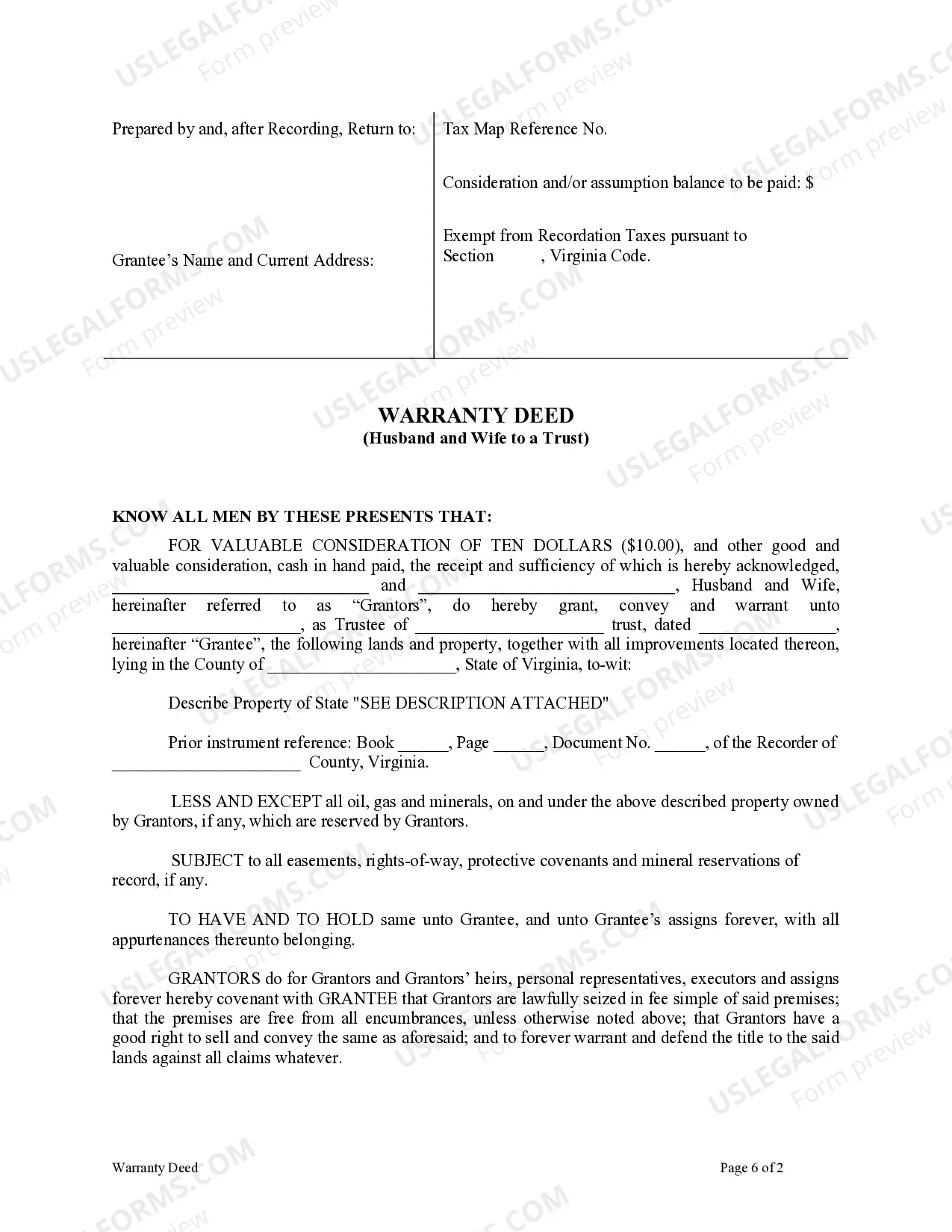
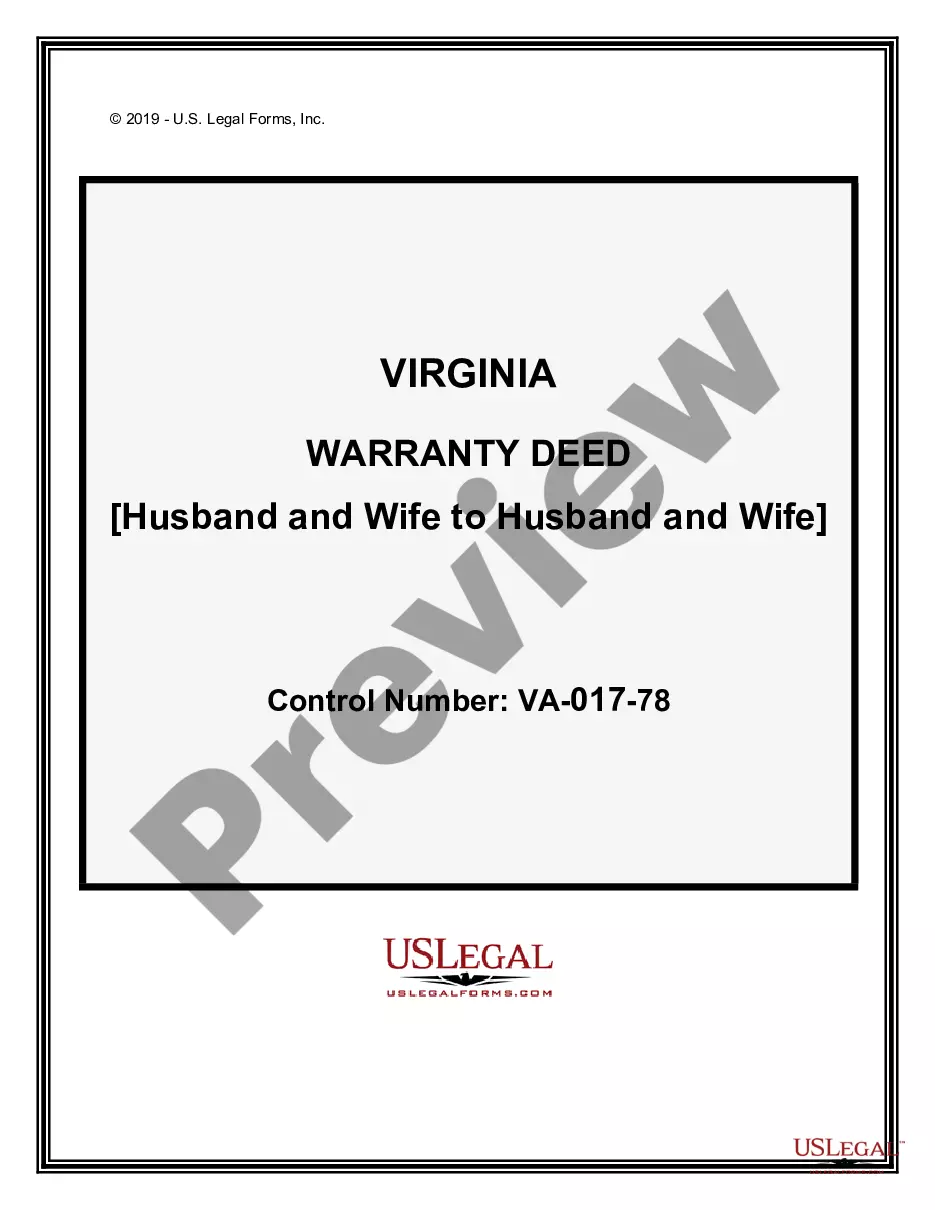
This form is a Warranty Deed from Husband and Wife to a Trust. It allows married owners to convey property ownership to a trust while ensuring that the grantors retain certain rights, such as oil, gas, and mineral rights, unless stated otherwise. This form is distinct from other real estate transfer documents because it specifically addresses the transfer of property into a trust, providing both legal protection and clear definition of ownership rights.
Form components explained
- Identification of grantors (husband and wife) and the grantee (the trust).
- Description of the property being conveyed, including any exceptions to the transfer.
- Warranties against encumbrances to assure the grantee of clear title.
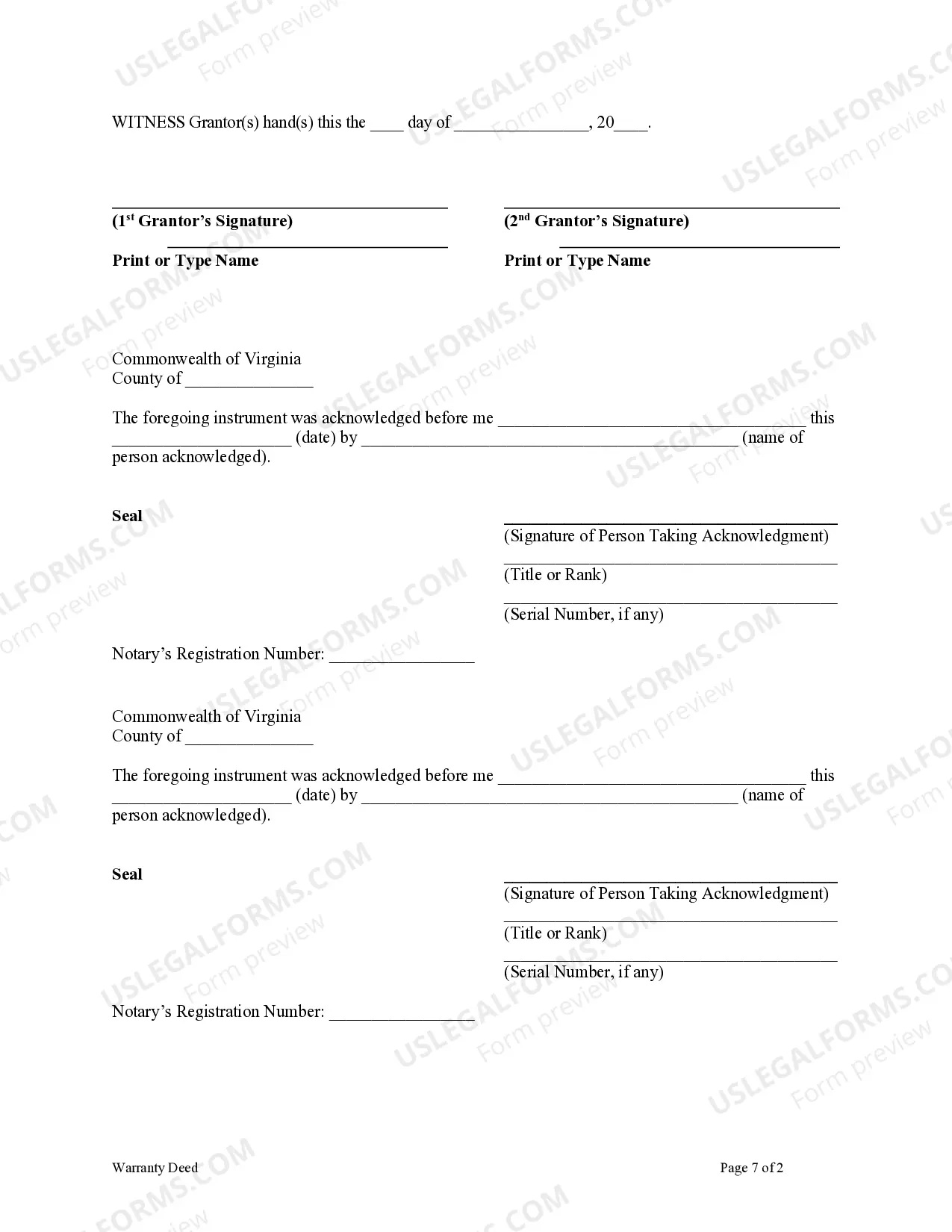
- Signature lines for both grantors to formally execute the deed.
- Sections for recording and reference information.




Common use cases
This form should be used when a married couple wishes to transfer their real property into a trust. This could be for estate planning purposes, to manage assets more efficiently, or to help avoid probate. It is essential when both spouses want to maintain control of the property while designating a trustee for management and oversight.
Intended users of this form
- Married couples who own real property and want to put it into a trust.
- Couples looking to simplify estate planning and management of their assets.
- Individuals seeking to retain rights while transferring ownership to a trust.
Steps to complete this form
- Identify the parties involved: enter the full names of both the husband and wife as grantors, along with the name of the trust as the grantee.
- Describe the property: provide a clear description of the property being transferred, including any exemptions or reservations.
- Enter the date: include the date on which the deed is executed.
- Sign the deed: both grantors need to sign the document for it to be valid.
- Record the deed: file the executed deed with the local county recorder's office to complete the transfer of ownership.
Notarization guidance
This form does not typically require notarization unless specified by local law. However, having the deed notarized can add an extra layer of legal protection and help facilitate recordation.
Get your form ready online
Our built-in tools help you complete, sign, share, and store your documents in one place.
Make edits, fill in missing information, and update formatting in US Legal Forms—just like you would in MS Word.
Download a copy, print it, send it by email, or mail it via USPS—whatever works best for your next step.
Sign and collect signatures with our SignNow integration. Send to multiple recipients, set reminders, and more. Go Premium to unlock E-Sign.
If this form requires notarization, complete it online through a secure video call—no need to meet a notary in person or wait for an appointment.
We protect your documents and personal data by following strict security and privacy standards.

Make edits, fill in missing information, and update formatting in US Legal Forms—just like you would in MS Word.

Download a copy, print it, send it by email, or mail it via USPS—whatever works best for your next step.

Sign and collect signatures with our SignNow integration. Send to multiple recipients, set reminders, and more. Go Premium to unlock E-Sign.

If this form requires notarization, complete it online through a secure video call—no need to meet a notary in person or wait for an appointment.

We protect your documents and personal data by following strict security and privacy standards.
Common mistakes to avoid
- Failing to include a clear legal description of the property being conveyed.
- Not signing the deed, making it invalid.
- Ignoring local recording requirements, which can hinder the legal transfer process.
- Missing to specify any exceptions to mineral rights or other property rights being retained.
Why use this form online
- Convenient access at any time to download and complete the form.
- Editability allows for updates without needing to start over.
- Ensures compliance with legal standards based on provided state laws.
Key takeaways
- The Warranty Deed from Husband and Wife to a Trust is essential for transferring property ownership to a trust.
- It includes important legal assurances about the propertyâs title.
- Proper execution and recording of the deed are critical for legal validity and enforcement.
Looking for another form?

Form popularity
FAQ
The advantages of placing your house in a trust include avoiding probate court, saving on estate taxes and possibly protecting your home from certain creditors. Disadvantages include the cost of creating the trust and the paperwork.
Determine the Current Title and Vesting to Your Property. Prepare a Deed. Be Aware of Your Lender and Title Insurance. Prepare a Preliminary Change of Ownership Report. Execute Your Deed. Record Your Deed. Wait for the Deed to be Returned. Keep the Property in the Trust.
Locate your current deed. Use the proper deed. Check with your title insurance company and lender. Prepare a new deed. Sign in the presence of a notary. Record the deed in the county clerk's office. Locate the deed that's in trust. Use the proper deed.
A trust will spare your loved ones from the probate process when you pass away. Putting your house in a trust will save your children or spouse from the hefty fee of probate costs, which can be up to 3% of your asset's value.Any high-dollar assets you own should be added to a trust, including: Patents and copyrights.
Some states have laws governing who may or may not serve as a trustee in a deed of trust. Generally, the trustee must be an attorney, title insurance company, trust company, bank, savings and loan, credit union, or other company specifically authorized by law to serve as a trustee.
A. No person may be named or act, in person or by agent or attorney, as the trustee of a deed of trust conveying property to secure the payment of money or the performance of an obligation, either individually or as one of several trustees, unless such person is a resident of the Commonwealth.
How To Establish A Trust. You will need to retain an estate attorney to draft and execute your trust document. For a simple revocable or irrevocable trust, it may cost anywhere from $2,000 $5,000.
Yes, a quit claim deed supercedes the trust. The only thing that can be done is to file a suit in court challenging the deed as the product of fraud and undue influence. A court action like that will cost thousands of dollars, but might be worth it if the house was owned free and clear.
In the context of a California mortgage transaction, a trust deed also transfer ownership. Only this time, the title is being placed in the hands of a third-party trustee, who holds the property on behalf of the lender and the homeowner-borrower until the mortgage is paid.