Utah Warning of Default on Residential Lease
Overview of this form
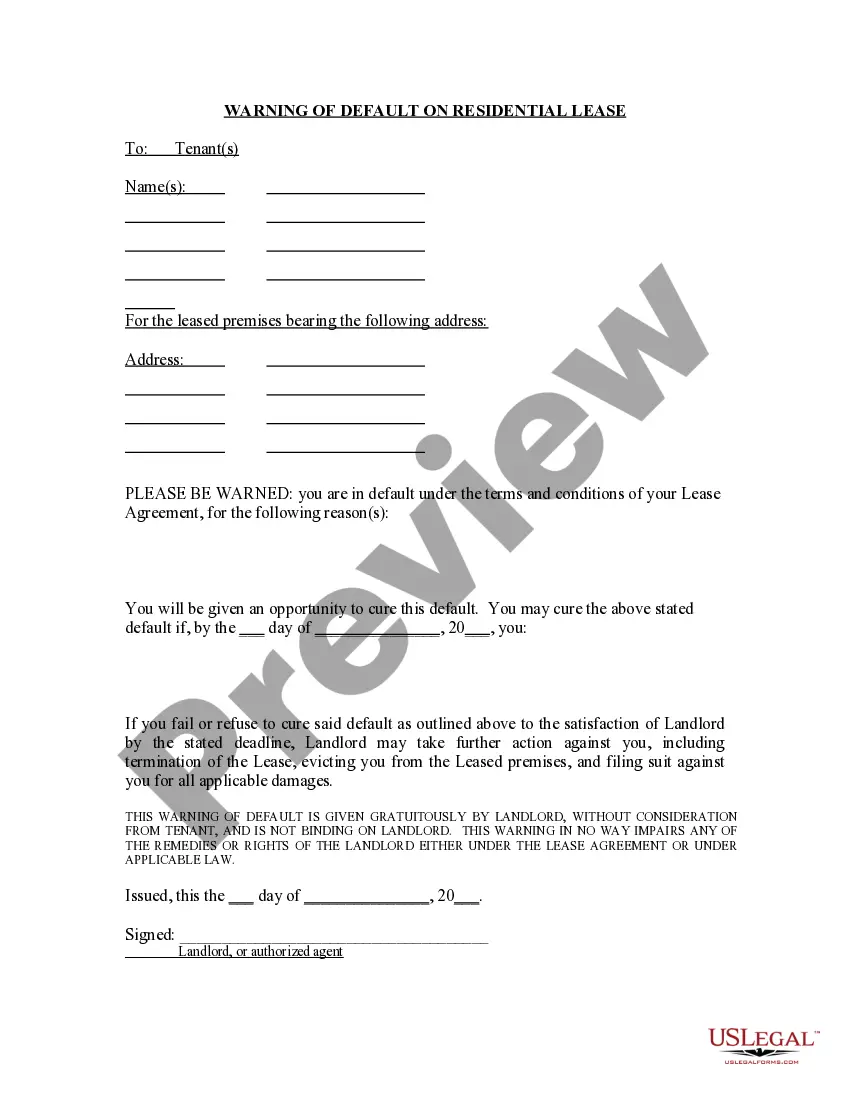
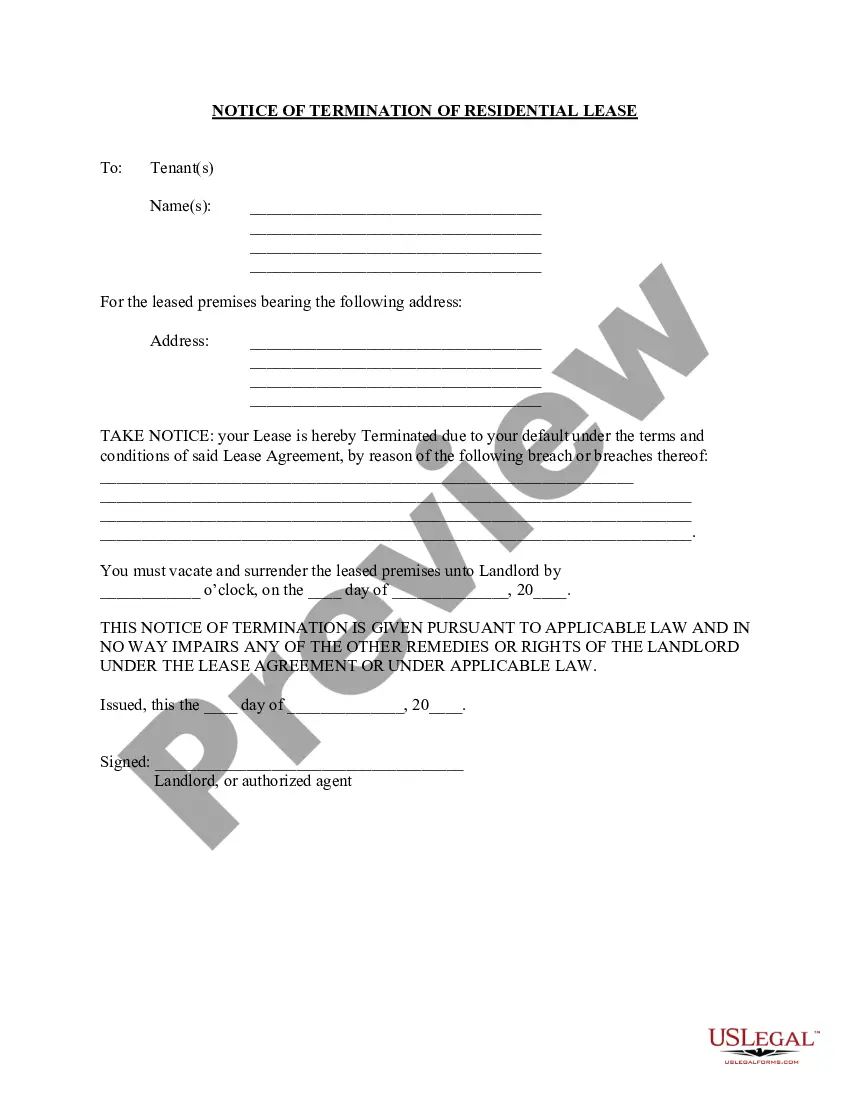
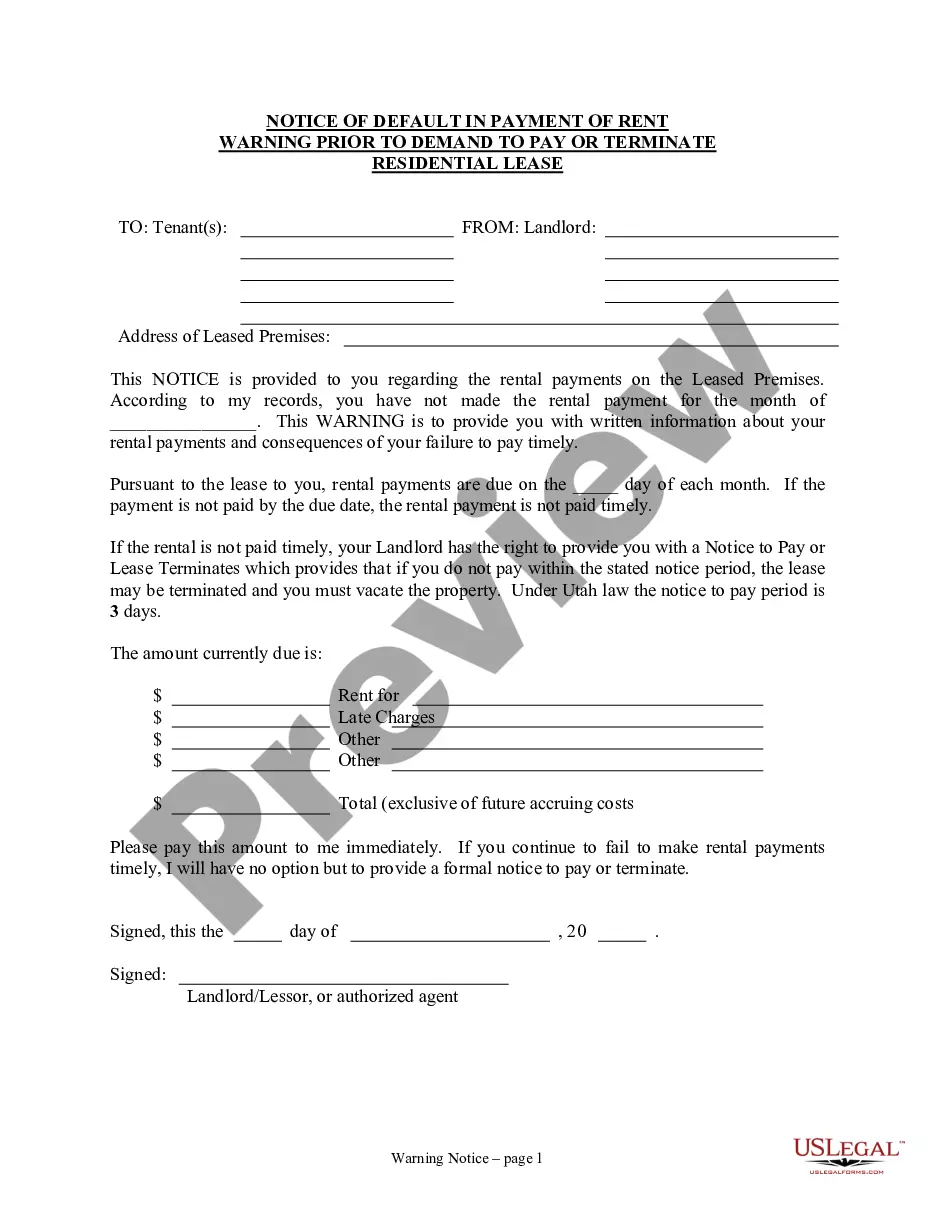
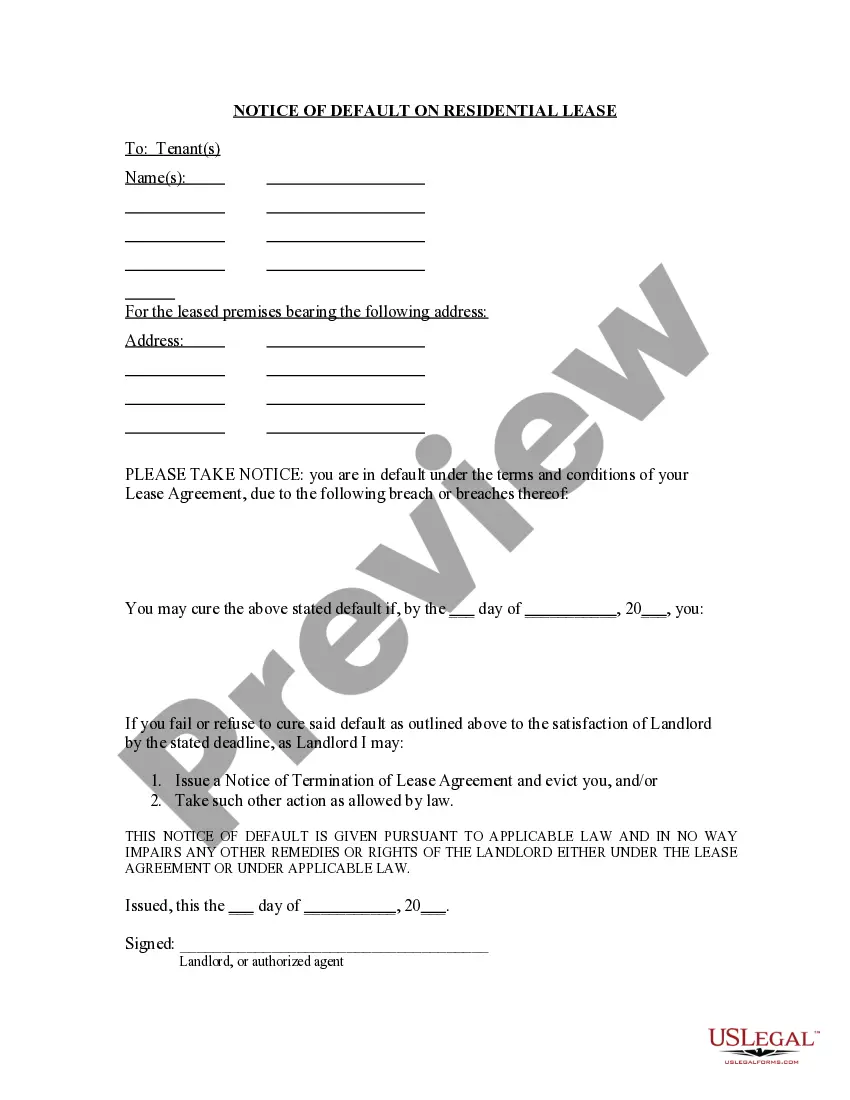
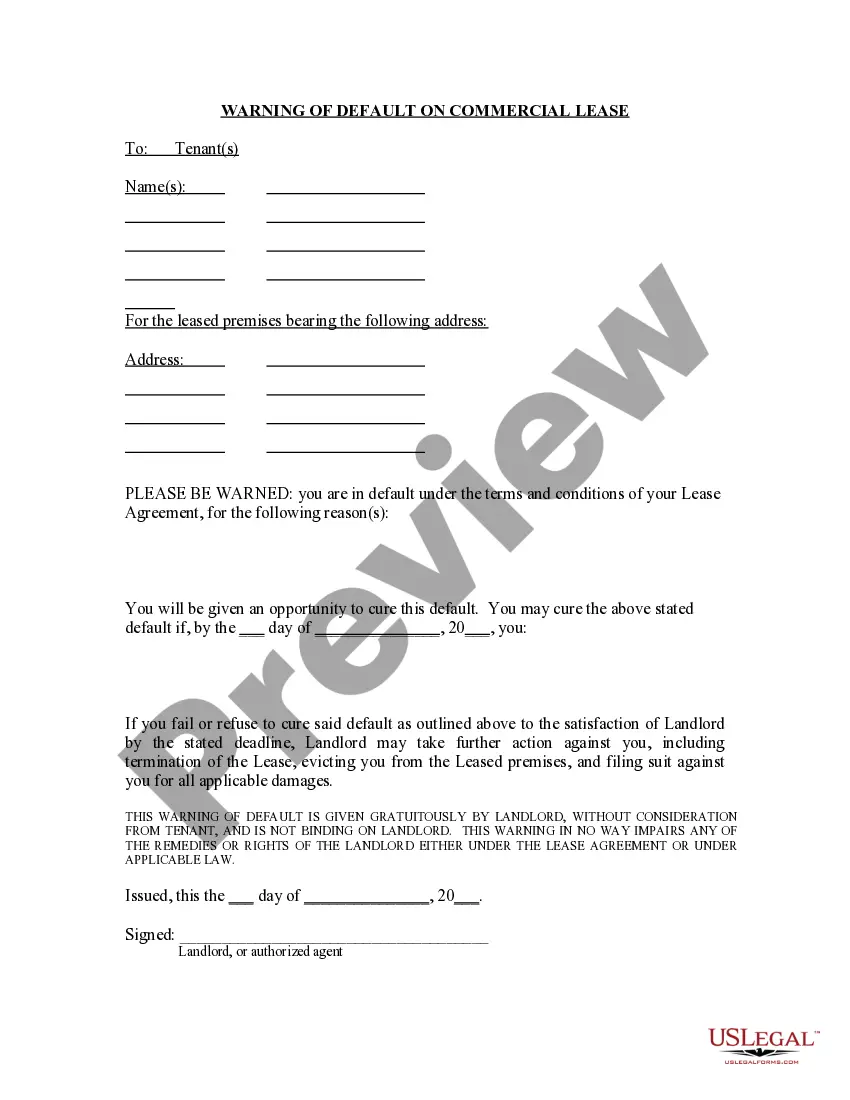
The Warning of Default on Residential Lease is a legal document that serves as a notice from a landlord to a tenant. It expresses the landlord's concern regarding the tenant's potential default under the lease agreement if specific conditions are not addressed. This form helps protect the landlord's rights while ensuring the tenant is aware of any issues that need attention. It is specifically designed for use in residential lease situations, differentiating it from other types of notices or forms that may pertain to different legal contexts.
Key components of this form
- Date of issuance
- Landlord's signature
- Notice of default terms and conditions
- Statement of non-binding nature of the warning
- Identification of the tenant
When this form is needed
This form should be used when a landlord wishes to notify a tenant of a potential default under their lease agreement. Common scenarios for issuing this warning include non-payment of rent, violations of lease terms, or failure to maintain the property as agreed. It serves to formally document the issue and provide the tenant with an opportunity to rectify the situation before further legal action may be necessary.
Who should use this form
- Residential landlords concerned about tenant defaults
- Property managers responsible for rental agreements
- Tenants wishing to understand their rights and obligations
- Legal professionals advising landlords or tenants
How to complete this form
- Enter the date of issuance at the top of the form.
- Clearly identify the tenant by name and lease specifics.
- Detail the specific conditions that are leading to the warning of default.
- Have the landlord or authorized agent sign the document.
- Deliver the completed warning letter to the tenant in accordance with local laws.
Notarization guidance
Notarization is not commonly needed for this form. However, certain documents or local rules may make it necessary. Our notarization service, powered by Notarize, allows you to finalize it securely online anytime, day or night.
Get your form ready online
Our built-in tools help you complete, sign, share, and store your documents in one place.
Make edits, fill in missing information, and update formatting in US Legal Forms—just like you would in MS Word.
Download a copy, print it, send it by email, or mail it via USPS—whatever works best for your next step.
Sign and collect signatures with our SignNow integration. Send to multiple recipients, set reminders, and more. Go Premium to unlock E-Sign.
If this form requires notarization, complete it online through a secure video call—no need to meet a notary in person or wait for an appointment.
We protect your documents and personal data by following strict security and privacy standards.

Make edits, fill in missing information, and update formatting in US Legal Forms—just like you would in MS Word.

Download a copy, print it, send it by email, or mail it via USPS—whatever works best for your next step.

Sign and collect signatures with our SignNow integration. Send to multiple recipients, set reminders, and more. Go Premium to unlock E-Sign.

If this form requires notarization, complete it online through a secure video call—no need to meet a notary in person or wait for an appointment.

We protect your documents and personal data by following strict security and privacy standards.
Common mistakes
- Failing to include specific details of the alleged lease violations.
- Not providing adequate time for the tenant to remedy the situation.
- Inaccurately identifying the tenant or property.
- Neglecting to sign the document, which can render it invalid.
Benefits of using this form online
- Convenient access to legally vetted templates at any time.
- Easy editability to customize based on specific situations.
- Reliable format that complies with legal standards.
- Quick download for immediate use and implementation.
Legal use & context
- This form is used in the context of residential lease agreements.
- It serves as a preliminary step before pursuing further legal action for eviction or breach of contract.
- Inclusion of this warning helps protect the landlord's rights and provides documented evidence of the tenant's default.
Quick recap
- The Warning of Default on Residential Lease is a critical tool for landlords to communicate issues with tenants.
- Proper completion and delivery of this form can help prevent escalation to eviction.
- Understanding state-specific requirements is essential for legal compliance.
Looking for another form?
Form popularity
FAQ
In landlord-tenant law, default refers to the failure of a tenant to timely pay rent due.In general, the landlord is required to give the tenant notice of the default before bringing eviction proceedings or applying security deposit proceeds to the payment in default.
Step 1: Speak to your tenant. Step 2: Provide notice of contract breach. Step 3: Decide between an interdict or cancellation. Step 4: Eviction process. Step 5: Eviction notice. Final advice.
By the law, Utah tenants are required to abide in a certain way. They must follow certain procedures as outlined by the law as well. Tenants also have certain rights that they are entitled to, as well as things they are responsible for. The tenant has the right to dwell in a safe and sanitary housing unit.
A landlord can't force you to move out before the lease ends, unless you fail to pay the rent or violate another significant term, such as repeatedly throwing large and noisy parties. In these cases, landlords in Utah must follow specific procedures to end the tenancy.
Paying the rent - One way or another, if you walk away from your lease and no one else rents the apartment then you will owe the landlord this money.Your landlord will typically collect this rent at the expiration of your lease.
Tenant default occurs when a Tenant breaches one of the tenant's covenants in its lease. Tenant default can arise in a number of different ways but will typically be for one of the following: Non-payment of rent or other sums reserved under the lease.
Although renters must abide by the Homeowners' Association rules, they still have rights under the law. The property owner must also follow their home state's Landlord-Tenant Laws that include the Fair Housing Act and Fair Credit Reporting Act.
Default by landlord The most common form of landlord default is failure to provide services and maintain the property condition. When a landlord defaults on the terms of the lease, tenants may sue for damages.
Protect your rental income. Even the most reliable tenants sometimes struggle to pay their rent.Tenant default insurance from Simply Business provides vital back-up for landlords it can cover your rental income if your tenant fails to pay rent.