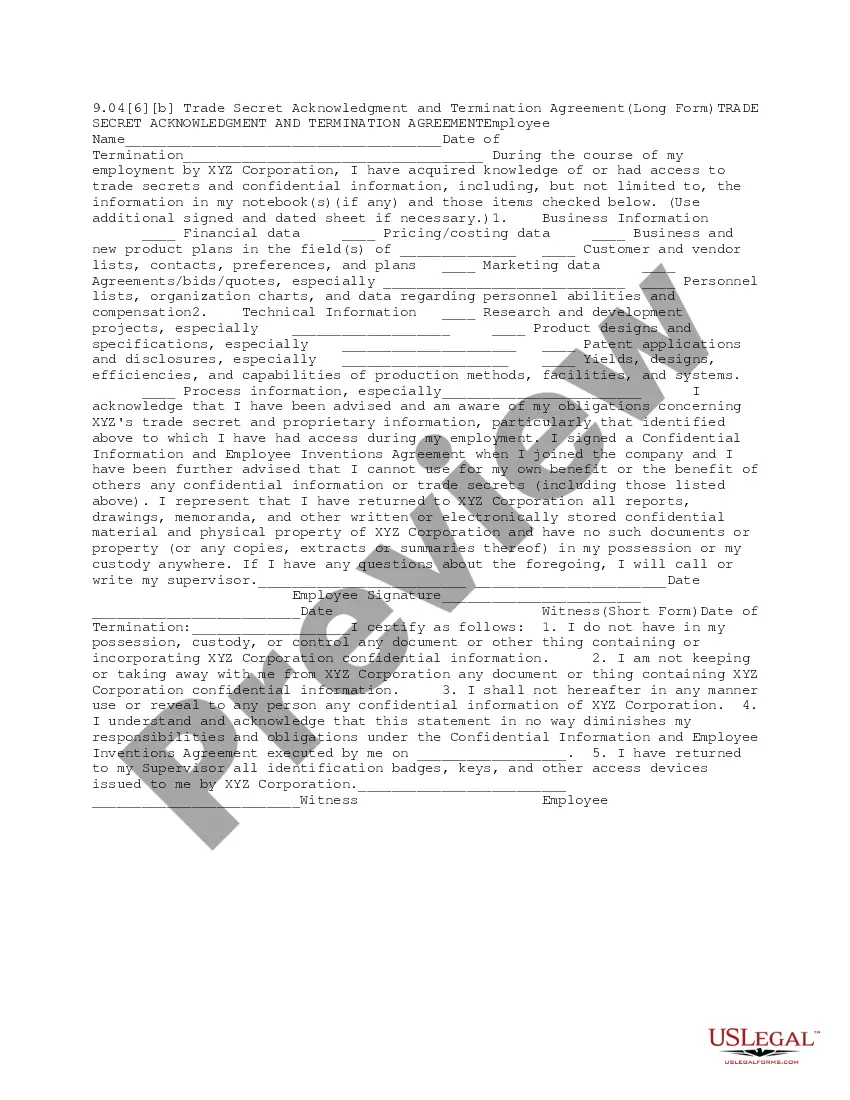
Trade Secret Acknowledgment and Termination Agreement
What is this form?
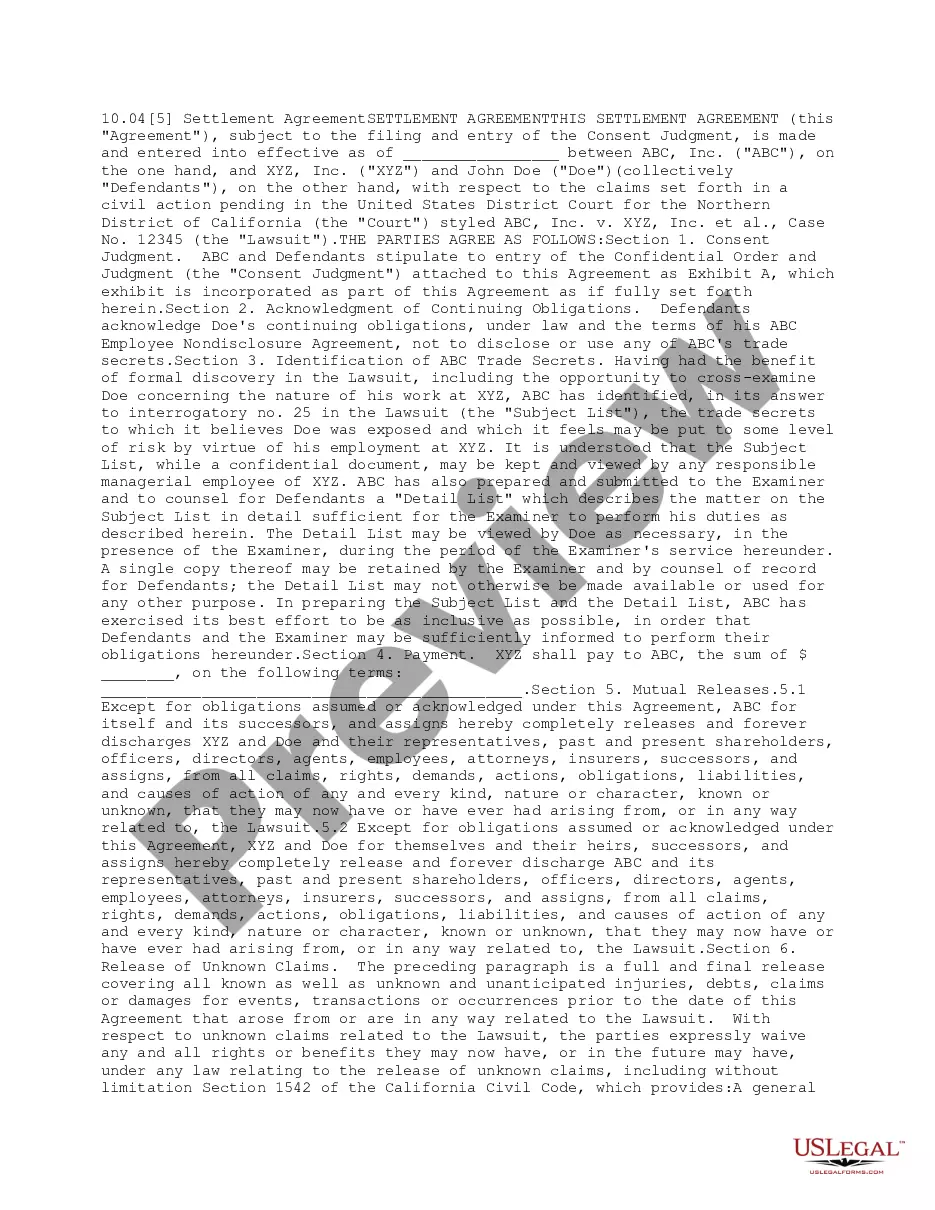
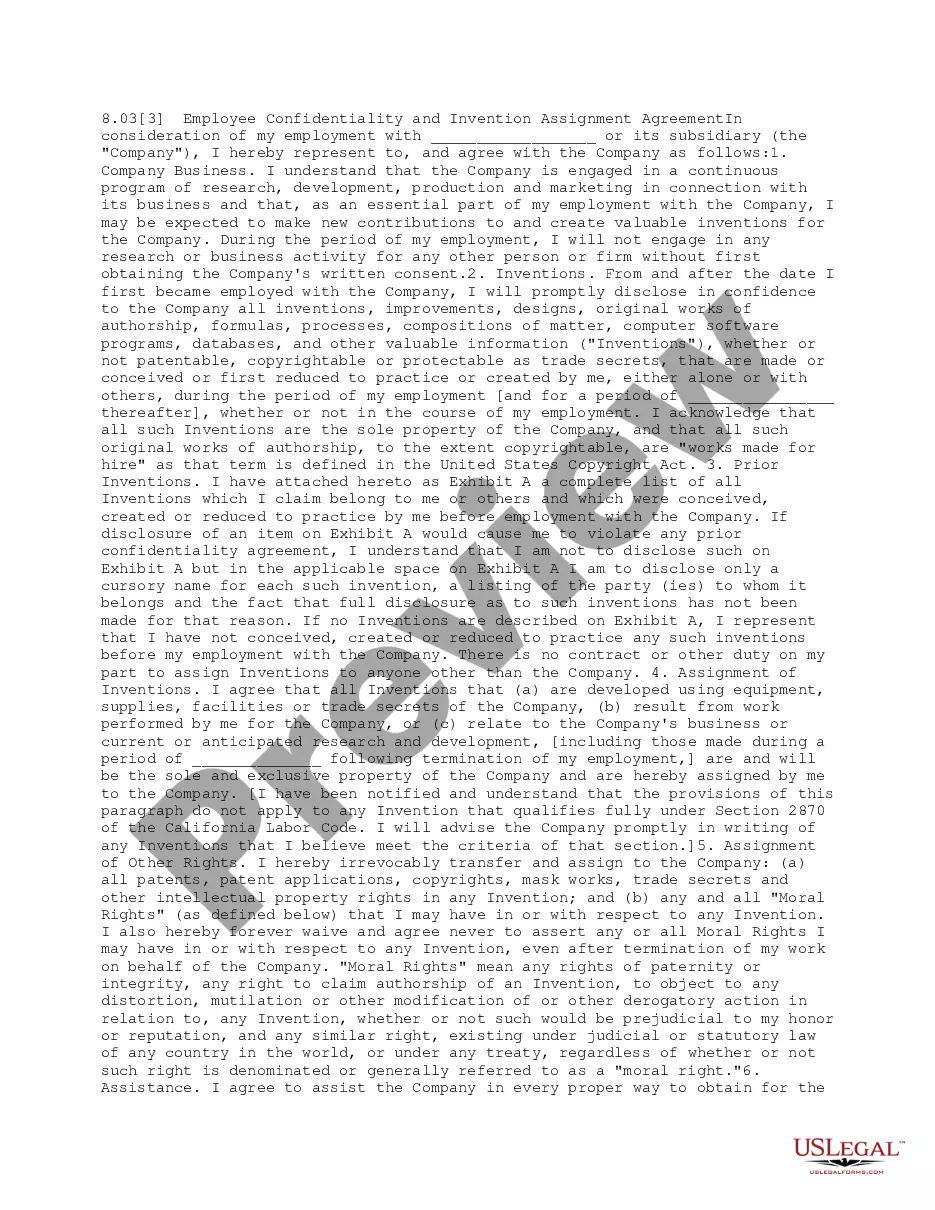
The Trade Secret Acknowledgment and Termination Agreement is a crucial document signed by an exiting employee. It confirms the employee's acknowledgment of access to the company's confidential and proprietary trade secrets during their employment. This agreement outlines the employee's ongoing obligations to protect sensitive information even after leaving the company, ensuring that trade secrets remain secure.
Form components explained
- Employee details including name and date of termination.
- Identification of specific trade secrets and confidential information accessed during employment.
- Acknowledgment of employee's obligations regarding the use and disclosure of trade secrets.
- Certification of the return of all confidential materials and property belonging to the company.
- Signature lines for both the employee and a witness, confirming the agreement.
When to use this document
This form should be used when an employee is leaving a company, regardless of the reason. It is essential for protecting the company's sensitive information, ensuring that exiting employees are aware of their responsibilities to maintain confidentiality about trade secrets after their departure.
Intended users of this form
- Employers who need to safeguard their trade secrets when an employee resigns or is terminated.
- Employees who want to formally acknowledge their knowledge of proprietary information and their ongoing obligations regarding it.
- Companies across various industries that utilize proprietary information for competitive advantage.
How to complete this form
- Enter the employee's name and date of termination at the top of the form.
- Identify the specific trade secrets and confidential information accessed during employment by checking the appropriate boxes.
- Read and acknowledge your ongoing obligations regarding the use of this information.
- Sign and date the agreement, and have a witness sign as well.
- Return all company property and confidential materials to the supervisor before the termination date.
Notarization requirements for this form
In most cases, this form does not require notarization. However, some jurisdictions or signing circumstances might. US Legal Forms offers online notarization powered by Notarize, accessible 24/7 for a quick, remote process.
Get your form ready online
Our built-in tools help you complete, sign, share, and store your documents in one place.
Make edits, fill in missing information, and update formatting in US Legal Forms—just like you would in MS Word.
Download a copy, print it, send it by email, or mail it via USPS—whatever works best for your next step.
Sign and collect signatures with our SignNow integration. Send to multiple recipients, set reminders, and more. Go Premium to unlock E-Sign.
If this form requires notarization, complete it online through a secure video call—no need to meet a notary in person or wait for an appointment.
We protect your documents and personal data by following strict security and privacy standards.

Make edits, fill in missing information, and update formatting in US Legal Forms—just like you would in MS Word.

Download a copy, print it, send it by email, or mail it via USPS—whatever works best for your next step.

Sign and collect signatures with our SignNow integration. Send to multiple recipients, set reminders, and more. Go Premium to unlock E-Sign.

If this form requires notarization, complete it online through a secure video call—no need to meet a notary in person or wait for an appointment.

We protect your documents and personal data by following strict security and privacy standards.
Common mistakes to avoid
- Failing to accurately list all trade secrets accessed during employment.
- Neglecting to return all company property before signing the agreement.
- Not having the form witnessed, which could render it less enforceable.
- Overlooking the need to keep a copy of the signed agreement for personal records.
Benefits of completing this form online
- Immediate access allows for quick completion and processing.
- Editability ensures that users can customize the form to fit specific circumstances.
- Reliability of legally vetted templates drafted by licensed attorneys.
- Easy download for filing or record-keeping as needed.
Legal use & context
- This agreement is legally binding and enforceable in court, provided both parties sign it.
- Failure to adhere to the obligations outlined can result in legal consequences for the employee.
- Employers can use this form to protect their trade secrets from potential exploitation by former employees.
Looking for another form?
Form popularity
FAQ
An invention assignment agreement is a contract that gives the employer certain rights to inventions created or conceptualized by the employee during the employment relationship.
Your company's trade secrets in paper or electronic format should be accompanied by a confidentiality notice. Each page should be stamped Confidential. The notice should notify all parties that the document includes trade secrets and that access to the information is limited by your business.
The non-disclosure agreement sometimes shortened as NDA is also known as a trade secret agreement or a confidentiality agreement. An NDA is a legally binding contract between parties that requires them to keep certain information confidential.
PIIA is the acronym for the most common name for these agreements, ''proprietary information and invention assignment'' agreements.The agreement also requires that the employee agree that whatever the employee creates, discovers, develops or invents while employed with the company is owned by the company.
Also known as Proprietary Information and Inventions Assignment Agreements (or PIIAAs), Confidential Information and Inventions Assignment Agreements ensure that intellectual property and other proprietary rights created by employees during the course of their employment are assigned to the employer.
Trade secrets are intellectual property (IP) rights on confidential information which may be sold or licensed. In general, to qualify as a trade secret, the information must be: commercially valuable because it is secret, be known only to a limited group of persons, and.
A confidentiality agreement is a written legal contract between an employer and an employee. The confidentiality agreement lays out binding terms and conditions that prohibit the employee from disclosing company confidential and proprietary information.
To be legally considered a trade secret in the United States, a company must make a reasonable effort in concealing the information from the public; the secret must intrinsically have economic value, and the trade secret must contain information.Unlike a patent, a trade secret is not publicly known.
First, if you're in California, Labor Code § 2870 puts significant limits on what your employer can claim, regardless of the contract. Basically, they can't claim anything you developed before you arrived or anything that's unrelated to their business (unless you used their facilities to develop it).