Brief in Support of Defendant's Responses to Plaintiff's Motion for Summary Judgment on the Issue of Liability
Understanding this form
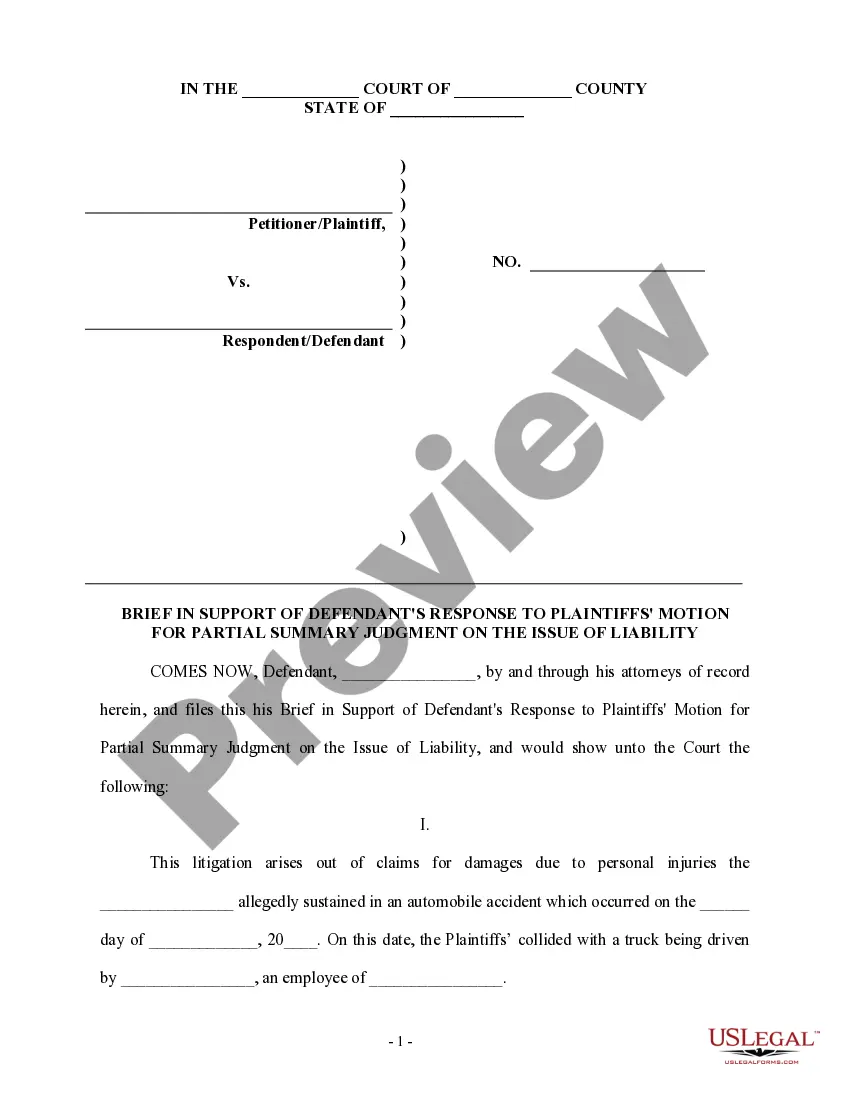
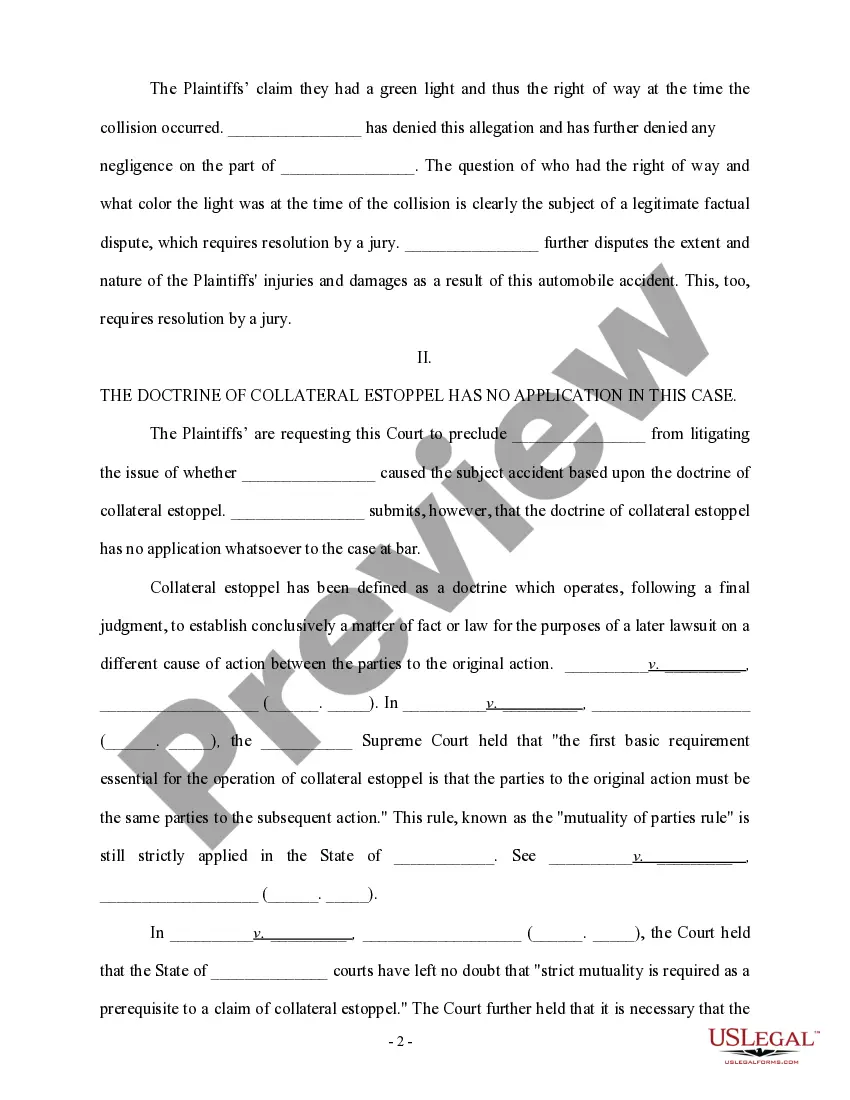
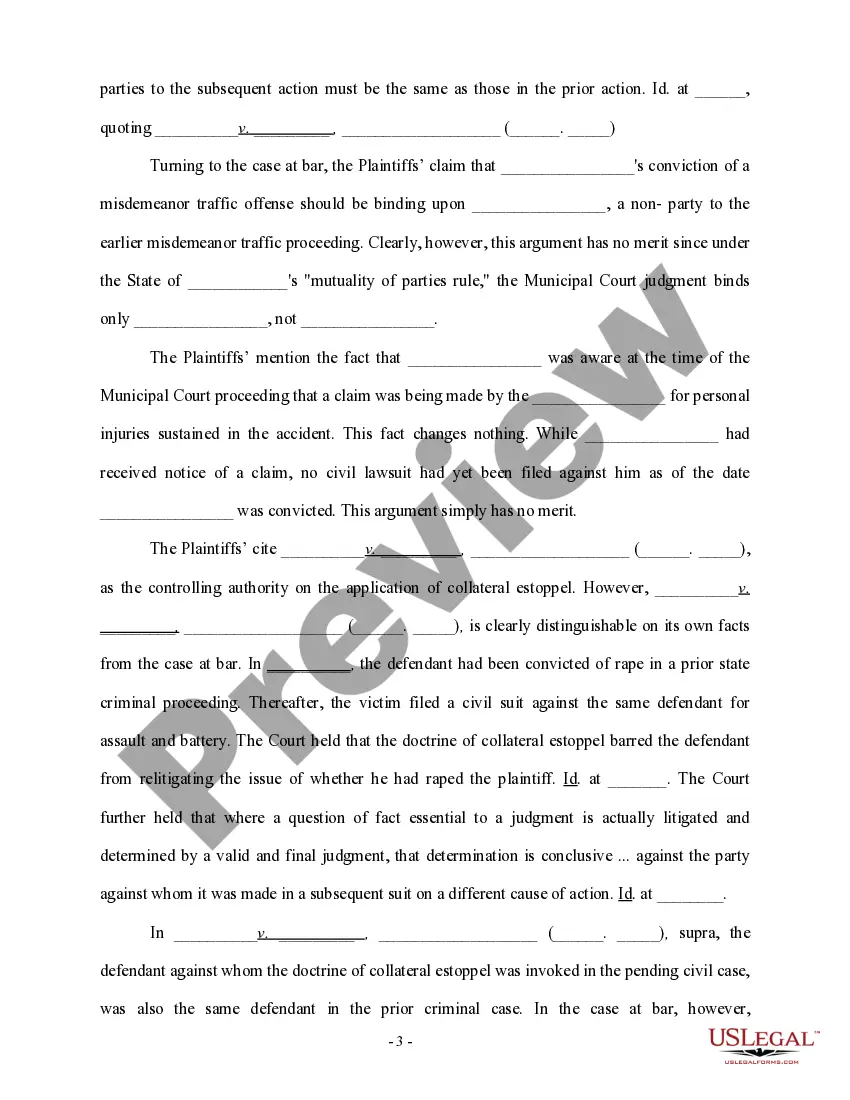
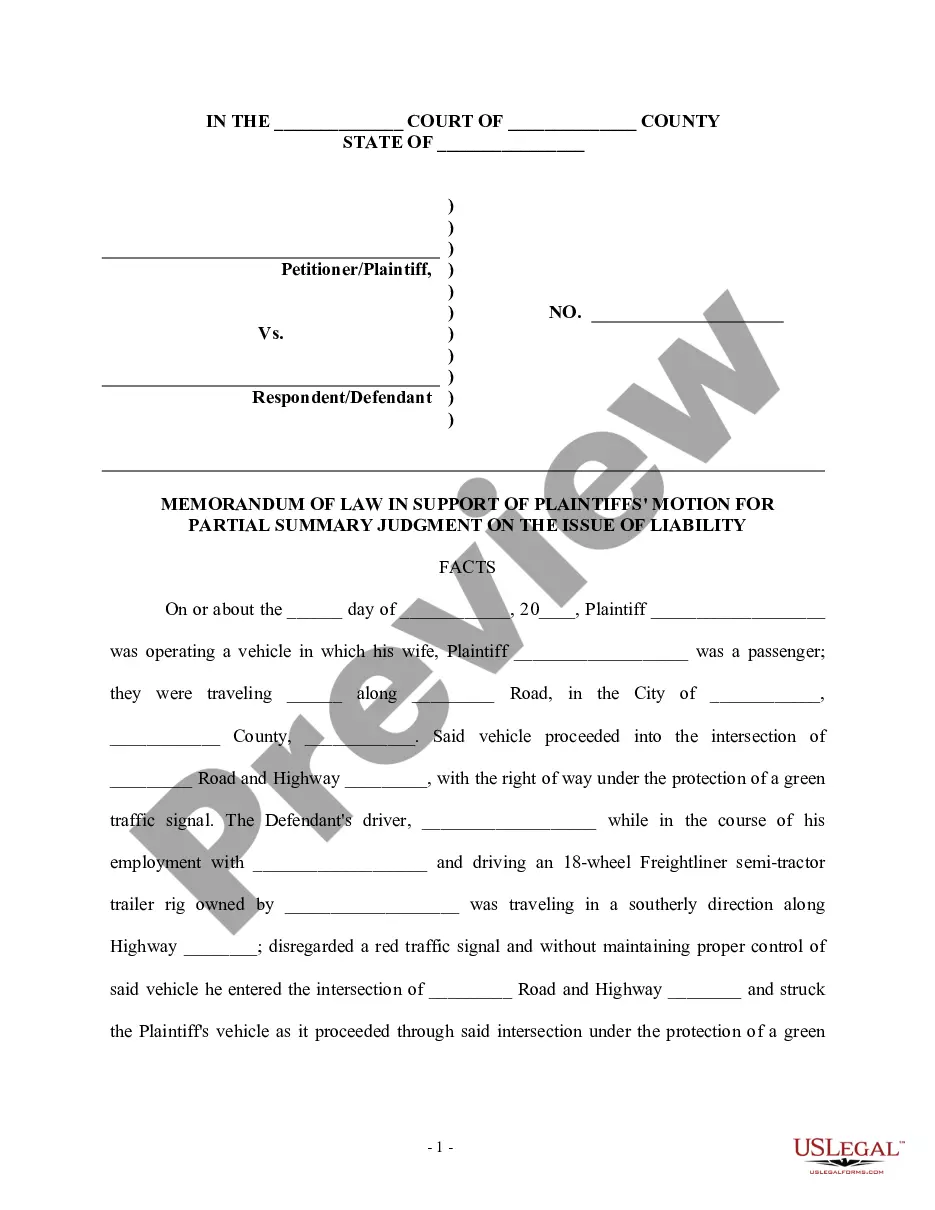
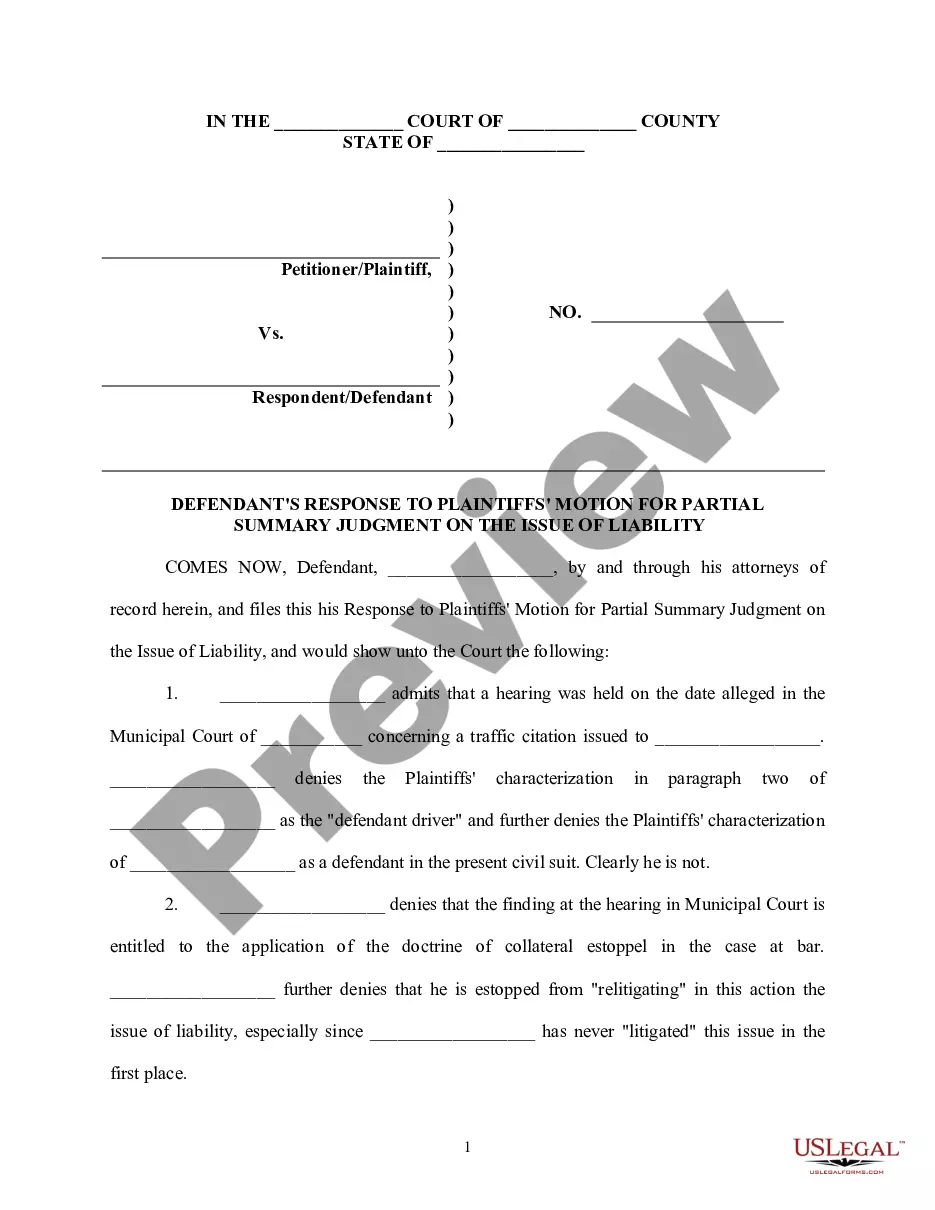
This form is a legal document known as the Brief in Support of Defendant's Responses to Plaintiff's Motion for Summary Judgment on the Issue of Liability. It is submitted by the defendant in response to a plaintiff's motion for summary judgment regarding liability in a civil case following an automobile accident. This form is crucial for outlining the defendant's arguments against the plaintiff's claims and disputing the motion's validity.
What’s included in this form
- Introduction of the case and context surrounding the accident.
- Arguments against the plaintiffâs claim of negligence.
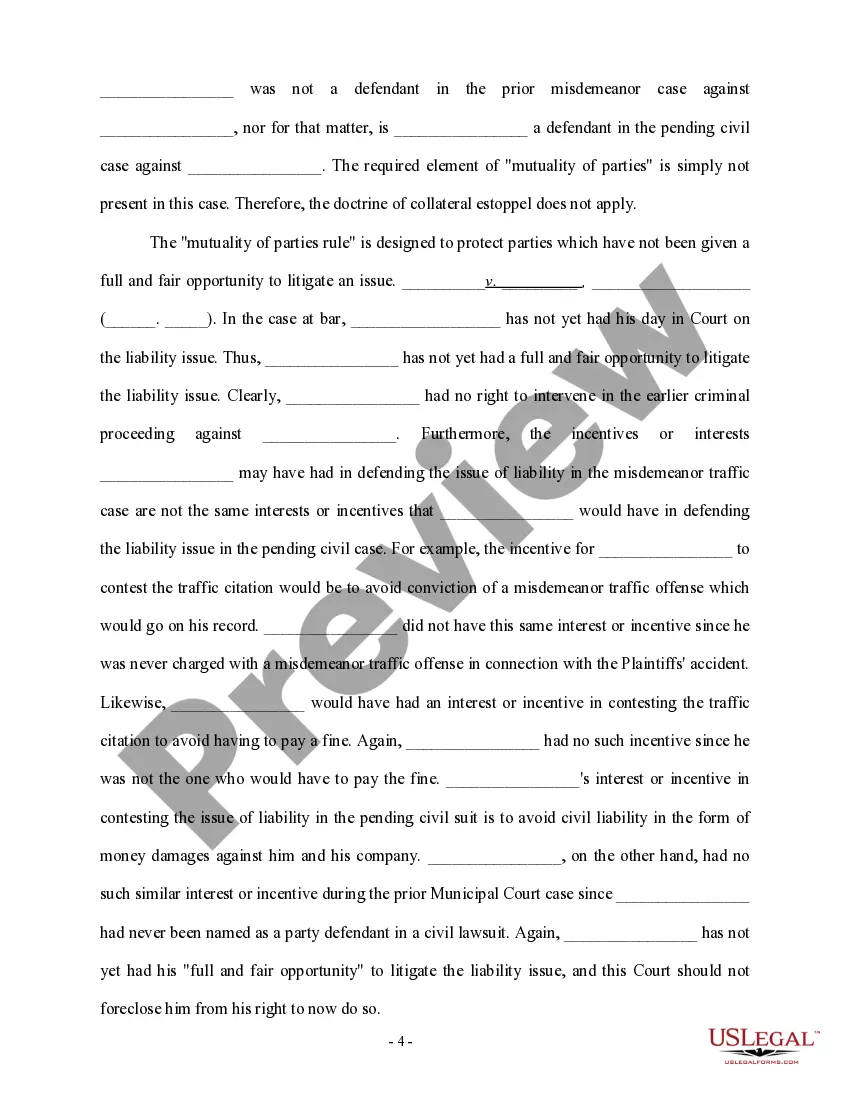
- Discussion of the applicability of the doctrine of collateral estoppel.
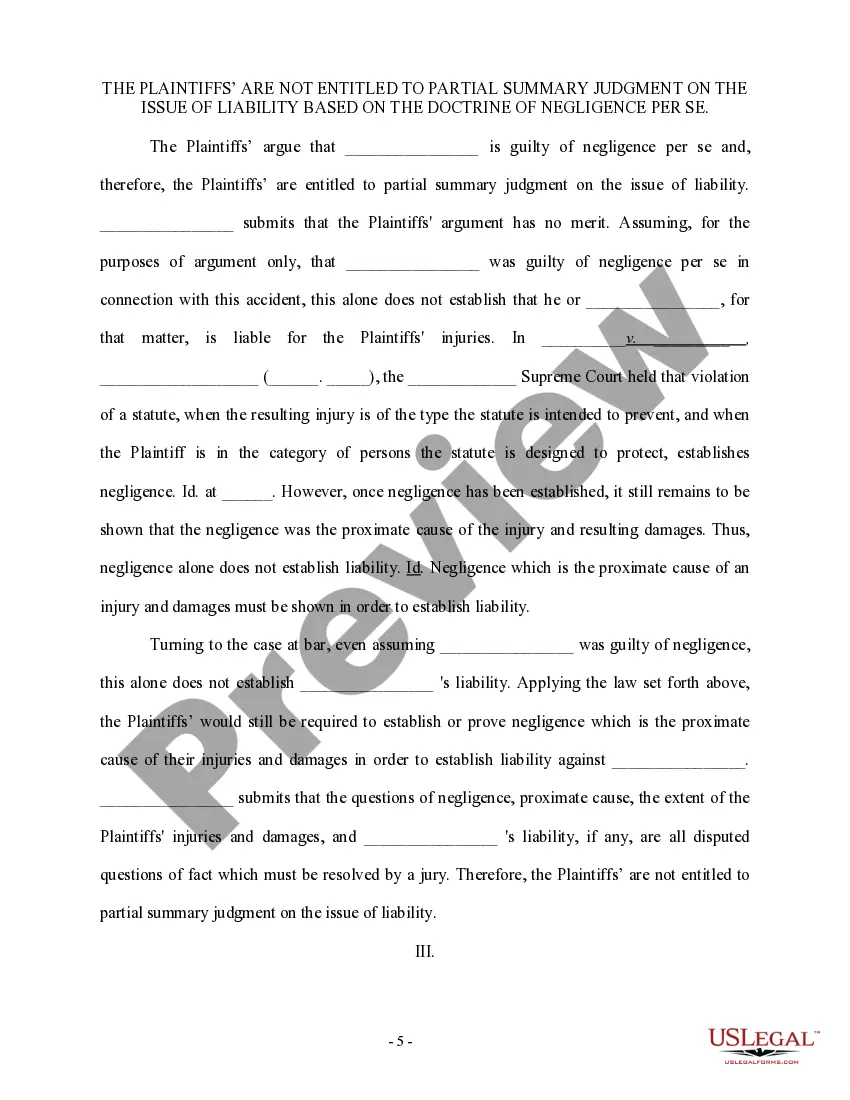
- Claims relating to the defense against negligence per se.
- Conclusion requesting the denial of the plaintiffâs motion for summary judgment.
When to use this form
This form should be used when a defendant is responding to a plaintiff's motion for summary judgment in a civil liability lawsuit, particularly in cases involving personal injury claims from an automobile accident. It is essential when there are disputes regarding negligence and liability that require judicial resolution.
Who needs this form
- Defendants in civil cases regarding automobile accidents.
- Attorneys representing defendants in liability disputes.
- Individuals seeking to formally respond to a motion for summary judgment.
Steps to complete this form
- Identify the parties involved, including the defendant and plaintiff.
- Provide a detailed account of the incident related to the claims.
- Outline the legal arguments against the motion for summary judgment.
- Cite relevant statutes or case law supporting your arguments.
- Sign and date the document to validate your submission.
Notarization requirements for this form
This form does not typically require notarization to be legally valid. However, some jurisdictions or document types may still require it. US Legal Forms provides secure online notarization powered by Notarize, available 24/7 for added convenience.
Get your form ready online
Our built-in tools help you complete, sign, share, and store your documents in one place.
Make edits, fill in missing information, and update formatting in US Legal Forms—just like you would in MS Word.
Download a copy, print it, send it by email, or mail it via USPS—whatever works best for your next step.
Sign and collect signatures with our SignNow integration. Send to multiple recipients, set reminders, and more. Go Premium to unlock E-Sign.
If this form requires notarization, complete it online through a secure video call—no need to meet a notary in person or wait for an appointment.
We protect your documents and personal data by following strict security and privacy standards.

Make edits, fill in missing information, and update formatting in US Legal Forms—just like you would in MS Word.

Download a copy, print it, send it by email, or mail it via USPS—whatever works best for your next step.

Sign and collect signatures with our SignNow integration. Send to multiple recipients, set reminders, and more. Go Premium to unlock E-Sign.

If this form requires notarization, complete it online through a secure video call—no need to meet a notary in person or wait for an appointment.

We protect your documents and personal data by following strict security and privacy standards.
Common mistakes
- Failing to include all relevant facts and evidence supporting the defense.
- Neglecting to cite applicable case law or statutes pertinent to the arguments.
- Submitting the form without proper signatures or dates.
- Relying on outdated legal principles or precedents.
Benefits of completing this form online
- Immediate access to a professionally drafted legal document.
- Edit and customize the form easily to fit specific case details.
- Downloadable format for convenience and record-keeping.
- Reliable content prepared by licensed attorneys.
Legal use & context
- This form is legally valid when completed correctly according to jurisdictional rules.
- It's essential to understand that failure to properly dispute a motion may result in a summary judgment favoring the plaintiff.
- Using this form aids in preserving the defendant's rights during litigation.
Main things to remember
- The Brief in Support of Defendant's Responses is essential in challenging a plaintiff's summary judgment motion.
- Understanding local laws and precedents is critical for effectively using this form.
- Accurate completion and timeliness are vital to preserving legal rights in court.
Looking for another form?






Form popularity
FAQ
Stated different, to successfully defend against summary judgment the non-moving party (you) should seek to demonstrate that indeed there are material facts in dispute. Alternatively, the non-moving party (you) can argue that the undisputed facts support a judgment as a matter of law in your favor.
When it comes to summary judgment, plaintiff lawyers are often guilty of forgetting the fact that either party can file one. If you have solid evidence that can't be disputed, you may very well be able to prove your claim without going to trial.
The key to defeating a motion for summary judgment is to show the court that there are still facts in dispute. Summary judgment is only appropriate if none of the facts are disputed.
If a defendant refuses to produce documents or witnesses for depositions, you can oppose the summary-judgment motion by submitting your declaration and showing that facts essential to justify your opposition may exist but cannot for reasons stated be presented to the court.
A "memorandum of law" or a "memorandum of points and authorities" "briefs" the court, i.e., explains to the court the legal authority, consisting of both decisional and statutory law, which supports the moving party's request.
A response must be in writing and include the same supporting documents as a motion for summary judgment. The opposition to the motion for summary judgment should also include a statement of facts showing the dispute and supporting documents.
Rule 56 of the Federal Rules of Civil Procedure governs summary judgment for federal courts. Under Rule 56, in order to succeed in a motion for summary judgment, a movant must show 1) that there is no genuine dispute as to any material fact, and 2) that the movant is entitled to judgment as a matter of law.