Attorney Fee Letter for Personal Injury - Contingency Retainer
What this document covers
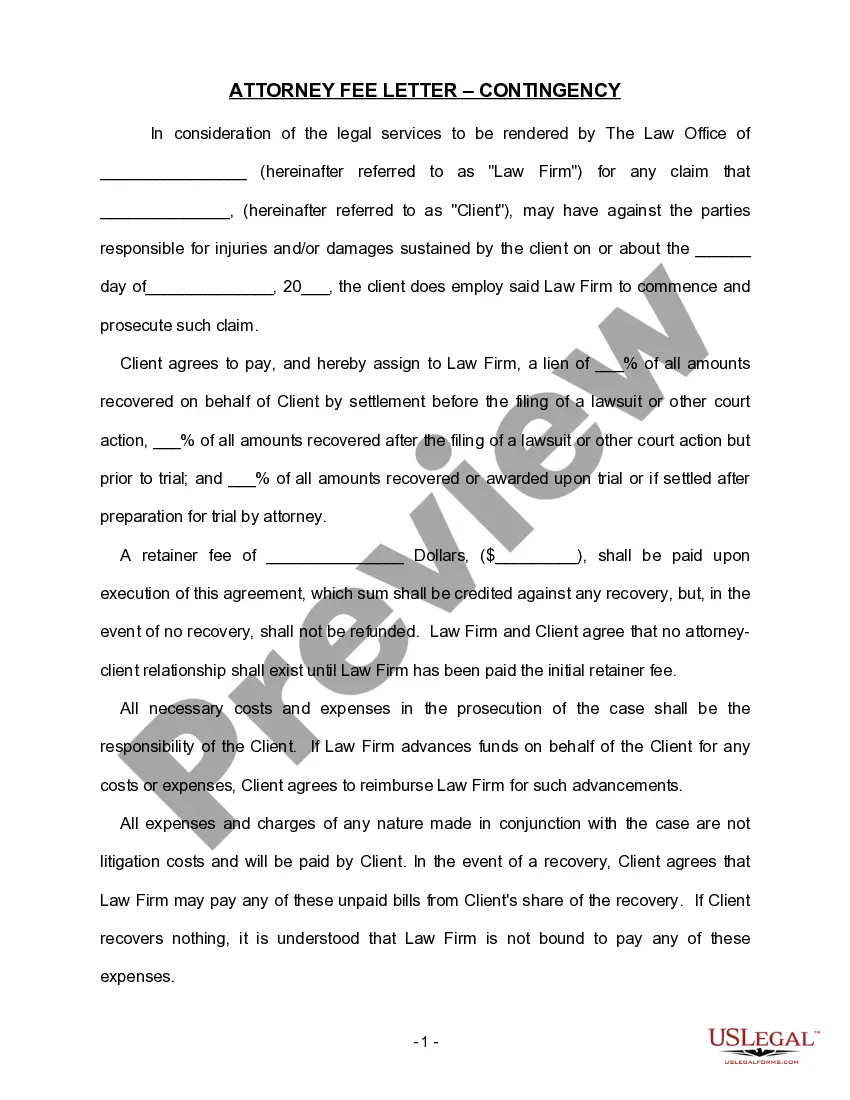
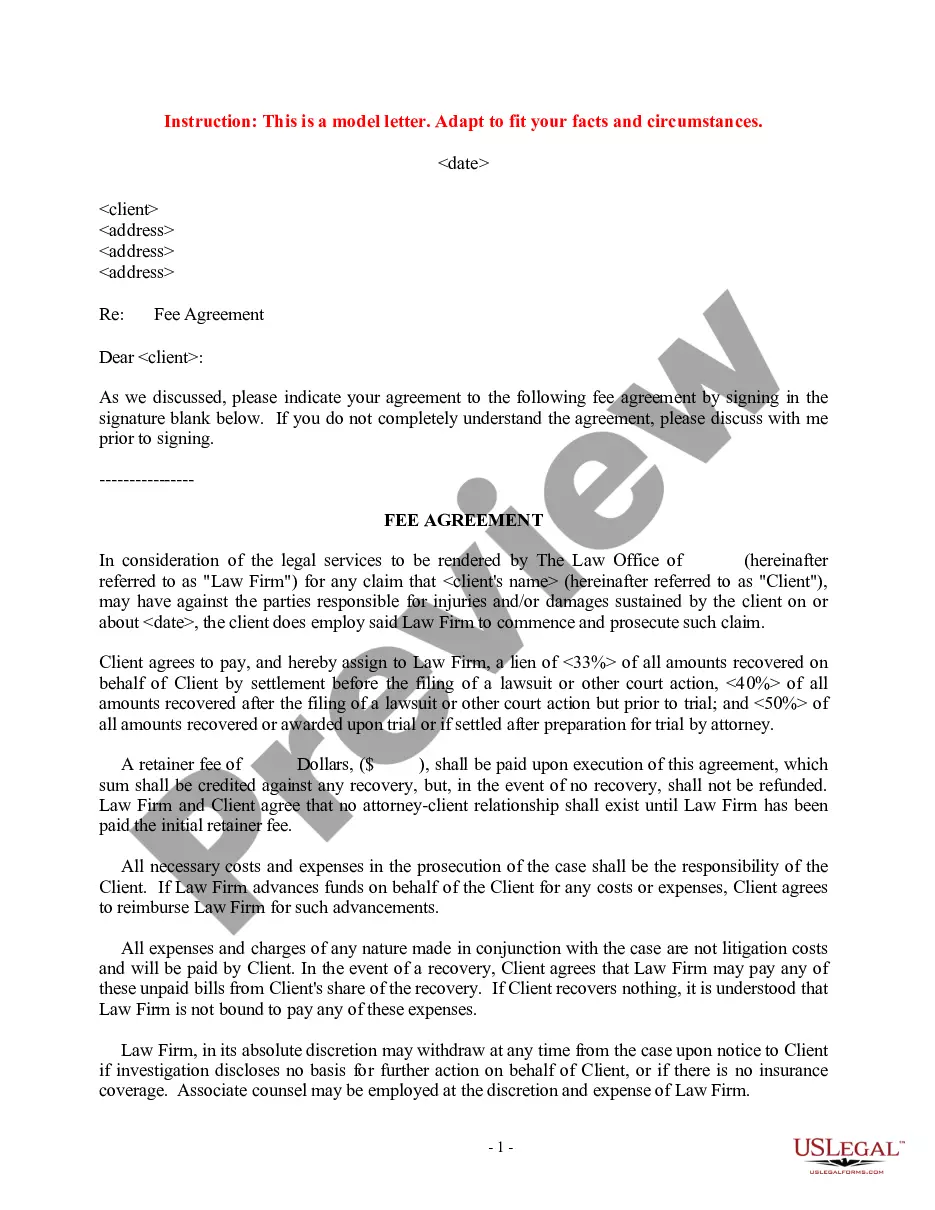
The Attorney Fee Letter for Personal Injury - Contingency Retainer is a legal document that outlines the agreement between a client and a law firm regarding representation in personal injury cases. This form establishes a contingency fee structure, meaning the attorney's payment is based on the successful recovery of damages for the client. It is crucial for establishing the terms of representation and ensuring both parties' expectations are clear, setting it apart from other legal contracts.
Form components explained
- Identification of the law firm and client.
- Details on the contingency fee structure, including percentages for different recovery stages.
- A retainer fee amount and conditions under which it will be credited or refunded.
- Client responsibilities regarding costs, expenses, and cooperation with the law firm.
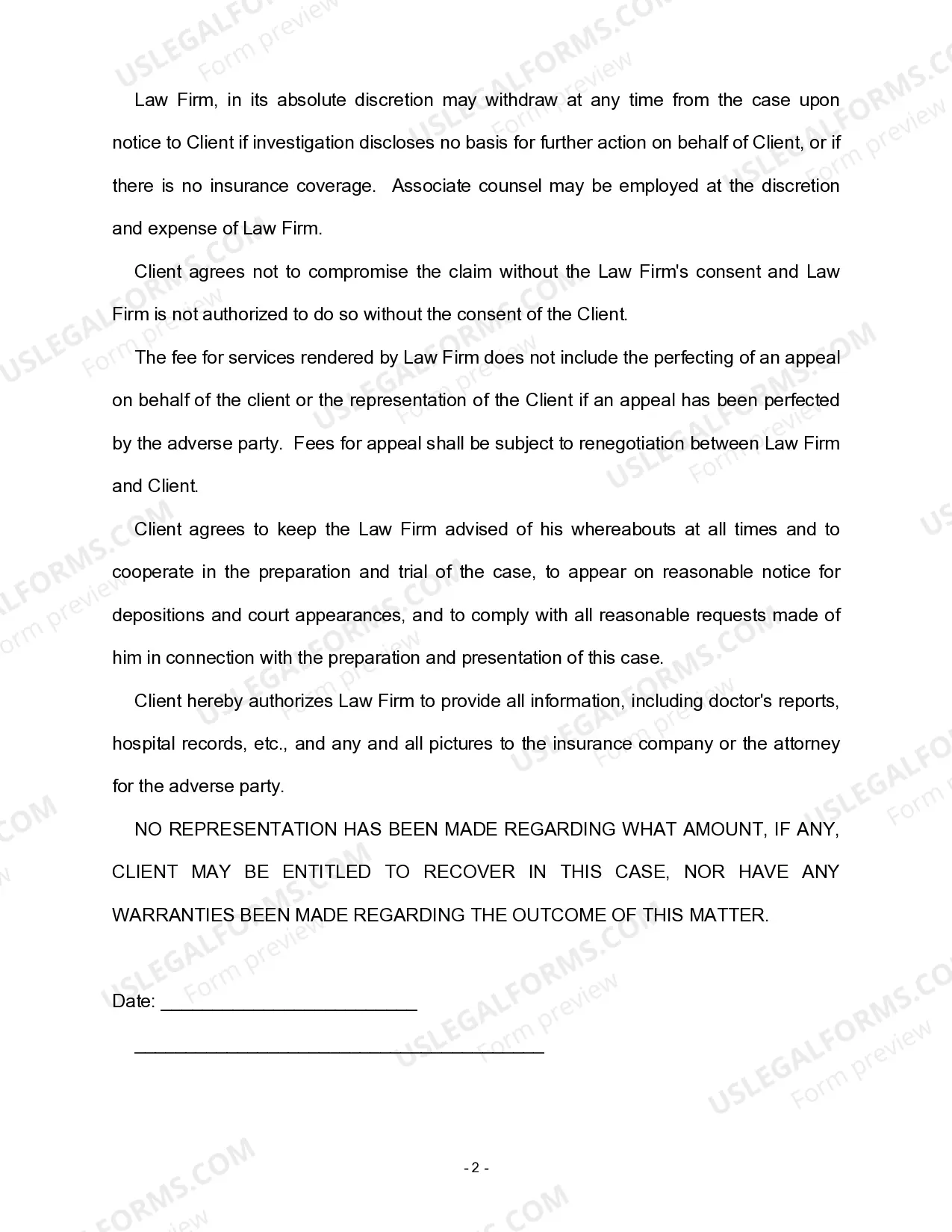
- Provisions for withdrawing from the case and handling appeals.
- Authorization for the law firm to share necessary information with third parties.




Situations where this form applies
This form is used when an individual seeks legal representation for personal injury claims and wishes to structure attorney fees based on the success of the case. It is particularly important when the client does not have sufficient funds to pay upfront legal fees and agrees to pay the attorney a percentage of any recovery obtained. This agreement is typically executed before the attorney begins work on the case.
Who can use this document
- Individuals pursuing a personal injury claim who want to establish a clear fee agreement.
- Clients who do not wish to pay hourly rates or upfront fees to their attorney.
- Those seeking legal counsel for cases with uncertain outcomes, where a contingency fee is appropriate.
Steps to complete this form
- Identify the law firm and client by filling in the names in the designated blanks.
- Specify the date of the incident and the retainer fee amount clearly.
- Detail the agreed percentages for contingency fees based on the recovery stage.
- Ensure both parties sign the agreement, indicating understanding and acceptance of the terms.
- Keep a copy for personal records once signed by both parties.
Is notarization required?
This form does not typically require notarization unless specified by local law. However, having it notarized can provide additional verification of signatures and help prevent disputes in the future.
Get your form ready online
Our built-in tools help you complete, sign, share, and store your documents in one place.
Make edits, fill in missing information, and update formatting in US Legal Forms—just like you would in MS Word.
Download a copy, print it, send it by email, or mail it via USPS—whatever works best for your next step.
Sign and collect signatures with our SignNow integration. Send to multiple recipients, set reminders, and more. Go Premium to unlock E-Sign.
If this form requires notarization, complete it online through a secure video call—no need to meet a notary in person or wait for an appointment.
We protect your documents and personal data by following strict security and privacy standards.

Make edits, fill in missing information, and update formatting in US Legal Forms—just like you would in MS Word.

Download a copy, print it, send it by email, or mail it via USPS—whatever works best for your next step.

Sign and collect signatures with our SignNow integration. Send to multiple recipients, set reminders, and more. Go Premium to unlock E-Sign.

If this form requires notarization, complete it online through a secure video call—no need to meet a notary in person or wait for an appointment.

We protect your documents and personal data by following strict security and privacy standards.
Typical mistakes to avoid
- Failing to specify the correct percentages for recovery stages.
- Not filling out the retainer fee amount, leading to potential misunderstandings.
- Forgetting to sign the document, which invalidates the agreement.
- Not reviewing the terms thoroughly before signing, which can result in unexpected obligations.
Benefits of using this form online
- Convenient access to legal forms that can be downloaded and customized.
- Editability allows for personalization to meet specific case needs.
- Reliability of attorney-drafted templates ensures legal soundness.
Main things to remember
- The Attorney Fee Letter for Personal Injury - Contingency Retainer establishes clear terms between the client and attorney regarding contingency fees.
- This form is essential for clients who wish to delay payment until after a successful recovery.
- Completing the form accurately is crucial to avoid misunderstandings and ensure legality.
Looking for another form?





Form popularity
FAQ
An attorney may accept a credit card as a form of payment for a retainer, but the entire fee must be put onto the account. Using a credit card may be a good option if the interest on the card is low. A credit card may be easier to pay back than a personal loan.
Overview. A retainer fee can be any denomination that the attorney requests. It may be as low as $500 or as high as $5,000 or more. Some attorneys base retainer fees on their hourly rate multiplied by the number of hours that they anticipate your case will take.
What is a typical retainer fee attorney? Some lawyers charge retainer fees of $1000, while others charge $5000+. Depending on the lawyer and the complexity of your case, you can usually expect to pay a retainer fee of between $3000 and $5000.
When someone threatens to call their lawyer, he or she could very well have a lawyer "on retainer." To have a lawyer on retainer means that the client pays a lawyer a small amount on a regular basis. In return, the lawyer performs some legal services whenever the client needs them.
The amount serves as a guarantee by the client to pay the attorney upon completion of the agreed work. The attorney cannot claim the retainer fee until he has completed the work and invoiced the client. Any remaining retainer fee after paying the hourly attorney fees should be returned to the client.
The amount serves as a guarantee by the client to pay the attorney upon completion of the agreed work. The attorney cannot claim the retainer fee until he has completed the work and invoiced the client. Any remaining retainer fee after paying the hourly attorney fees should be returned to the client.
A retainer fee helps secure the services of the attorney and shows a willingness on the part of the client to hire and cooperate with the lawyer. As such, a retainer agreement is a formal document outlining the relationship between an attorney and client.
A retainer agreement is a work-for-hire contract. It falls between a one-off contract and permanent employment, which may be full-time or part-time. Its distinguishing feature is that the client or customer pays in advance for professional work to be specified later.
2.1 The purpose of a Retainer Agreement is to set out the exact duties of the Member and the Client so that all parties to the Agreement have clear expectations regarding what will be provided, how the service will be provided, and at what cost.