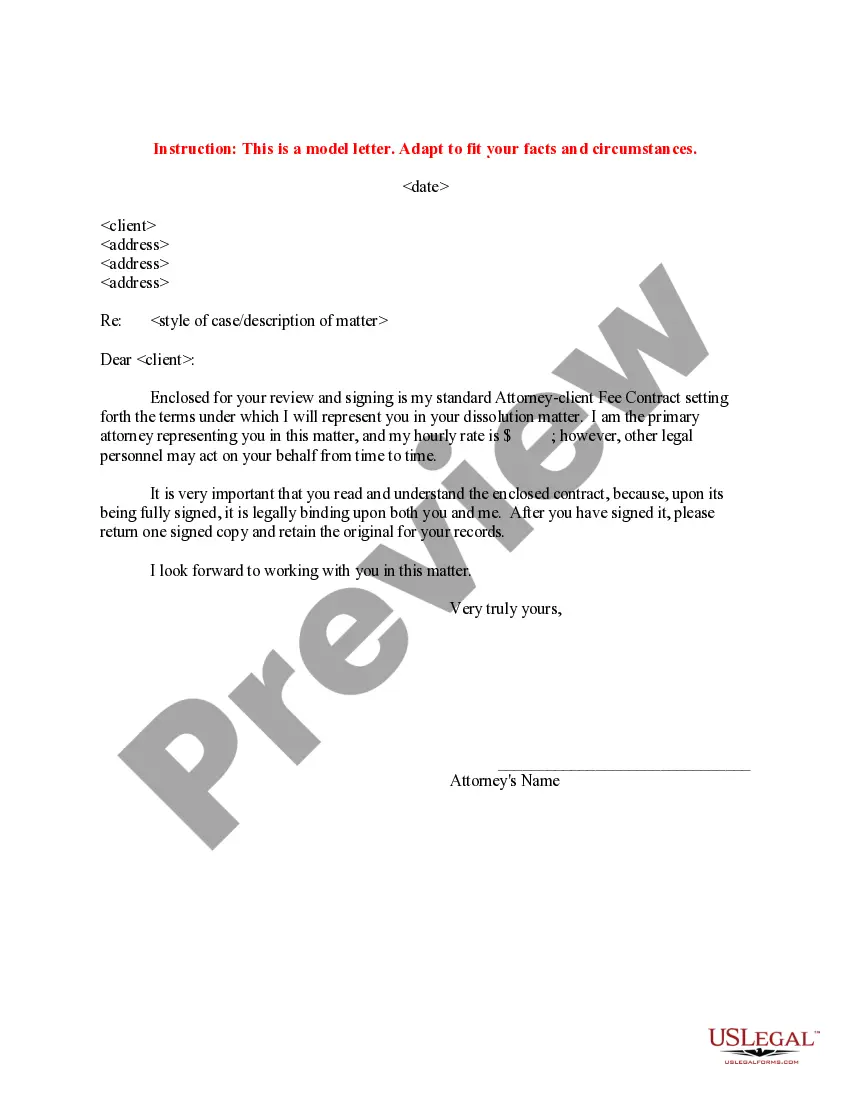
Attorney - Client Fee Contract Cover Letter
Understanding this form
The Attorney - Client Fee Contract Cover Letter is a template letter designed to accompany a fee agreement between an attorney and a client. This form helps establish the preliminary communication regarding the nature of the legal services and the fees involved. Unlike more detailed contracts, this cover letter provides a concise introduction to the legal representation process and sets the tone for a professional relationship.
Form components explained
- Date: The date when the letter is being sent.
- Client's information: Name and address of the client.
- Case description: A brief overview of the legal matter being addressed.
- Salutation: A personalized greeting to the client.
- Closing statement: A professional sign-off and the attorney's name.


Common use cases
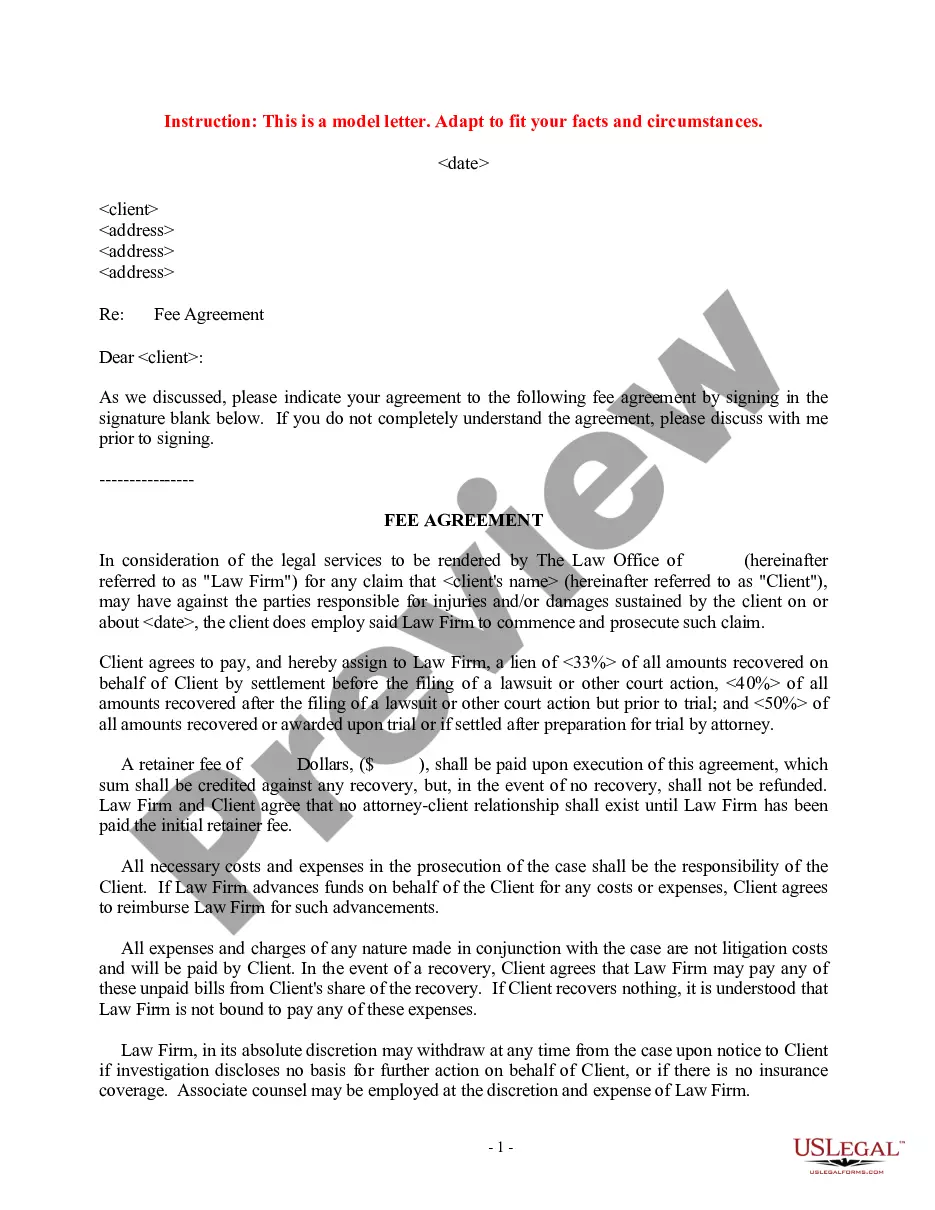
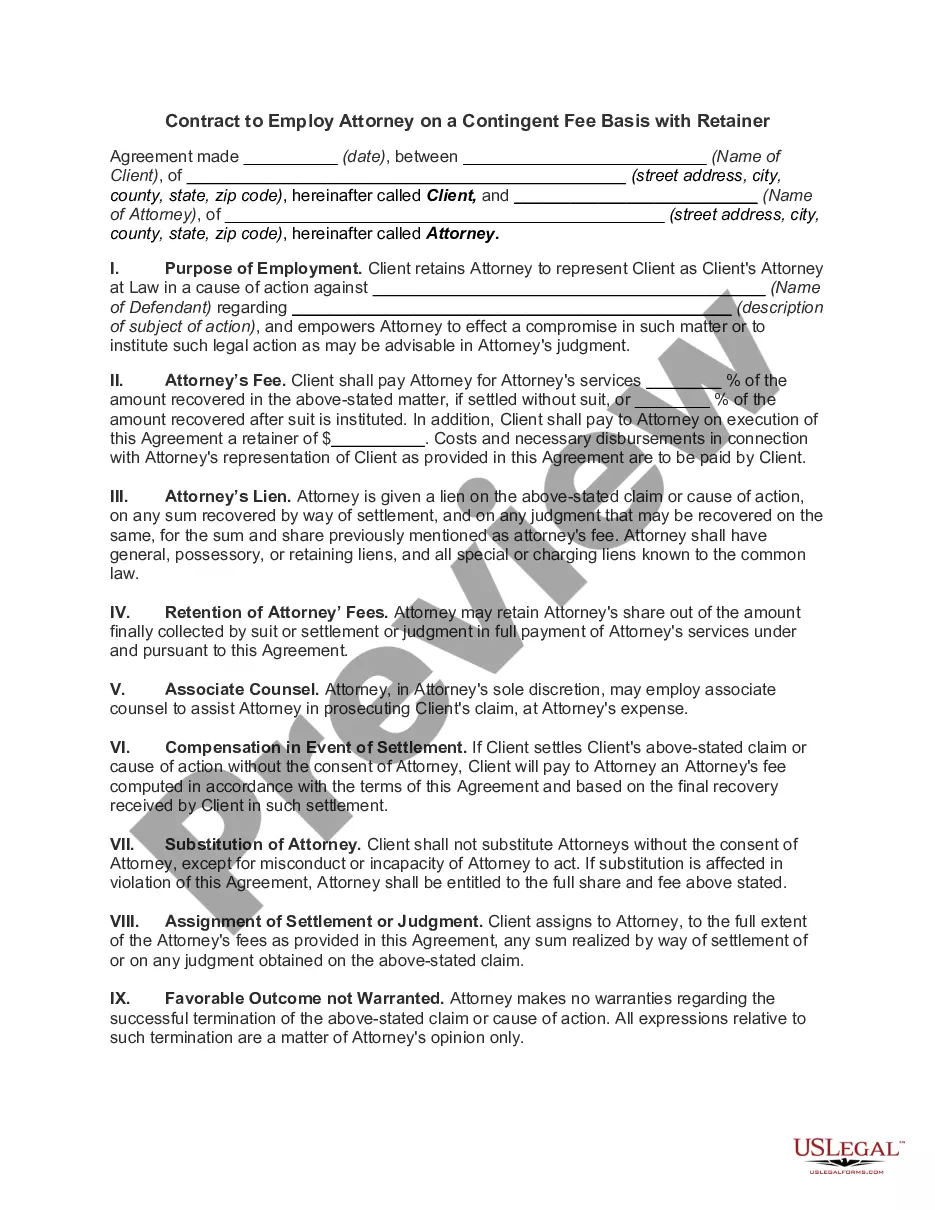
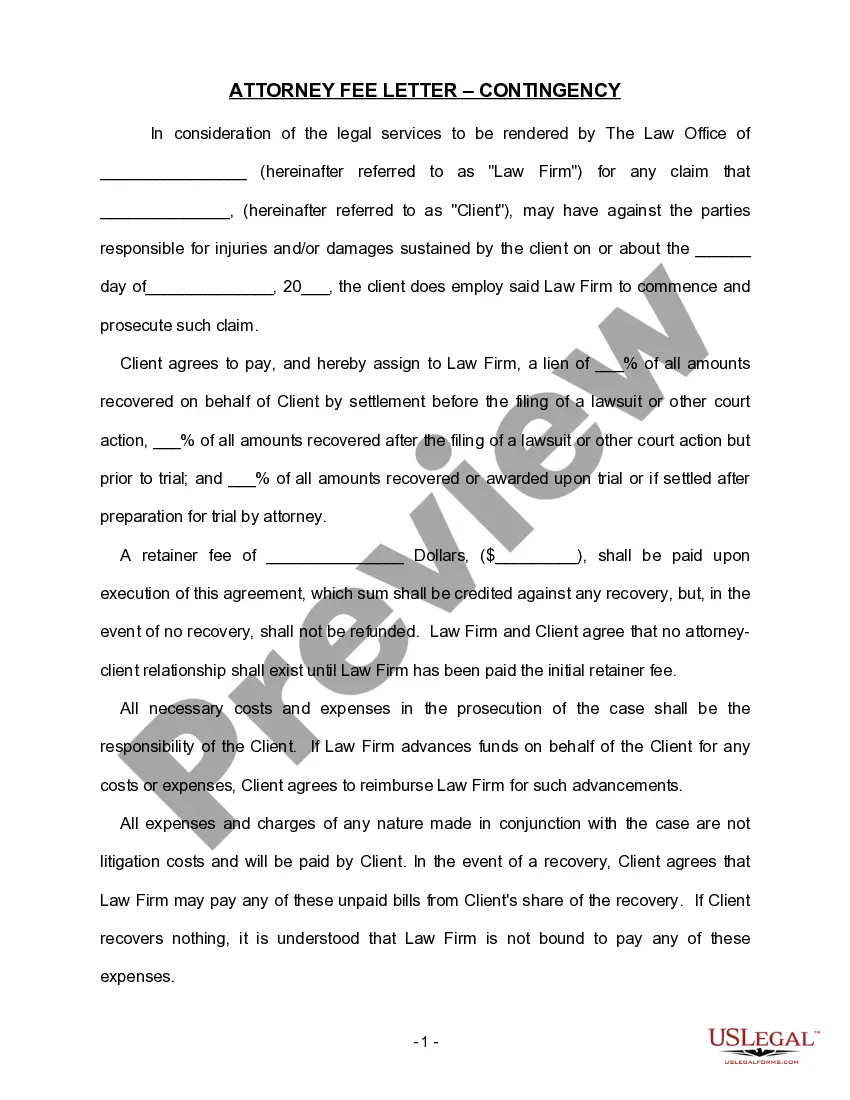
This cover letter should be used when an attorney is entering into a fee agreement with a new client. It serves as a formal introduction to the services that will be provided and outlines how the client will be charged for those services. It is especially useful in cases where the attorney may have multiple fee structures or unique payment terms that need to be communicated clearly from the outset.
Intended users of this form
- Attorneys who are formalizing a client relationship.
- Clients who are engaging legal services for the first time.
- Law firms that need standardized communication for fee arrangements.
Steps to complete this form
- Begin by entering the date at the top of the letter.
- Fill in the client's name and address accurately.
- Clearly describe the style of the case or the legal matter you will be addressing.
- Include a personalized salutation to the client.
- Sign off the letter with your name as the attorney.
Is notarization required?
In most cases, this form does not require notarization. However, some jurisdictions or signing circumstances might. US Legal Forms offers online notarization powered by Notarize, accessible 24/7 for a quick, remote process.
Get your form ready online
Our built-in tools help you complete, sign, share, and store your documents in one place.
Make edits, fill in missing information, and update formatting in US Legal Forms—just like you would in MS Word.
Download a copy, print it, send it by email, or mail it via USPS—whatever works best for your next step.
Sign and collect signatures with our SignNow integration. Send to multiple recipients, set reminders, and more. Go Premium to unlock E-Sign.
If this form requires notarization, complete it online through a secure video call—no need to meet a notary in person or wait for an appointment.
We protect your documents and personal data by following strict security and privacy standards.

Make edits, fill in missing information, and update formatting in US Legal Forms—just like you would in MS Word.

Download a copy, print it, send it by email, or mail it via USPS—whatever works best for your next step.

Sign and collect signatures with our SignNow integration. Send to multiple recipients, set reminders, and more. Go Premium to unlock E-Sign.

If this form requires notarization, complete it online through a secure video call—no need to meet a notary in person or wait for an appointment.

We protect your documents and personal data by following strict security and privacy standards.
Common mistakes
- Failing to include the date, which can create confusion about the timeframe of the agreement.
- Omitting the clientâs accurate address or name, leading to potential misunderstandings.
- Using vague language to describe the case, which may leave clients unclear about the services provided.
Why complete this form online
- Convenience: Easily download and customize the letter from anywhere.
- Editability: Modify the template to fit specific legal circumstances.
- Reliability: Forms are drafted based on input from licensed attorneys, ensuring a professional standard.
Legal use & context
- This cover letter is an essential document for establishing a formal agreement with a client.
- It aids in clarifying the financial aspects of legal representation, reducing potential disputes.
- Ensures both parties are aligned on the expectations and responsibilities regarding fees.
Looking for another form?


Form popularity
FAQ
The introduction to your cover letter. A paragraph on why you want to work at that law firm. A paragraph highlighting why you're a good fit for the law firm. The ending to your law covering letter.
To address a cover letter without a name, use some variation of, "Dear Software Team Hiring Manager." You can also use, "Dear Hiring Manager" if the addressee really is unknown. Remember that "To Whom It May Concern" is an old-fashioned salutation for cover letters. It also feels very impersonal.
Place your contact information in the header. Address the hiring manager by name. Show relevant achievements to introduce yourself in the first paragraph. Target the employer's needs and prove you can help in the second paragraph.
Personal details - At the top of the page, include details such as your name, address, email and telephone number. Education and qualifications - Detail any professional memberships (e.g. the Law Society) or qualifications you possess, such as the Legal Practice Course (LPC).
Cover Letter Tips State why you're excited about the job and the company, and how the job matches your career goals. In one or two paragraphs, connect your past accomplishments with the requirements listed in the job description. Focus on your most relevant experience, qualifications and skills.
The cover letter is a sample of your written work and should be brief (preferably one page), persuasive, well-reasoned, and grammatically perfect. A good cover letter: Tells the employer who you are (e.g., a first-year student at YLS) and what you are seeking (e.g., a summer intern position);
Keep your cover letter focused and succinct. (1-2 pages is the norm.) Differentiate yourself! Be accurate and truthful at all times. Show enthusiasm for the opportunity. Use meaningful details to bring your accomplishments to life.