Parent - Child Domestic Curfew Contract
What this document covers
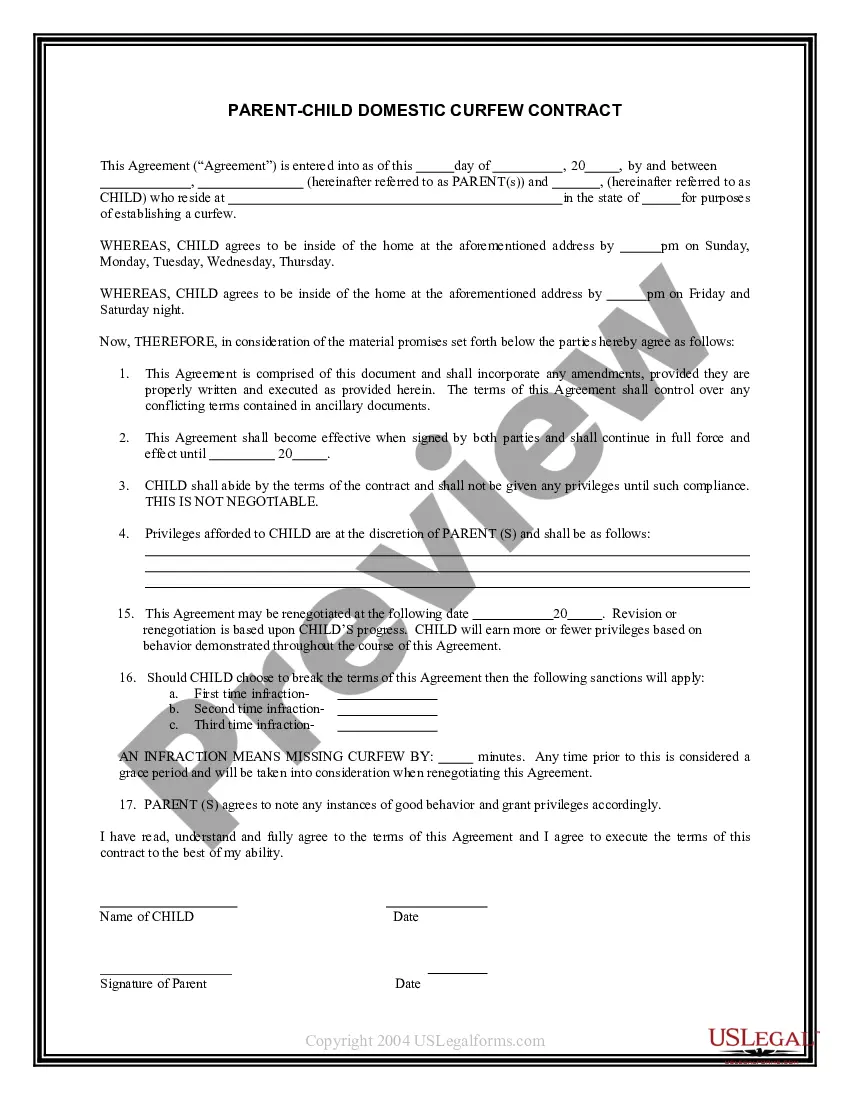
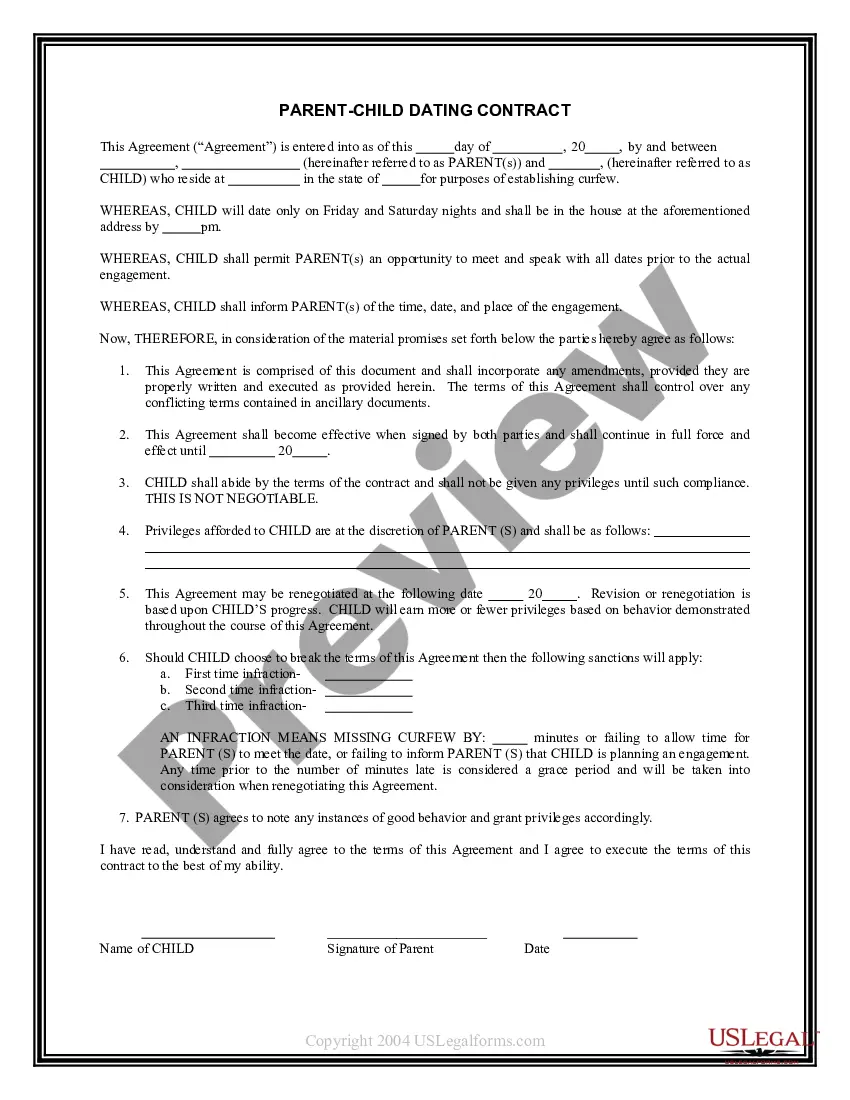
The Parent - Child Domestic Curfew Contract is a legally binding agreement between parents and their child, establishing clear terms for daily curfew compliance. This contract outlines the specific curfew hours the child must adhere to, the privileges for meeting these terms, and the consequences of failing to do so. It differs from informal agreements by providing a structured and enforceable framework to promote responsibility and accountability in a household setting.
Key parts of this document
- Identification of the parties involved: names of the parents and the child.
- Defined curfew hours: specific times when the child must be home.
- Privileges: rewards or benefits the child will receive for complying with the curfew.
- Repercussions: clear consequences if the child fails to comply with the curfew terms.
- Signature lines: space for all parties to sign, affirming their agreement.
Situations where this form applies
This form is useful when parents want to establish a formal curfew for their child. Situations include transitioning a child to more independence, implementing a new curfew due to changes in school or social activities, or addressing behavioral concerns where structured agreements may foster compliance. It serves to clarify expectations and reinforce discipline in the household.
Who should use this form
- Parents or guardians seeking to establish curfew guidelines with their child.
- Families transitioning to more lenient curfews for teenagers.
- Parents needing a documented agreement to encourage accountability.
- Guardians wanting to address specific behavioral issues related to independence.
Completing this form step by step
- Identify the parties: enter the names of the parents and the child.
- Specify the curfew hours: clearly state the times by which the child must return home.
- Outline privileges: list any rewards the child will earn for compliance with the curfew.
- Describe repercussions: detail the consequences if the curfew is not followed.
- Sign the agreement: have all parties sign and date the document to acknowledge their agreement.
Notarization requirements for this form
This form does not typically require notarization unless specified by local law. Parents should check their state laws to ensure compliance.
Get your form ready online
Our built-in tools help you complete, sign, share, and store your documents in one place.
Make edits, fill in missing information, and update formatting in US Legal Forms—just like you would in MS Word.
Download a copy, print it, send it by email, or mail it via USPS—whatever works best for your next step.
Sign and collect signatures with our SignNow integration. Send to multiple recipients, set reminders, and more. Go Premium to unlock E-Sign.
If this form requires notarization, complete it online through a secure video call—no need to meet a notary in person or wait for an appointment.
We protect your documents and personal data by following strict security and privacy standards.

Make edits, fill in missing information, and update formatting in US Legal Forms—just like you would in MS Word.

Download a copy, print it, send it by email, or mail it via USPS—whatever works best for your next step.

Sign and collect signatures with our SignNow integration. Send to multiple recipients, set reminders, and more. Go Premium to unlock E-Sign.

If this form requires notarization, complete it online through a secure video call—no need to meet a notary in person or wait for an appointment.

We protect your documents and personal data by following strict security and privacy standards.
Typical mistakes to avoid
- Not specifying clear curfew times, which can lead to misunderstandings.
- Failing to communicate the privileges and repercussions effectively.
- Not having all parties sign the agreement, making it less enforceable.
- Overlooking updates to the agreement as circumstances change.
Why complete this form online
- Convenient access: download and complete the form from the comfort of home.
- Editability: easily modify terms to fit specific family needs or circumstances.
- Reliability: ensures a legally sound document drafted by licensed attorneys.
Legal use & context
- This contract can be legally binding if both parties agree to its terms and conditions.
- It promotes clear communication and expectations, minimizing future conflicts.
- While enforceable, the actual enforcement may vary based on local family laws.
Quick recap
- The Parent - Child Domestic Curfew Contract establishes clear boundaries for curfew adherence.
- It benefits both parents and children by fostering responsibility and accountability.
- This form can be customized according to individual family needs.
Looking for another form?




Form popularity
FAQ
For seventeen-year-olds, curfew might be eleven p.m. on weekdays and midnight on weekends. For kids sixteen and younger, curfew is often 10 p.m. on weekdays and 11 p.m. on Friday and Saturday. Kids in this age range are to be home until six a.m. Have your kid look it up.
Speak to your daughter's friend's parents and tell them that you want your daughter to come home. If they continue to let her stay with them, call the police. You can also call DCF.
There aren't too many restrictions for teen drivers, but one of the most important ones is the curfew. For the first 12 months after earning their license, teens aren't allowed to be on the roads between 11pm and 5am. There are exceptions for teens who work late or early shifts, though.
If allowed to sleep on their own schedule, many teens would get eight hours or more per night, sleeping from 11 p.m. or midnight until 8 or 9 a.m., but school start times18 in most school districts force teens to wake up much earlier in the morning.
It is prohibited for unaccompanied children and adolescents under the age of 16 to stay in a public place between pm and am. The police can take unattended teenagers under 16 to their parents home.
If allowed to sleep on their own schedule, many teens would get eight hours or more per night, sleeping from 11 p.m. or midnight until 8 or 9 a.m., but school start times18 in most school districts force teens to wake up much earlier in the morning.
Speak to your daughter's friend's parents and tell them that you want your daughter to come home. If they continue to let her stay with them, call the police. You can also call DCF.
Your Community: Laws and Parental Norms These laws enable police to detain any unaccompanied minor teen (under 18) found in public between certain hours, often between pm- am unless going to/from work, a school-sponsored activity or in an emergency.
For seventeen-year-olds, curfew might be eleven p.m. on weekdays and midnight on weekends. For kids sixteen and younger, curfew is often 10 p.m. on weekdays and 11 p.m. on Friday and Saturday. Kids in this age range are to be home until six a.m. Have your kid look it up.