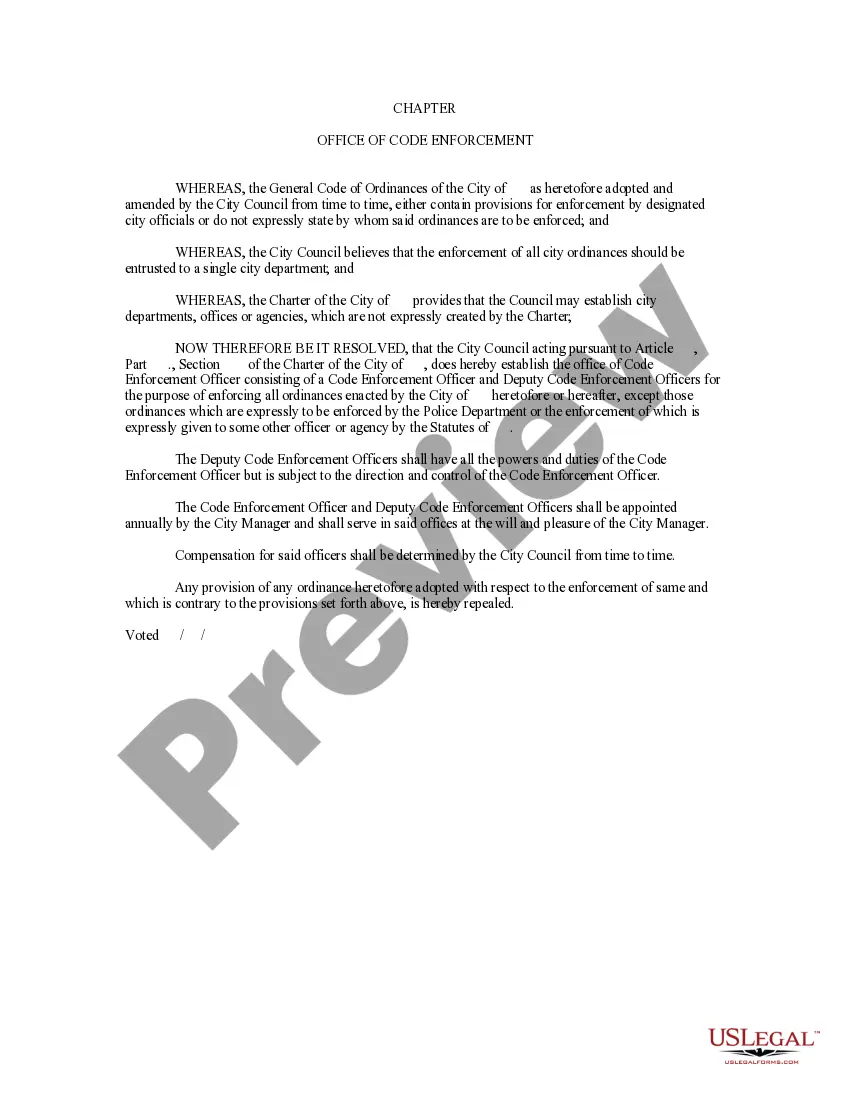
Office of Code of Enforcement
Understanding this form
The Office of Code Enforcement form is a legal document used by city councils to establish a dedicated office responsible for enforcing municipal codes and ordinances. This form specifies the roles of the Code Enforcement Officer and Deputy Officers, ensuring that enforcement is streamlined and clear. Unlike other regulatory forms, this document directly assigns enforcement powers and responsibilities within a specific city limit, providing a framework for compliance with local laws.
Form components explained
- Establishment of the Office of Code Enforcement Officer.
- Authority of the Code Enforcement Officer and Deputy Officers.
- Process for appointing Code Enforcement Officers by the City Manager.
- Details about compensation as determined by the City Council.
- Repeal of any contradictory ordinances.
When to use this document
This form should be utilized when a city council needs to formalize the structure and responsibilities of its code enforcement system. Scenarios include when a new office is being created, an existing office is being restructured, or when there is a need to clarify enforcement authority within municipal regulations.
Who this form is for
- City council members looking to establish a Code Enforcement Office.
- City managers responsible for the appointment of enforcement officers.
- Civic planners involved in municipal governance.
- Legal advisors to local government entities.
How to prepare this document
- Identify the city name where the Code Enforcement office will be established.
- Specify the article and section of the city charter that empowers the council to create this office.
- Detail any specific ordinances that the new office will enforce.
- Indicate the terms of appointment for the Code Enforcement Officer and Deputy Officers.
- Include the date of the resolution to formalize the establishment of the office.
Notarization requirements for this form
Notarization is not commonly needed for this form. However, certain documents or local rules may make it necessary. Our notarization service, powered by Notarize, allows you to finalize it securely online anytime, day or night.
Get your form ready online
Our built-in tools help you complete, sign, share, and store your documents in one place.
Make edits, fill in missing information, and update formatting in US Legal Forms—just like you would in MS Word.
Download a copy, print it, send it by email, or mail it via USPS—whatever works best for your next step.
Sign and collect signatures with our SignNow integration. Send to multiple recipients, set reminders, and more. Go Premium to unlock E-Sign.
If this form requires notarization, complete it online through a secure video call—no need to meet a notary in person or wait for an appointment.
We protect your documents and personal data by following strict security and privacy standards.

Make edits, fill in missing information, and update formatting in US Legal Forms—just like you would in MS Word.

Download a copy, print it, send it by email, or mail it via USPS—whatever works best for your next step.

Sign and collect signatures with our SignNow integration. Send to multiple recipients, set reminders, and more. Go Premium to unlock E-Sign.

If this form requires notarization, complete it online through a secure video call—no need to meet a notary in person or wait for an appointment.

We protect your documents and personal data by following strict security and privacy standards.
Avoid these common issues
- Not specifying the correct city charter provisions related to departmental creation.
- Failing to include all necessary powers delegated to enforcement officers.
- Omitting the date of the city council vote.
- Neglecting to repeal conflicting ordinances as stated in the form.
Benefits of using this form online
- Convenient access to customizable legal templates anytime.
- Easy to download and edit to fit specific municipal requirements.
- Reliable legal language drafted by licensed attorneys to ensure compliance.
Looking for another form?






Form popularity
FAQ
A Code Enforcement Officer is authorized to issue a citation to a person when, based upon personal investigation, the officer has reasonable cause to believe that the person has committed a civil infraction in violation of a duly enacted code or ordinance and that the County Court will hear the charge.
If you don't comply with building codes, you may be on the hook for fines and an expensive tear-out and redo of your project.That's one big advantage that a building contractor has over an ambitious DIYer. A contractor needs to keep up with building codes that change from state to state and from town to town.
The Law Enforcement Officers Safety Act (LEOSA) is a United States federal law, enacted in 2004, that allows two classes of personsthe "qualified law enforcement officer" and the "qualified retired or separated law enforcement officer"to carry a concealed firearm in any jurisdiction in the United States, regardless
Accordingly, unless an exception applies, an administrative search warrant is required before a code enforcement officer or code enforcement official may enter onto private property to conduct administrative inspections of residential or commercial premises for code violations.
New buildings must have a CO, and existing buildings must have a current or amended CO when there is a change in use, egress or type of occupancy.No one may legally occupy a building until the Department has issued a Certificate of Occupancy or Temporary Certificate of Occupancy.
In New York City, homeowners generally do not have to worry about working on their electrical or plumbing systems because, by law, they are not allowed to touch them. ''The rules here for electrical work are pretty simple,'' said Ilyse Fink, a spokeswoman for the New York City Department of Buildings.
Code enforcement officers enforce the regulations and standards of state and local governments. Unlike police officers, however, code enforcement officers are not "peace officers" under California law and are not empowered to effectuate arrests or to carry weapons during the course of duty.
Such inspector shall have charge of the enforcement of such codes, ordinances, rules and regulations of the town and of the zoning ordinance of the town, if there be one, and for such purposes such inspector, and his assistants, if any, shall have the right to enter and inspect at any time any building, structure or
In order to carry their firearms off-duty into public places, law enforcement officers must: (1) carry their agency's identification card; (2) carry only a weapon issued or approved by their respective agency; (3) be sober and not drinking alcohol while carrying; and (4) be an active-duty law enforcement officer and