Reprint Sales License Agreement
What is this form?
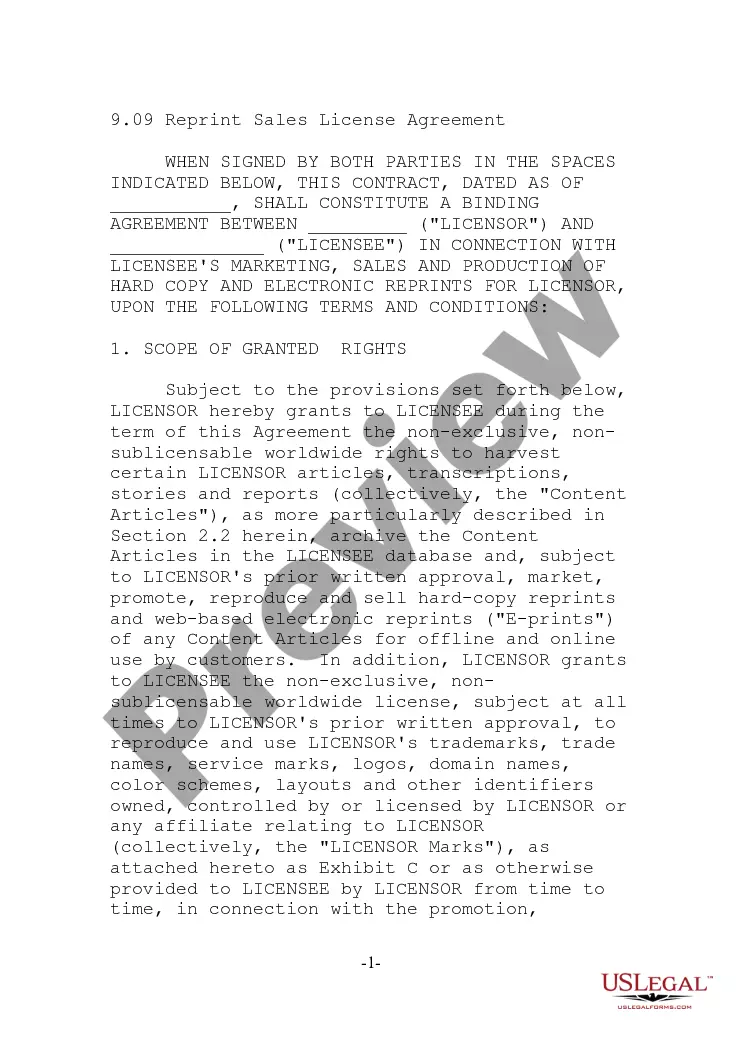
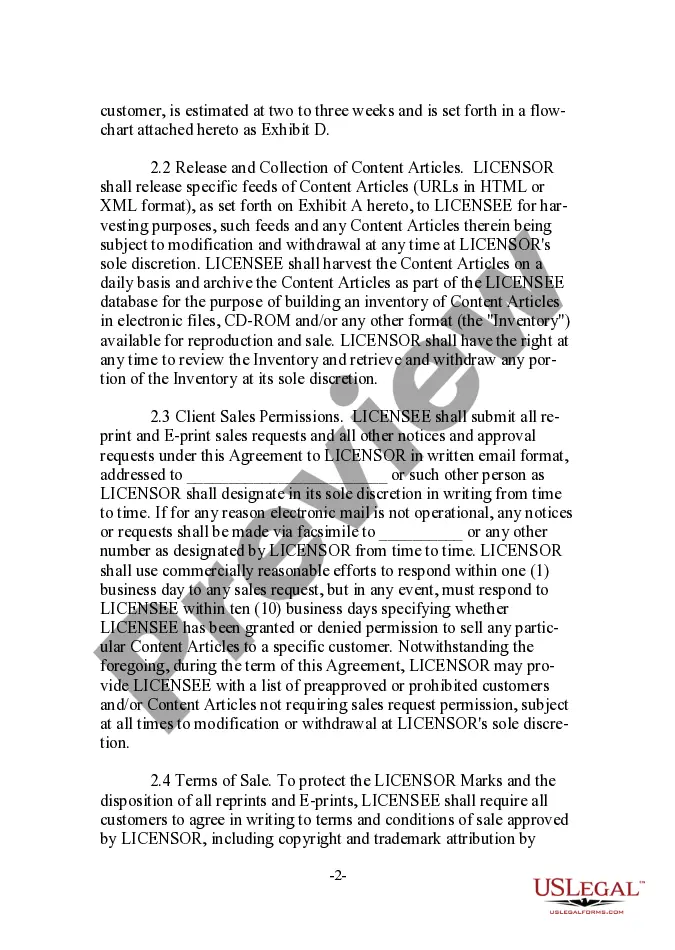
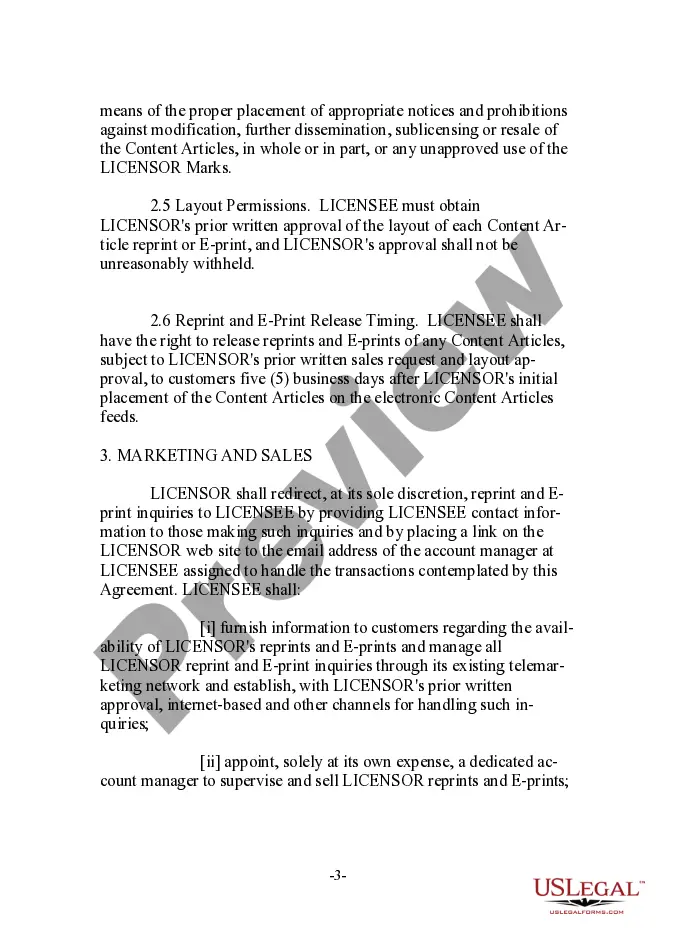
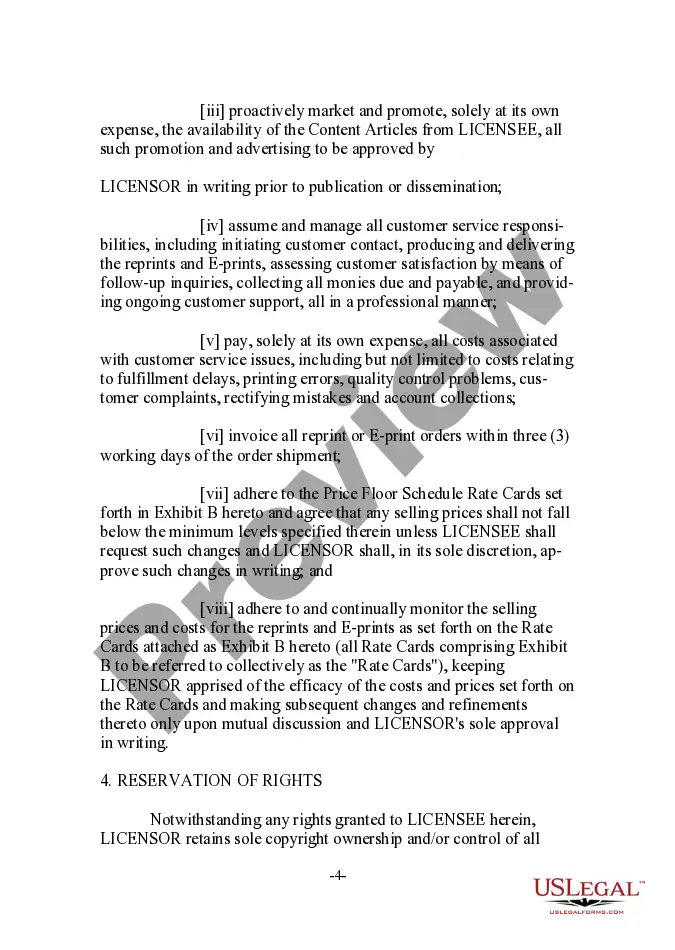
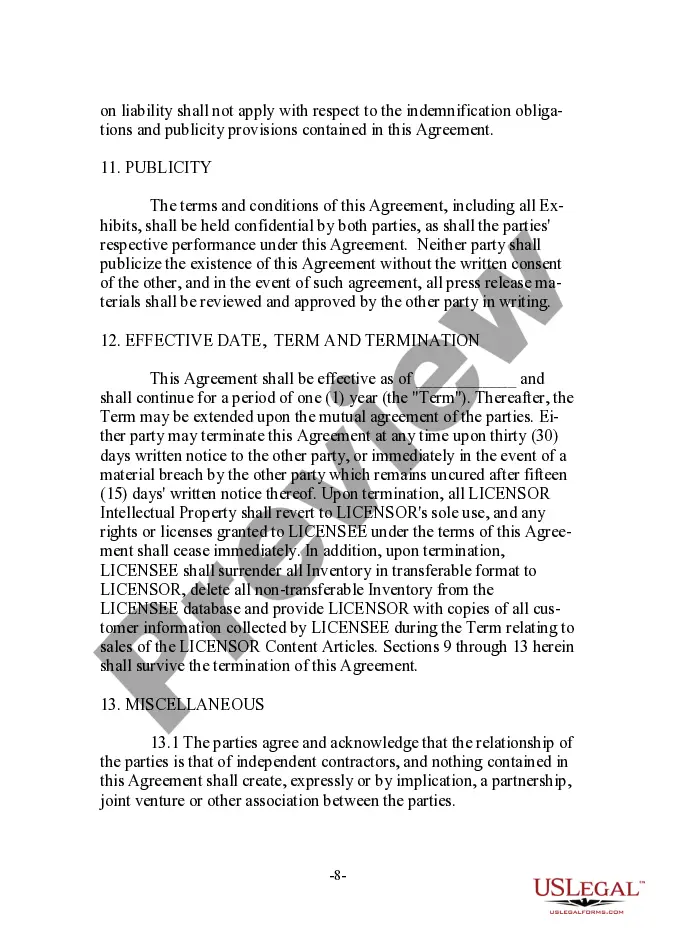
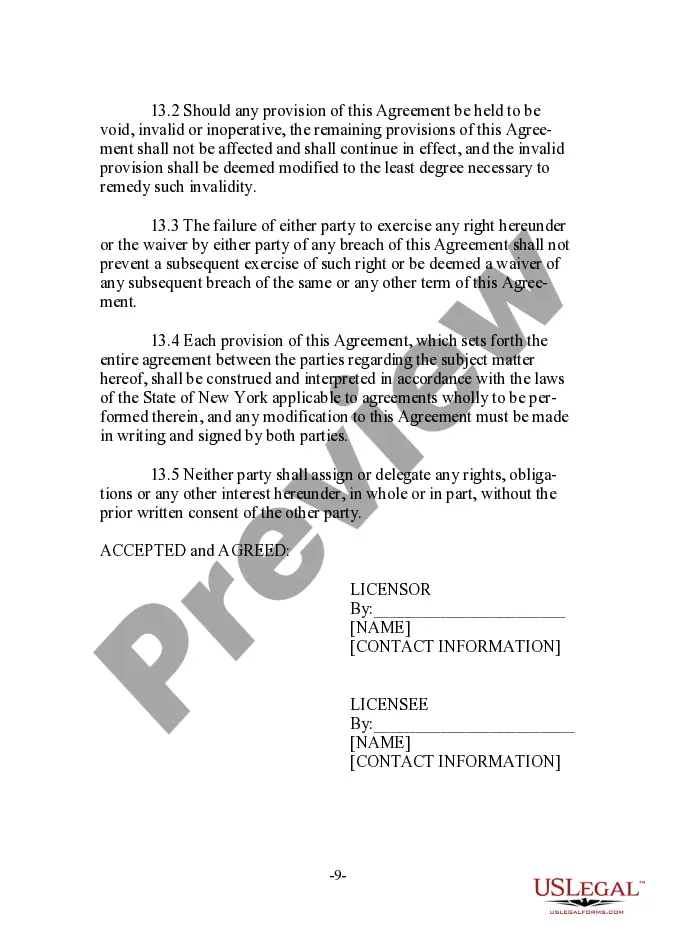
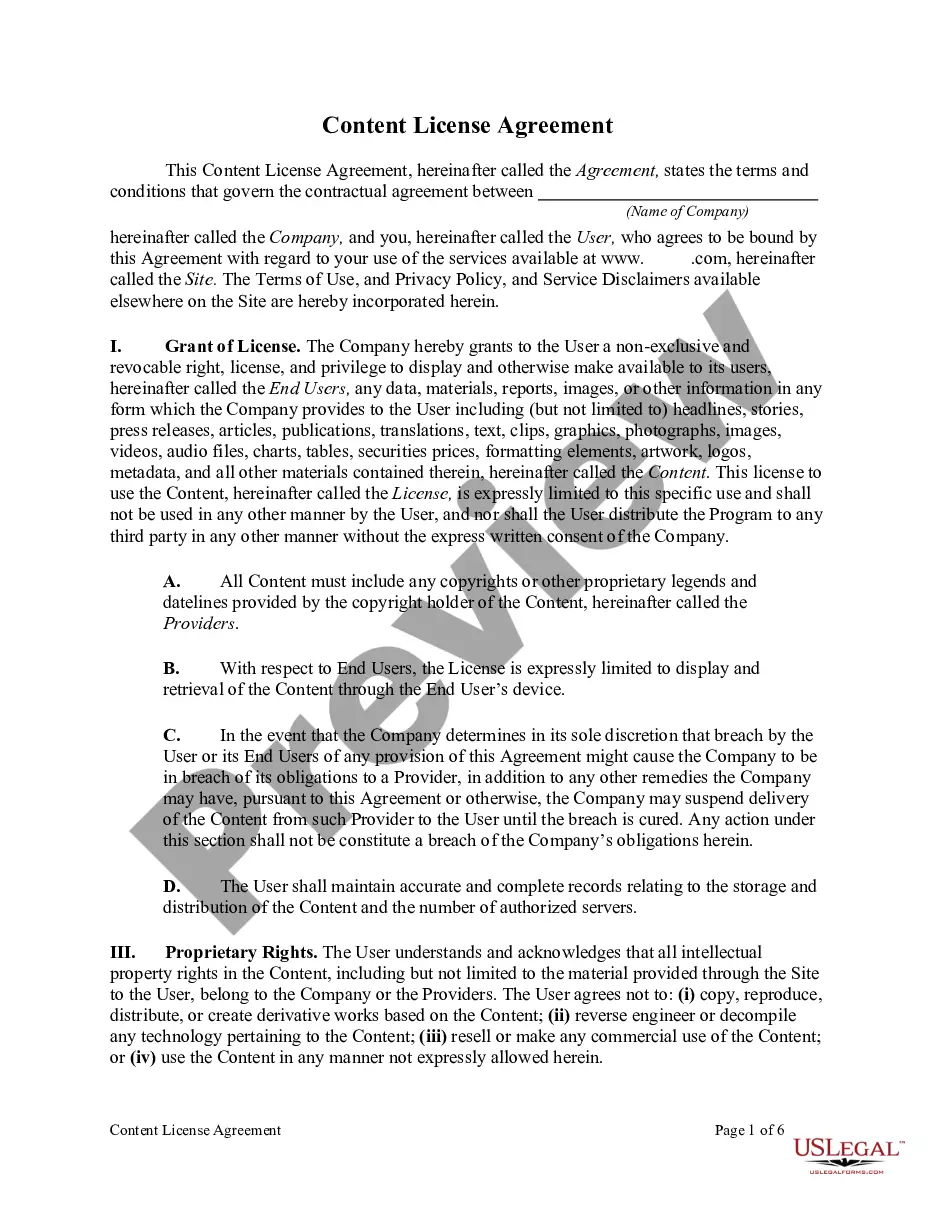
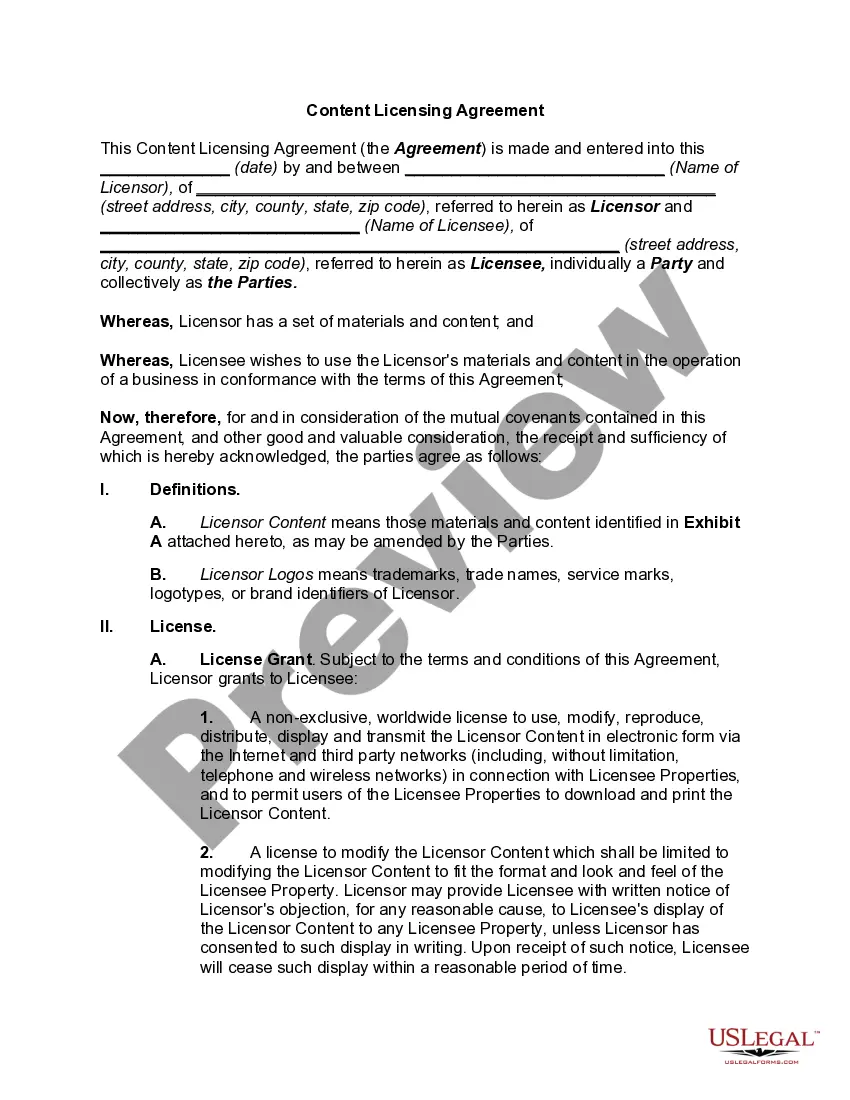
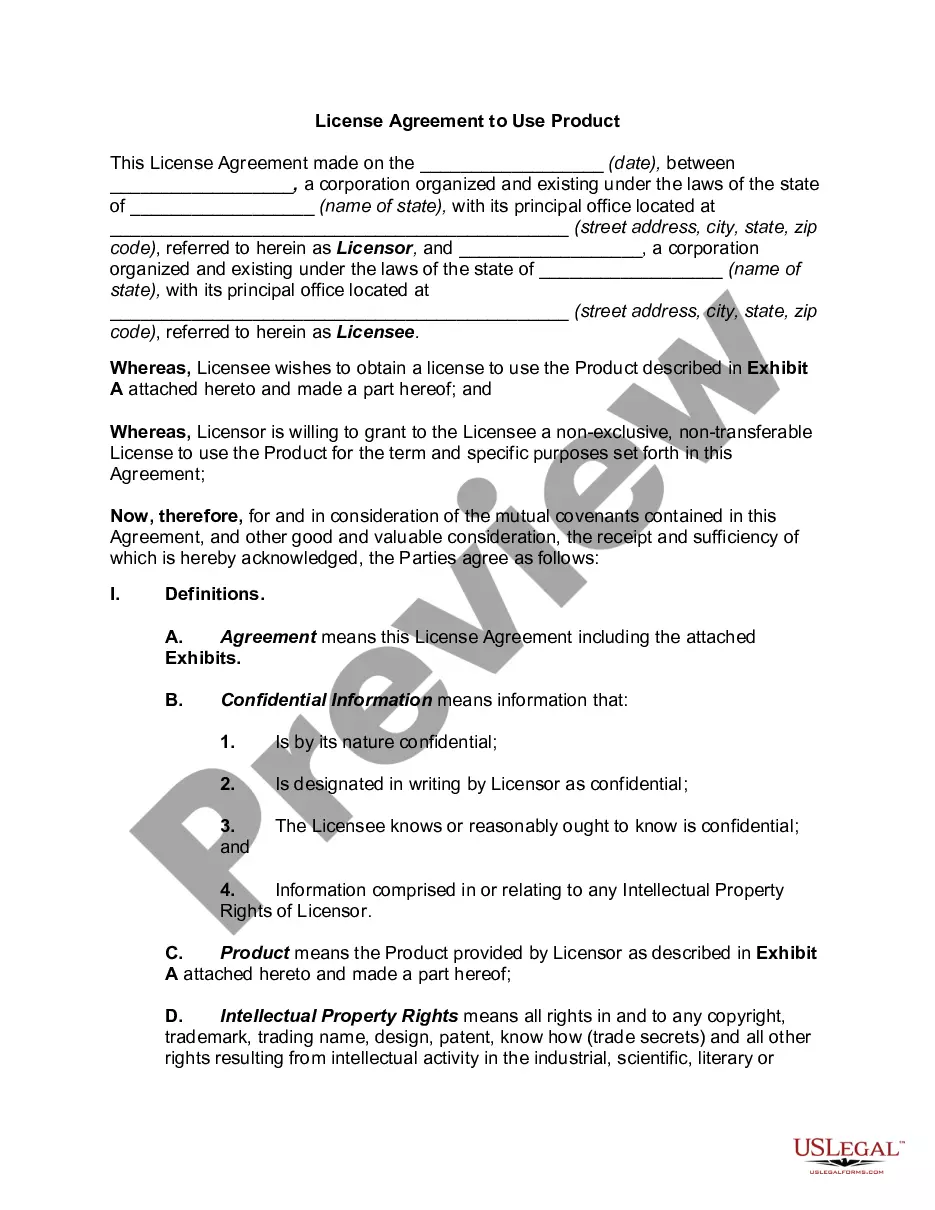
The Reprint Sales License Agreement is a legal document that establishes a formal partnership between a content owner (the Licensor) and a seller (the Licensee). This agreement authorizes the Licensee to produce and sell hardcopy and electronic reprints of the Licensor's content, which can include articles, stories, and reports. Unlike a standard sales agreement, it specifically focuses on licensing intellectual property rights, making it essential for those involved in selling reprints in various industries, including entertainment and multimedia.
Form components explained
- Grant of rights: Defines the scope of rights granted to the Licensee for content usage.
- Sales permissions: Outlines the process for obtaining approvals on reprint sales.
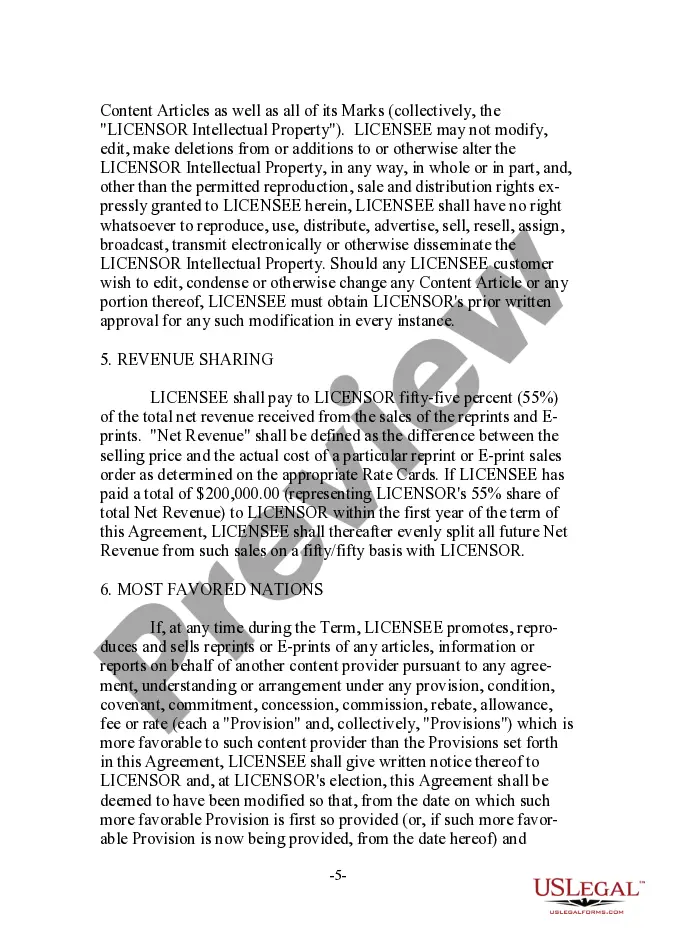
- Revenue sharing: Specifies the financial arrangement between the Licensor and Licensee.
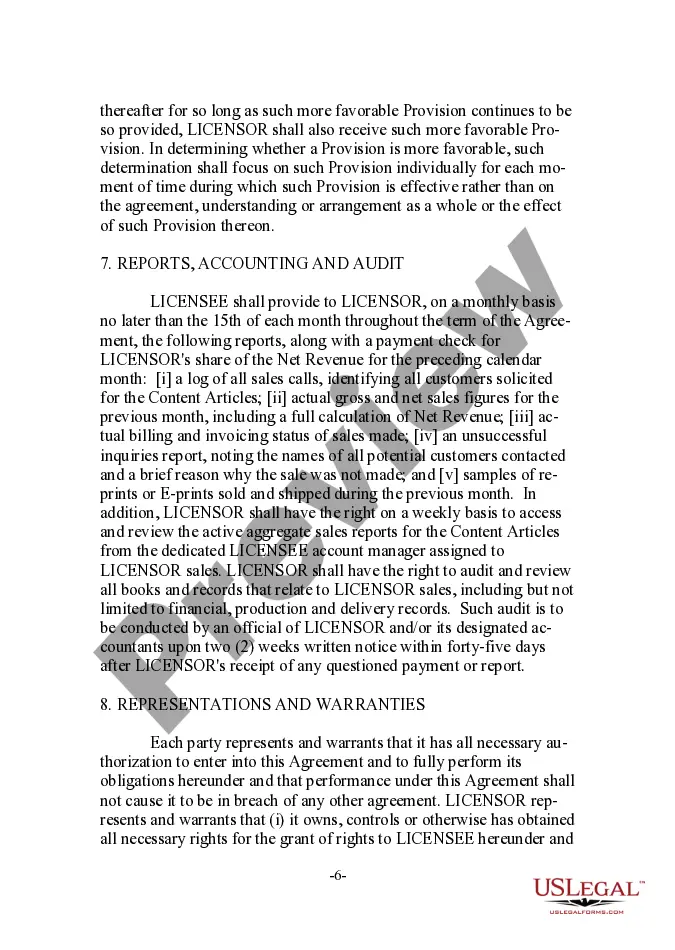
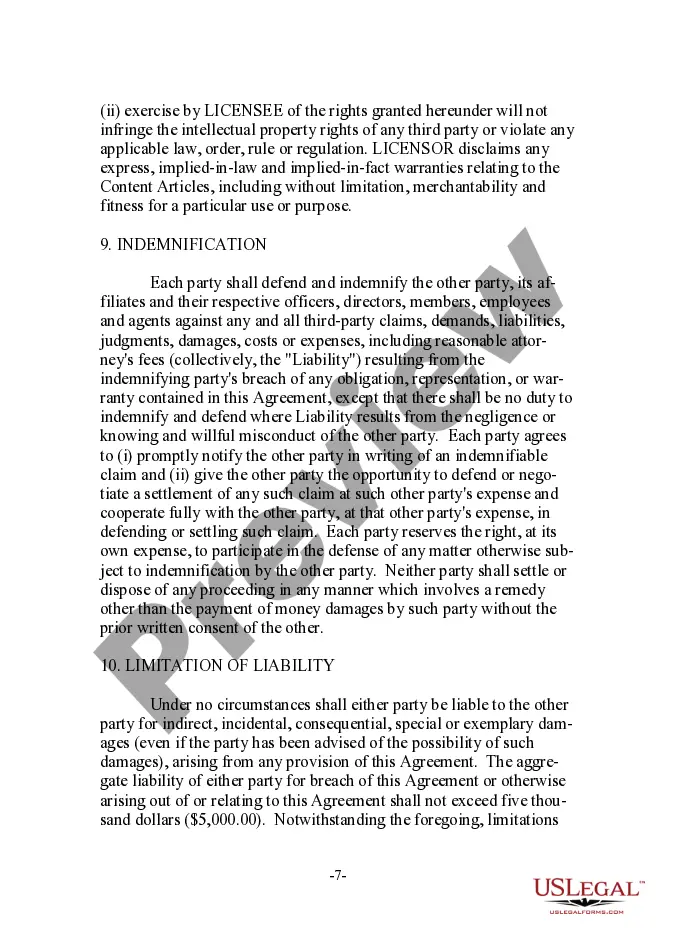
- Indemnification: Establishes the responsibilities of each party in case of legal claims.
- Termination: Details conditions under which the agreement can be ended.
Common use cases
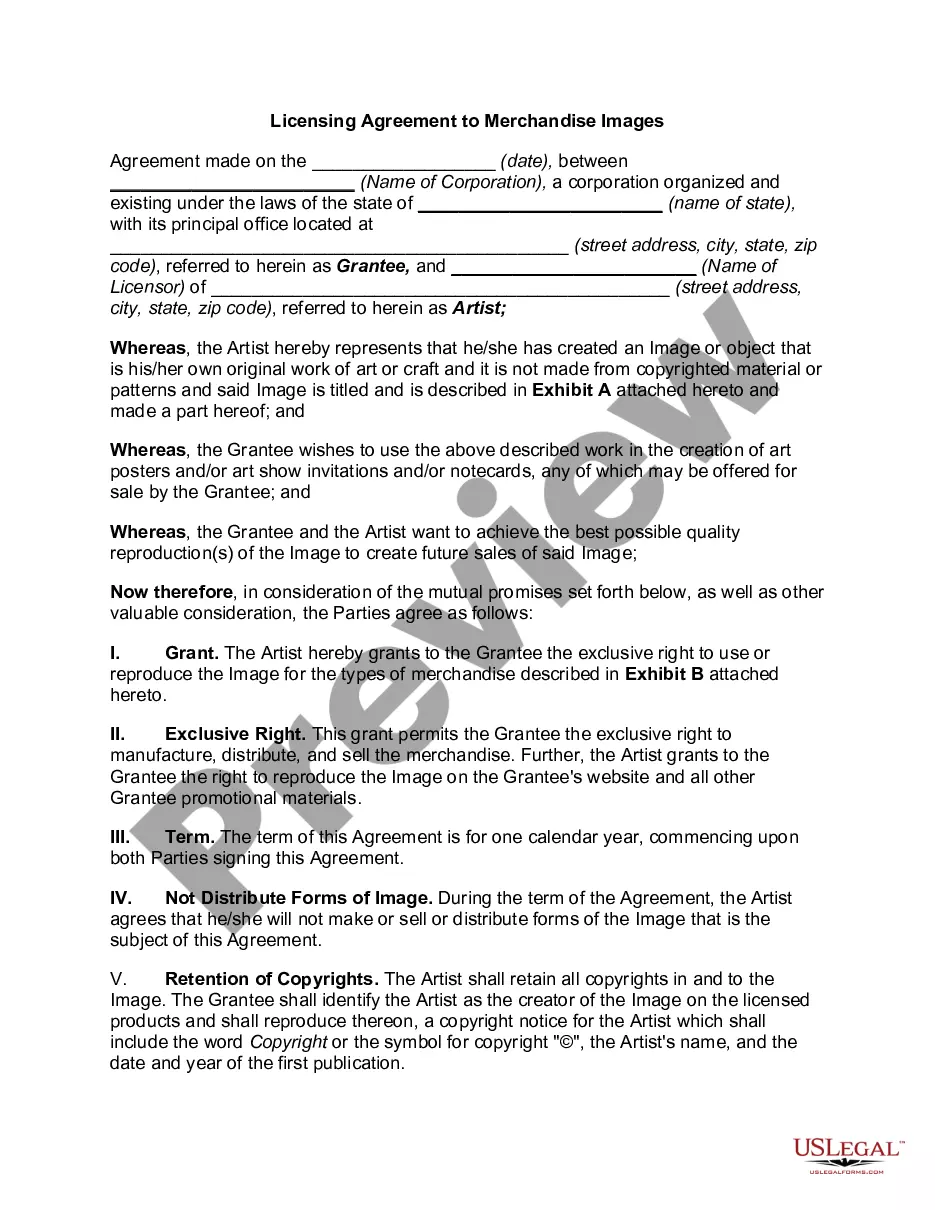
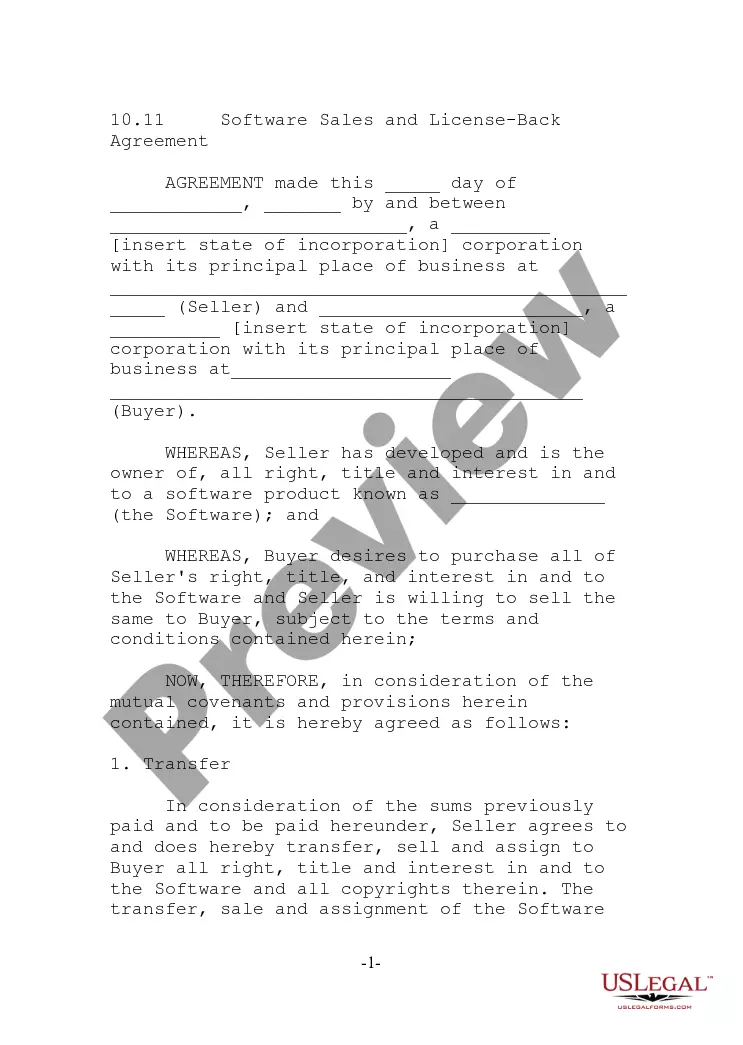
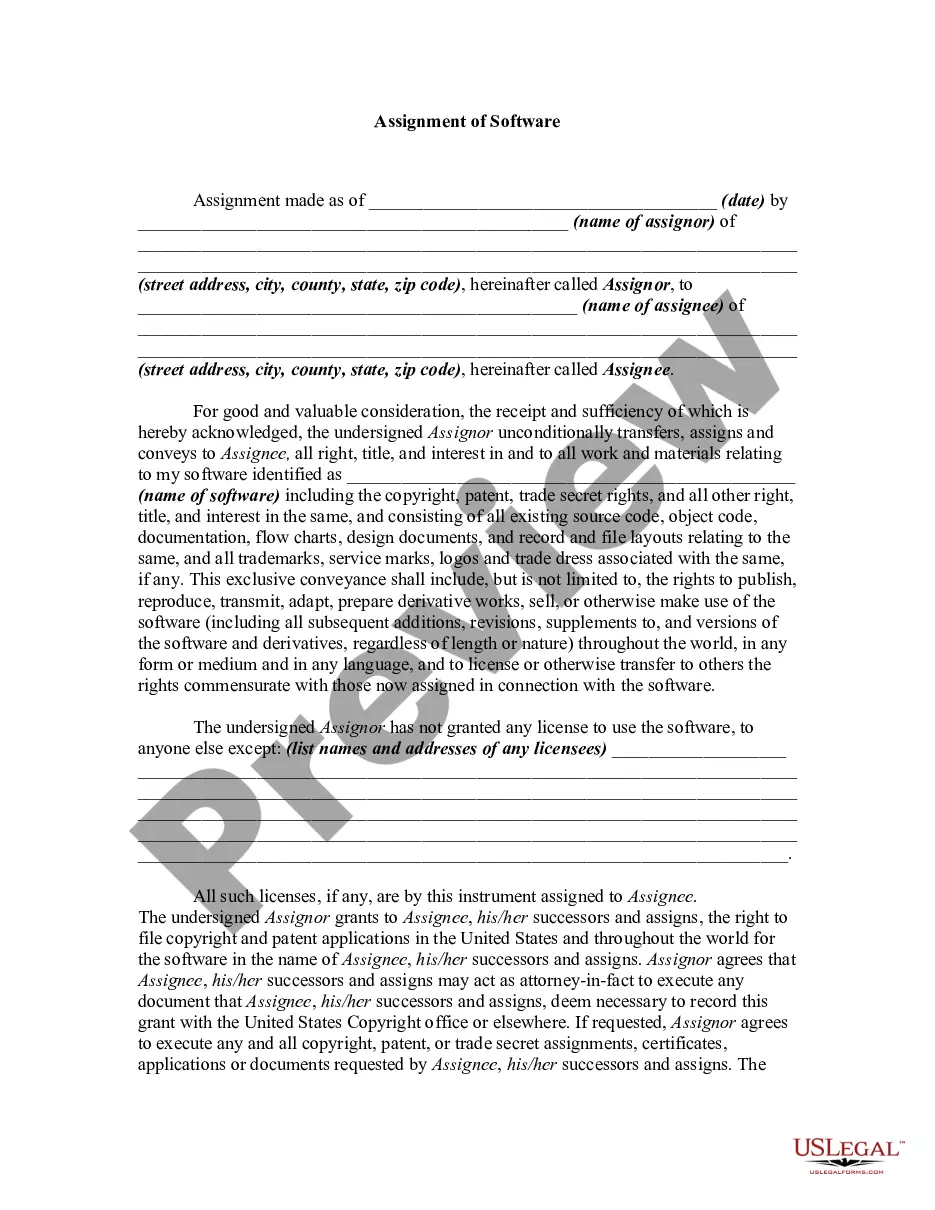
This form is used when a content owner wishes to allow another party to market and sell reprints of its materials. It is beneficial in scenarios such as a publisher granting a printing company the right to distribute reprints or when an author licenses their articles to an online platform for resale. The Reprint Sales License Agreement formalizes the relationship and protects the rights of both parties.
Who can use this document
- Content creators looking to monetize their articles or digital media through reprints.
- Businesses or individuals in the publishing industry seeking to resell existing content.
- Marketers who plan to use third-party content for promotional purposes.
- Legal professionals managing licensing agreements on behalf of clients.
Steps to complete this form
- Identify the parties: Fill in the names of the Licensor and Licensee.
- Specify the content: Clearly outline the articles or content that will be licensed, referencing the attachments provided.
- Enter dates: Include the effective date of the agreement at the specified section.
- Detail payment terms: Specify the revenue sharing details and any other financial arrangements.
- Sign the agreement: Ensure that authorized representatives of both parties sign and date the document.
Notarization guidance
This form usually doesn’t need to be notarized. However, local laws or specific transactions may require it. Our online notarization service, powered by Notarize, lets you complete it remotely through a secure video session, available 24/7.
Get your form ready online
Our built-in tools help you complete, sign, share, and store your documents in one place.
Make edits, fill in missing information, and update formatting in US Legal Forms—just like you would in MS Word.
Download a copy, print it, send it by email, or mail it via USPS—whatever works best for your next step.
Sign and collect signatures with our SignNow integration. Send to multiple recipients, set reminders, and more. Go Premium to unlock E-Sign.
If this form requires notarization, complete it online through a secure video call—no need to meet a notary in person or wait for an appointment.
We protect your documents and personal data by following strict security and privacy standards.

Make edits, fill in missing information, and update formatting in US Legal Forms—just like you would in MS Word.

Download a copy, print it, send it by email, or mail it via USPS—whatever works best for your next step.

Sign and collect signatures with our SignNow integration. Send to multiple recipients, set reminders, and more. Go Premium to unlock E-Sign.

If this form requires notarization, complete it online through a secure video call—no need to meet a notary in person or wait for an appointment.

We protect your documents and personal data by following strict security and privacy standards.
Common mistakes
- Failing to specify the exact content being licensed, leading to ambiguity.
- Not clarifying the process for obtaining sales permissions.
- Omitting revenue-sharing details or miscalculating percentages.
- Not obtaining necessary approvals for reprint layouts, which could lead to disputes.
Why use this form online
- Easy customization: Users can tailor the form to their specific circumstances.
- Accessibility: The form can be downloaded instantly from any location.
- Guidance: Clear instructions help users navigate the completion process effectively.
- Cost-effective: Reduces the need for expensive legal consultations by providing a solid starting point.
Looking for another form?
Form popularity
FAQ
Any titles that can truly be called antique (books printed before 1925) are public domain and may be reprinted without any special permission or fees. There is no need to ask permission of or pay the author (or her family) or the original publisher.Scan every page of the book. There is no fast way to do this.
Describe the publication in which the material originally appeared. Give specific details in the space provided. Write in the title of the publication that will reprint the Material.
A reprint is a copy of an article or advertisement. They are available exactly as originally printed, on 70# glossy paper, in multiples of 100 up to a total number of 300. Reprints can be ordered in black and white or full color, and can be customized with additional typesetting, logos and covers.
: a reproduction of printed matter: such as. a : a subsequent printing of a book already published that preserves the identical text of the previous printing. b : offprint. c : matter (such as an article) that has appeared in print before.
2022 Reprinted with permission plus full citation means. that you are directly using a table or figure from. another source without any significant changes. 2022 Adapted with permission plus full citation means. that you've adapted i.e., used, but in a changed form
In publishing, the contractual and therefore legal right to reprint or reproduce text, illustrations, photographs, etc., that have already been published elsewhere.
The author of a copyrighted work can prevent others from copying, performing, or using the work without his or her consent. A third party wishing to reprint all or any part of a copyrighted work must first obtain the permission of the copyright holder. Failure to do so could result in a lawsuit and substantial fines.
First Rights means the publication is buying the right to be the first to publish your piece. If they buy One-time Rights, they will be allowed to print a piece once, but not necessarily first; the piece may have already appeared elsewhere.
Reprints of your work that previously appeared in another publication are considered second serial rights. These rights are nonexclusive, meaning the author can sell the piece to many publications at the same time.