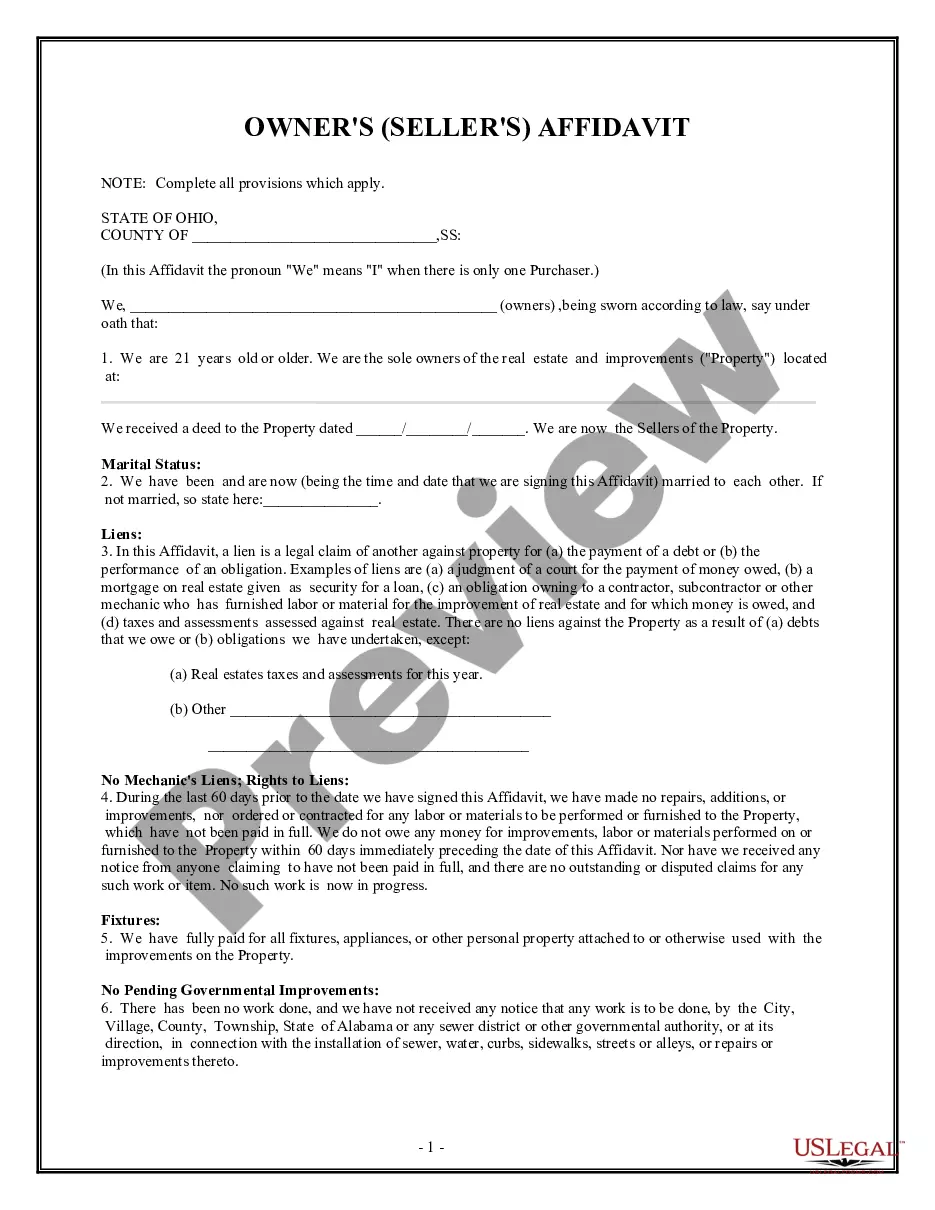
Three Party Nondisclosure Agreement - Statistical Analysis
Understanding this form
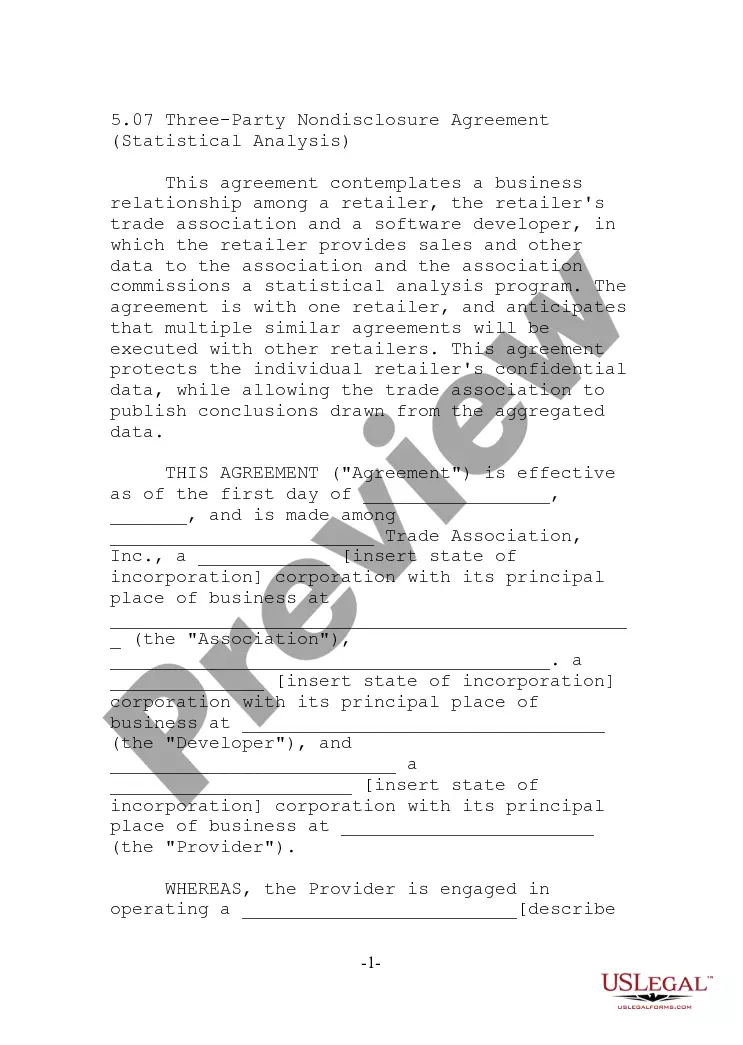
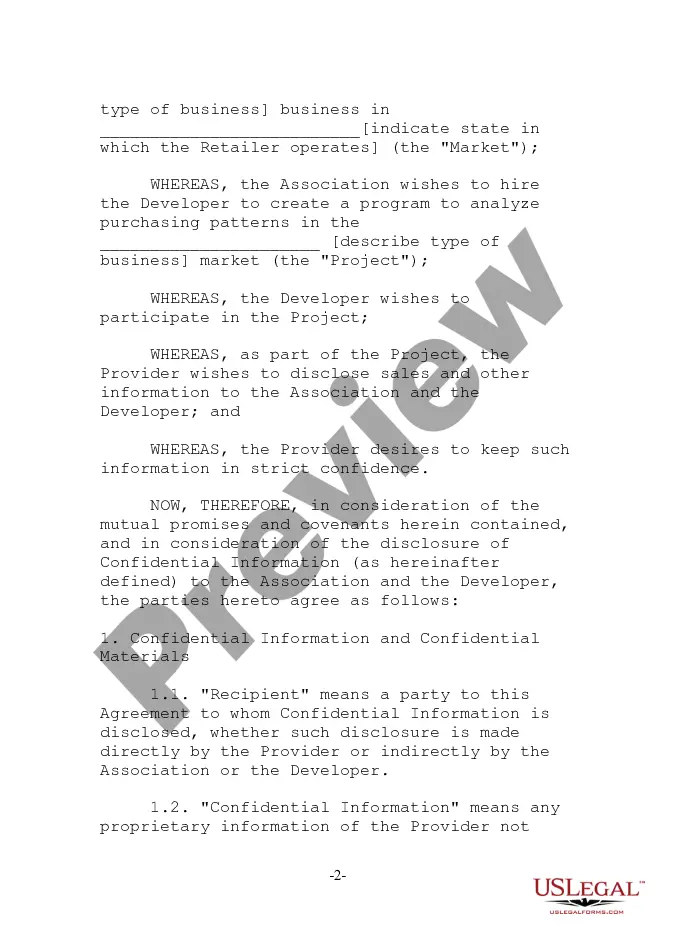
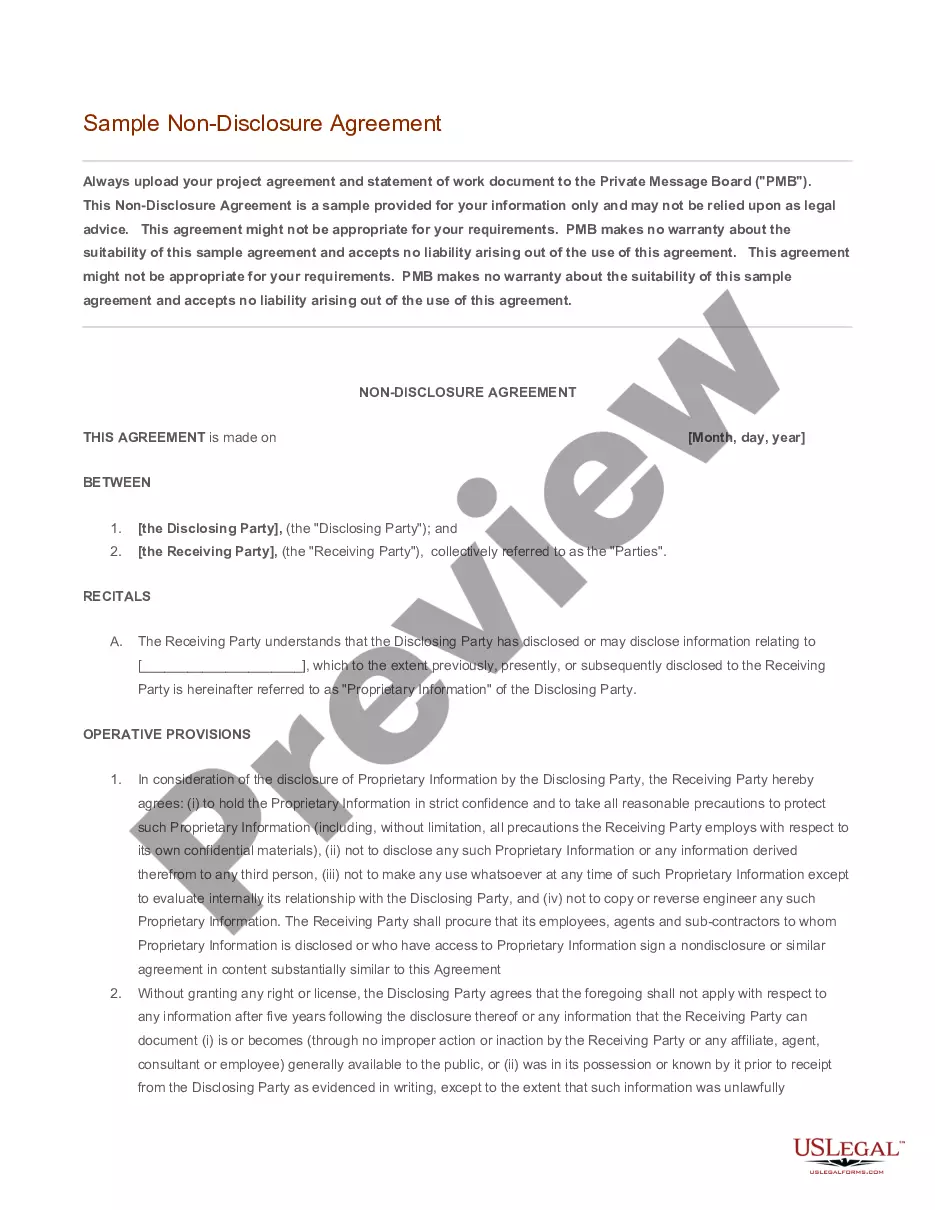
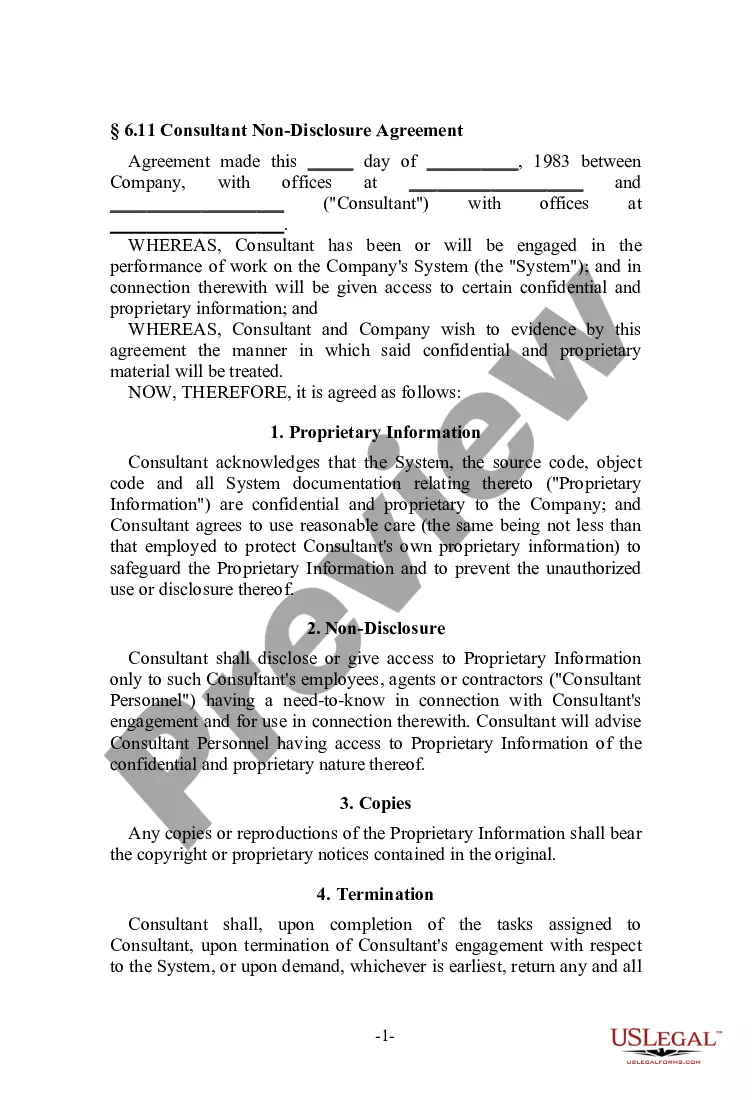
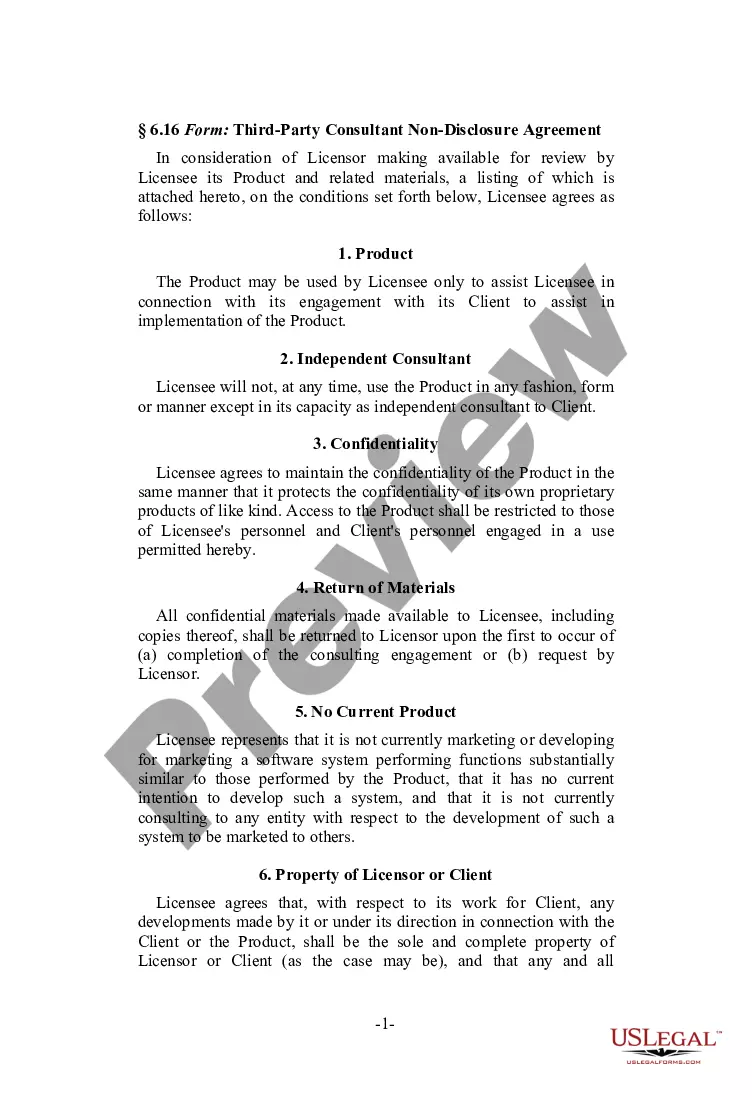
The Three Party Nondisclosure Agreement - Statistical Analysis is a legal document designed to protect confidential information shared among three parties: a retailer, a trade association, and a software developer. This agreement specifically facilitates the analysis of sales data while ensuring the confidentiality of sensitive information. It differs from other nondisclosure agreements by explicitly addressing the use of statistical analysis in a business context, making it suitable for industries involved in sales data and analytics.
Main sections of this form
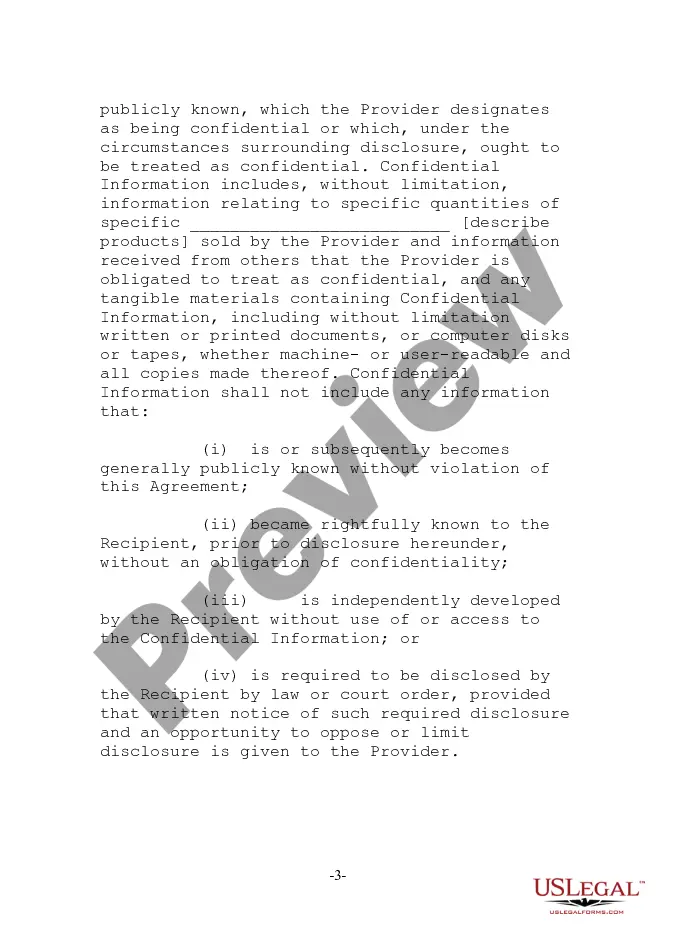
- Confidential Information: Defines what constitutes confidential information and outlines the obligations of the parties regarding its protection.
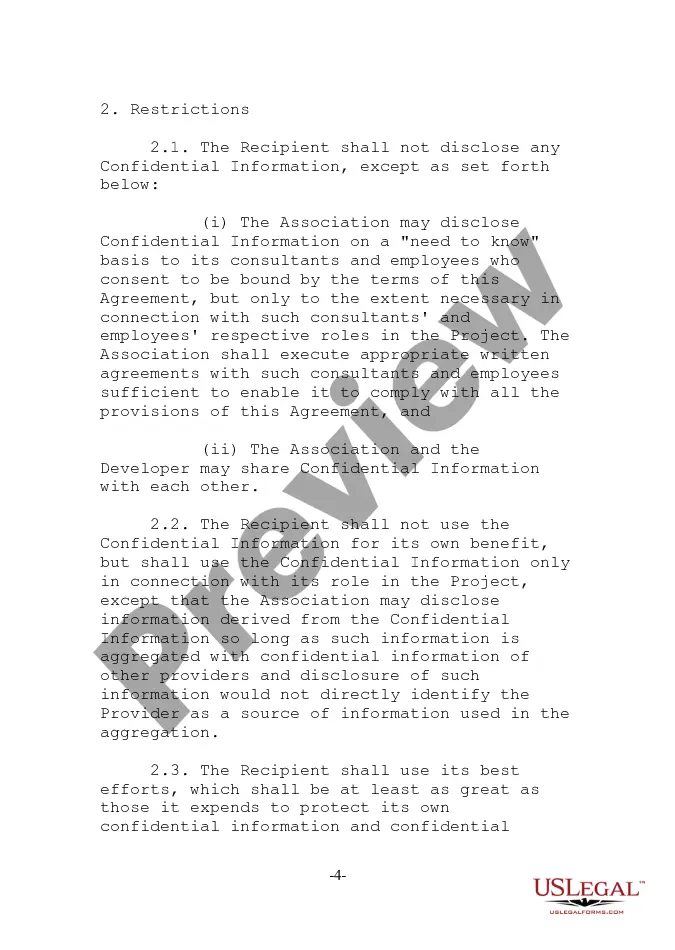
- Restrictions: Details the limitations on the use and disclosure of confidential information among the parties.
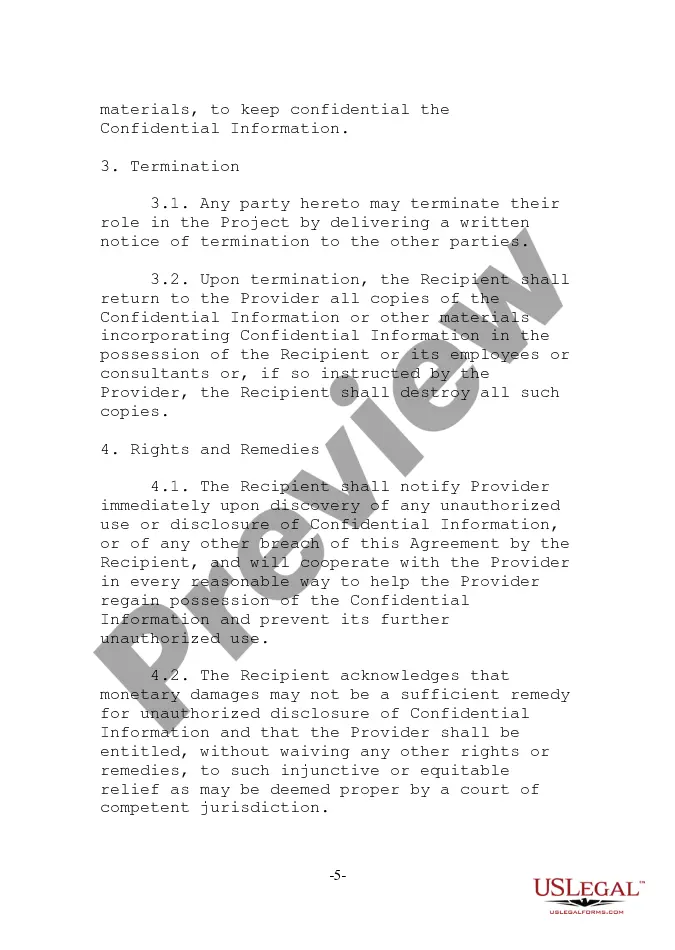
- Termination Clause: Specifies how a party can terminate its role in the agreement and the subsequent handling of confidential information.
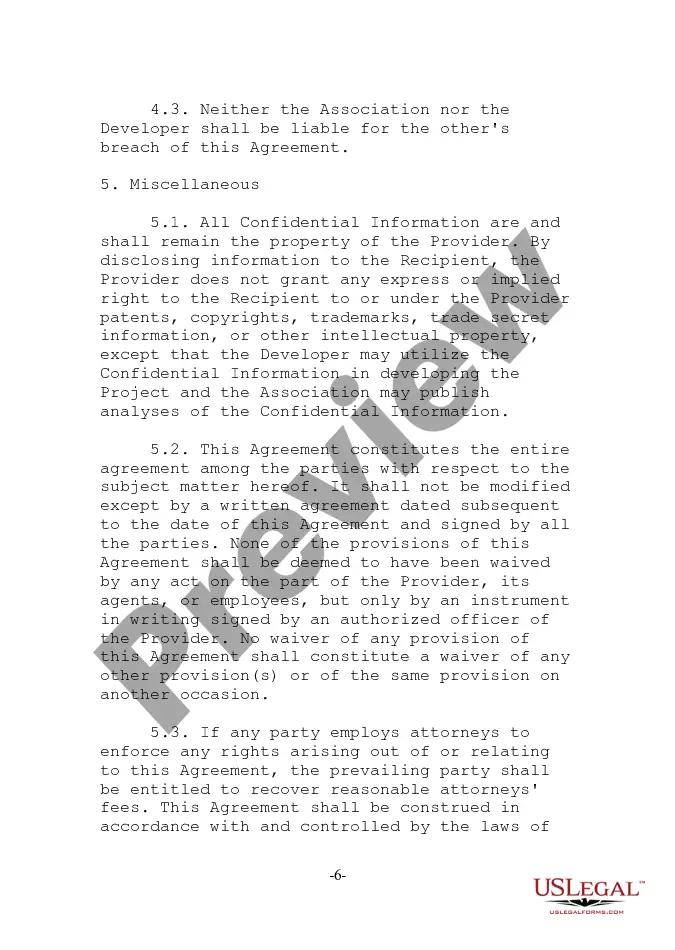
- Rights and Remedies: Outlines the legal remedies available in case of unauthorized disclosures or breaches of the agreement.
- Miscellaneous Provisions: Covers additional legal stipulations, including governing law and waiver of rights.
When this form is needed
This agreement is useful when a retailer intends to share sales data with a trade association for analysis purposes, while the trade association collaborates with a software developer to conduct statistical studies. Scenarios may include launching a new product, assessing market trends, or developing strategies based on aggregated sales data. The form ensures that the retailer's individual data remains protected during such collaborative efforts.
Who needs this form
- Retailers looking to share sensitive sales information for analysis.
- Trade associations involved in commissioning statistical analysis on member data.
- Software developers engaged in projects that require access to confidential sales information.
- Businesses interested in protecting proprietary information while participating in joint analysis projects.
How to prepare this document
- Identify the parties involved: Retailer, trade association, and software developer.
- Fill in the effective date at the top of the agreement.
- Specify the type of business and market relevant to the retailer.
- Clearly define what constitutes confidential information in the agreement.
- Include signatures, printed names, and titles of all parties to finalize the agreement.
Notarization guidance
This form does not typically require notarization unless specified by local law. Confirm any state-specific notarization requirements to ensure compliance.
Get your form ready online
Our built-in tools help you complete, sign, share, and store your documents in one place.
Make edits, fill in missing information, and update formatting in US Legal Forms—just like you would in MS Word.
Download a copy, print it, send it by email, or mail it via USPS—whatever works best for your next step.
Sign and collect signatures with our SignNow integration. Send to multiple recipients, set reminders, and more. Go Premium to unlock E-Sign.
If this form requires notarization, complete it online through a secure video call—no need to meet a notary in person or wait for an appointment.
We protect your documents and personal data by following strict security and privacy standards.

Make edits, fill in missing information, and update formatting in US Legal Forms—just like you would in MS Word.

Download a copy, print it, send it by email, or mail it via USPS—whatever works best for your next step.

Sign and collect signatures with our SignNow integration. Send to multiple recipients, set reminders, and more. Go Premium to unlock E-Sign.

If this form requires notarization, complete it online through a secure video call—no need to meet a notary in person or wait for an appointment.

We protect your documents and personal data by following strict security and privacy standards.
Common mistakes
- Failing to clearly define what constitutes confidential information.
- Not specifying the obligations of each party regarding the use of the confidential data.
- Omitting signatures from all parties involved in the agreement.
- Neglecting to update the effective date or details if the information changes.
Why complete this form online
- Convenience: Easily download and complete the form from any location.
- Editability: Tailor the agreement to fit specific business needs directly.
- Reliability: Access professionally drafted language by licensed attorneys.
- Time-saving: Instant availability allows for quick turnaround in legal processing.
Legal use & context
- This agreement is legally enforceable in accordance with the stipulated jurisdiction.
- Properly executed nondisclosure agreements can enhance trust among business partners.
- Failure to use a clear agreement may result in confidentiality breaches and legal disputes.
Main things to remember
Key takeaways:
- The Three Party Nondisclosure Agreement is vital for protecting sensitive information in collaborative projects.
- Complete the form carefully, ensuring all parties understand their roles and responsibilities.
- Review common mistakes to avoid pitfalls in the agreement process.
Looking for another form?
Form popularity
FAQ
A legal contract is a legally enforceable agreement between two or more parties. It may be verbal or written. Typically, a party promises to do something for the other in exchange for a benefit.
DISBUSEMENT OF LOAN(S) OBLIGATIONS OF THE BUYER(S) AND/OR THE BUILDER(S) REPRESENTATIONS AND WARRANTIES. NOTICE. GOVERNING LAW AND DISPUTE RESOLUTION.
PandaTip: Quite simply, a tripartite agreement is an agreement between three parties. You could have a tripartite non-disclosure agreement, a tripartite non-compete agreement you name it. That said, tripartite agreements surface most often when banks are a party to a transaction.
Third party contracts are agreements that involve a person who isn't a party to a contract but is involved with the transaction. This person may be a buyer representing one of the parties.
Third party contracts are agreements that involve a person who isn't a party to a contract but is involved with the transaction. This person may be a buyer representing one of the parties.
Fundamentally, two or more parties enter into a contract. A "party" may be anindividual, a group of people, or even an "artificial person" such as a corporation. The parties to a contract must have the legal capacity to enter intothat contract.
4. How can a third party can be avoided in a contract? A third party can be included in a contract only when he/she is an intended beneficiary named in the contract and must be intended to be benefited expressly in the contract. An incidental beneficiary has no rights to recover anything under the contract.
A tripartite agreement is an agreement in which there are three parties. Generally speaking the agreement between buyer and seller is sufficient and there is no need of any third party.
A tri-party agreement is a business deal between three separate parties. In the mortgage industry, a tri-party or tripartite agreement often takes place during the construction phase of a new home or condominium complex, to secure so-called bridge loans for the construction itself.