USLegal Guide to Disabled Adults
Overview of this form
The USLegal Guide to Disabled Adults offers a comprehensive overview of disability law, including definitions and classifications of disabilities. It outlines important legislation such as the Social Security Act and the Americans With Disabilities Act, explaining their implications for education, employment, and public access. This guide is distinct in its detail about specific types of disabilities and their legal protections, making it an essential resource for individuals navigating disability rights.
Main sections of this form
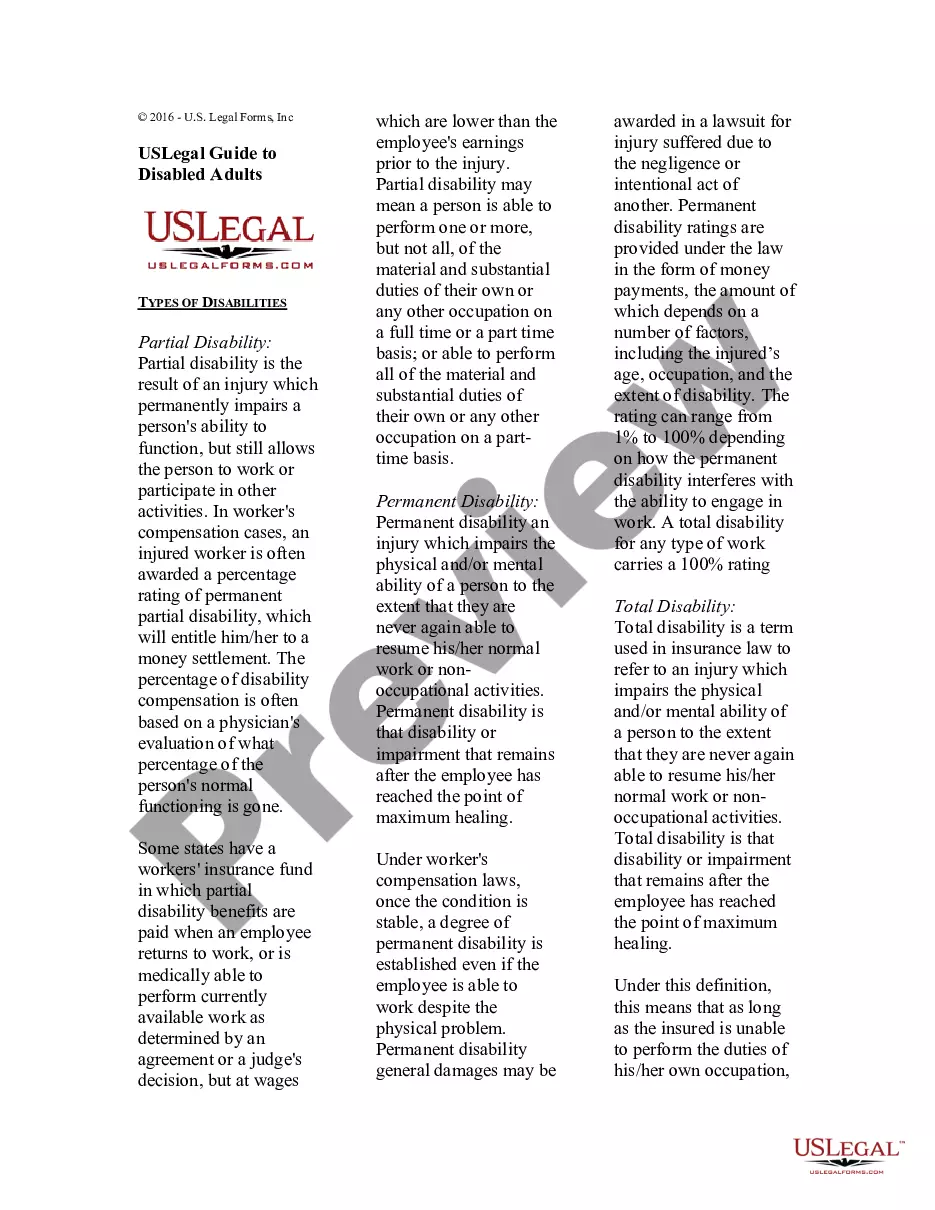
- Definition of disability and types: Partial disability, permanent disability, total disability, and mental disability.
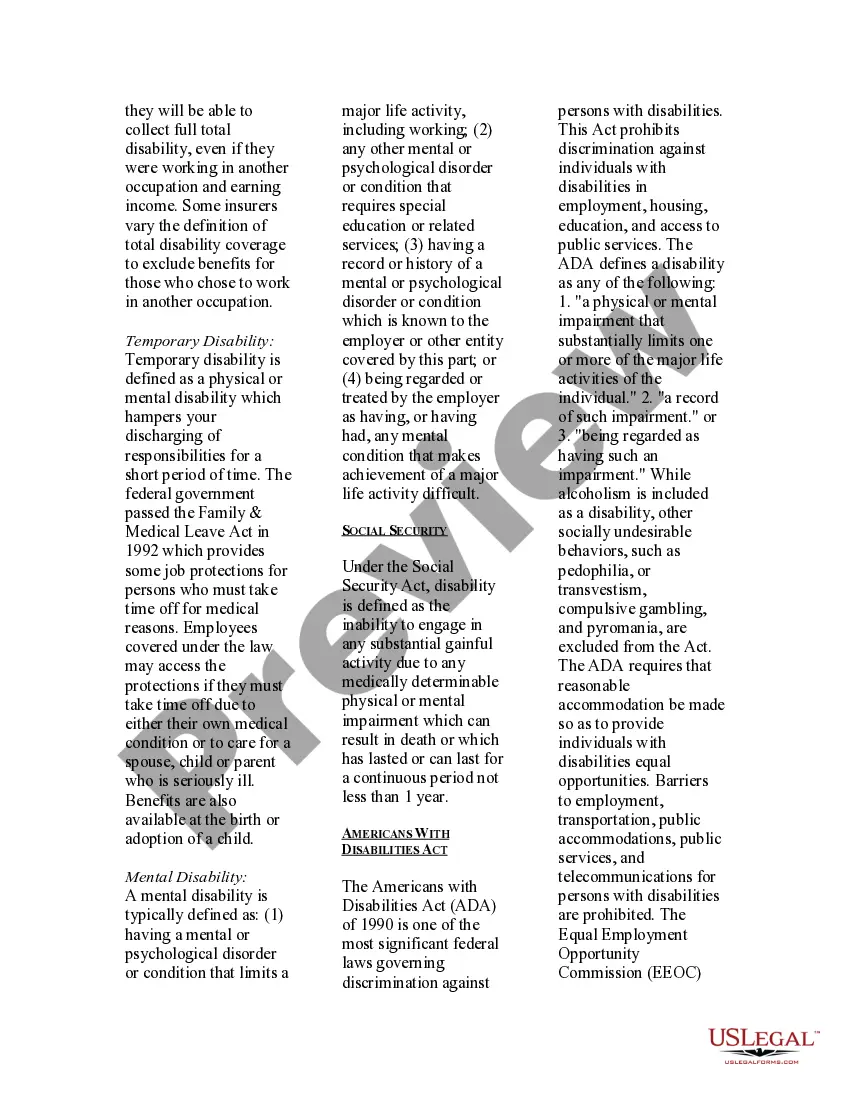
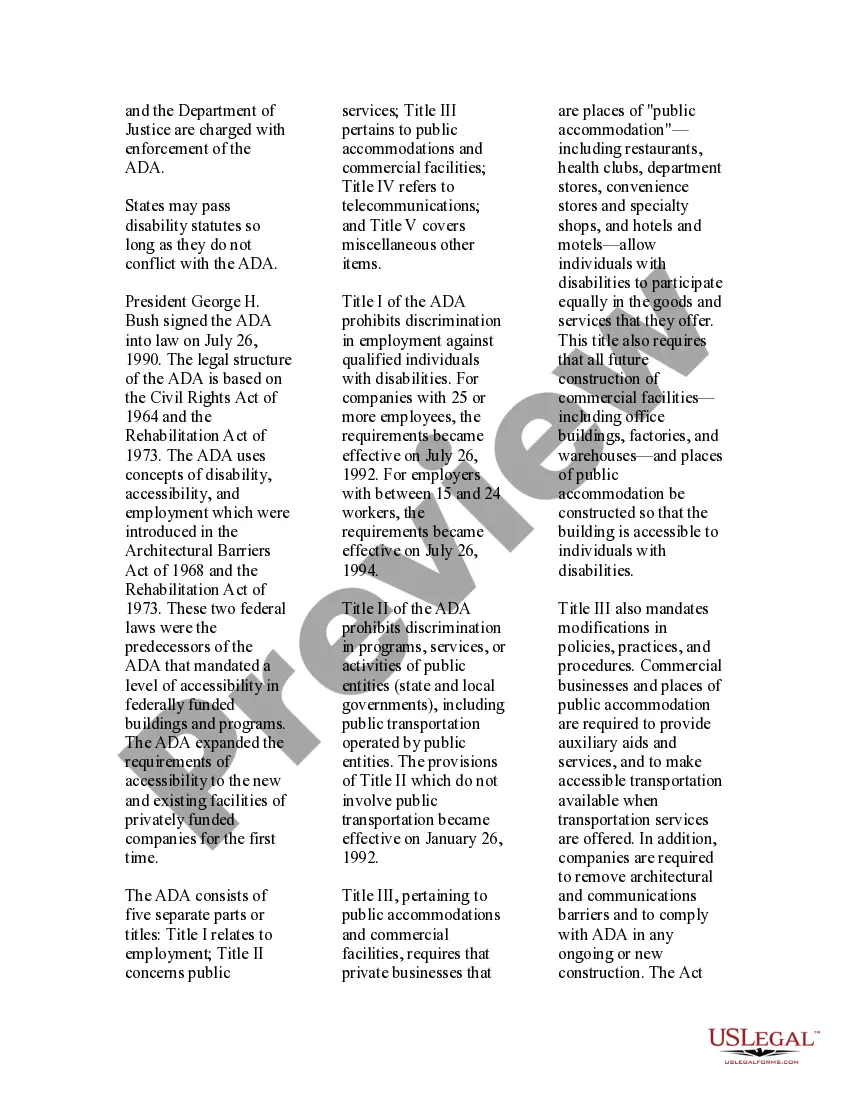
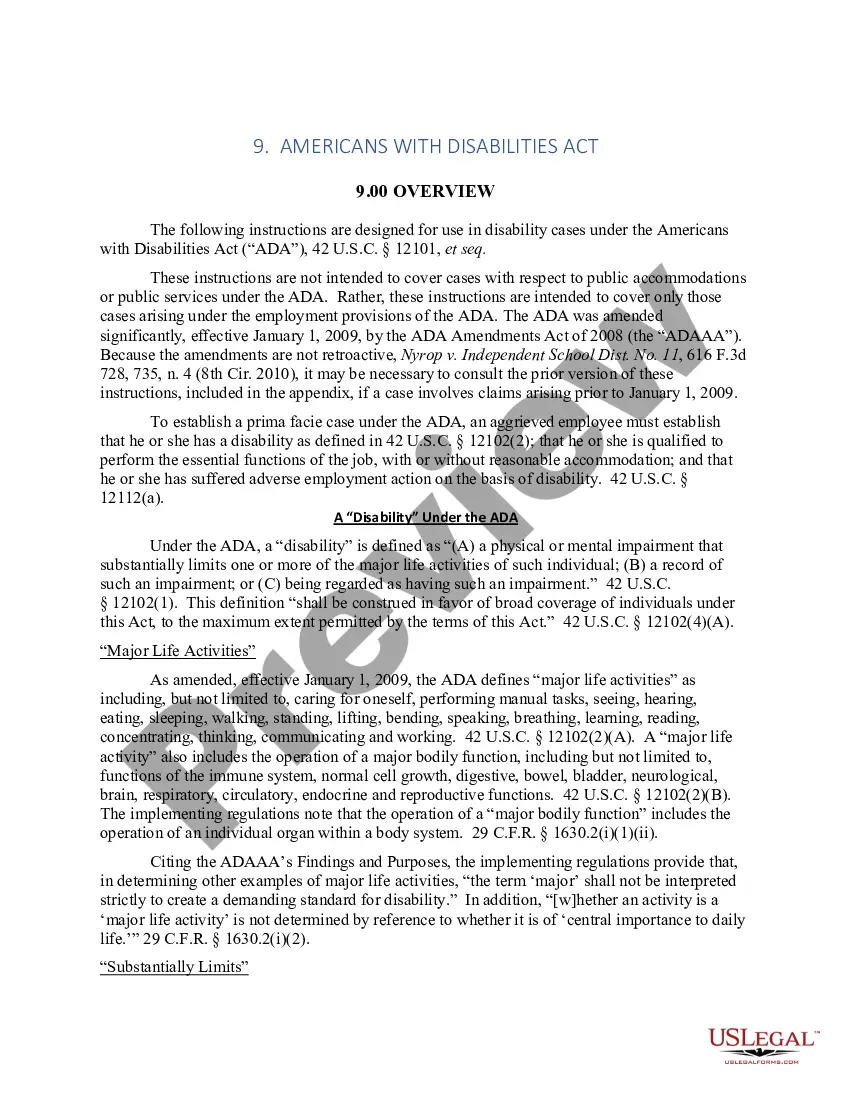
- Overview of key laws: Social Security Act and the Americans With Disabilities Act (ADA).
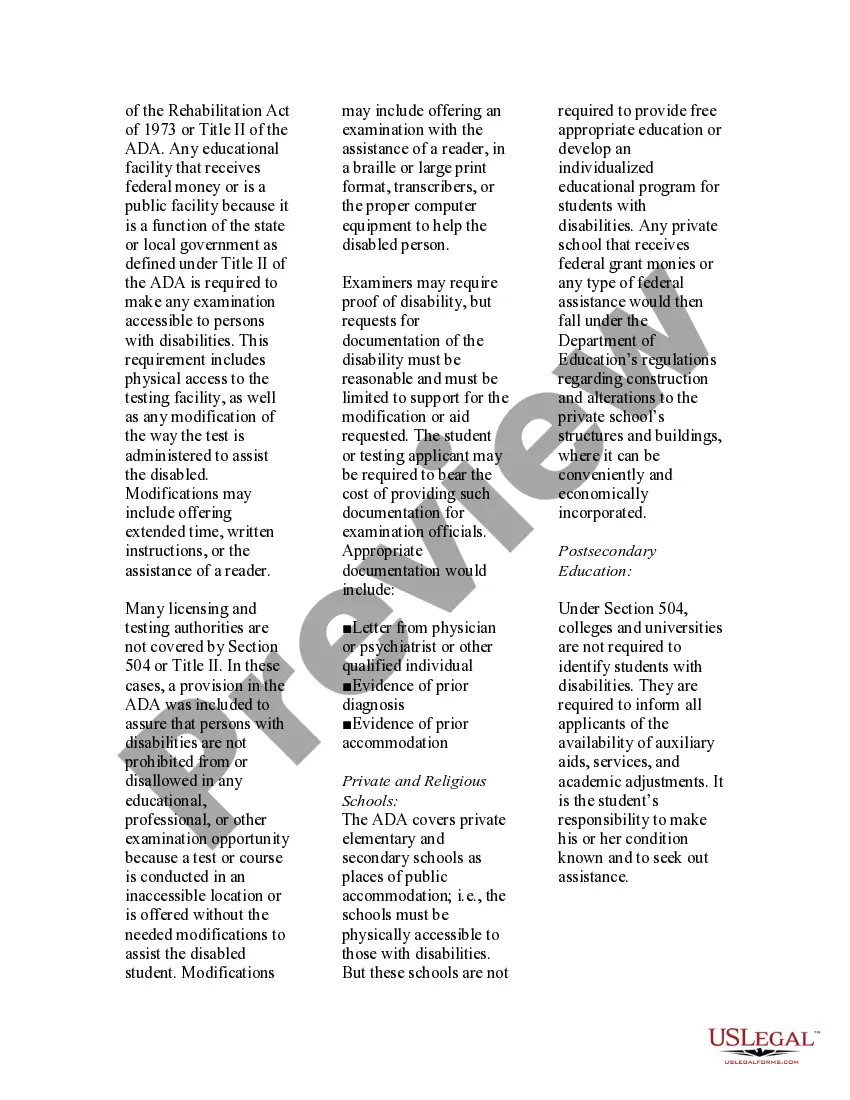
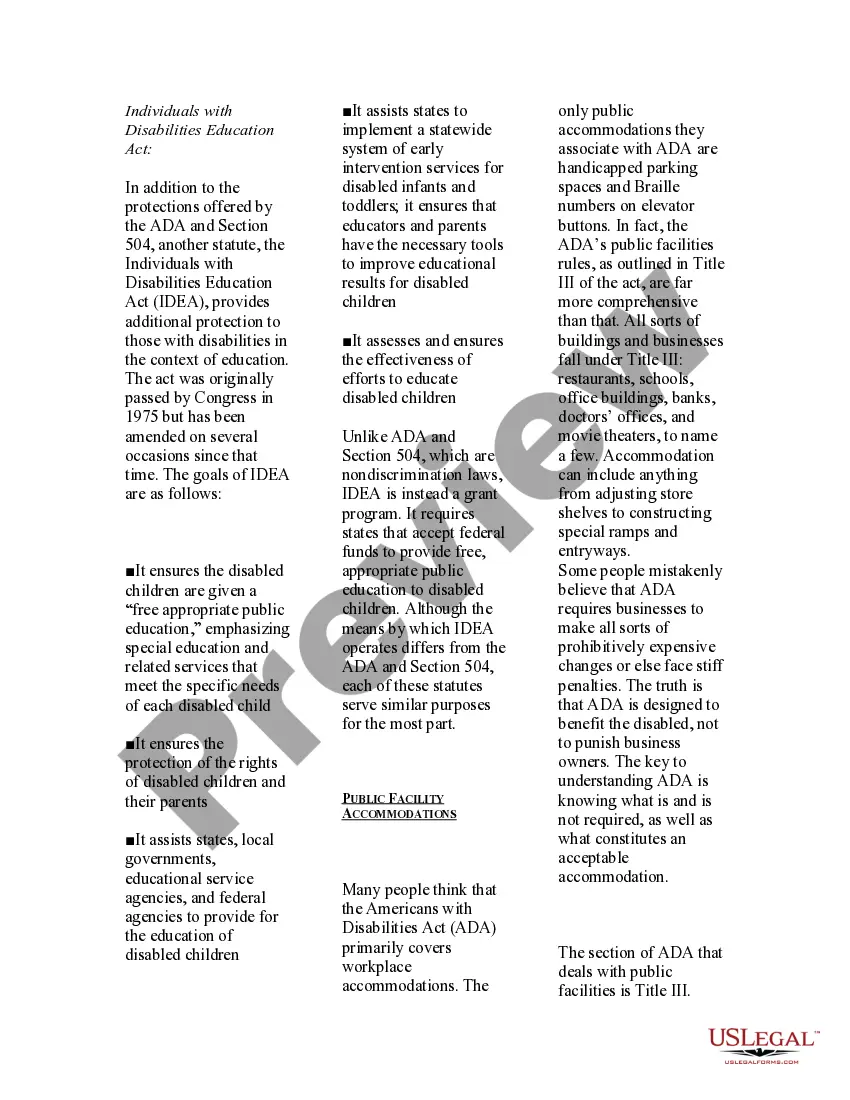
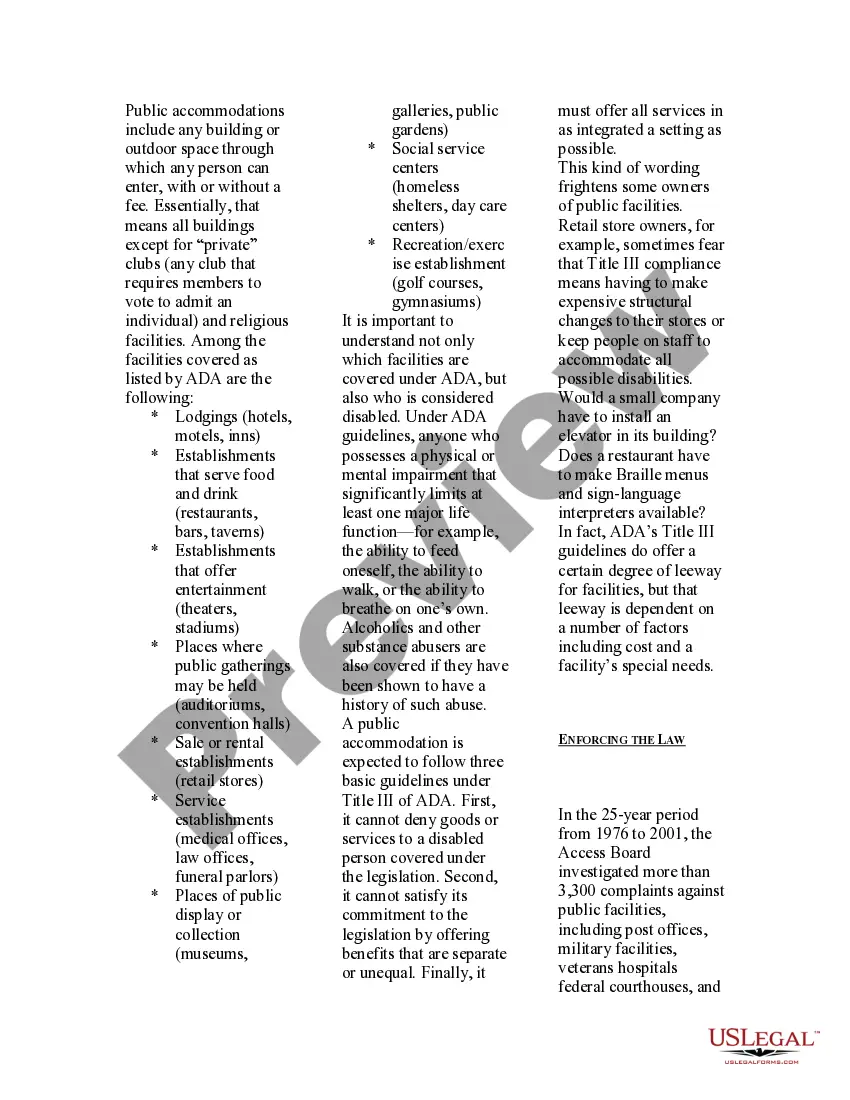
- Rights and accommodations at work, in education, and public facilities.
- Guidance on the legal responsibilities of employers and institutions regarding disability.
- Explanation of the process and criteria for obtaining disability benefits.


When to use this document
This guide is useful when an individual needs to understand their rights under disability law, whether they are seeking employment, education, or public services. It serves as a reference for those who may need accommodations due to a disability and for advocates assisting individuals with disabilities in understanding their legal protections.
Who should use this form
- Individuals with disabilities seeking information on their rights.
- Families and caregivers of disabled individuals needing guidance on legal matters.
- Educators and employers looking to comply with disability law.
- Advocates and legal representatives assisting disabled clients.
How to complete this form
- Review the definitions of various types of disabilities to identify your category.
- Understand the relevant laws and how they apply to your situation.
- Assess your eligibility for benefits under the Social Security Act and other statutes.
- Determine what accommodations you may need in work, education, and public access.
- Engage with legal representatives or advocacy groups if needed for further assistance.
Notarization guidance
Notarization is generally not required for this form. However, certain states or situations might demand it. You can complete notarization online through US Legal Forms, powered by Notarize, using a verified video call available anytime.
Get your form ready online
Our built-in tools help you complete, sign, share, and store your documents in one place.
Make edits, fill in missing information, and update formatting in US Legal Forms—just like you would in MS Word.
Download a copy, print it, send it by email, or mail it via USPS—whatever works best for your next step.
Sign and collect signatures with our SignNow integration. Send to multiple recipients, set reminders, and more. Go Premium to unlock E-Sign.
If this form requires notarization, complete it online through a secure video call—no need to meet a notary in person or wait for an appointment.
We protect your documents and personal data by following strict security and privacy standards.

Make edits, fill in missing information, and update formatting in US Legal Forms—just like you would in MS Word.

Download a copy, print it, send it by email, or mail it via USPS—whatever works best for your next step.

Sign and collect signatures with our SignNow integration. Send to multiple recipients, set reminders, and more. Go Premium to unlock E-Sign.

If this form requires notarization, complete it online through a secure video call—no need to meet a notary in person or wait for an appointment.

We protect your documents and personal data by following strict security and privacy standards.
Avoid these common issues
- Failing to document the disability accurately when seeking benefits.
- Not understanding the specific provisions of the ADA relevant to their situation.
- Overlooking state-specific regulations that may provide additional protections.
Why complete this form online
- Instant access to up-to-date legal information on disability rights.
- Convenient downloading of resources without the need for in-person visits.
- Ability to easily print and share the guide with relevant parties.
Legal use & context
- This guide serves as a resource for understanding federal and state disability laws.
- It outlines the rights of individuals with disabilities, helping to ensure compliance with the ADA.
- While informative, this guide should not be a replacement for legal advice from a qualified attorney.
Looking for another form?

Form popularity
FAQ
Lawmakers reasoned that if you were old enough to vote, you were old enough to drink, Mr. Parent said. That philosophy continued in 1971, when Congress lowered the voting age to 18 in response to fury over the draft during the Vietnam War, which conscripted thousands of men between 18 and 21 into war.
An adult is a mature, fully developed person. An adult has reached the age when they are legally responsible for their actions.Adult means relating to the time when you are an adult, or typical of adult people.
The age of 18 is widely accepted as the start of adulthood but those one or two years younger occupy a strange twilight zone where they are given many freedoms and responsibilities but denied others.
According to the U.S. government, a child officially becomes an adult when they turn 18. That's when they can vote and start paying taxes.
Accordingly, an adult is someone who accepts responsibility, makes independent decisions, and becomes financially independent.
Why is 18 considered the age of adulthood? Because that's when people get to vote.Retaining a higher age of majority didn't seem to make sense if lawmakers were going to let young people vote at 18, so states began using 18 as the new measure for legal adulthood.
An adult is a person who has attained the age of majority. The age of majority is the legally defined age at which a person is considered an adult, with all the attendant rights and responsibilities of adulthood. The age of majority is defined by state laws, which vary by state, but is 18 in most states.
Lawmakers reasoned that if you were old enough to vote, you were old enough to drink, Mr. Parent said. That philosophy continued in 1971, when Congress lowered the voting age to 18 in response to fury over the draft during the Vietnam War, which conscripted thousands of men between 18 and 21 into war.