Participation Agreement for Single Well
Understanding this form
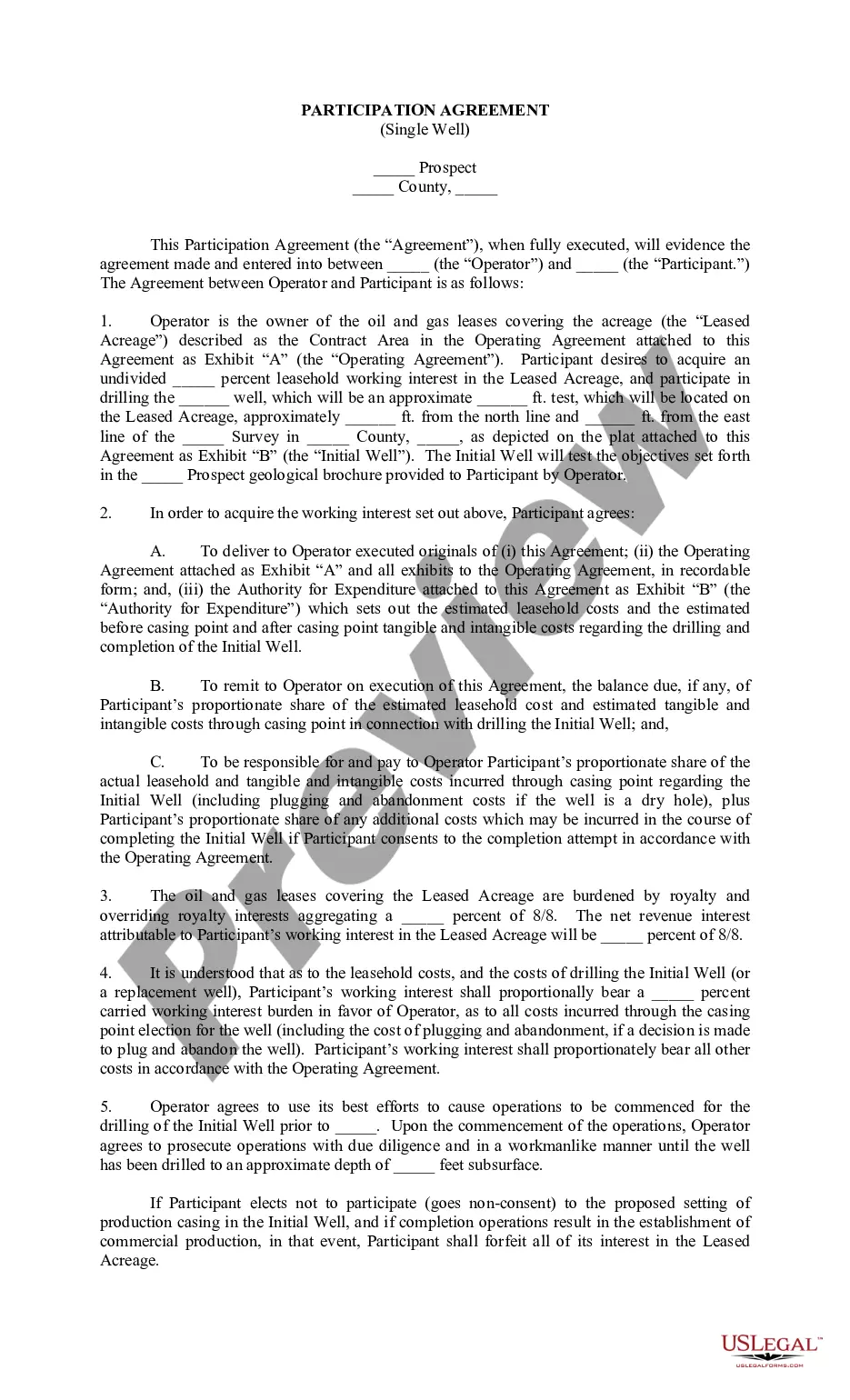
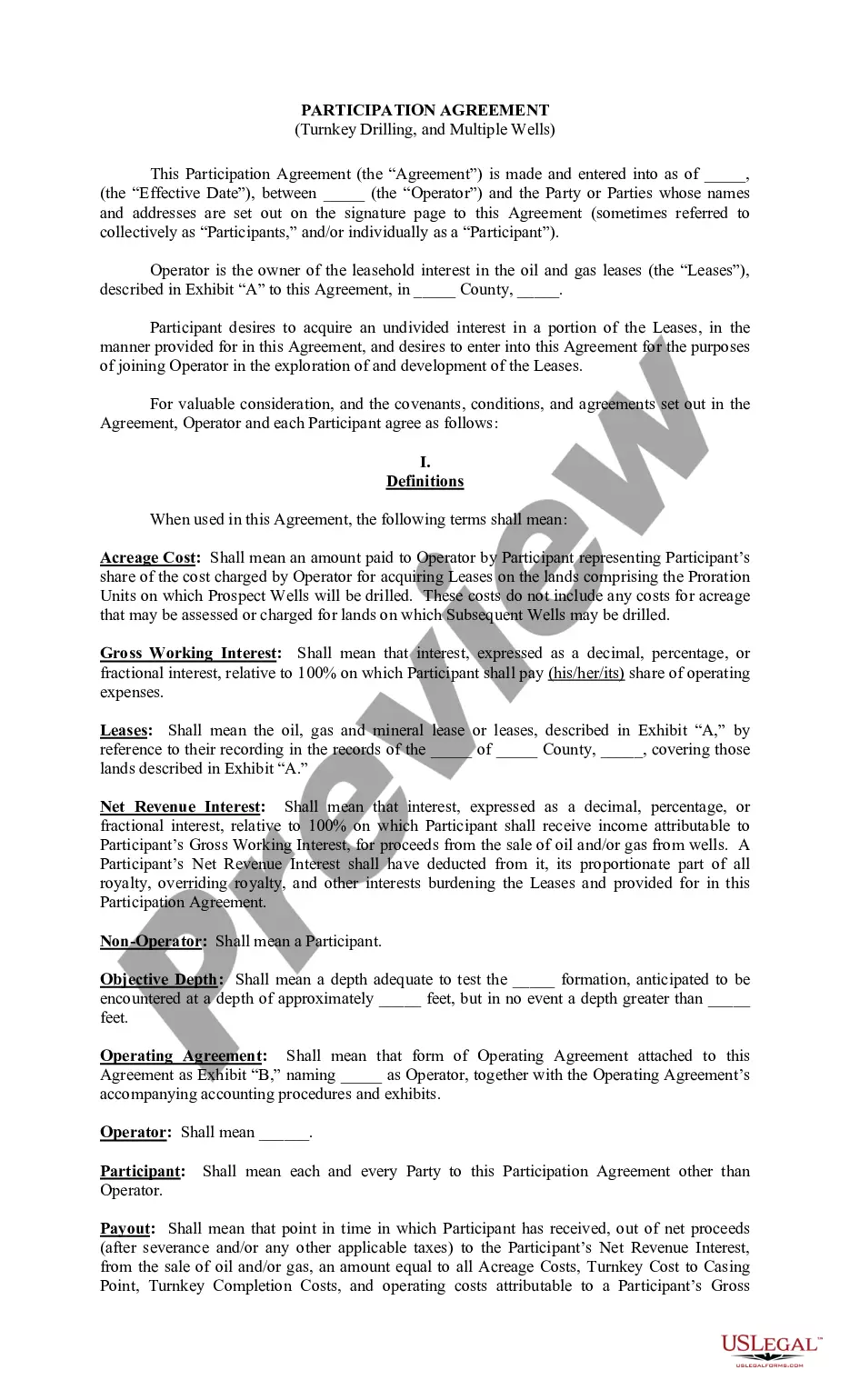
The Participation Agreement for Single Well is a legal contract between an Operator and a Participant. It outlines the terms under which the Participant can acquire a working interest in the oil and gas leases owned by the Operator. This agreement is crucial for individuals or entities looking to participate in the drilling of a specific well, reflecting the unique legal nature of oil and gas agreements as compared to standard contracts.
Form components explained
- Identification of parties: Names of the Operator and Participant.
- Details of the Leased Acreage: Description of the location and specifications of the well.
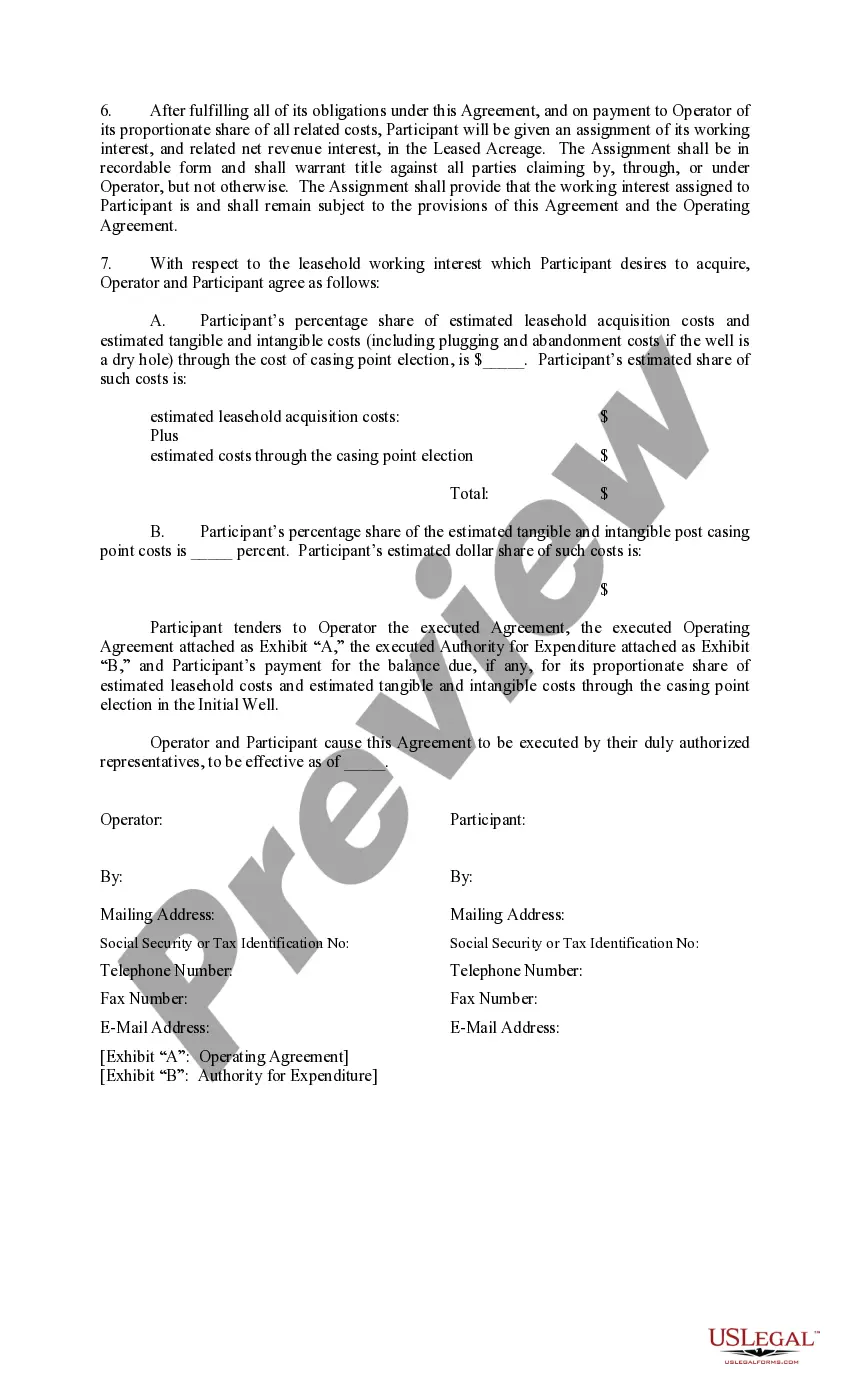
- Cost obligations: Breakdown of estimated leasehold, tangible, and intangible costs.
- Rights and responsibilities: Provisions regarding the working interest and costs related to drilling and potential abandonment.
- Assignment of interests: Procedures for transferring the working interest to the Participant upon fulfilling obligations.
When this form is needed
This form is ideal for situations where an individual or business wants to engage in oil and gas development by acquiring a leasehold interest in a specific well. It applies when the Operator is already holding oil and gas leases and wants to allow other investors to participate in the drilling and potential production of oil or gas, sharing both the risks and rewards of the venture.
Who this form is for
- Individuals or entities interested in investing in oil and gas drilling operations.
- Operators who seek to involve additional participants in a drilling project.
- Legal and financial advisors assisting clients with investment in the oil and gas sector.
Instructions for completing this form
- Identify the Operator and Participant by filling in their legal names.
- Specify the details of the Leased Acreage, including location and depth of the well.
- Calculate and enter the Participant's percentage share of costs associated with drilling.
- Clearly outline any obligations regarding payments to the Operator.
- Ensure all signatures are obtained where required for the agreement to be valid.
Notarization requirements for this form
This form does not typically require notarization unless specified by local law. It is advisable to verify whether notarization is needed in your jurisdiction for the Agreement to be legally binding.
Get your form ready online
Our built-in tools help you complete, sign, share, and store your documents in one place.
Make edits, fill in missing information, and update formatting in US Legal Forms—just like you would in MS Word.
Download a copy, print it, send it by email, or mail it via USPS—whatever works best for your next step.
Sign and collect signatures with our SignNow integration. Send to multiple recipients, set reminders, and more. Go Premium to unlock E-Sign.
If this form requires notarization, complete it online through a secure video call—no need to meet a notary in person or wait for an appointment.
We protect your documents and personal data by following strict security and privacy standards.

Make edits, fill in missing information, and update formatting in US Legal Forms—just like you would in MS Word.

Download a copy, print it, send it by email, or mail it via USPS—whatever works best for your next step.

Sign and collect signatures with our SignNow integration. Send to multiple recipients, set reminders, and more. Go Premium to unlock E-Sign.

If this form requires notarization, complete it online through a secure video call—no need to meet a notary in person or wait for an appointment.

We protect your documents and personal data by following strict security and privacy standards.
Common mistakes to avoid
- Not providing accurate details for the well location or depth.
- Forgetting to calculate and detail payment obligations clearly.
- Failing to obtain all necessary signatures from involved parties.
- Neglecting to attach required exhibits or agreements as specified.
Why complete this form online
- Convenient downloading: Acquire the form immediately without delays.
- Editability: Easily fill in the necessary details digitally for accuracy.
- Reliability: Use professionally drafted legal forms to minimize risks and legal issues.
Looking for another form?





Form popularity
FAQ
That can include private benefit, inurement, lobbying, political campaign activity, excessive unrelated business income, not filing an annual 990 tax information form, and failing to achieve its original purpose.
Political activity. All section 501(c)(3) organizations are prohibited from directly or indirectly participating in, or intervening in, any political campaign on behalf of (or in opposition to) any candidate running for public office. The prohibition applies to all campaigns (federal, state and local level).
IRC 501(c)(4), (c)(5), and (c)(6) organizations may engage in political campaigns on behalf of or in opposition to candidates for public office provided that such intervention does not constitute the organization's primary activity.
A 501(c)(3) organization may engage in some lobbying, but too much lobbying activity risks loss of tax-exempt status.Organizations may, however, involve themselves in issues of public policy without the activity being considered as lobbying.
In general, no organization may qualify for section 501(c)(3) status if a substantial part of its activities is attempting to influence legislation (commonly known as lobbying). A 501(c)(3) organization may engage in some lobbying, but too much lobbying activity risks loss of tax-exempt status.
For example, a section 501(c)(3) organization may not publish or distribute printed statements or make oral statements on behalf of, or in opposition to, a candidate for public office. Consequently, a written or oral endorsement of a candidate is strictly forbidden.
Currently, the law prohibits political campaign activity by charities and churches by defining a 501(c)(3) organization as one "which does not participate in, or intervene in (including the publishing or distributing of statements), any political campaign on behalf of (or in opposition to) any candidate for public
Exemption Requirements - 501(c)(3) Organizations To be tax-exempt under section 501(c)(3) of the Internal Revenue Code, an organization must be organized and operated exclusively for exempt purposes set forth in section 501(c)(3), and none of its earnings may inure to any private shareholder or individual.