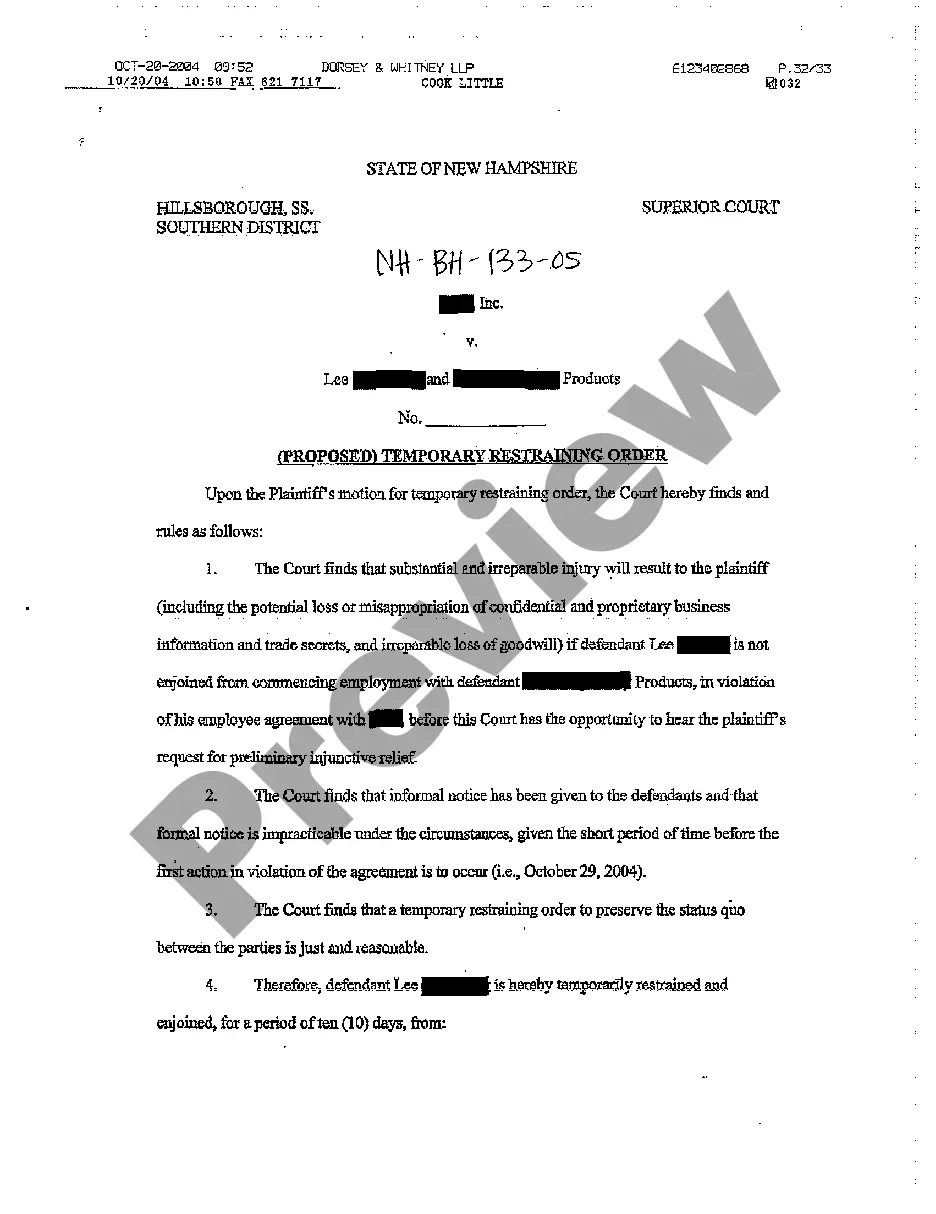
USLegal Guide on Restraining Orders and No Contact Orders
Overview of this form
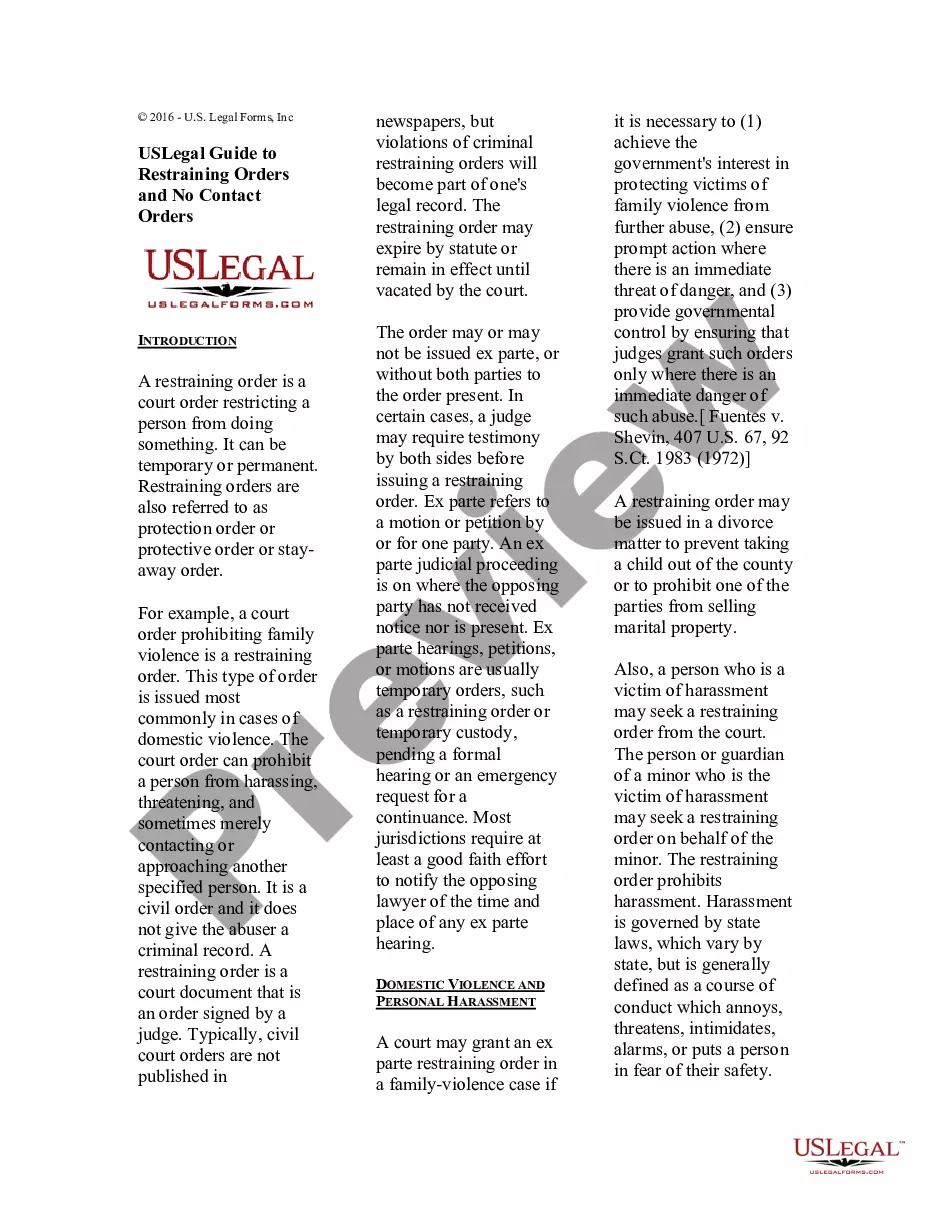
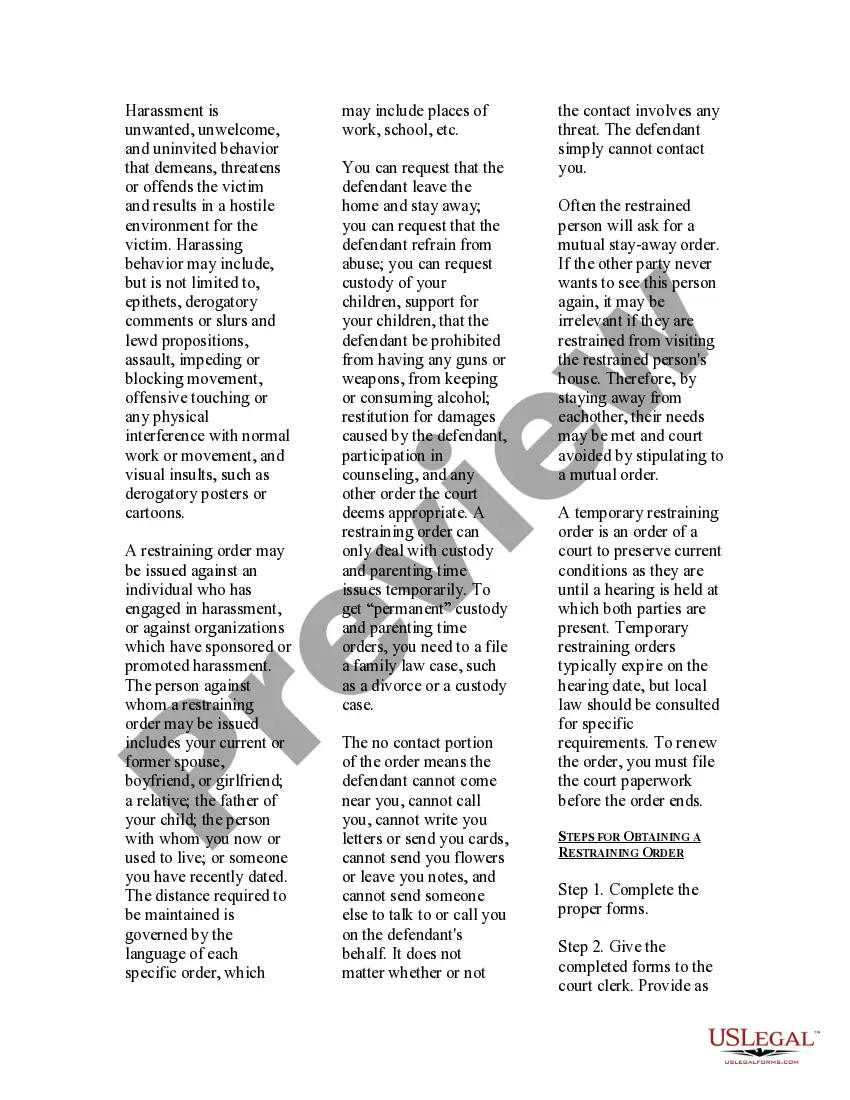
The USLegal Guide on Restraining Orders and No Contact Orders provides a comprehensive overview of restraining orders, which are legal documents issued by a court to protect individuals from harassment, threats, or violence. Unlike similar forms, such as standard protection orders, this guide offers specific details on the types of acts that can be restrained, who can be restrained, and the requests that can be included in the order. This form is essential for individuals seeking to establish clear legal boundaries for their safety and well-being.
Key parts of this document
- Definition of restraining orders and no contact orders
- Overview of acts that can be restrained
- Explanation of who can be restrained
- Details on what can be requested in the order
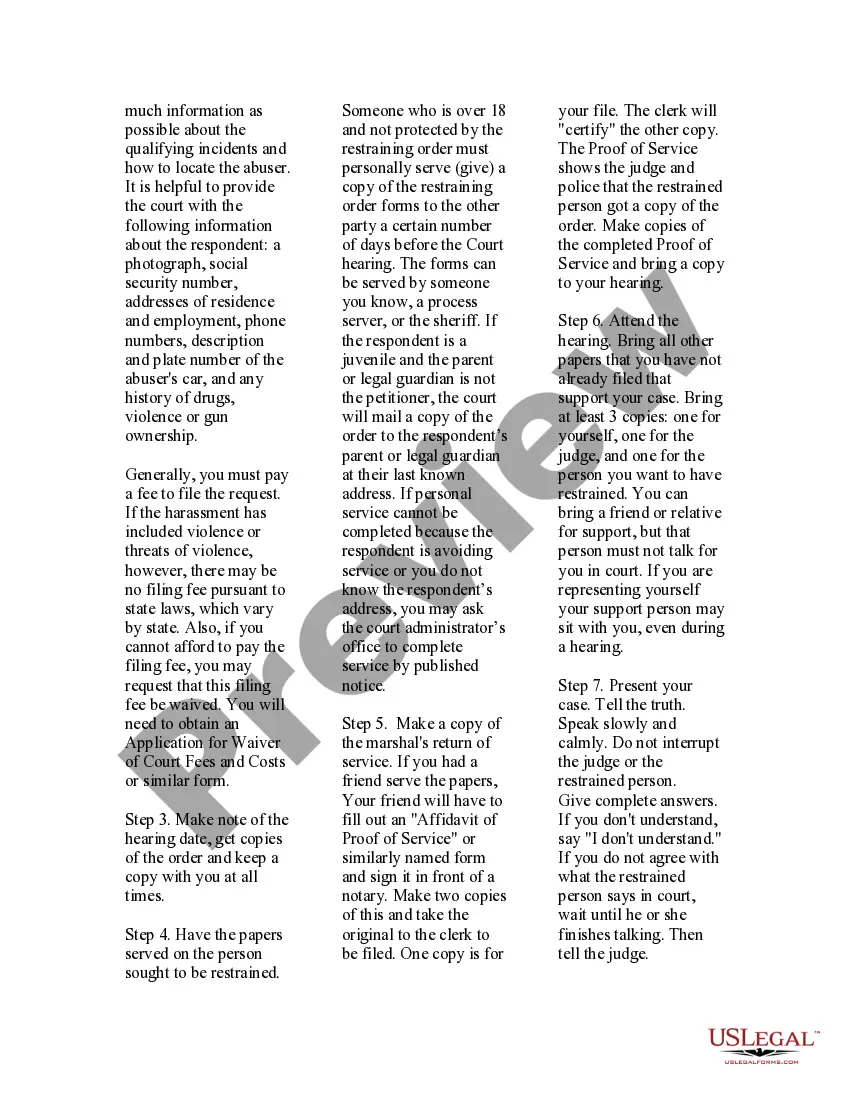
- Steps for obtaining a restraining order


When to use this document
This guide should be used when there is a need for legal protection from harassment, threats, or any form of abuse. Individuals facing domestic violence, stalking, or personal harassment can utilize this guide to understand the steps involved in obtaining a restraining order to ensure their safety.
Who can use this document
- Individuals who are victims of domestic violence
- People experiencing harassment or stalking
- Guardians seeking protection for minors
- Individuals seeking legal advice on protective orders
Instructions for completing this form
- Fill out the required forms with accurate details regarding the incidents.
- File the completed forms with the court clerk and pay any applicable fees.
- Serve the restraining order to the individual you wish to restrain through a third party.
- Attend the court hearing with all relevant documentation to present your case.
- Follow up by ensuring the order is upheld and renewed as necessary.
Does this form need to be notarized?
This form usually doesn’t need to be notarized. However, local laws or specific transactions may require it. Our online notarization service, powered by Notarize, lets you complete it remotely through a secure video session, available 24/7.
Get your form ready online
Our built-in tools help you complete, sign, share, and store your documents in one place.
Make edits, fill in missing information, and update formatting in US Legal Forms—just like you would in MS Word.
Download a copy, print it, send it by email, or mail it via USPS—whatever works best for your next step.
Sign and collect signatures with our SignNow integration. Send to multiple recipients, set reminders, and more. Go Premium to unlock E-Sign.
If this form requires notarization, complete it online through a secure video call—no need to meet a notary in person or wait for an appointment.
We protect your documents and personal data by following strict security and privacy standards.

Make edits, fill in missing information, and update formatting in US Legal Forms—just like you would in MS Word.

Download a copy, print it, send it by email, or mail it via USPS—whatever works best for your next step.

Sign and collect signatures with our SignNow integration. Send to multiple recipients, set reminders, and more. Go Premium to unlock E-Sign.

If this form requires notarization, complete it online through a secure video call—no need to meet a notary in person or wait for an appointment.

We protect your documents and personal data by following strict security and privacy standards.
Common mistakes
- Failing to provide complete information on incidents of harassment.
- Not serving the restraining order correctly.
- Missing court deadlines for hearings or renewals.
- Neglecting to keep a copy of the order for personal records.
Advantages of online completion
- Convenient access to legal forms and guidance from anywhere.
- Edit and customize the form to meet specific needs.
- Reliable templates drafted by licensed professionals.
Looking for another form?
Form popularity
FAQ
The court is looking for a description of your relationship to the respondent, when, where, what happened, and who did what to whom. Using the facts of the incident only, keep your statement brief and to the point. Briefly describe the most recent incident of abuse and/or threats of abuse or other behaviors.
A protective order does NOT go both ways. So he can get in trouble for having contact with her, but she cannot get in trouble for having contact with him.Also, evidence that she continues to contact him is very compelling in any attempt to dissolve the protective order or avoid having it extended.
If you have had a restraining order placed against you, you may wonder if that will show on a background check and how it will affect you. Typically, restraining orders are civil, which means they shouldn't show on a criminal background check.
To obtain a no-contact order of protection you need to file in the district court where you live. You can also file a no-contact order in the county where the person who is abusing you lives, or in the county where the abuse or unlawful act happened.
After a no-contact order is issued, it is entered into the law enforcement computer-based criminal intelligence information system.Even if you are not driving and the officer looks up the alleged victim's license information, the officer will see that a no-contact order is protecting an alleged victim.
You cannot drop the charges, but as long as the judge believes that you are not being forced or coerced into dropping the No Contact order, he/she should drop it. Just go to the court that put the order in effect and ask the Clerk's office to pull the case and tell them what it is that you are seeking.
A no contact order usually instructs the defendant not to have any in-person contact with the alleged victim. The defendant is instructed to stay a minimum number of feet away from the victim's place of residence, employment and known areas that he or she frequents.
Generally, to prove a no-contact order has been broken you must show the existence of the no-contact order. You also must show that the other person had sufficient legal notice of the order against them.
The laws on restraining orders and no-contact agreements vary by state, but the main idea is that no-contact agreements exist to punish someone who has already caused harm and to prevent further harm, whereas restraining orders exist to prevent someone from causing harm in the first place.