Assumption Agreement of NAB Nordamerika Beteiligungs Holding GMBH between France Telecom and Deutsche Telecom AG regarding acquisition of Class A Stock
About this form
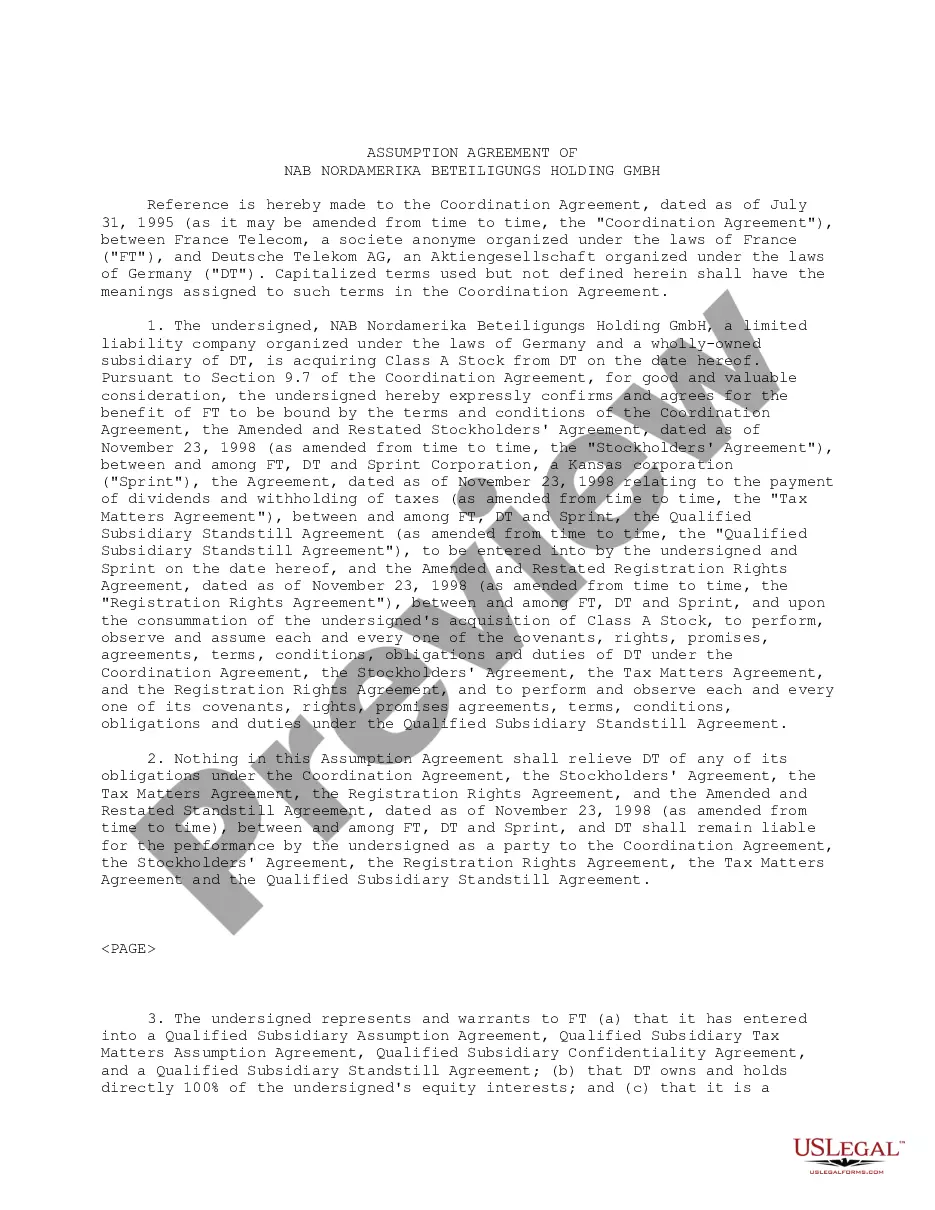
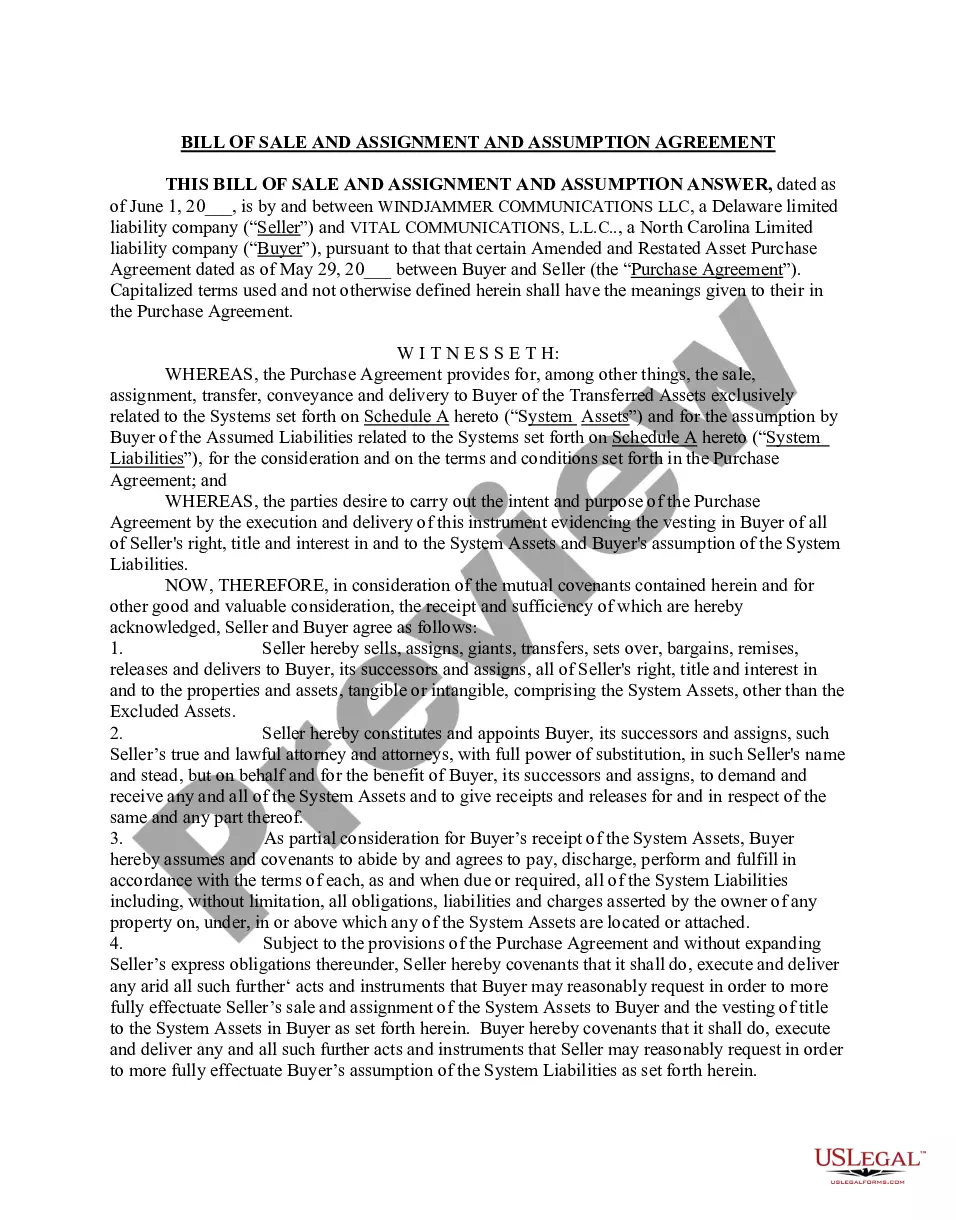
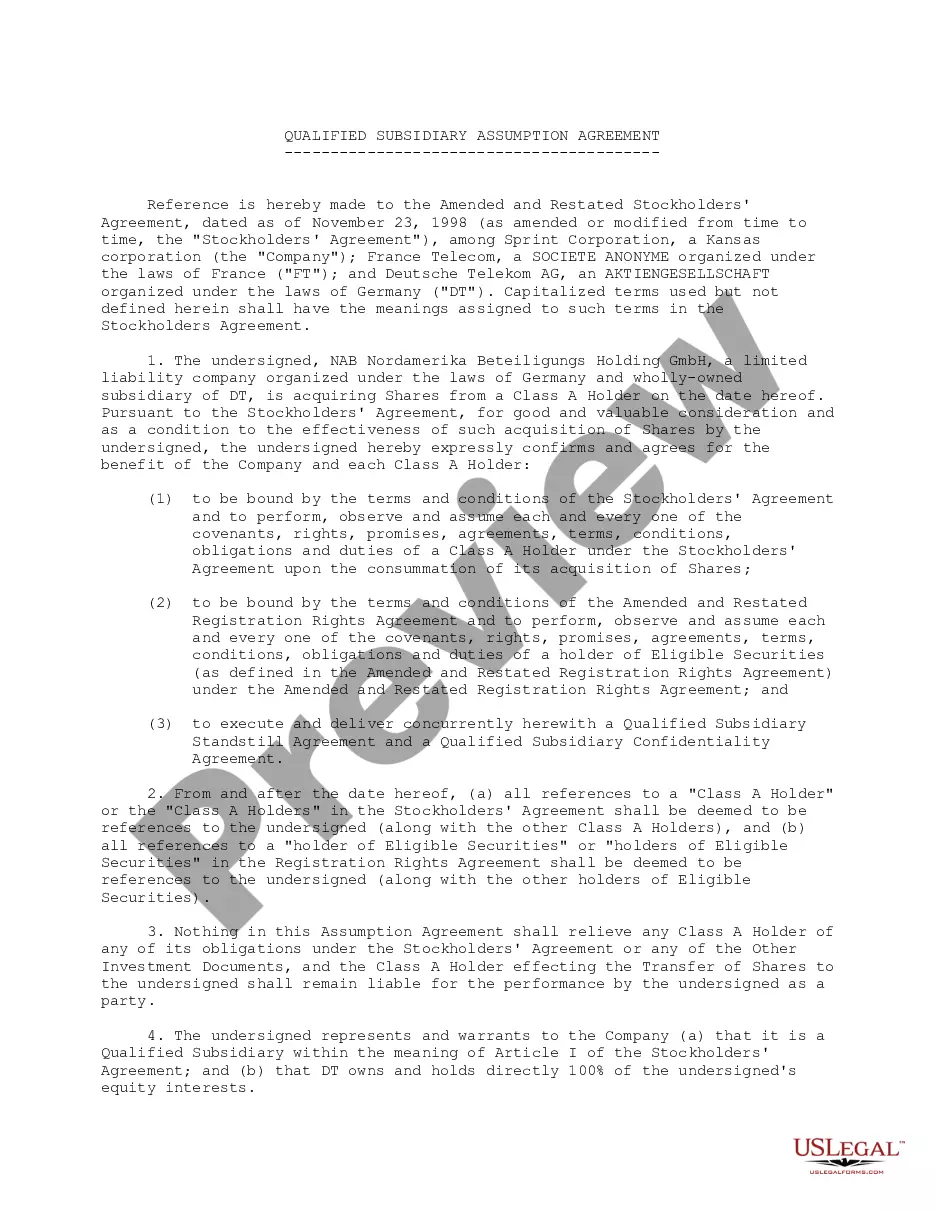
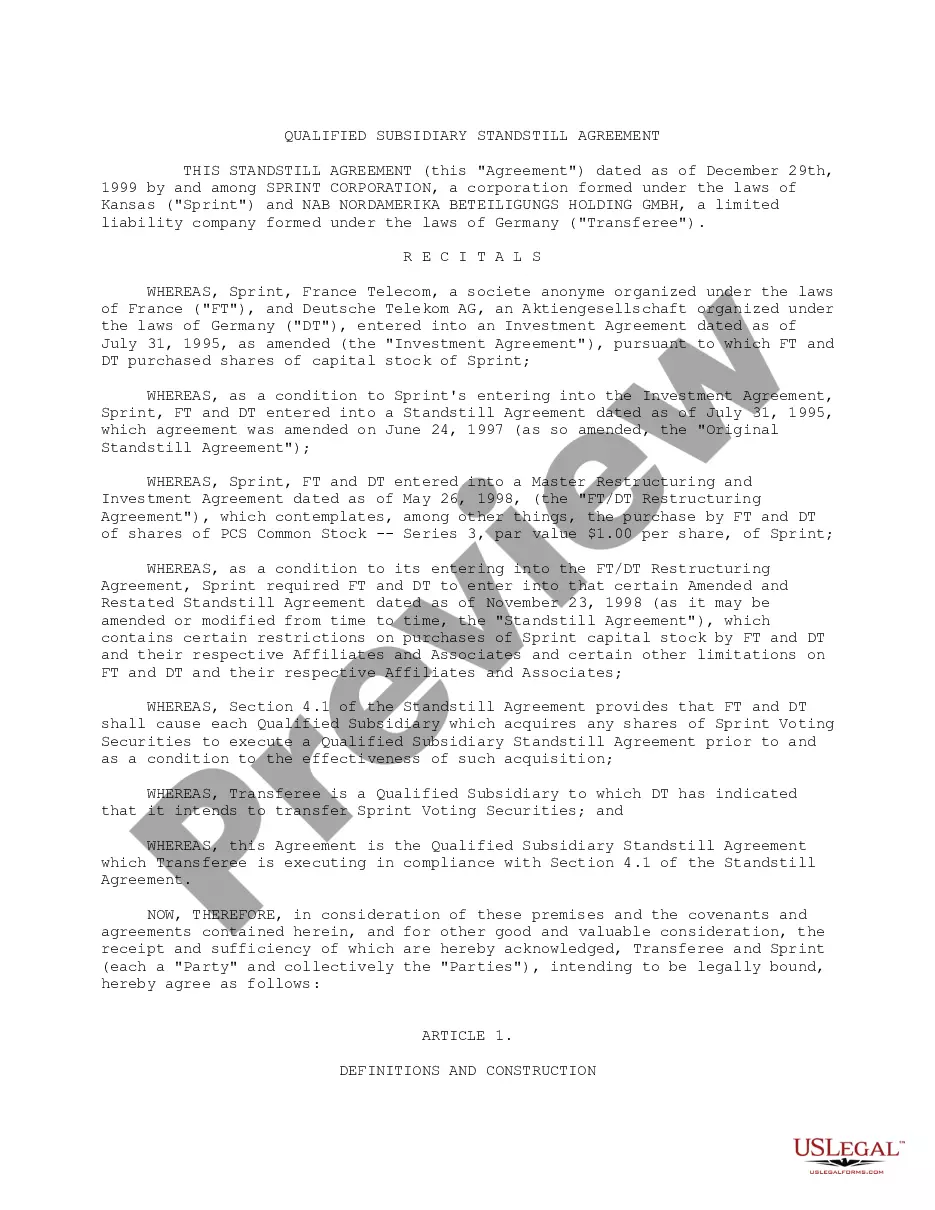
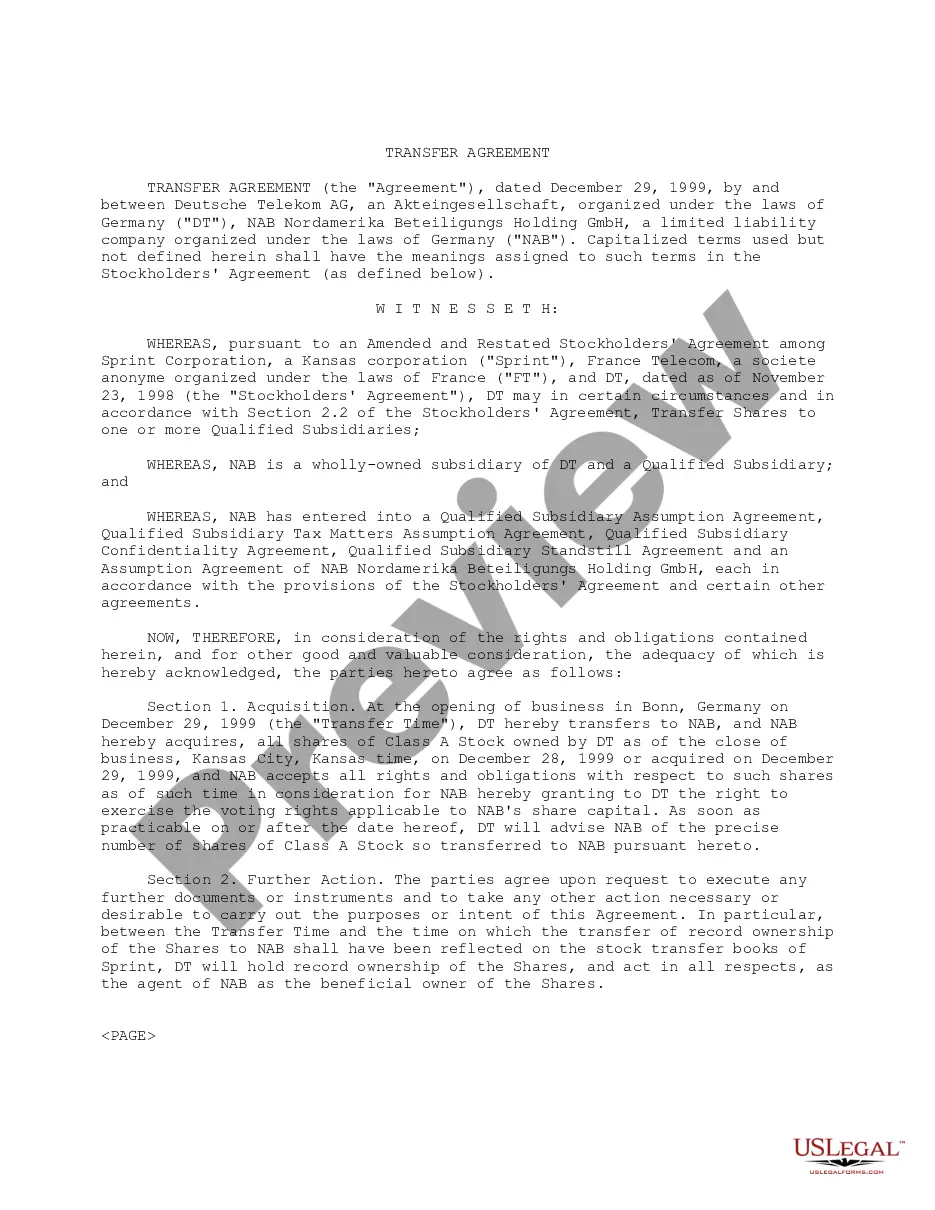
The Assumption Agreement of NAB Nordamerika Beteiligungs Holding GMBH between France Telecom and Deutsche Telecom AG regarding the acquisition of Class A Stock is a legal document that formalizes the process by which NAB Nordamerika Beteiligungs Holding GMBH assumes certain rights and responsibilities from Deutsche Telekom AG as it acquires Class A Stock. This form is essential for ensuring that all parties understand their obligations under previously established agreements, thus maintaining legal clarity in the transaction. It differs from similar agreements by being specifically tailored to the coordination of shareholders in European corporate structures.
Key components of this form
- Reference to the Coordination Agreement and other relevant agreements.
- Specifics of the acquisition of Class A Stock by NAB Nordamerika Beteiligungs Holding GMBH.
- Confirmation of obligations and rights under the Coordination Agreement and associated documents.
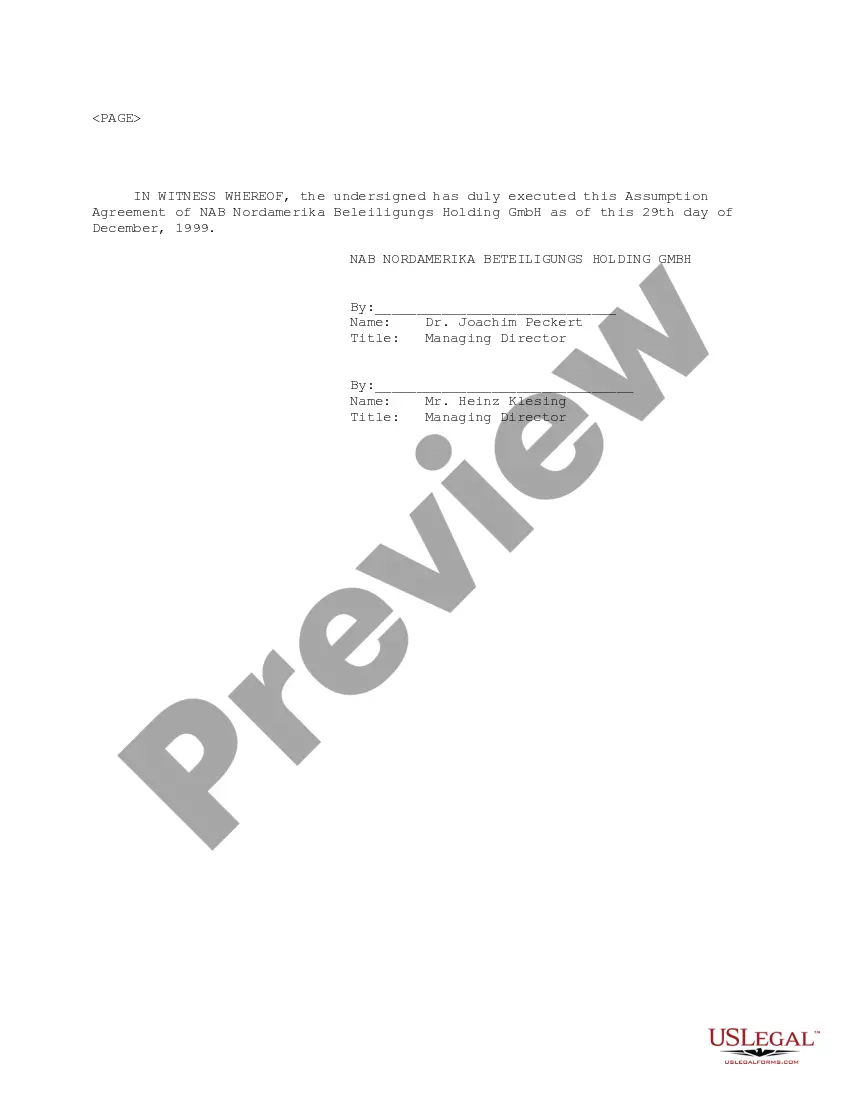
- Representation and warranties by NAB Nordamerika Beteiligungs Holding GMBH.
- Signature section for authorized individuals from NAB Nordamerika Beteiligungs Holding GMBH.
When this form is needed
This form should be used when a company, specifically a subsidiary, is acquiring stock from its parent company or another significant shareholder. It is particularly relevant in scenarios where legal agreements, such as coordination agreements, must be acknowledged and reaffirmed in the context of the transaction. Use this form to ensure compliance with existing corporate governance and contractual obligations during the acquisition process.
Who should use this form
- Companies involved in stock transactions with subsidiaries.
- Corporate legal teams managing shareholder agreements.
- Investors or entities acquiring stock from established corporate structures.
- Corporate executives and managers needing to formalize stock acquisitions.
How to prepare this document
- Identify all parties involved: NAB Nordamerika Beteiligungs Holding GMBH, France Telecom, and Deutsche Telekom AG.
- Specify the acquisition details, including the Class A Stock being acquired.
- Review and confirm obligations outlined in previous agreements referenced in the form.
- Ensure all parties review and agree to the terms stated in the form.
- Secure signatures from authorized representatives of NAB Nordamerika Beteiligungs Holding GMBH.
Does this form need to be notarized?
Notarization is not commonly needed for this form. However, certain documents or local rules may make it necessary. Our notarization service, powered by Notarize, allows you to finalize it securely online anytime, day or night.
Get your form ready online
Our built-in tools help you complete, sign, share, and store your documents in one place.
Make edits, fill in missing information, and update formatting in US Legal Forms—just like you would in MS Word.
Download a copy, print it, send it by email, or mail it via USPS—whatever works best for your next step.
Sign and collect signatures with our SignNow integration. Send to multiple recipients, set reminders, and more. Go Premium to unlock E-Sign.
If this form requires notarization, complete it online through a secure video call—no need to meet a notary in person or wait for an appointment.
We protect your documents and personal data by following strict security and privacy standards.

Make edits, fill in missing information, and update formatting in US Legal Forms—just like you would in MS Word.

Download a copy, print it, send it by email, or mail it via USPS—whatever works best for your next step.

Sign and collect signatures with our SignNow integration. Send to multiple recipients, set reminders, and more. Go Premium to unlock E-Sign.

If this form requires notarization, complete it online through a secure video call—no need to meet a notary in person or wait for an appointment.

We protect your documents and personal data by following strict security and privacy standards.
Common mistakes
- Failing to reference all relevant previous agreements.
- Omitting signatures from authorized parties.
- Not ensuring all parties are clear on their obligations under the agreements.
- Allowing discrepancies in understanding the terms of the stock acquisition.
Why use this form online
- Convenient access to download and fill out the form from any device.
- Editability allows users to customize the form as needed for their specific transaction.
- Ensures reliability with templates drafted by licensed attorneys to meet legal standards.
- Easy storage and retrieval of electronic copies for future reference.
Looking for another form?


Form popularity
FAQ
Key Takeaways. Class A shares refer to a classification of common stock that was traditionally accompanied by more voting rights than Class B shares. Traditional Class A shares are not sold to the public and also can't be traded by the holders of the shares.
KEY TAKEAWAYS. Class A shares charge upfront fees and have lower expense ratios, so they are better for long-term investors. Class A shares also reduce upfront fees for larger investments, so they are a better choice for wealthy investors.
Class A, Common Stock Each share confers one vote and ordinary access to dividends and assets. Class B, Preferred Stock Each share confers one vote, but shareholders receive $2 in dividends for every $1 distributed to Class A shareholders. This class of stock has priority distribution for dividends and assets.
This benefits the investor because Class A shares have lower annual expense ratios than Class B shares. Class C mutual fund shares are best for investors who have a short time horizon and plan on redeeming their shares soon.Additionally, investors who purchase Class C shares could pay a high annual management fee.
The only difference between Class A and Class B is the voting power one receives along with the share. A company that issues multiple levels of stock usually does so to concentrate voting power. Thus, directors, for example, would own Class A shares while Class B shares are sold to the general market.
When more than one class of stock is offered, companies traditionally designate them as Class A and Class B, with Class A carrying more voting rights than Class B shares. Class A shares may offer 10 voting rights per stock held, while class B shares offer only one.
When more than one class of stock is offered, companies traditionally designate them as Class A and Class B, with Class A carrying more voting rights than Class B shares. Class A shares may offer 10 voting rights per stock held, while class B shares offer only one.
Class-A shares are held by regular investors and carry one vote per share. Class-B shares, held primarily by Brin and Page, have 10 votes per share. Class-C shares are typically held by employees and have no voting rights.