Sections 302A.471 and 302A.473 of Minnesota Business Corporation Act
What is this form?
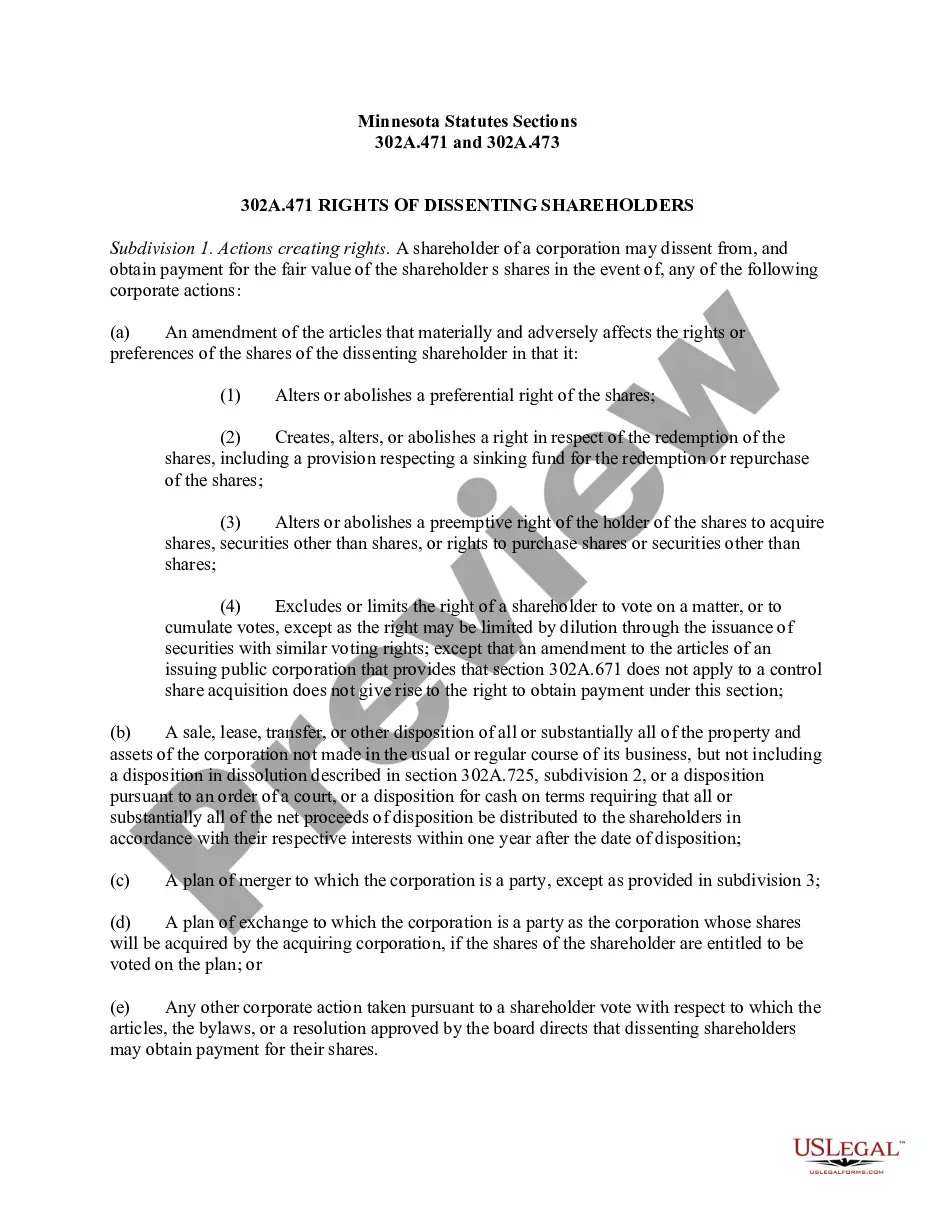
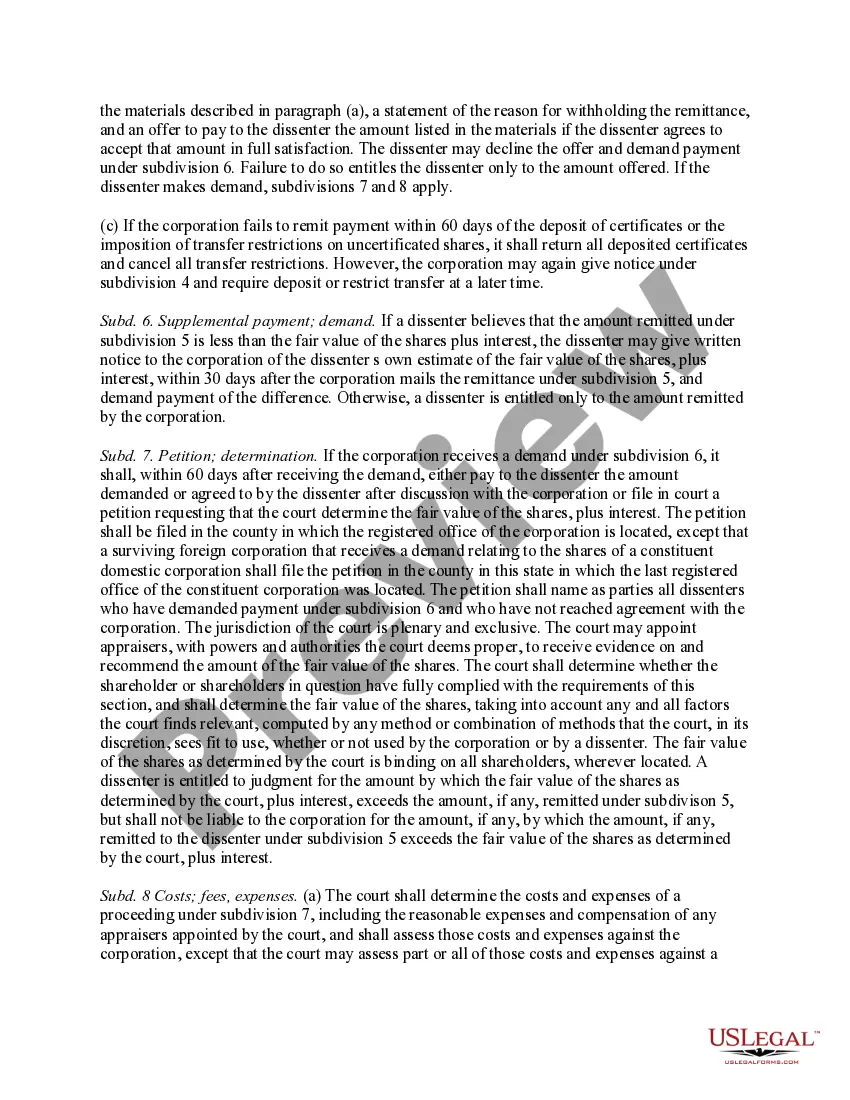
The Sections 302A.471 and 302A.473 of the Minnesota Business Corporation Act outline the rights of dissenting shareholders in specific corporate actions. This form allows shareholders to dissent and seek fair payment for their shares when faced with significant corporate changes, such as mergers or amendments to corporate articles that adversely affect their rights. Unlike other forms related to corporate governance, this one specifically addresses the entitlements of shareholders who wish to express their discontent with corporate decisions and ensure they receive fair value for their ownership stakes.
Main sections of this form
- Rights of dissenting shareholders under certain corporate actions.
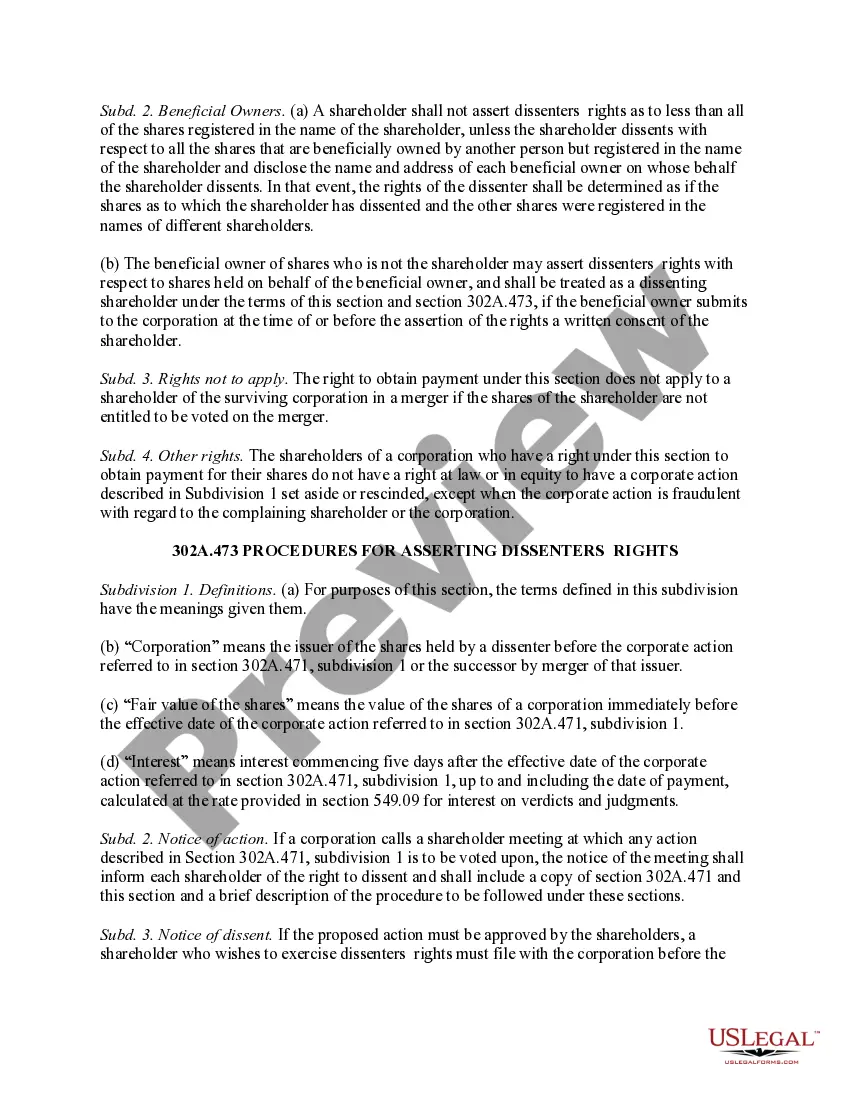
- Procedures for asserting dissenters' rights before and after corporate actions.
- Definitions of terms such as "fair value" and "interest".
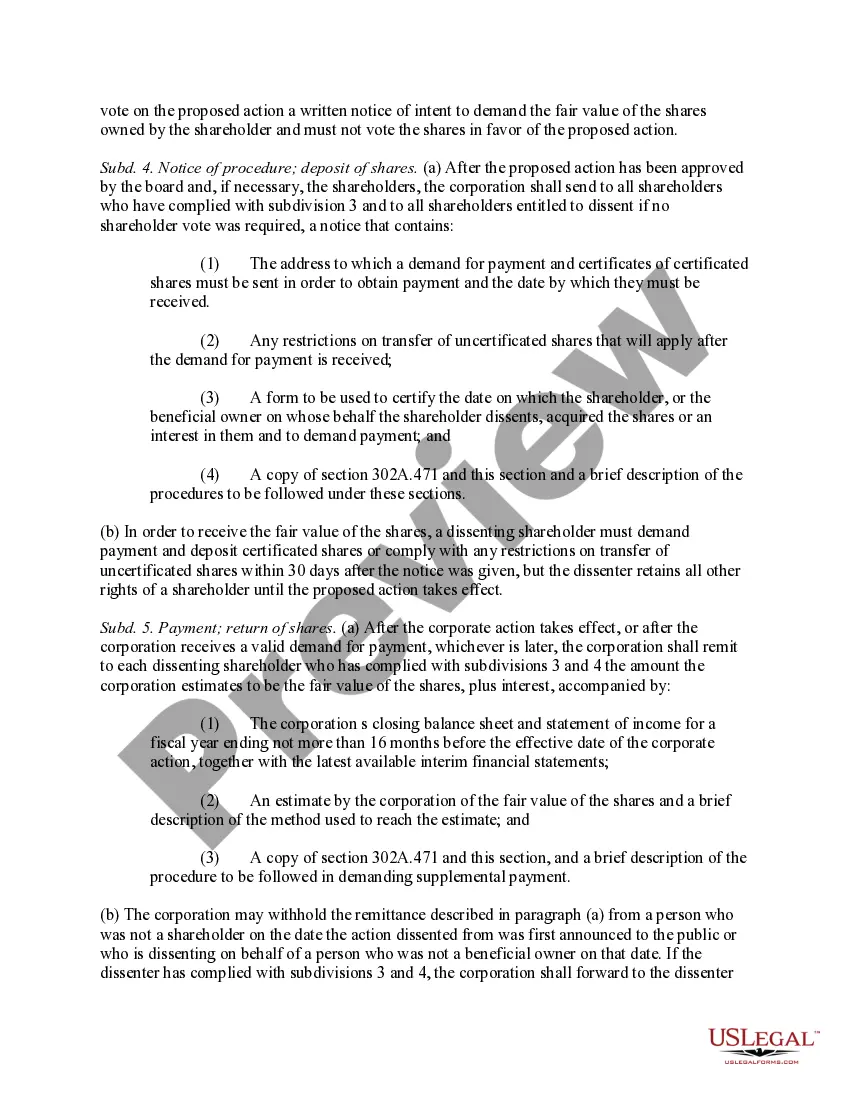
- Notification requirements for shareholders regarding their dissenting rights.
- Steps for filing a notice of dissent and the timeline for demands for payment.
When to use this form
This form should be used when a shareholder disagrees with significant corporate decisions such as amendments to corporate articles, mergers, or other actions that may limit their rights. It is particularly relevant during shareholder meetings where these decisions are voted on, and when a shareholder wishes to dissent to ensure they are compensated fairly for their shares instead of being compelled to accept unfavorable changes.
Who this form is for
- Shareholders of corporations in Minnesota who disagree with proposed corporate actions.
- Beneficial owners of shares who wish to assert dissenters' rights.
- Individuals seeking to understand their legal rights regarding corporate transactions affecting their ownership interests.
Completing this form step by step
- Identify the specific corporate action you wish to dissent from.
- Prepare a written notice of intent to demand payment for your shares before voting.
- File the notice with the corporation to ensure your dissent is acknowledged.
- Provide any necessary disclosures if you hold shares on behalf of another beneficial owner.
- Follow subsequent notification procedures for demanding payment after the corporate action takes effect.
Does this form need to be notarized?
This form does not typically require notarization to be legally valid. However, some jurisdictions or document types may still require it. US Legal Forms provides secure online notarization powered by Notarize, available 24/7 for added convenience.
Get your form ready online
Our built-in tools help you complete, sign, share, and store your documents in one place.
Make edits, fill in missing information, and update formatting in US Legal Forms—just like you would in MS Word.
Download a copy, print it, send it by email, or mail it via USPS—whatever works best for your next step.
Sign and collect signatures with our SignNow integration. Send to multiple recipients, set reminders, and more. Go Premium to unlock E-Sign.
If this form requires notarization, complete it online through a secure video call—no need to meet a notary in person or wait for an appointment.
We protect your documents and personal data by following strict security and privacy standards.

Make edits, fill in missing information, and update formatting in US Legal Forms—just like you would in MS Word.

Download a copy, print it, send it by email, or mail it via USPS—whatever works best for your next step.

Sign and collect signatures with our SignNow integration. Send to multiple recipients, set reminders, and more. Go Premium to unlock E-Sign.

If this form requires notarization, complete it online through a secure video call—no need to meet a notary in person or wait for an appointment.

We protect your documents and personal data by following strict security and privacy standards.
Mistakes to watch out for
- Failing to submit a written notice of intent before the shareholder vote.
- Not dissentering all shares owned if required, which could limit rights.
- Missing the deadline for demanding payment or filing necessary documentation.
Why complete this form online
- Convenient access to legal forms from anywhere, at any time.
- Edit and customize forms as needed for your specific situation.
- Reliable templates drafted by licensed attorneys, ensuring compliance with state laws.
Legal use & context
- This form is legally binding under the Minnesota Business Corporation Act, enabling shareholders to assert their rights effectively.
- It outlines a defined process for dissenters, ensuring they can seek fair value for their shares during corporate restructuring.
- Shareholders must carefully follow outlined procedures to maintain their legal rights during corporate actions.
Looking for another form?
Form popularity
FAQ
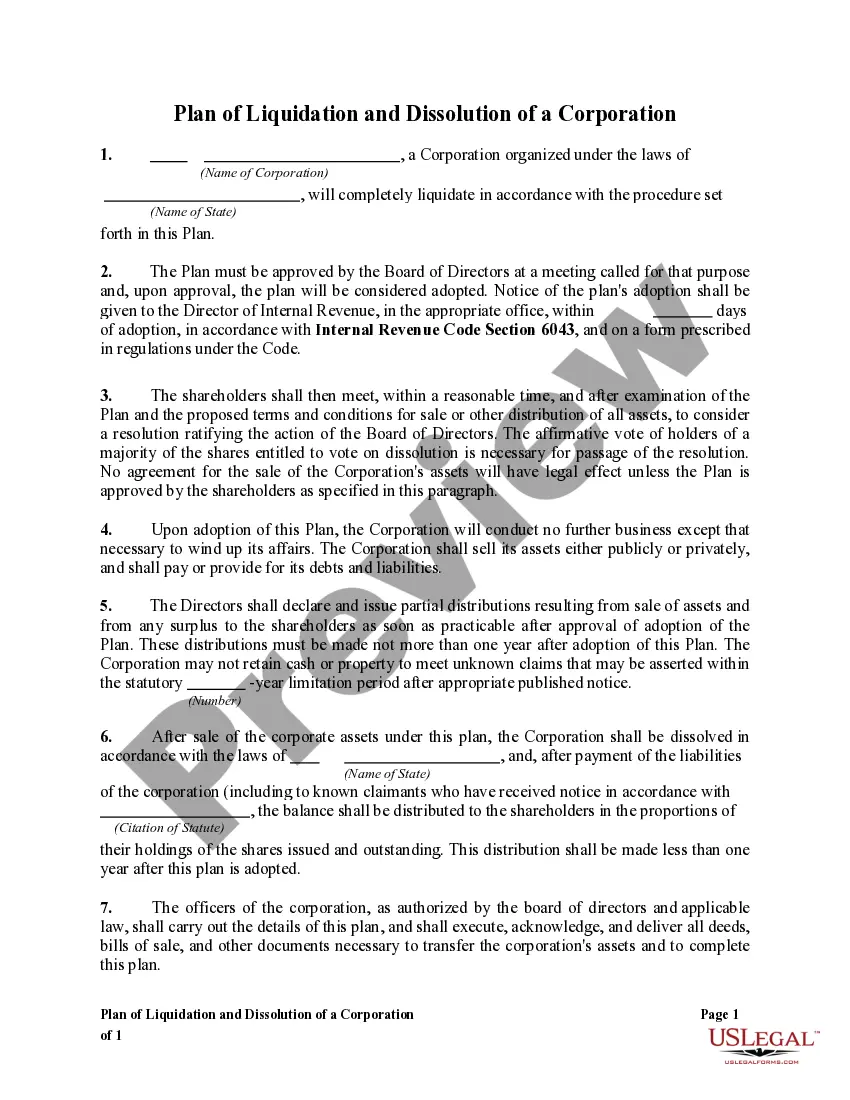
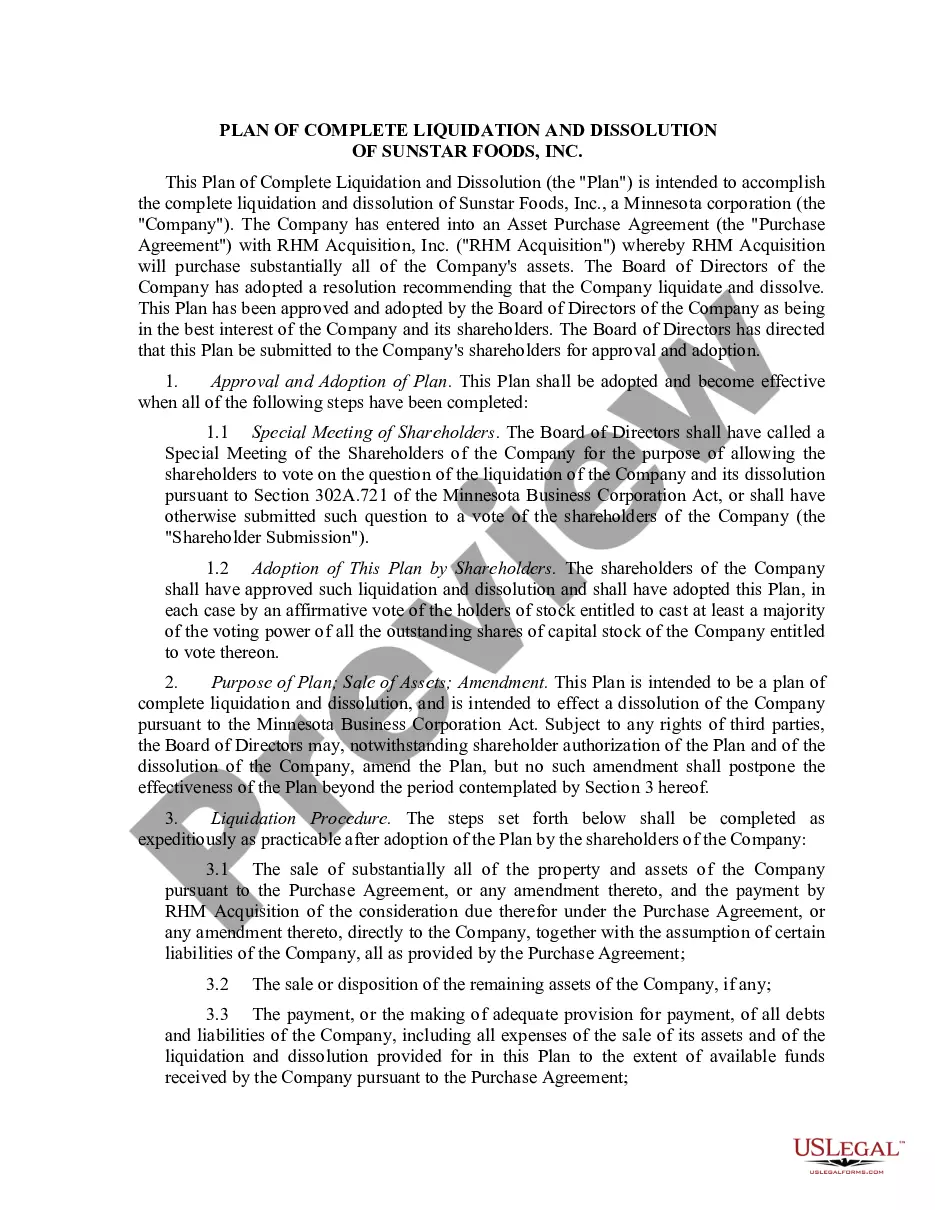
Minnesota requires that different articles be filed, based on whether the LLC accepted or did not accept contributions. If your LLC accepted contributions, you must first file a notice of dissolution with the Secretary of State by mail or in person. This is followed by filing an articles of termination form.
Under 322C, the ability of a member, or anyone else, to act as an agent of the LLC is to be addressed, if at all, in an operating agreement. An LLC may file statements of authority with the Office of Minnesota Secretary of State (similar to those filed by partnerships) with respect to non-members.
Choose a Corporate Name. Prepare and File Articles of Incorporation. Appoint a Registered Agent. Set Up a Corporate Records Book. Prepare Corporate Bylaws. Appoint Initial Corporate Directors. Hold Your First Board of Directors Meeting. Issue Stock.
Citation Data American Bar Association. Committee on Corporate Laws. Model Business Corporation Act : Official Text with Official Comment and Statutory Cross-References, Revised through June 2005. Chicago, IL :Section of Business Law, American Bar Association, 2005.
The Canada Business Corporations Act (CBCA) is the federal law that regulates business structures in Canada.The CBCA covers the rules for founding a corporation or other business structure in Canada, the reporting requirements it operates under, and the approved procedure for dissolving the company when it closes up.
Every Minnesota LLC owner should have an operating agreement in place to protect the operations of their business. While not legally required by the state, having an operating agreement will set clear rules and expectations for your LLC while establishing your credibility as a legal entity.
The MBCA contains comprehensive laws on doing business as a corporation. It covers a number of topics, like the steps involved in forming a corporation, limited liability and its effects, exceptions to the concept of limited liability, corporate management structure, and voting and shareholders' rights.
Despite criticism of Delaware's corporate statutes by the drafters of the original Model Business Corporation Act (MBCA), there has been a constructive symbiosis between the MBCA and Delaware's corporation law, including its statutory component: each set of statutes has been informed by drafting and case-law experience
This statute covers, among other things, incorporation of the corporation, its capacity and powers, management as well as matters relating to shareholders and various corporate transactions, such as amendments to the corporation's articles and by-laws, amalgamations, continuances and dissolution.