Plan of Liquidation
Understanding this form
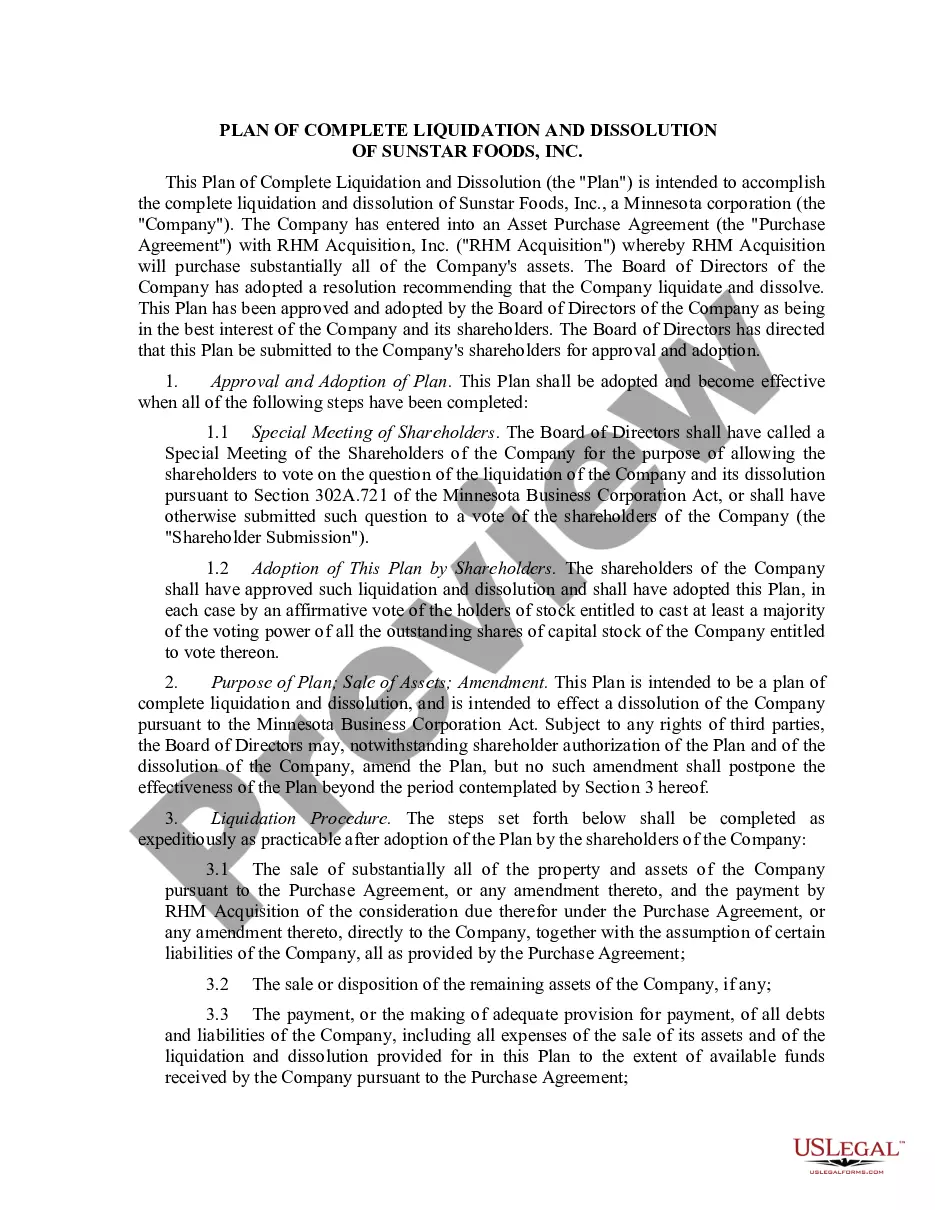
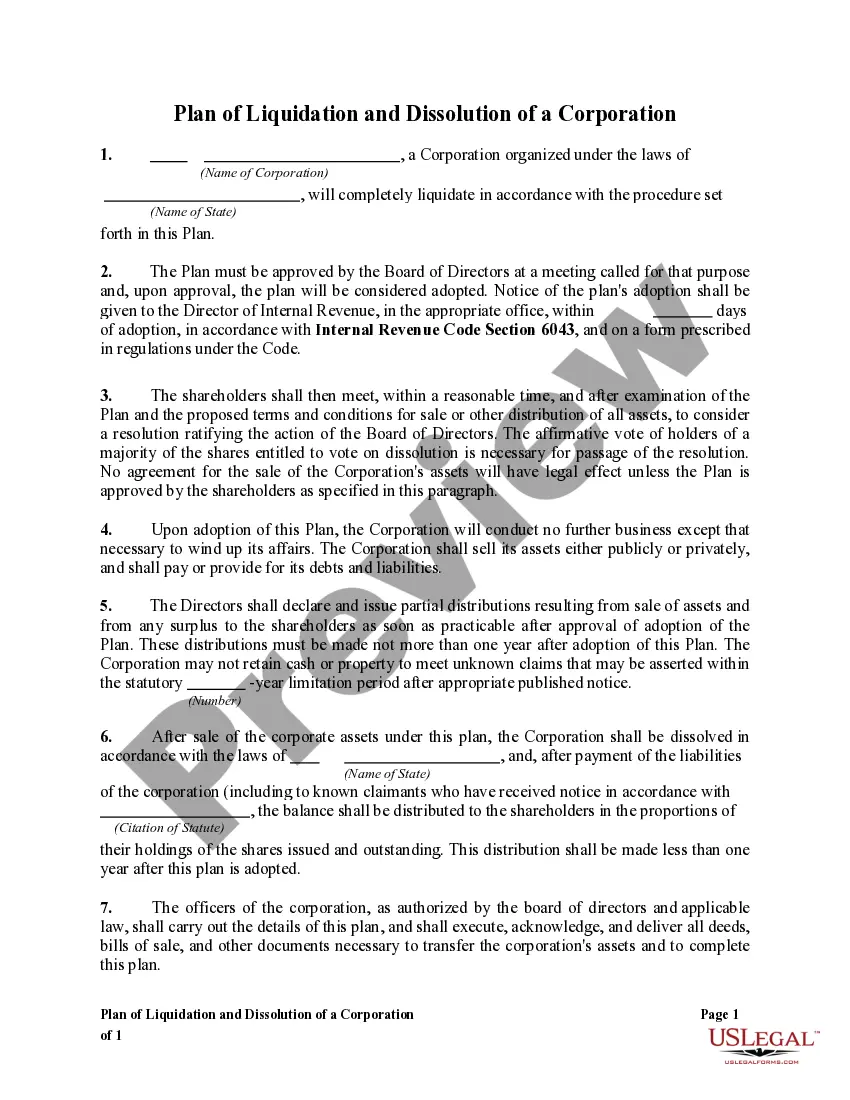
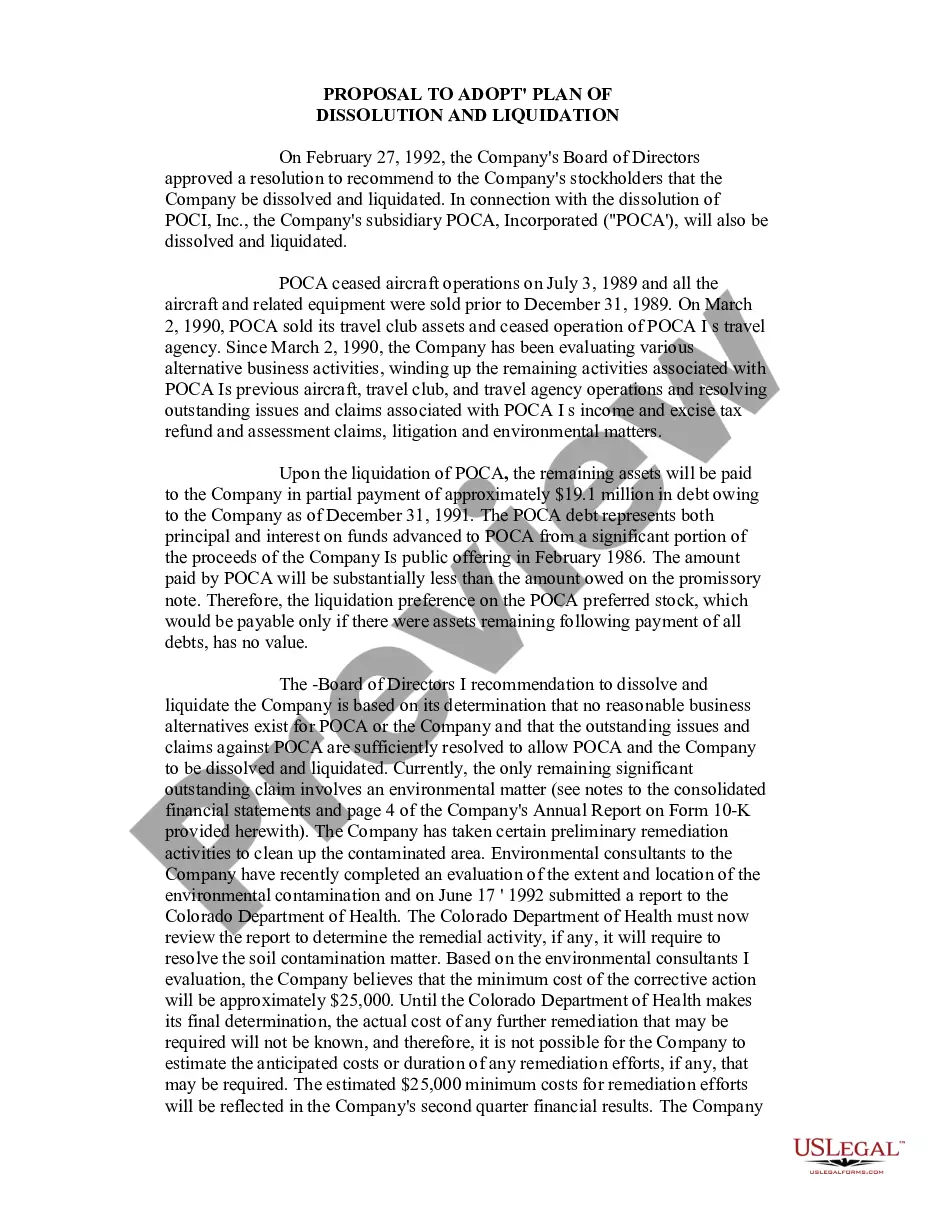
The Plan of Liquidation is a legal document designed for corporations to formally outline the process of completely dissolving and liquidating their assets. This form serves as a model, allowing companies to customize it according to their unique circumstances. Unlike other corporate forms, this Plan of Liquidation specifically addresses the full dissolution of the corporation and the orderly sale of its assets, ensuring compliance with relevant state laws, such as those in Minnesota.
Main sections of this form
- Approval and adoption process by shareholders.
- Purpose of liquidation and asset sale provisions.
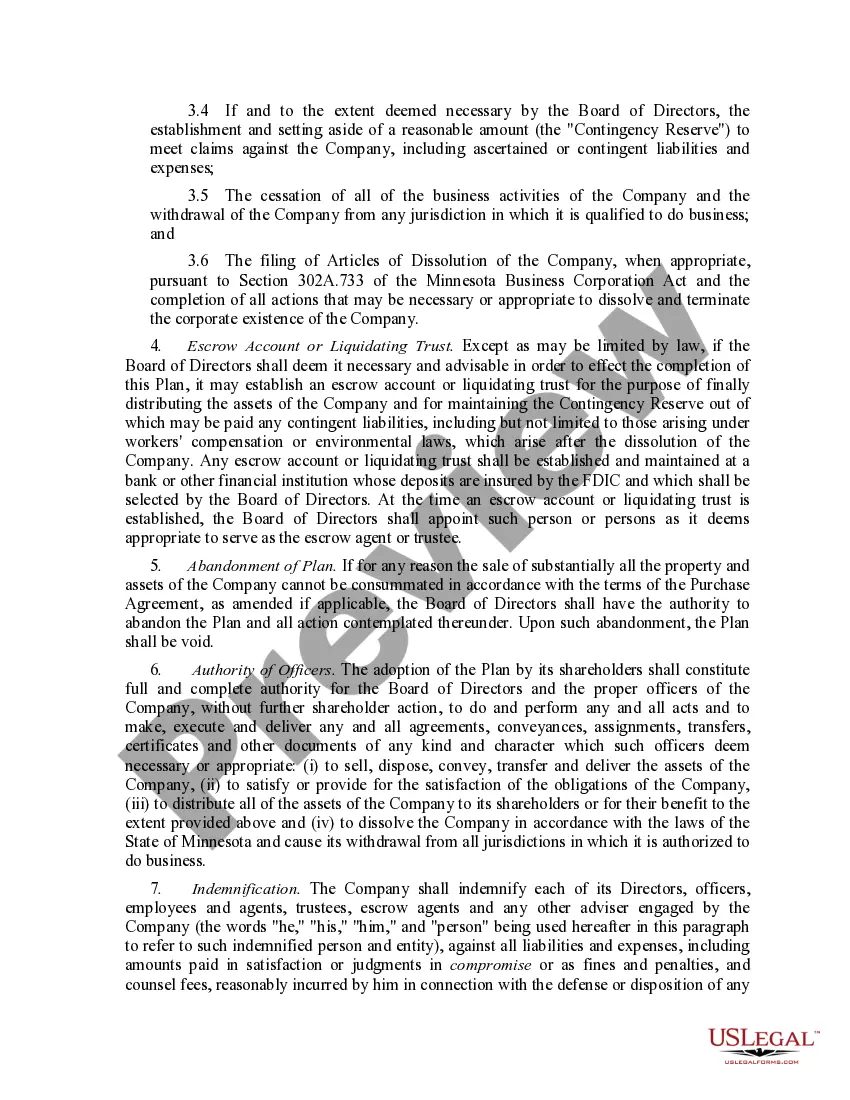
- Detailed liquidation procedures and timelines.
- Establishment of escrow accounts or liquidating trusts.
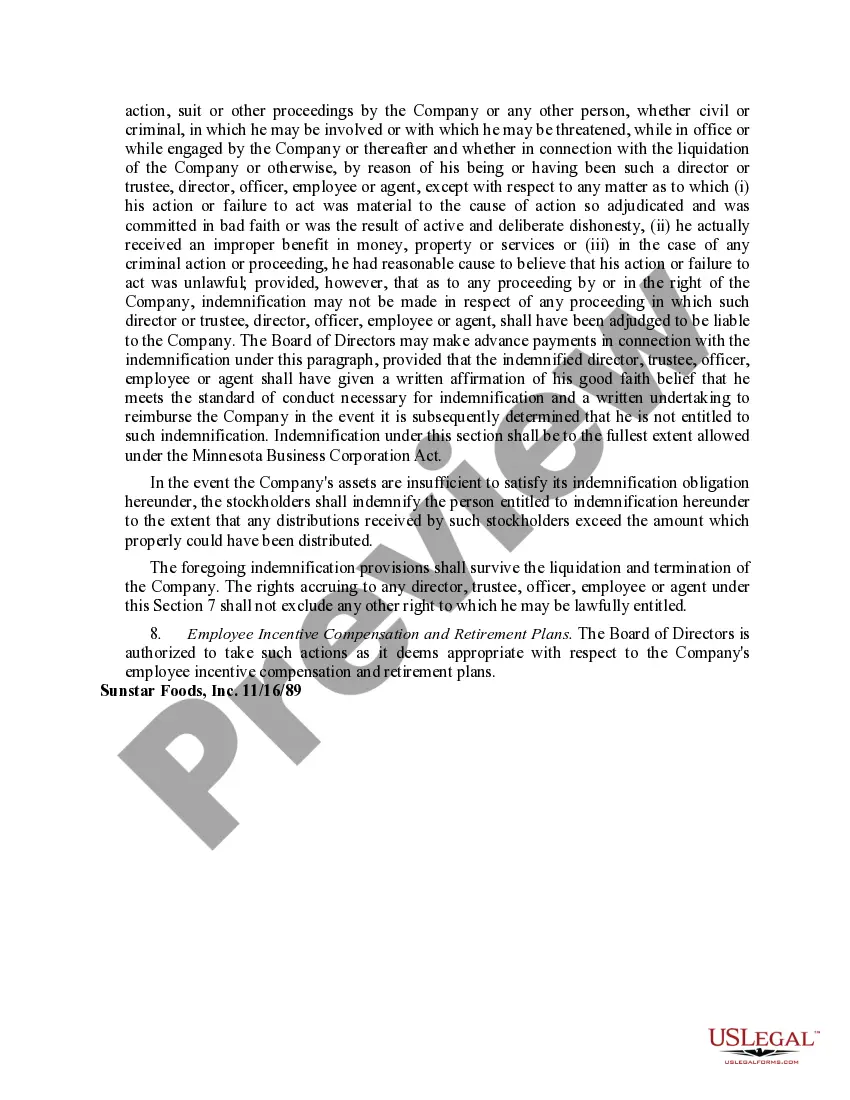
- Authority of officers post-adoption of the plan.
- Indemnification clauses for directors and officers.
When to use this document
This Plan of Liquidation should be used when a corporation intends to cease all business activities and distribute its remaining assets to shareholders. Situations that may necessitate this form include mergers, acquisitions, or strategic decision-making processes to exit a market or business line. It provides clarity and organization throughout the dissolution process.
Intended users of this form
- Corporations looking to liquidate and dissolve their business.
- Shareholders involved in the approval of a corporate dissolution.
- Board of Directors of the corporation overseeing the liquidation process.
How to complete this form
- Gather necessary corporate documents and financial records.
- Schedule a special meeting for shareholders to discuss the liquidation.
- Draft and present the Plan of Liquidation for shareholder approval.
- Outline the procedures for selling corporate assets and settling debts.
- File Articles of Dissolution with the state after all steps are completed.
Notarization guidance
This form does not typically require notarization to be legally valid. However, some jurisdictions or document types may still require it. US Legal Forms provides secure online notarization powered by Notarize, available 24/7 for added convenience.
Get your form ready online
Our built-in tools help you complete, sign, share, and store your documents in one place.
Make edits, fill in missing information, and update formatting in US Legal Forms—just like you would in MS Word.
Download a copy, print it, send it by email, or mail it via USPS—whatever works best for your next step.
Sign and collect signatures with our SignNow integration. Send to multiple recipients, set reminders, and more. Go Premium to unlock E-Sign.
If this form requires notarization, complete it online through a secure video call—no need to meet a notary in person or wait for an appointment.
We protect your documents and personal data by following strict security and privacy standards.

Make edits, fill in missing information, and update formatting in US Legal Forms—just like you would in MS Word.

Download a copy, print it, send it by email, or mail it via USPS—whatever works best for your next step.

Sign and collect signatures with our SignNow integration. Send to multiple recipients, set reminders, and more. Go Premium to unlock E-Sign.

If this form requires notarization, complete it online through a secure video call—no need to meet a notary in person or wait for an appointment.

We protect your documents and personal data by following strict security and privacy standards.
Typical mistakes to avoid
- Failing to obtain proper shareholder approval before liquidating.
- Not following state-specific filing procedures.
- Neglecting to address outstanding debts and liabilities adequately.
- Omitting important details regarding asset distribution and escrow accounts.
Benefits of using this form online
- Immediate access to a professionally drafted form tailored to meet legal standards.
- Easy customization to suit the specific needs of your corporation.
- Convenience of downloading and filling the form at your own pace.
- Assurance of compliance with applicable state laws.
Legal use & context
- This form serves as an official record of the corporation's intent to dissolve.
- It details the legally required steps in the liquidation process.
- Incorporating this form protects the rights of shareholders and outlines asset distribution.
Quick recap
- The Plan of Liquidation is essential for formal corporate dissolution.
- It ensures compliance with state laws and facilitates a structured liquidation process.
- Obtaining approval from shareholders is critical for the plan's effectiveness.
Looking for another form?
Form popularity
FAQ
332 provides tax-free treatment to the corporate shareholder's gain or loss from the receipt of the subsidiary's property in liquidation, and Sec.1504(a)(2) (generally 80% by voting power and value) and the distribution was made in complete cancellation or redemption of all the stock of the liquidating corporation.
Under Sec. 331, a liquidating distribution is considered to be full payment in exchange for the shareholder's stock, rather than a dividend distribution, to the extent of the corporation's earnings and profits (E&P).331 when they receive the liquidation proceeds in exchange for their stock.
After the costs of liquidation, secured creditors and preferential creditors are paid first, and then unsecured creditors. Creditors with valid specific security over stock and equipment (such as retention of title clauses or leases) generally have priority to recover those items where they can be clearly identified.
Liquidation in finance and economics is the process of bringing a business to an end and distributing its assets to claimants. It is an event that usually occurs when a company is insolvent, meaning it cannot pay its obligations when they are due.
Liquidate means converting property or assets into cash or cash equivalents by selling them on the open market. Liquidation similarly refers to the process of bringing a business to an end and distributing its assets to claimants.
Liquidation is important if a business fails due to anything from a lack of visionary management to increasing debts; from almost-zero revenue inflow to rising costs of unnecessary assets. Absence of profit planning and control on the continuity of losses for extended periods also call for liquidation.
Plan of Liquidation means a plan (including by operation of law) that provides for, contemplates or the effectuation of which is preceded or accompanied by (whether or not substantially contemporaneously) (i) the sale, lease, conveyance or other disposition of all or substantially all of the assets of the referent
In that process, the corporation notifies creditors of the impending cessation of business and does all acts appropriate to liquidate its business, such as collecting and selling assets, discharging liabilities, and distributing any remaining assets to shareholders.6 The corporation may, but is rarely required to,