Restricted Stock Plan of Sundstrand Corp.
Overview of this form
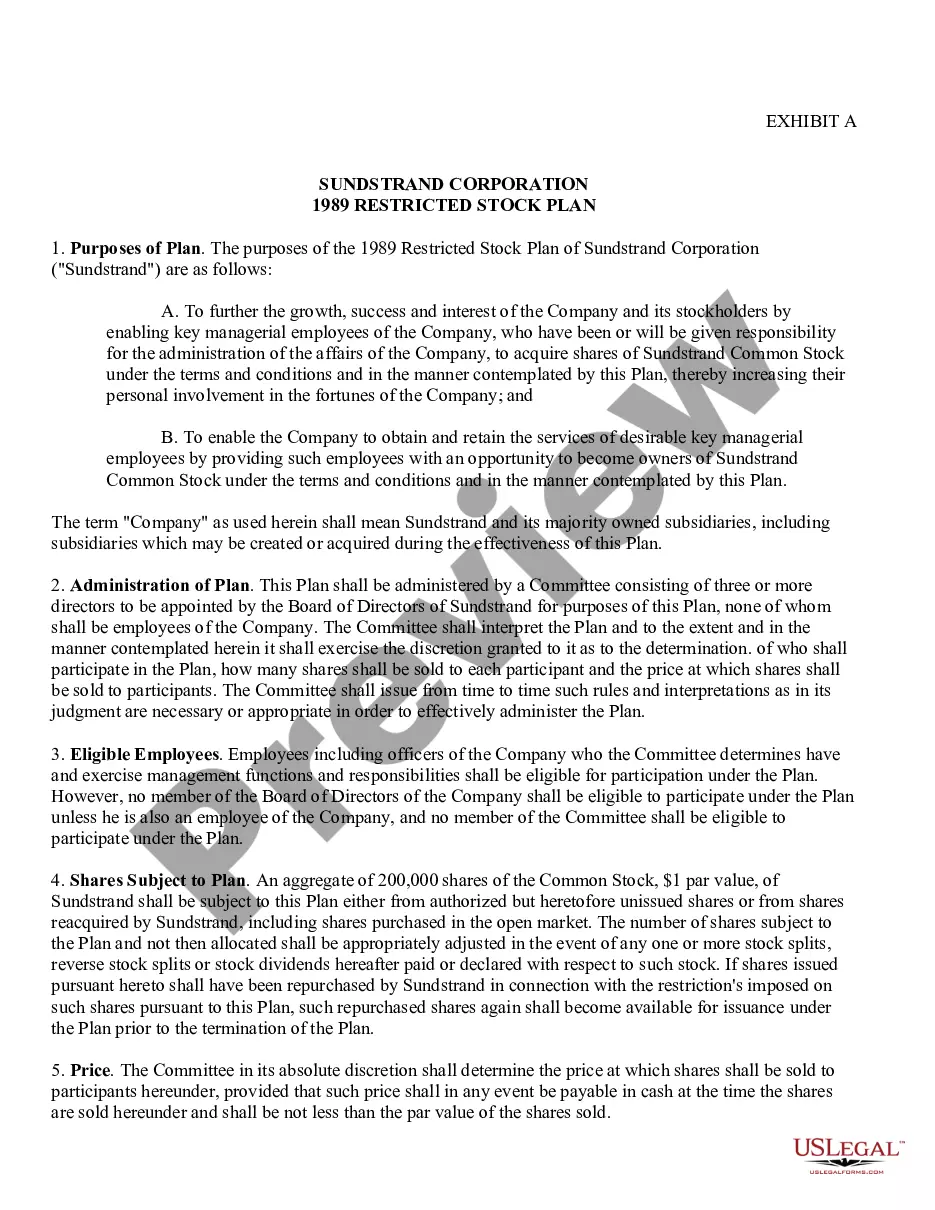
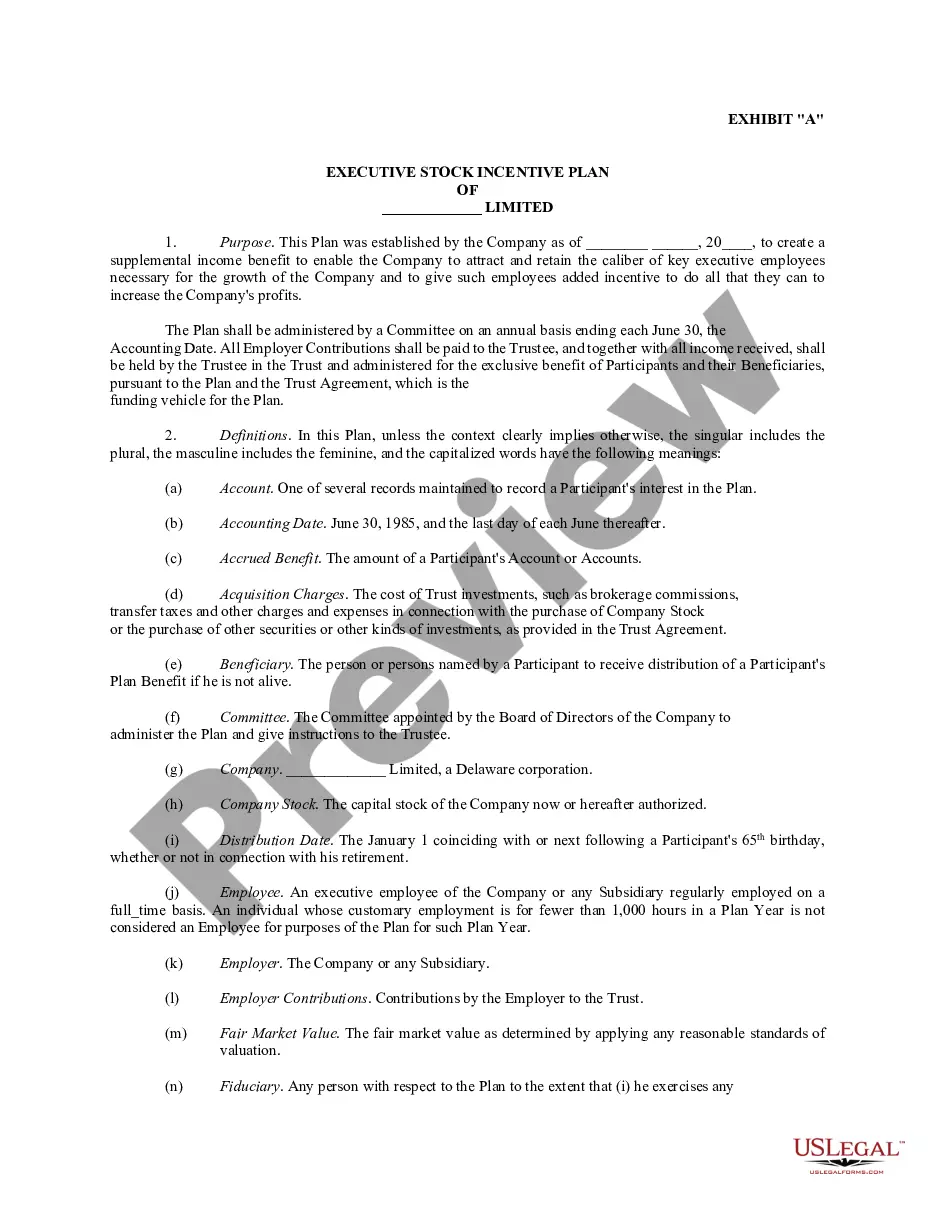
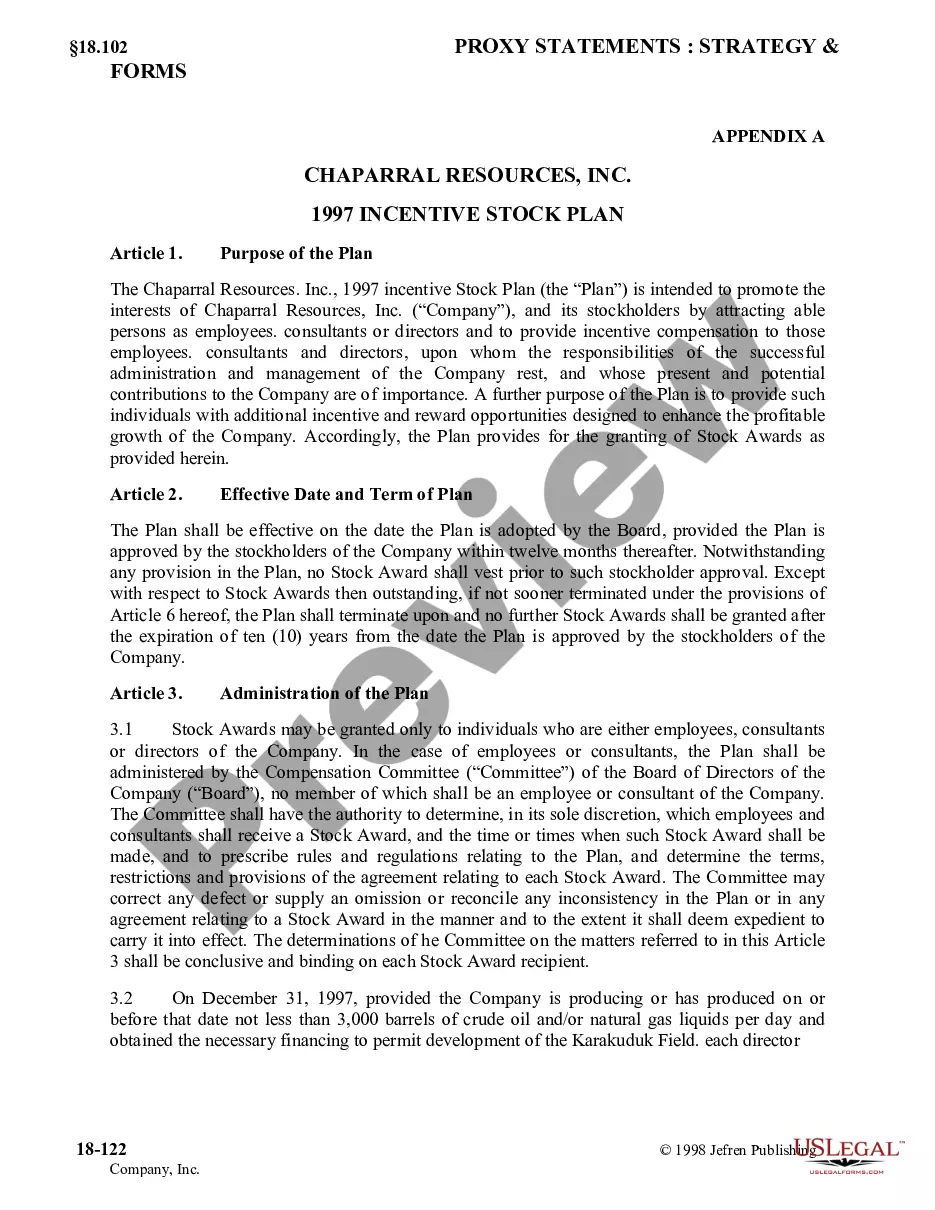
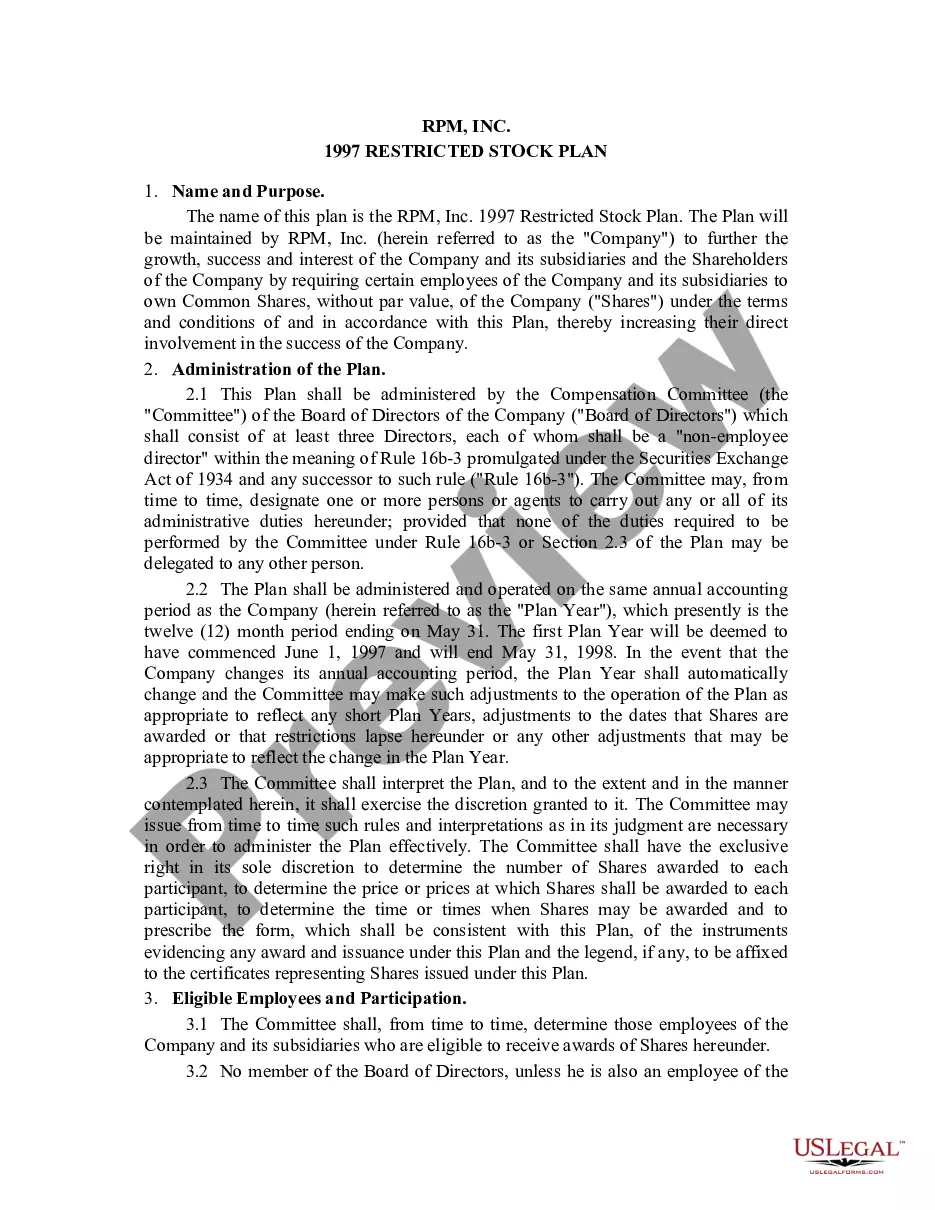
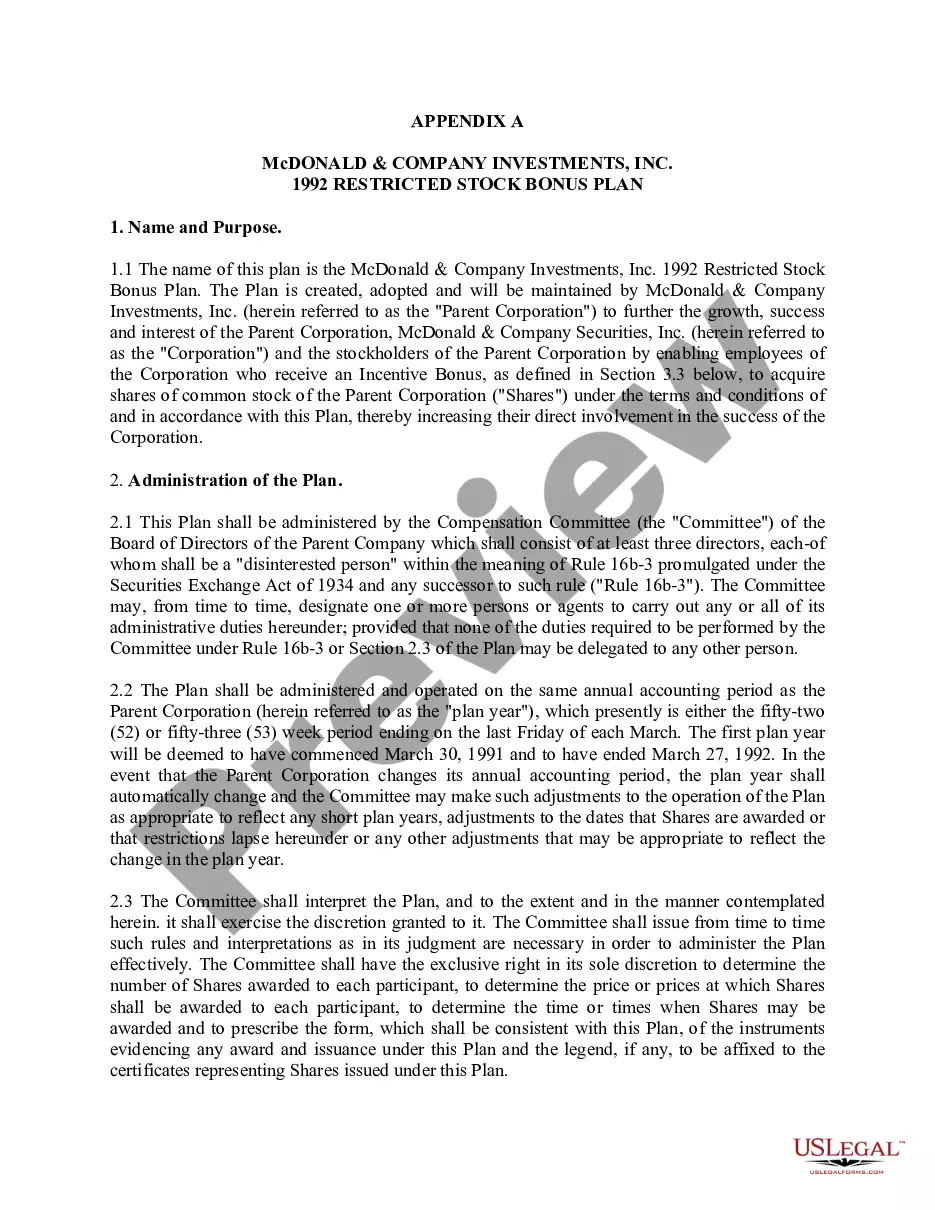
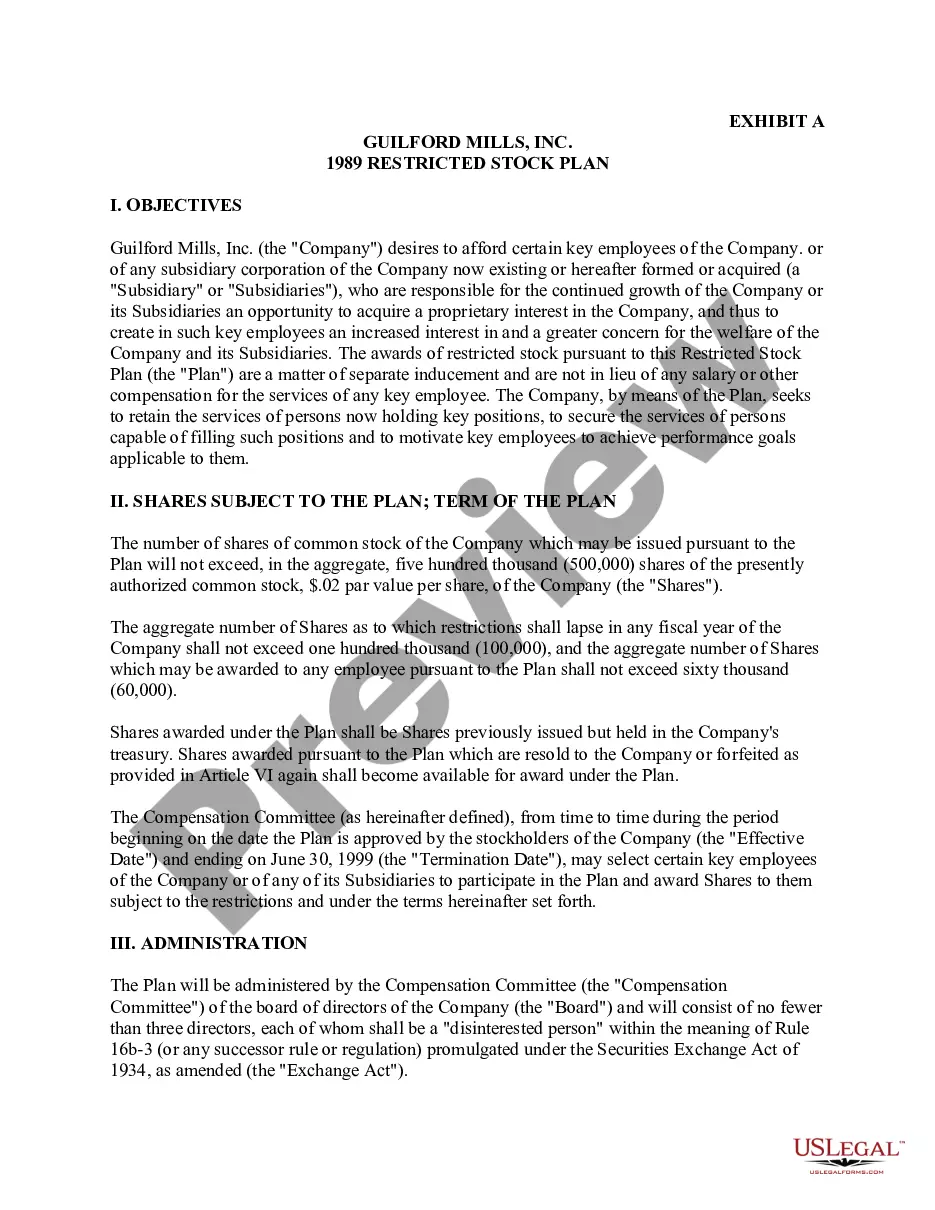
The Restricted Stock Plan of Sundstrand Corp. is a legal document that establishes the terms under which key managerial employees can acquire shares of Sundstrand Common Stock at a discounted price. This plan aims to enhance employee loyalty and align their interests with the company's growth by allowing them to purchase shares subject to specific restrictions. Unlike other ownership plans, this one includes contingencies regarding employment status, allowing the company to repurchase shares under certain conditions.
What’s included in this form
- Purpose of Plan: Encourages employee investment in the company's future.
- Administration: Managed by a committee of directors who also determine eligibility and share pricing.
- Eligible Employees: Key managerial employees and certain officers can participate.
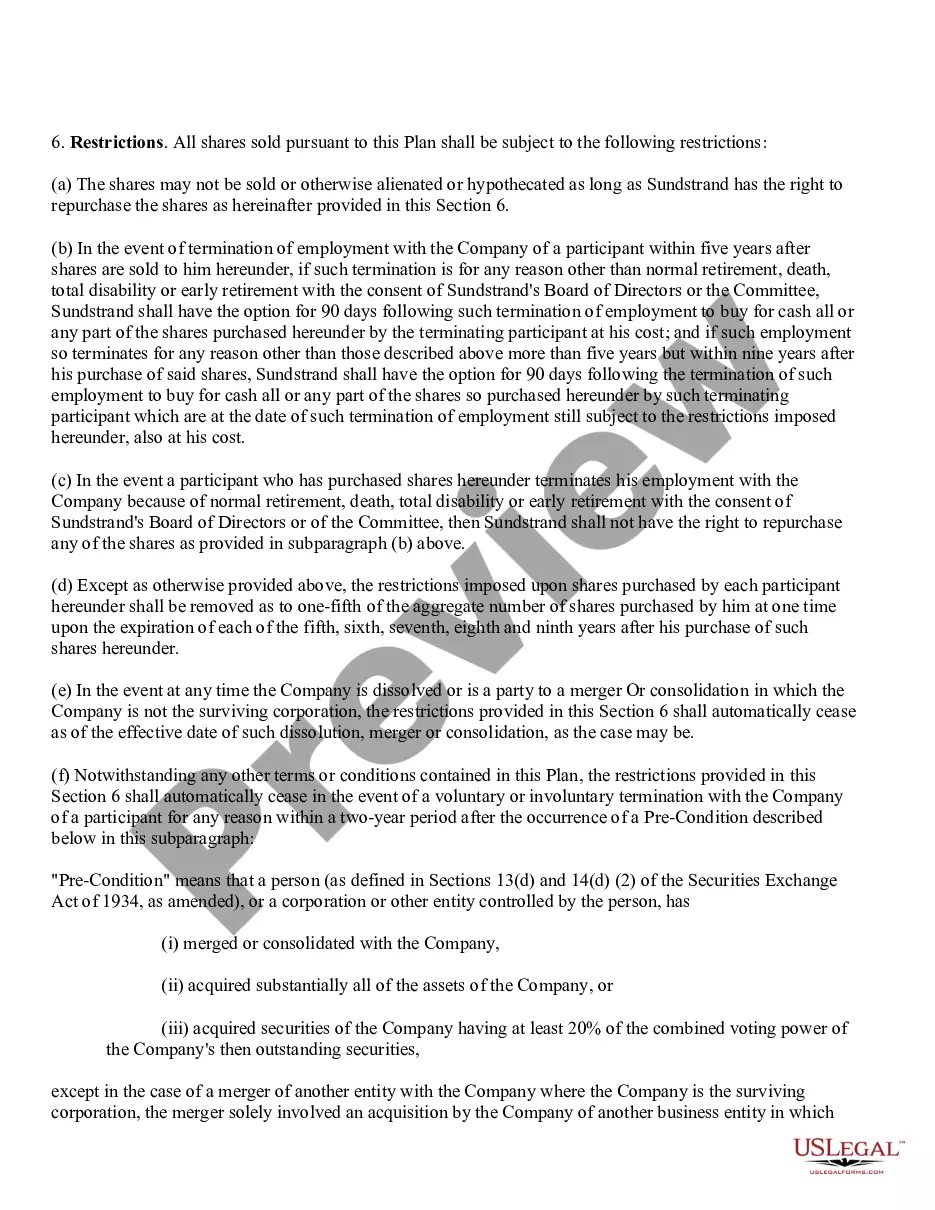
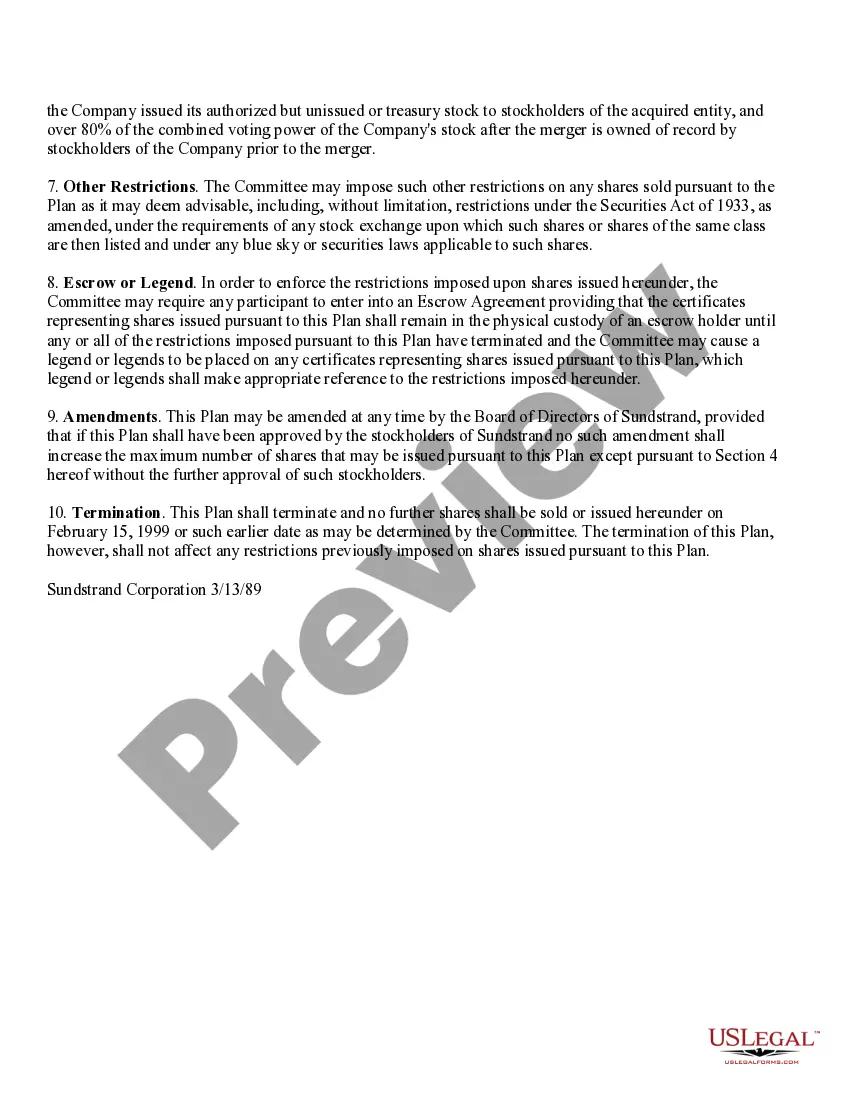
- Restrictions: Shares cannot be sold or transferred for up to nine years unless specific conditions are met.
- Repurchase Rights: The company can repurchase shares if the employee leaves under certain circumstances.
When to use this document
This form should be used when a corporation seeks to implement a restricted stock plan as part of its compensation strategy for key managerial employees. It is particularly relevant for companies aiming to retain talent and motivate employees by giving them a stake in the company's success.
Who can use this document
- Corporations looking to establish a restricted stock plan.
- Board of Directors who are responsible for executive compensation strategies.
- Key managerial employees eligible for stock purchase under the plan.
- Legal advisors drafting or reviewing the stock plan for compliance and other concerns.
How to prepare this document
- Identify the parties involved, including the corporation and the participating employees.
- Outline the terms of the stock plan, including the number of shares to be sold and pricing details.
- Specify any employment conditions or restrictions related to the shares.
- Detail the rights of the corporation to repurchase shares under specified conditions.
- Include a signature line for the Board of Directors to validate the plan.
Does this form need to be notarized?
This form does not typically require notarization unless specified by local law. However, it is advisable to check with a legal professional to ensure compliance with applicable regulations.
Get your form ready online
Our built-in tools help you complete, sign, share, and store your documents in one place.
Make edits, fill in missing information, and update formatting in US Legal Forms—just like you would in MS Word.
Download a copy, print it, send it by email, or mail it via USPS—whatever works best for your next step.
Sign and collect signatures with our SignNow integration. Send to multiple recipients, set reminders, and more. Go Premium to unlock E-Sign.
If this form requires notarization, complete it online through a secure video call—no need to meet a notary in person or wait for an appointment.
We protect your documents and personal data by following strict security and privacy standards.

Make edits, fill in missing information, and update formatting in US Legal Forms—just like you would in MS Word.

Download a copy, print it, send it by email, or mail it via USPS—whatever works best for your next step.

Sign and collect signatures with our SignNow integration. Send to multiple recipients, set reminders, and more. Go Premium to unlock E-Sign.

If this form requires notarization, complete it online through a secure video call—no need to meet a notary in person or wait for an appointment.

We protect your documents and personal data by following strict security and privacy standards.
Common mistakes
- Failing to clearly outline the restrictions on share transferability.
- Omitting details on the repurchase conditions for the company.
- Not specifying eligibility criteria for employees participating in the plan.
- Inaccurately calculating the number of shares available for the plan.
Benefits of completing this form online
- Convenience of downloading and filling in the form at your own pace.
- Editability allows for customization to fit specific corporate or employee needs.
- Ensures compliance with provisions established by legal professionals.
Legal use & context
- This form establishes a legally binding agreement between the company and its employees regarding restricted stock ownership.
- It protects the companyâs interests while providing employees with incentives to remain with the company.
- Disputes over stock ownership may arise if terms are not clearly defined or adhered to, highlighting the importance of clarity in the plan.
Summary of main points
- The Restricted Stock Plan incentivizes key employees with below-market stock options.
- Administered by a Committee, this plan requires careful adherence to the outlined restrictions.
- Understanding eligibility and the proper completion of this form is essential for successful implementation.
Looking for another form?









Form popularity
FAQ
Tax ownership of stock.If the corporation is an S corporation, the recipient does not report any of the corporation's taxable income or loss as a shareholder. It is not unusual for S corporations to require that recipients of restricted stock make Section 83(b) elections.
S corp stock options are limited, as these corporations are not allowed to issue common or preferred stock. S corporations also must be careful about how many stocks they are issuing, as having too many shareholders can cause the loss of the S corporation tax status.
Protected assets. An S corporation protects the personal assets of its shareholders. Pass-through taxation. Tax-favorable characterization of income. Straightforward transfer of ownership. Cash method of accounting. Heightened credibility.
Consequently, an S corporation may have a phantom stock plan without terminating its S corporation election. To avoid losing the "S election," the phantom stock plan must be structured carefully. Some of the criteria for an effective phantom stock plan for an S corporation includes: Liquidation rights must be limited.
RSUs are generally always worth something versus stock options, which can expire worthless if the stock price is below the strike price. Additionally, with RSUs you don't have to come up with the cash to exercise the options if your company doesn't offer some sort of cashless exercise option.
Be a domestic corporation. Have only allowable shareholders. Have no more than 100 shareholders. Have only one class of stock.
Since stock you receive through stock grants and RSUs is essentially compensation, you'll usually see it reported automatically on your W-2. Typically, taxes are withheld to go against what you might owe when you do your taxes.
Stock options are only valuable if the market value of the stock is higher than the grant price at some point in the vesting period. Otherwise, you're paying more for the shares than you could in theory sell them for. RSUs, meanwhile, are pure gain, as you don't have to pay for them.
Stock Component is also a significant part of the CTC at most companies. This component contains company shares, equity, ESOPs (Employee Stock Ownership Plan), or RSUs (Restricted Stock Units) depending on whether the company is listed in the stock market or not. The stocks are generally not provided when you join.