Letter to Client - Deposition of Client Scheduled
Understanding this form
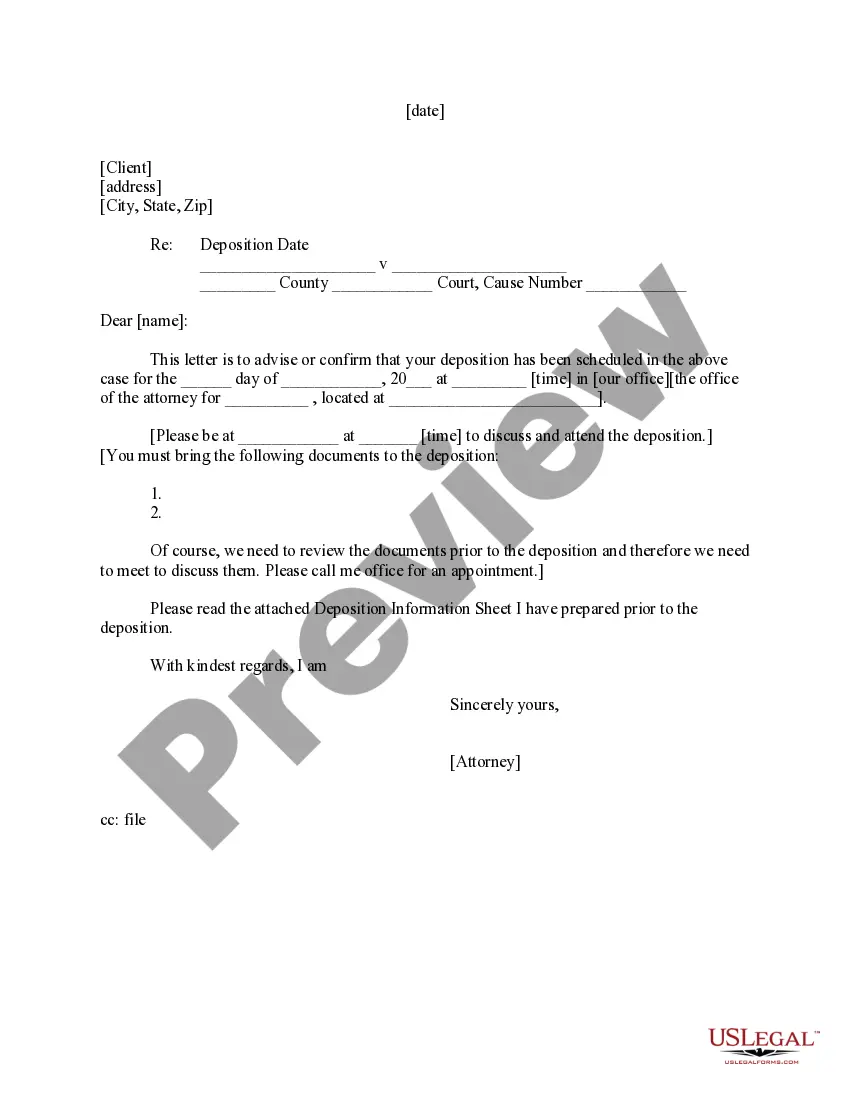
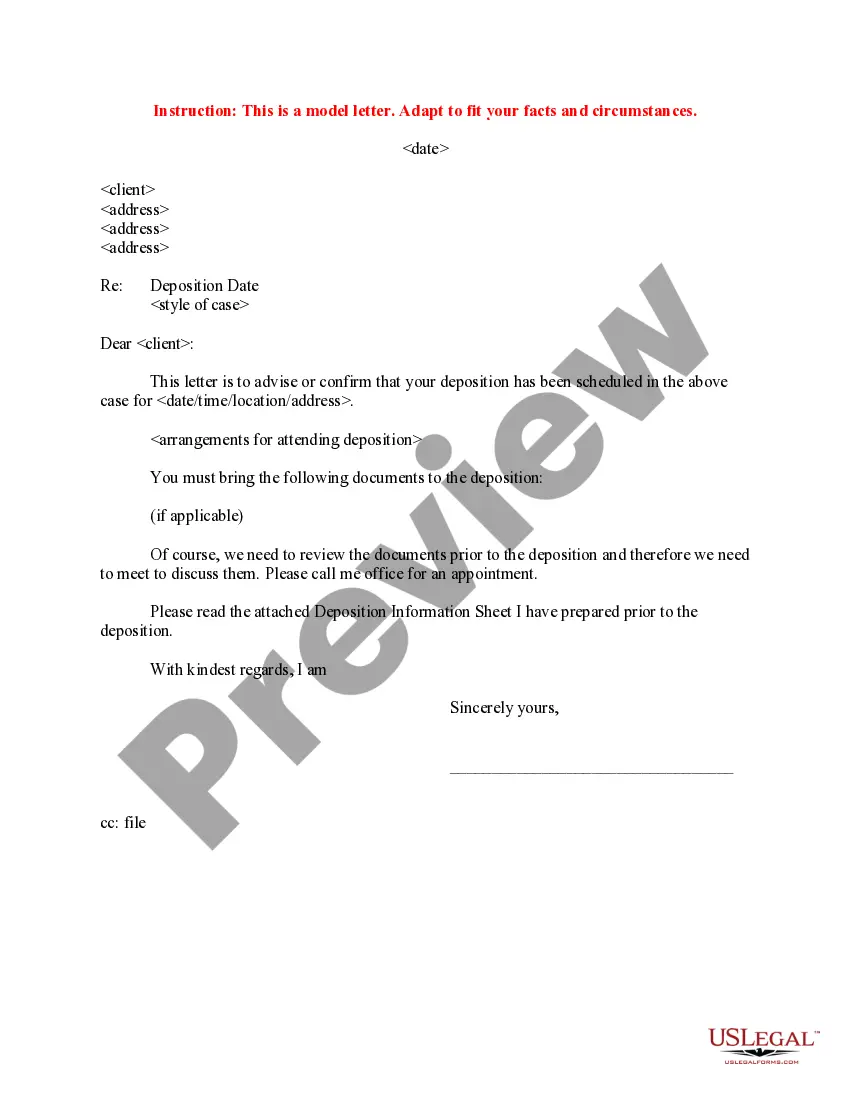
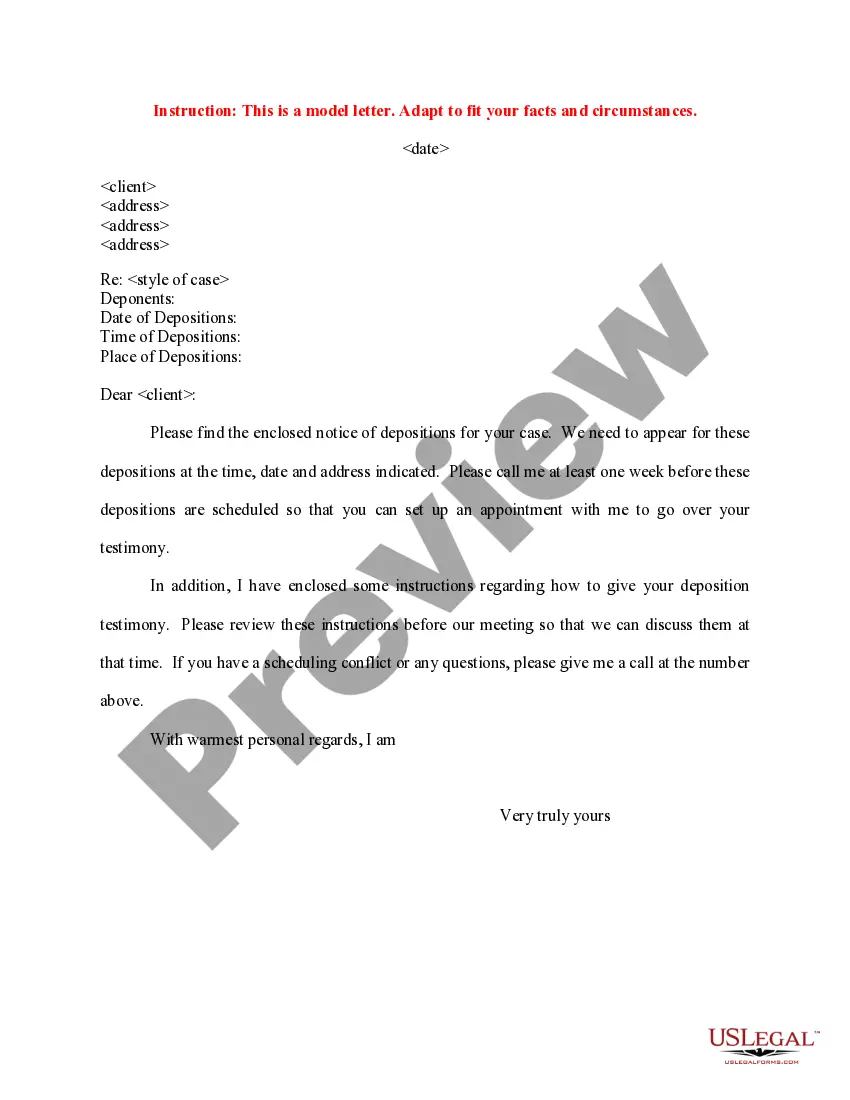
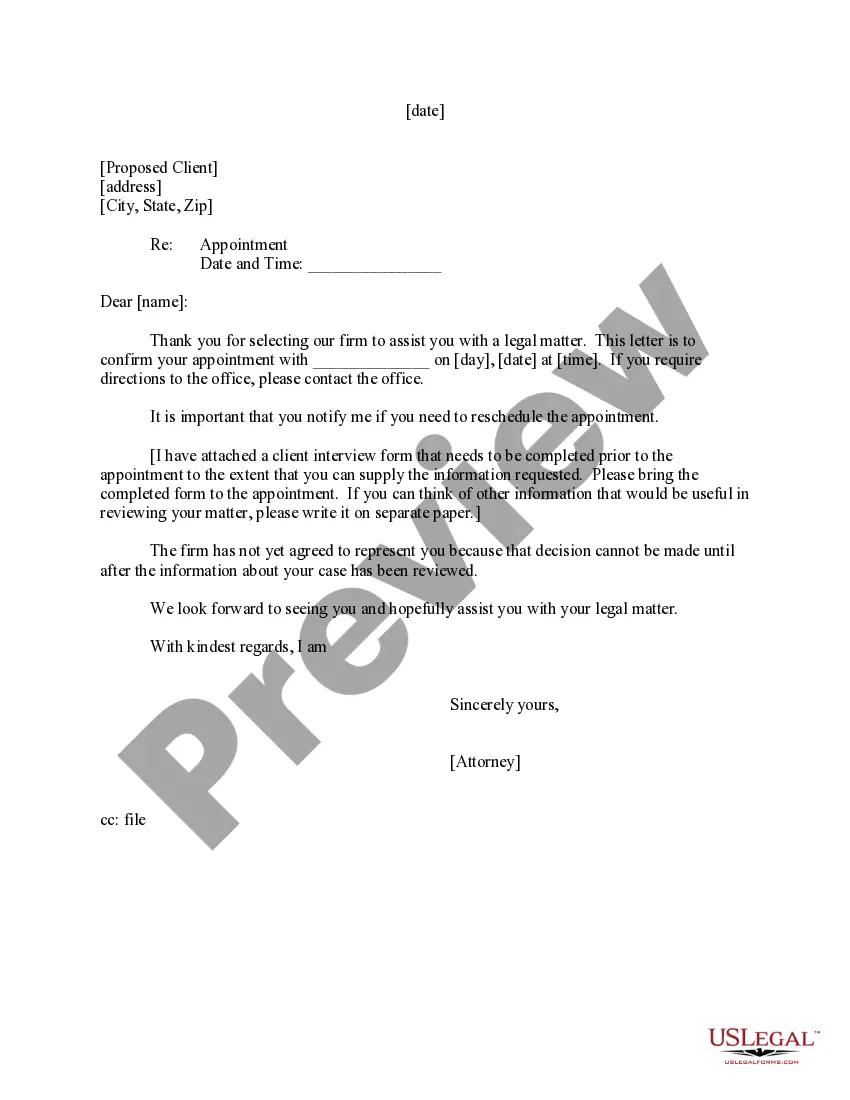
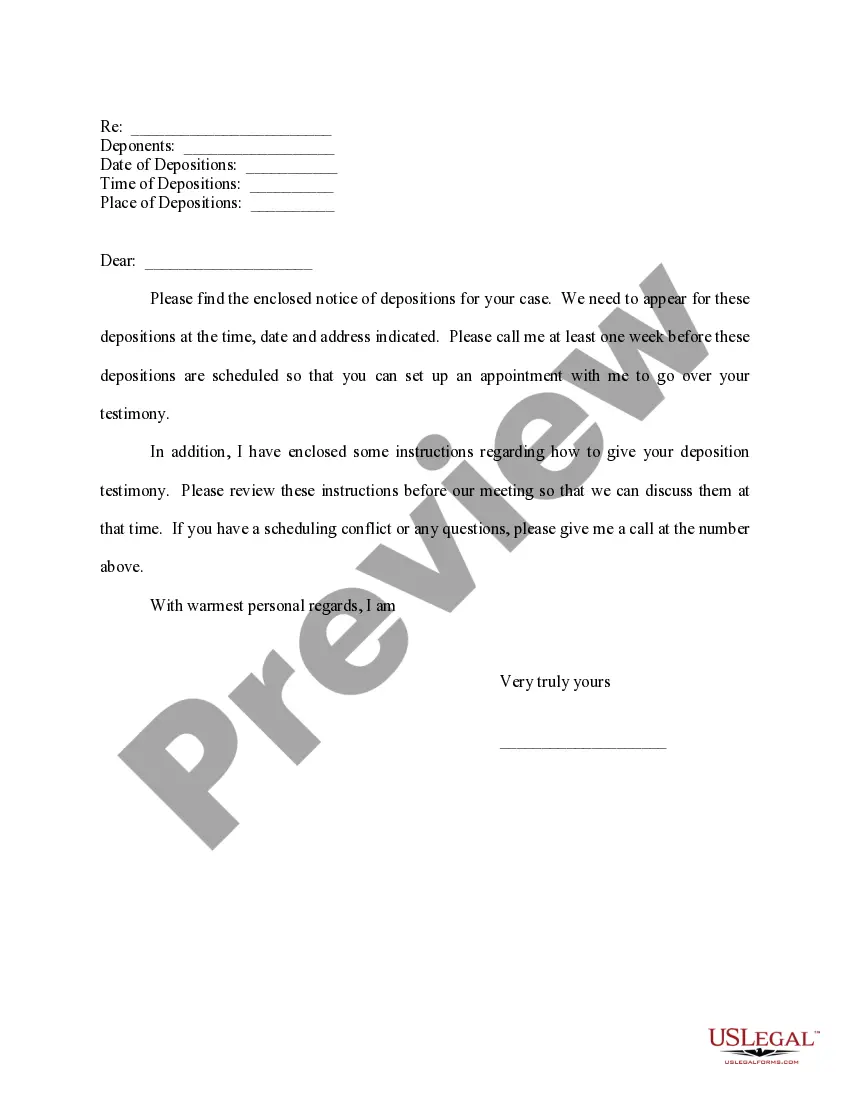
The Letter to Client - Deposition of Client Scheduled is a formal communication intended to inform a client about the scheduling of their deposition. This letter outlines the date, time, and location of the deposition and details any documents the client must bring, ensuring clarity regarding legal proceedings. Unlike similar correspondence, this letter is specifically focused on deposition logistics related to a legal case.
What’s included in this form
- Client information: Includes the client's address and contact details.
- Case information: Specifies the case title, court, and cause number.
- Deposition details: Date, time, and location for the deposition.
- Document requirements: Lists any specific documents the client needs to bring.
- Appointment request: Encourages the client to meet before the deposition for document review.

Situations where this form applies
This letter should be used when a client's deposition has been scheduled as part of a legal proceeding. It is crucial for attorneys to send this notification to prepare the client adequately, ensuring they arrive with the necessary documents and understand what to expect during the deposition process.
Intended users of this form
This letter is intended for:
- Attorneys needing to inform clients about scheduled depositions.
- Clients involved in a legal case requiring a deposition.
- Legal professionals managing multiple depositions for different clients.
Steps to complete this form
Here are the steps to complete this form:
- Fill in the client's address and contact information at the top of the letter.
- Provide the case information, including the parties involved and the cause number.
- Specify the date, time, and location of the deposition.
- List the required documents the client should bring to the deposition.
- Include a reminder for the client to schedule a meeting for document review prior to the deposition.
Notarization guidance
This form does not typically require notarization unless specified by local law.
Get your form ready online
Our built-in tools help you complete, sign, share, and store your documents in one place.
Make edits, fill in missing information, and update formatting in US Legal Forms—just like you would in MS Word.
Download a copy, print it, send it by email, or mail it via USPS—whatever works best for your next step.
Sign and collect signatures with our SignNow integration. Send to multiple recipients, set reminders, and more. Go Premium to unlock E-Sign.
If this form requires notarization, complete it online through a secure video call—no need to meet a notary in person or wait for an appointment.
We protect your documents and personal data by following strict security and privacy standards.

Make edits, fill in missing information, and update formatting in US Legal Forms—just like you would in MS Word.

Download a copy, print it, send it by email, or mail it via USPS—whatever works best for your next step.

Sign and collect signatures with our SignNow integration. Send to multiple recipients, set reminders, and more. Go Premium to unlock E-Sign.

If this form requires notarization, complete it online through a secure video call—no need to meet a notary in person or wait for an appointment.

We protect your documents and personal data by following strict security and privacy standards.
Common mistakes to avoid
- Failing to include all necessary documents required for the deposition.
- Not confirming the date and time of the deposition before sending the letter.
- Using unclear language that may confuse the client about their responsibilities.
Advantages of online completion
- Convenience: Easily customize and download from a reliable source.
- Editability: Tailor the letter to fit specific client and case details.
- Access: Obtain professional templates drafted by licensed attorneys.
What to keep in mind
- The letter serves as an important notification for clients regarding their deposition.
- Proper completion ensures clients are well-prepared for legal proceedings.
- Adjust the form as needed to meet state-specific requirements.
Looking for another form?







Form popularity
FAQ
Tell the truth. Speak audibly. Talk slowly. Think before you speak. Do not volunteer information; answer only the question that is asked. Be professional and polite. Take breaks as necessary (usually one per hour) If you do not understand the question, then ask for clarification.
Step 1: Research Each and Every Attendee. Step 2: Set a Main Goal and Objectives for the Meeting. Step 3: Plan the Agenda to Support Objectives. Step 4: Have a Plan B. Step 5: Plan Your Follow-Up Activities. Get a Head Start on Meeting Preparation.
Skip three lines and enter "Deposition of name of person being questioned." Skip one line and enter "Court Reporter:" justified to the left and the name, address and phone number of the court reporter justified to the right. Set up your word processor to number lines and pages beginning on the second page.
Be Confident. The first thing to remember when conducting depositions is maintain composure and confidence. Be Prepared. Use Bullet Points, But Don't Write an Extensive Outline. Study the Rules. Do Not Be Bullied. Review Your Work.
Use Clear Language. Whether in court or in a conference room for a deposition, it is always advantageous to rely on using clear, concise language instead of a building complex, jargon-filled questions. Ask About the Basics. Don't allow the basics of the case to simply be assumed. Anticipate Answers.
Never Guess to Answer a Question. Avoid Any Absolute Statements. Do Not Use Profanity. Do Not Provide Additional Information. Avoid Making Light of the Situation. Never Paraphrase a Conversation. Do Not Argue or Act Aggressively. Avoid Providing Privileged Information.
Tell the truth. Speak audibly. Talk slowly. Think before you speak. Do not volunteer information; answer only the question that is asked. Be professional and polite. Take breaks as necessary (usually one per hour) If you do not understand the question, then ask for clarification.
Deposition testimony is a stressful but important process during the discovery phase of a lawsuit. Preparation by the physician can make later procedures easier and more efficient.
Don't guess, speculate, or play a hunch. A deposition is sworn testimony; only say what you know to be true. On the other hand, don't use this tip to avoid giving testimony that you know. If you don't understand a question, ask for the questioner to rephrase it.