Jury Instruction - Explanatory Instruction - Prior Statement or Testimony of a Witness
Understanding this form
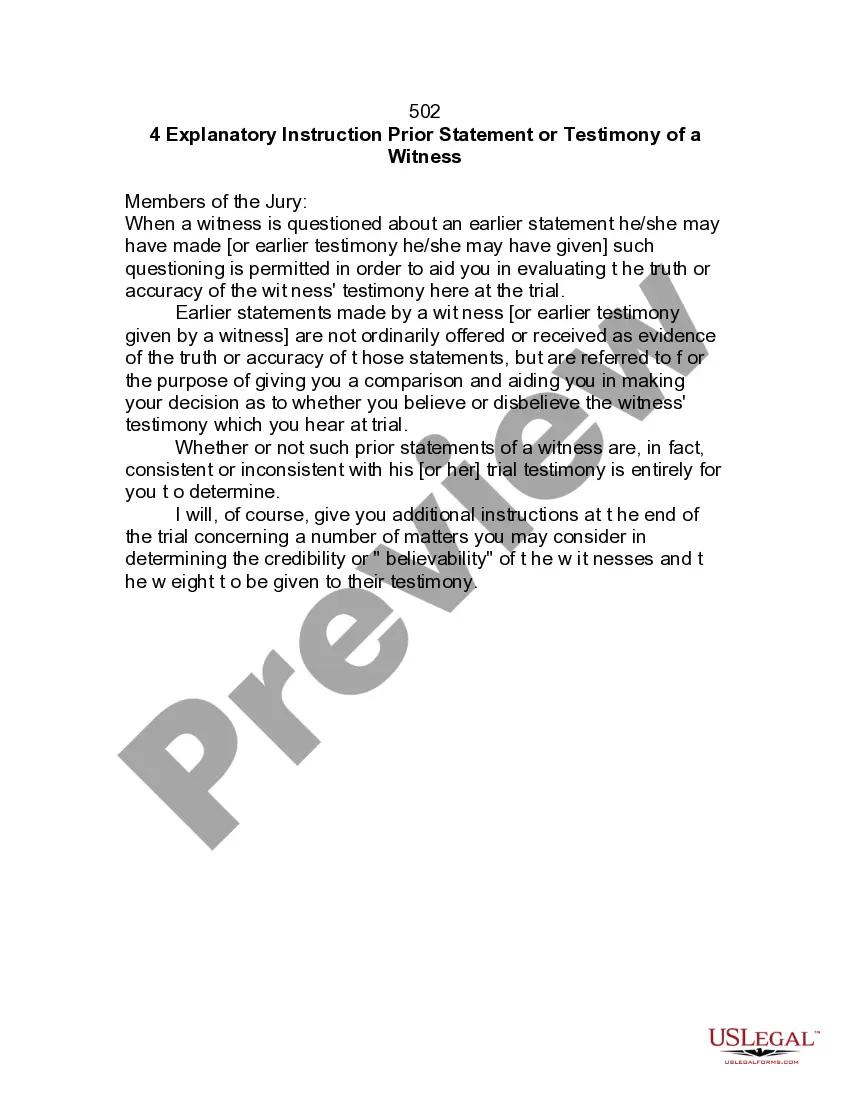
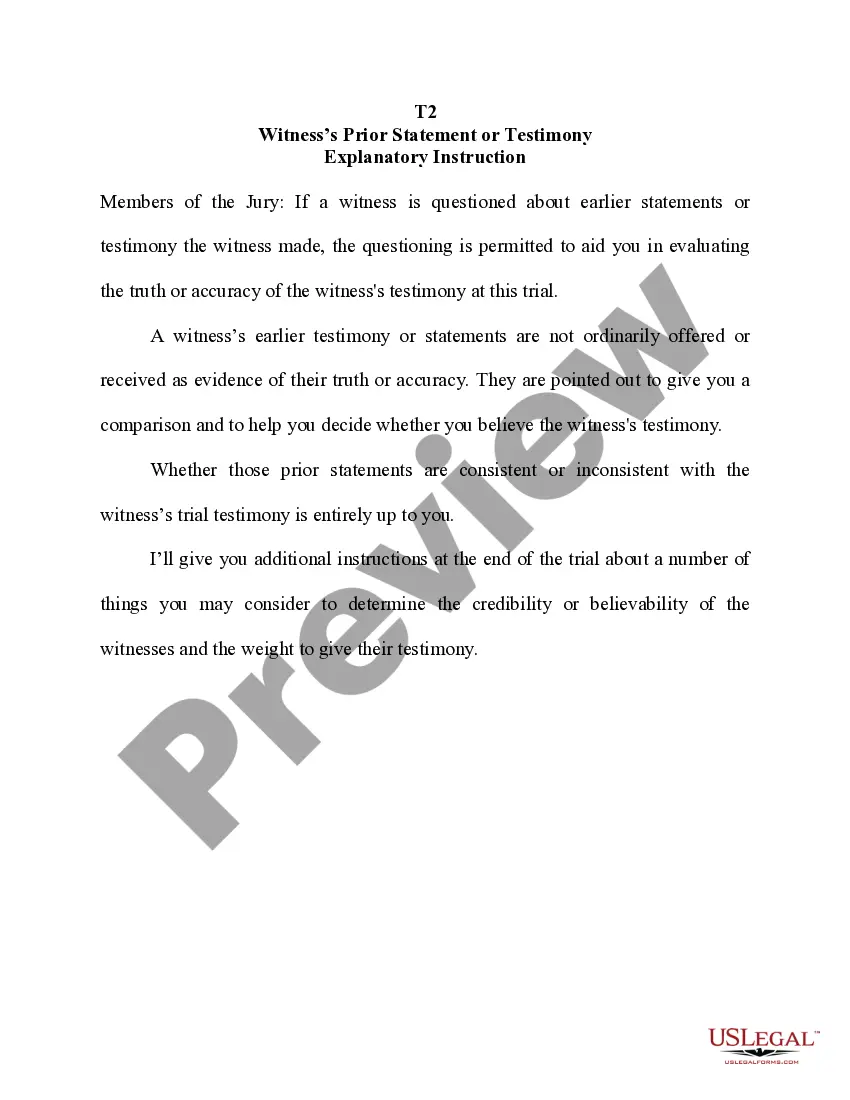
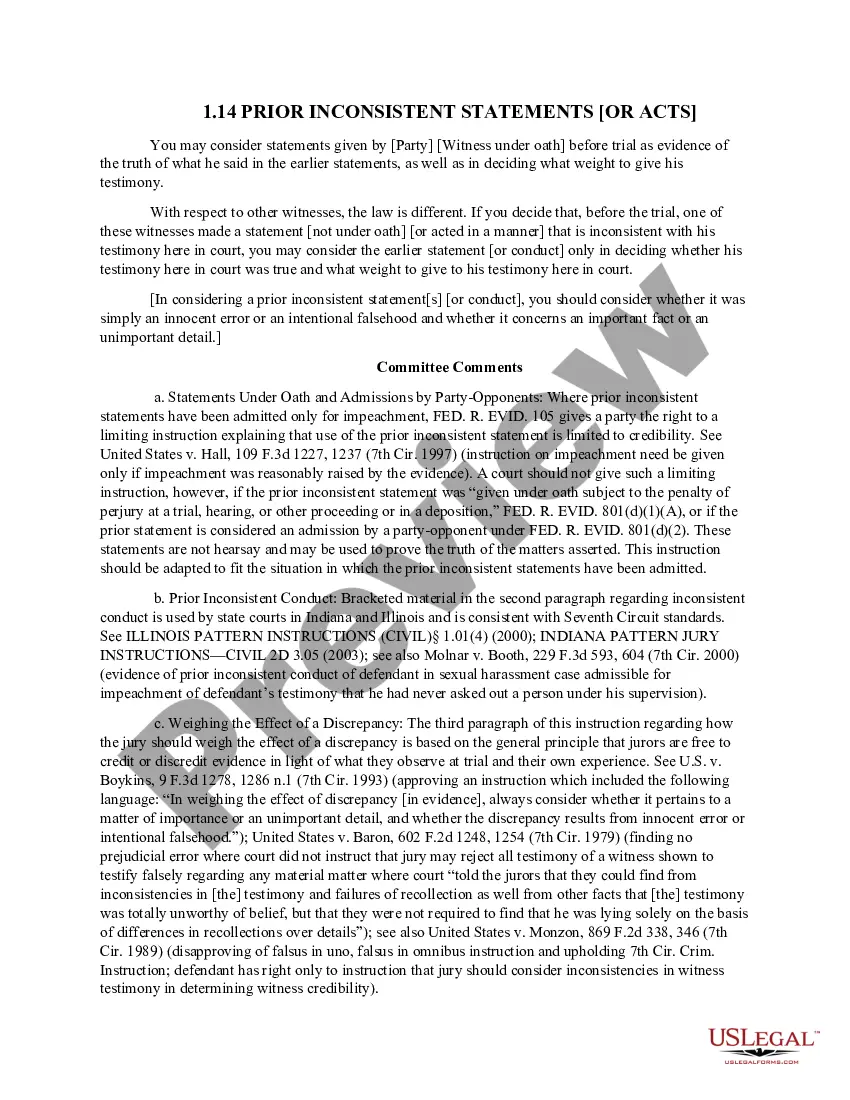
This form is a Jury Instruction - Explanatory Instruction regarding the prior statement or testimony of a witness. It provides guidance on how jurors should consider previous statements made by a witness during the trial. Unlike other legal forms that may focus solely on the evidentiary aspects of testimony, this jury instruction emphasizes how prior testimony can help jurors evaluate the credibility of a witness's current statements.
What’s included in this form
- Overview of the purpose of questioning a witness about prior statements or testimony.
- Explanation that earlier statements are not typically accepted as evidence of truth.
- Guidance for jurors to compare earlier statements with current testimony.
- Instructions for determining the credibility of a witness based on previous and current testimony.
When to use this document
This form is used in court proceedings when a witness's prior statements or testimony are relevant to assessing their current statements. It is particularly necessary in cases where credibility and reliability of testimony play key roles in the jury's deliberations.
Who can use this document
- Judges overseeing trials who need to instruct juries on the use of prior witness statements.
- Attorneys representing clients in trials to understand how to frame questions around witness credibility.
- Jurors to comprehend how to assess witness reliability based on past and present testimonies.
Steps to complete this form
- Review the form to understand the structure of the explanatory instruction.
- Customize the language if needed to fit the specific case context.
- Ensure clarity in explaining the purpose of prior witness statements.
- Be prepared to provide further instructions to jurors on assessing witness credibility.
Does this document require notarization?
Notarization is generally not required for this form. However, certain states or situations might demand it. You can complete notarization online through US Legal Forms, powered by Notarize, using a verified video call available anytime.
Get your form ready online
Our built-in tools help you complete, sign, share, and store your documents in one place.
Make edits, fill in missing information, and update formatting in US Legal Forms—just like you would in MS Word.
Download a copy, print it, send it by email, or mail it via USPS—whatever works best for your next step.
Sign and collect signatures with our SignNow integration. Send to multiple recipients, set reminders, and more. Go Premium to unlock E-Sign.
If this form requires notarization, complete it online through a secure video call—no need to meet a notary in person or wait for an appointment.
We protect your documents and personal data by following strict security and privacy standards.

Make edits, fill in missing information, and update formatting in US Legal Forms—just like you would in MS Word.

Download a copy, print it, send it by email, or mail it via USPS—whatever works best for your next step.

Sign and collect signatures with our SignNow integration. Send to multiple recipients, set reminders, and more. Go Premium to unlock E-Sign.

If this form requires notarization, complete it online through a secure video call—no need to meet a notary in person or wait for an appointment.

We protect your documents and personal data by following strict security and privacy standards.
Common mistakes to avoid
- Failing to clarify that prior statements are not evidence of the truth.
- Using ambiguous language that may confuse jurors.
- Neglecting to compare prior and current statements explicitly.
Advantages of online completion
- Convenience of downloading and editing forms anytime.
- Access to accurate legal language drafted by licensed attorneys.
- Time-saving in preparing jury instructions tailored to specific cases.
Legal use & context
- This form is intended for use in court proceedings where jury instructions regarding witness credibility are required.
- It helps establish clear legal standards for evaluating witness testimony, enhancing the integrity of the judicial process.
- Consistent application of this instruction promotes fair trial standards across jurisdictions.
Looking for another form?








Form popularity
FAQ
Listen carefully to the questions you are asked. If you don't understand the question, have it repeated, then give a thoughtful, considered answer. DO NOT GIVE AN ANSWER WITHOUT THINKING. While answers should not be rushed, neither should there be any unnaturally long delay to a simple question if you know the answer.
What the witness actually says in court is called testimony. In court, the witness is called to sit near the judge on the witness stand. In order to testify, witnesses must take an oath to agree or affirm to tell the truth.
When a witness gives testimony, (s)he is first asked some questions by the attorney who called him/her to the stand.When you are questioned by the opposing attorney, it is called cross examination. This process is sometimes repeated several times in order to clearly address all aspects of the questions and answers.
Jury lists are compiled from voter registrations and driver license or ID renewals. From those lists, summonses are mailed. A panel of jurors is then assigned to a courtroom.
The credibility of an expert witness often relies on the belief that experts are, in a sense, neutral even when they testify on behalf of one side or the other.No explicit rules prohibit an expert from switching sides or mandate that an expert do so.
The court further explained that a victim's testimony is sufficient in and of itself to support an assault conviction. Here, the court found there was sufficient evidence to uphold the defendant's conviction.
Testimony. Credibility and likeability are the keys. Think carefully at all times before you speak. Answer with words, not gestures.
These are civil or criminal jury instructions approved by a state court, bench committee, or bar association. They are commonly used by courts in the relevant jurisdiction, as they ease the process of drafting fair jury instructions and theoretically do not have errors.
SPEAK IN YOUR OWN WORDS. Don't try to memorize what you are going to say. SPEAK CLEARLY. APPEARANCE IS IMPORTANT. DO NOT DISCUSS THE CASE. BE A RESPONSIBLE WITNESS. BEING SWORN IN AS A WITNESS. TELL THE TRUTH.