Jury Instruction - Intentional Violation Of A Known Legal Duty - As Proof Of Willfulness
Overview of this form
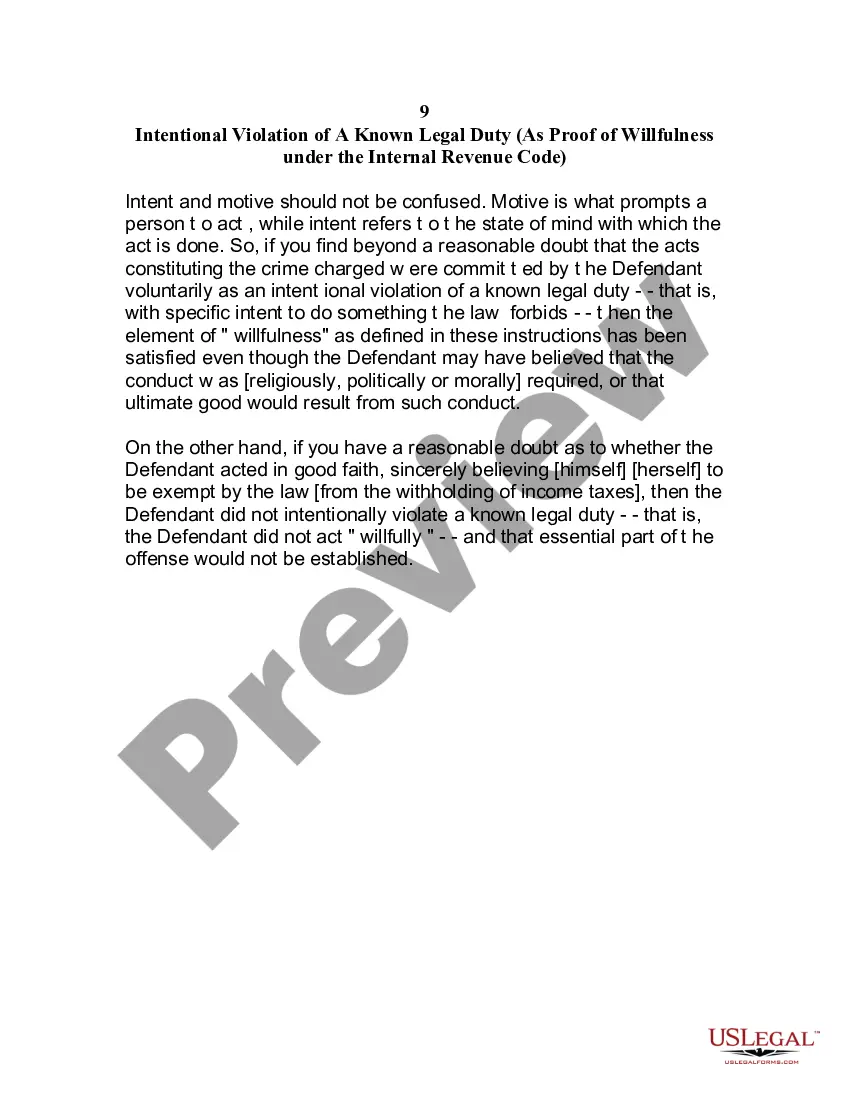
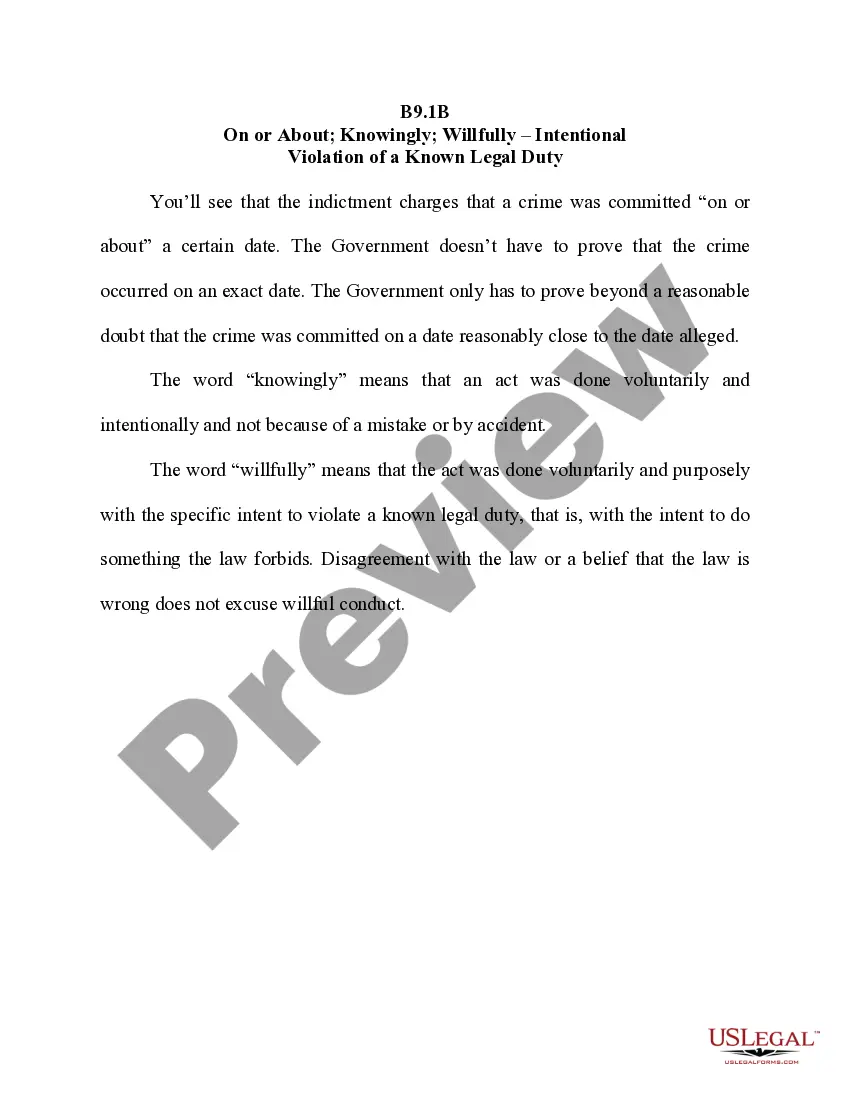
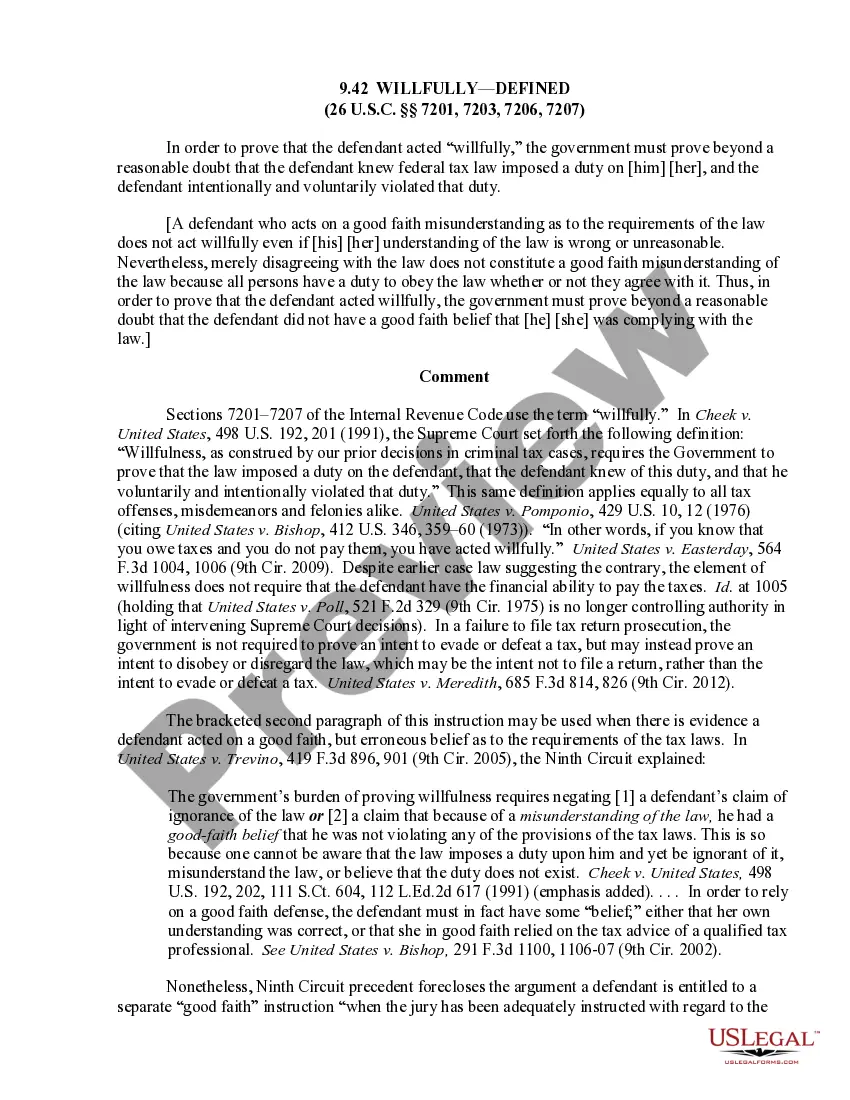
The Jury Instruction - Intentional Violation of a Known Legal Duty - As Proof of Willfulness is a legal document used to guide juries in understanding the criteria for determining willfulness in cases related to intentional legal violations. This form provides specific instructions that differentiate intent from motive, helping juries evaluate whether a defendant acted willfully in violating legal duties, particularly under the Internal Revenue Code. Unlike other jury instructions, this form focuses specifically on the element of willfulness in relation to knowledge of legal obligations.
Form components explained
- Definition of intent and motive, clarifying the differences.
- Criteria for establishing willfulness in the context of legal duties.
- Instruction on evaluating the defendant's beliefs regarding compliance with the law.
- References to relevant case law supporting the instruction provided.
Common use cases
This jury instruction should be used in legal cases where the prosecution needs to prove that a defendant willfully violated a known legal duty. This form is especially relevant in cases involving tax evasion or similar offenses where the defendantâs intent is central to establishing guilt. It helps ensure jurors understand the nuances of legal intent and belief about compliance with the law.
Who this form is for
- Legal professionals preparing for trial in cases of willful wrongdoing.
- Prosecutors seeking to clarify jury understandings of intent.
- Judges requiring standardized instructions for jury deliberation.
- Defendantsâ attorneys who want to prepare for counterarguments regarding intent.
Instructions for completing this form
- Review the key components of intentional violation and willfulness.
- Adapt the sample instructions to fit the particulars of the case.
- Insert relevant case law references where appropriate.
- Ensure clarity in the distinctions between intent and motive for the jury.
- Provide copies of the completed instruction to all parties involved.
Does this document require notarization?
Notarization is not commonly needed for this form. However, certain documents or local rules may make it necessary. Our notarization service, powered by Notarize, allows you to finalize it securely online anytime, day or night.
Get your form ready online
Our built-in tools help you complete, sign, share, and store your documents in one place.
Make edits, fill in missing information, and update formatting in US Legal Forms—just like you would in MS Word.
Download a copy, print it, send it by email, or mail it via USPS—whatever works best for your next step.
Sign and collect signatures with our SignNow integration. Send to multiple recipients, set reminders, and more. Go Premium to unlock E-Sign.
If this form requires notarization, complete it online through a secure video call—no need to meet a notary in person or wait for an appointment.
We protect your documents and personal data by following strict security and privacy standards.

Make edits, fill in missing information, and update formatting in US Legal Forms—just like you would in MS Word.

Download a copy, print it, send it by email, or mail it via USPS—whatever works best for your next step.

Sign and collect signatures with our SignNow integration. Send to multiple recipients, set reminders, and more. Go Premium to unlock E-Sign.

If this form requires notarization, complete it online through a secure video call—no need to meet a notary in person or wait for an appointment.

We protect your documents and personal data by following strict security and privacy standards.
Avoid these common issues
- Failing to clarify the difference between motive and intent.
- Providing overly complex language that jurors may not understand.
- Not aligning the instructions with the specifics of the charge.
Benefits of completing this form online
- Instant access to professionally drafted jury instructions.
- Easy editing to customize instructions for specific cases.
- Convenient downloading for immediate use in legal proceedings.
Legal use & context
This jury instruction is meant to provide a clear understanding of legal standards required for proving willfulness in a court of law. Using this instruction helps ensure that the jury applies the law correctly based on established guidelines, enhancing the fairness of the verdict.
Quick recap
- This form clarifies the legal distinctions necessary for jury consideration of willfulness.
- It is critical in cases involving the intentional violation of legal responsibilities.
- Understanding intent versus motive is essential for jurors to reach a just conclusion.
Looking for another form?

Form popularity
FAQ
Many criminal offenses require "specific intent" on the part of the accused regarding his or her actions.Specific intent, however, can seldom be proven by direct evidence: Intent must be proved by the reasonable inferences shown by the evidence and the surrounding circumstances.
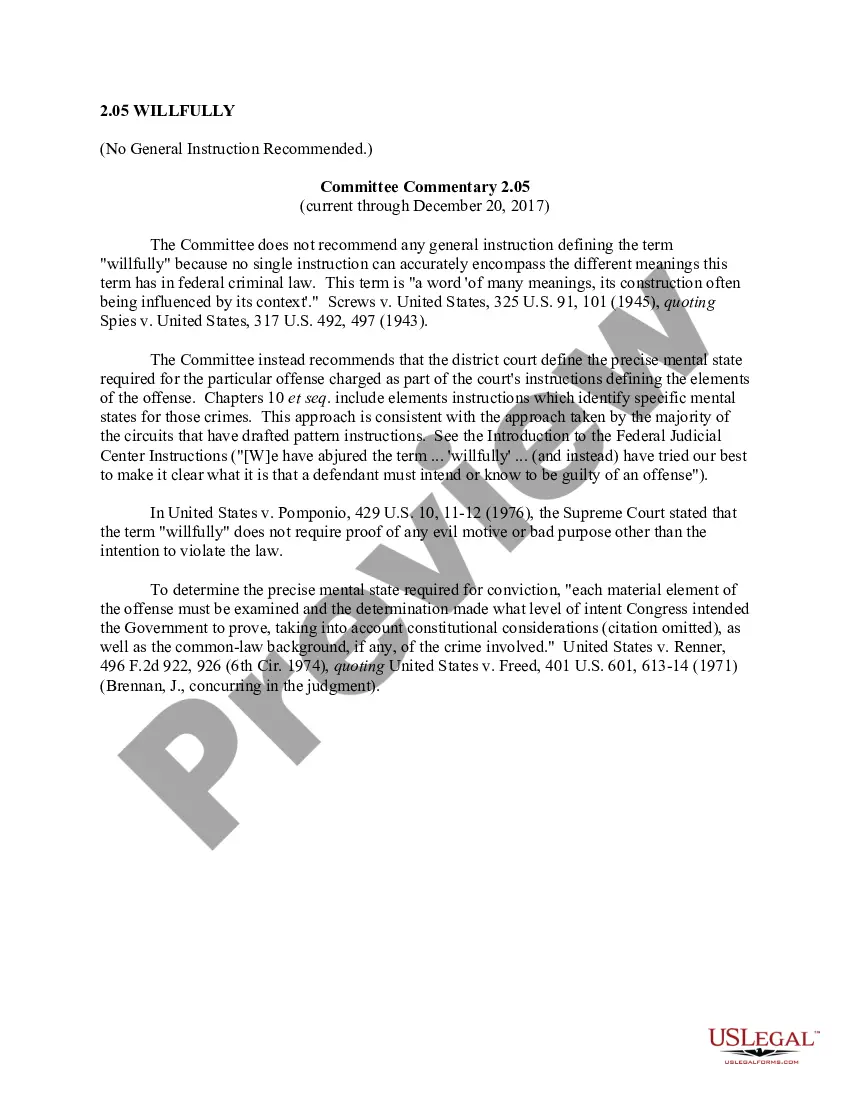
An act is done 'willfully' if done voluntarily and intentionally and with the specific intent to do something the law forbids. There is no requirement that the government show evil intent on the part of a defendant in order to prove that the act was done 'willfully. '
Proving Intent in Court Since intent is a mental state, it is one of the most difficult things to prove. There is rarely any direct evidence of a defendant's intent, as nearly no one who commits a crime willingly admits it. To prove criminal intent, one must rely on circumstantial evidence.
General intent crimes require no further mental state beyond a willingness to commit a crime. Usually a definition of a general intent crime describes only a specific act, and does not include a need for an intent to commit the crime.
The crimes that are generally easier to prove the intent would be the general intent and liability crimes. These are considered easier, because the prosecutor is not required to prove the defendant's intent at the time of the crime, but just the fact that they committed the crime that was against the law.
The important difference between willfully as defined in this instruction and the most frequently used definition of knowingly, as stated in Instruction 5.02, is that willfully requires proof beyond a reasonable doubt that the defendant knew his or her conduct was unlawful and intended to do something that 16 Page 17
A party's intention to knowingly and deliberately act or refrain from acting in a particular manner or to achieve a particular result.