Jury Instruction - Accomplice - Co-Defendant - Plea Agreement
About this form
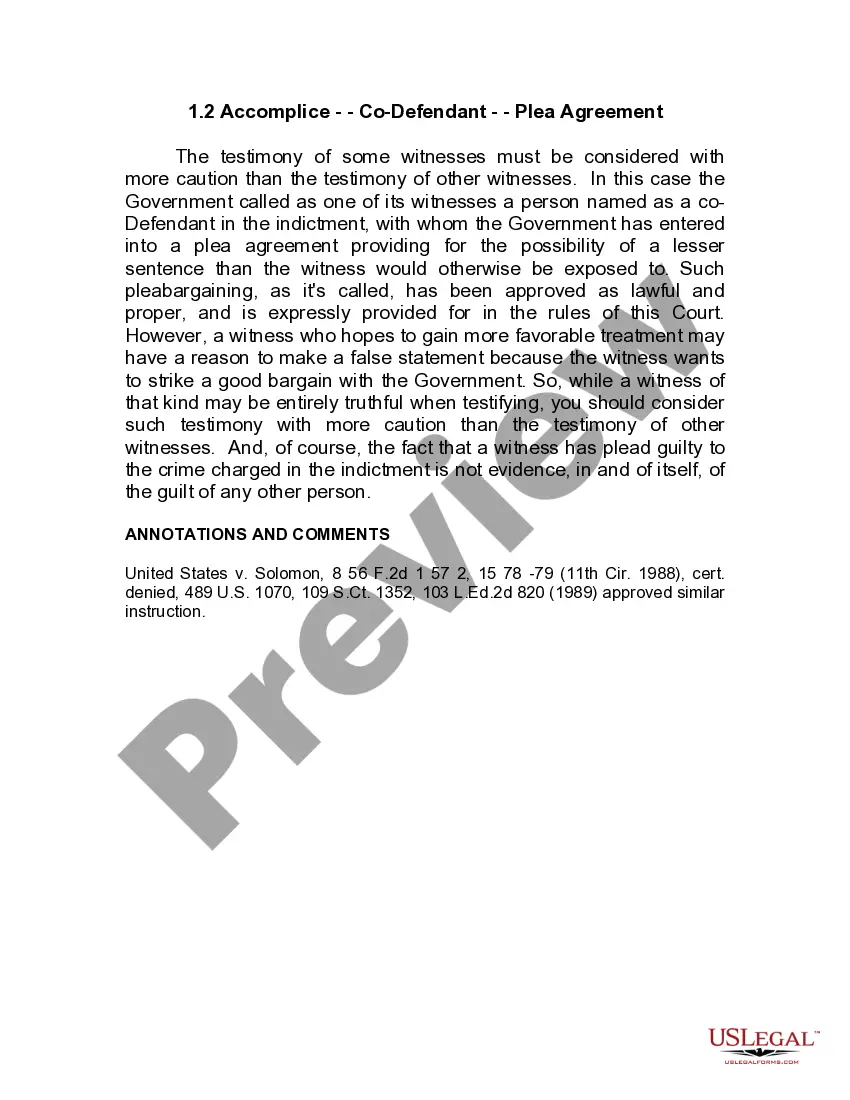
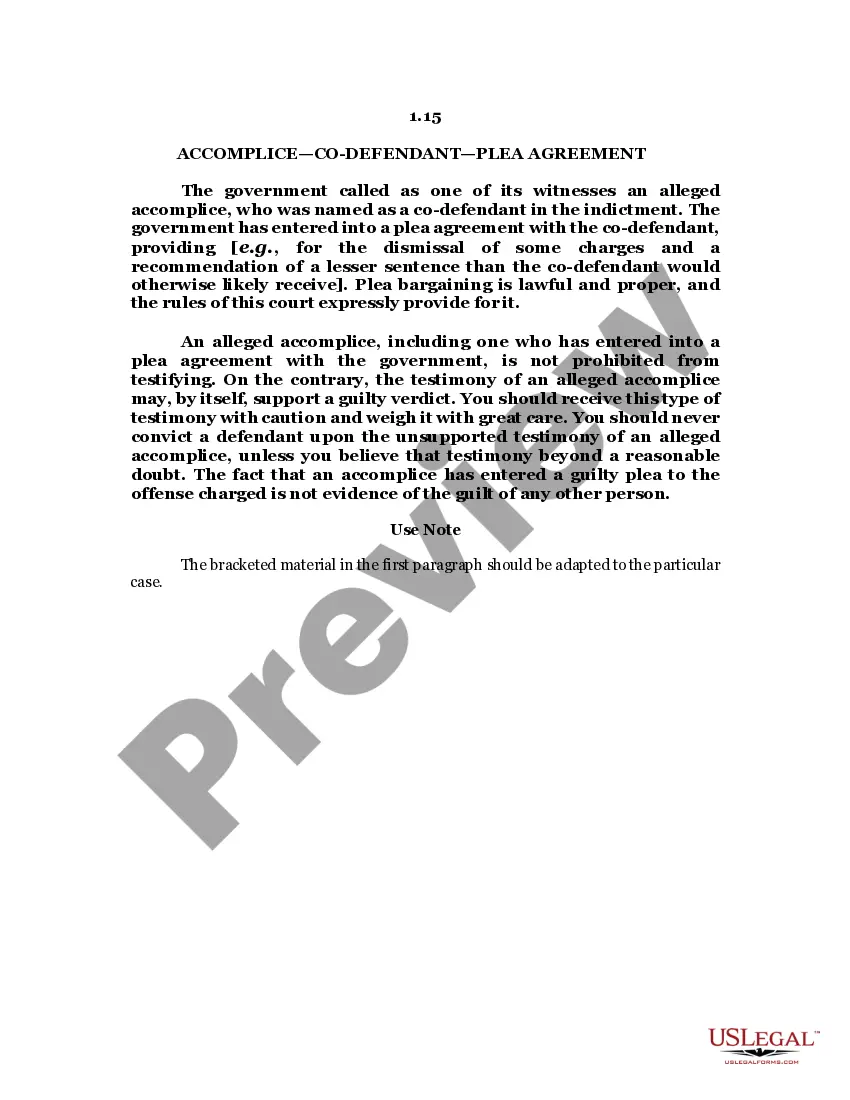
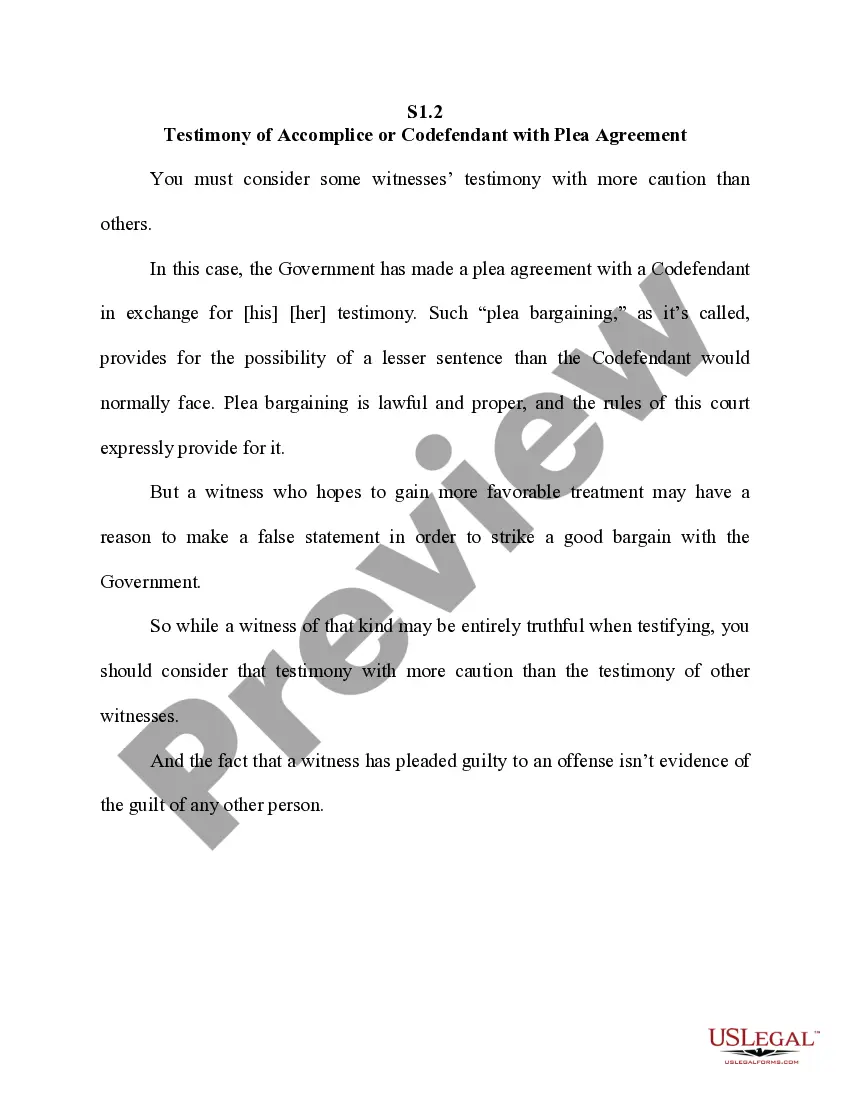
The Jury Instruction - Accomplice - Co-Defendant - Plea Agreement form provides guidance for jury instructions regarding the testimony of co-defendants who have entered into plea agreements. This form is essential in highlighting the need for jurors to evaluate testimony from such witnesses with caution due to potential biases arising from their plea deals. It differs from other jury instruction forms by specifically addressing the implications of plea bargaining and its effect on the credibility of a witness's testimony.
What’s included in this form
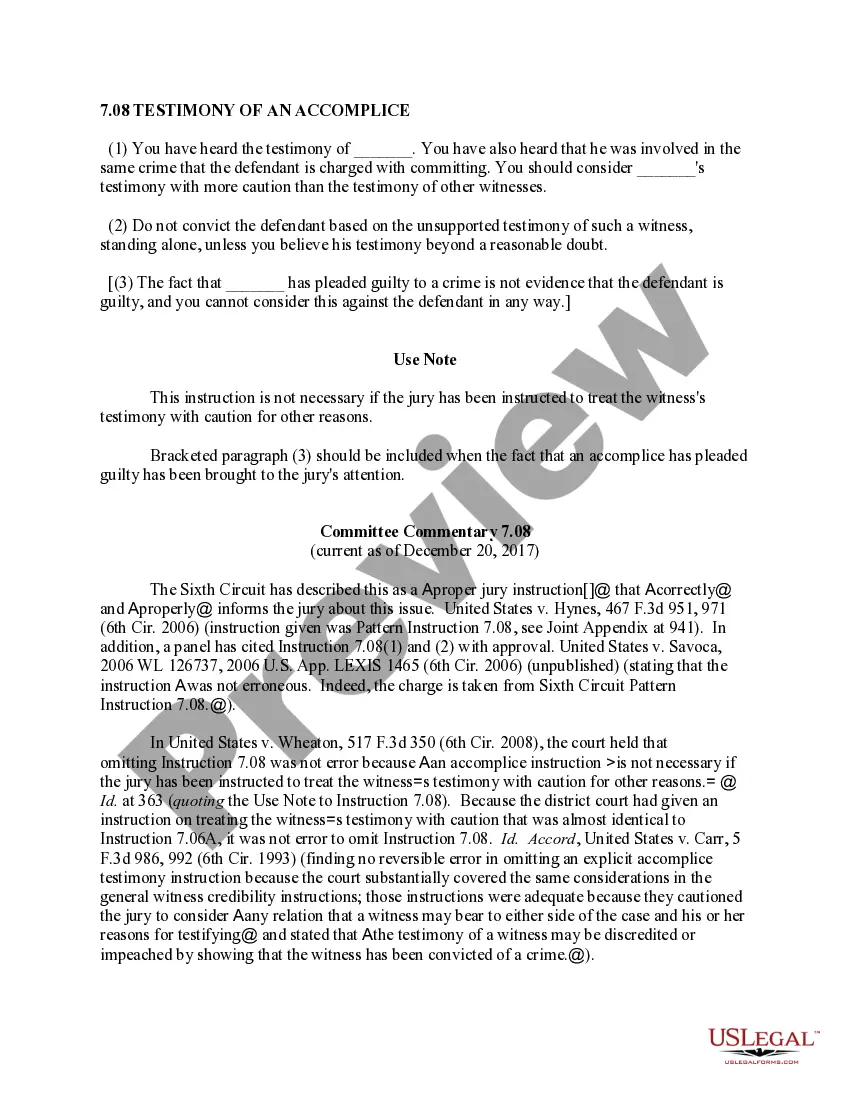
- Sample jury instructions tailored for evaluating co-defendant testimony.
- Guidance on considering testimony from witnesses who have plea agreements.
- Instructions emphasizing that a co-defendant's guilty plea does not imply guilt for others.
- Legal precedents referenced to support the instructions provided.
- Framework to modify the instructions according to specific cases.
When to use this document
This form is used in criminal cases where a co-defendant has taken a plea agreement and will testify against another defendant. It is crucial during jury selection and trial phases to ensure that jurors understand the implications of a witness's plea bargain and assess the reliability of their testimony. This form helps to clarify the rules surrounding how such evidence should be weighed.
Who can use this document
- Attorneys representing defendants in criminal trials.
- Prosecutors seeking to present evidence from co-defendants.
- Judges preparing for jury instructions in related cases.
- Legal professionals involved in criminal defense strategy.
Completing this form step by step
- Identify the specific case for which the jury instructions are needed.
- Review the sample questions and modify them to fit the case's facts.
- Incorporate relevant legal precedents to support the jury's understanding.
- Ensure the language is clear and accessible for jurors.
- Finalize the instructions for presentation to the court.
Does this form need to be notarized?
This form does not typically require notarization to be legally valid. However, some jurisdictions or document types may still require it. US Legal Forms provides secure online notarization powered by Notarize, available 24/7 for added convenience.
Get your form ready online
Our built-in tools help you complete, sign, share, and store your documents in one place.
Make edits, fill in missing information, and update formatting in US Legal Forms—just like you would in MS Word.
Download a copy, print it, send it by email, or mail it via USPS—whatever works best for your next step.
Sign and collect signatures with our SignNow integration. Send to multiple recipients, set reminders, and more. Go Premium to unlock E-Sign.
If this form requires notarization, complete it online through a secure video call—no need to meet a notary in person or wait for an appointment.
We protect your documents and personal data by following strict security and privacy standards.

Make edits, fill in missing information, and update formatting in US Legal Forms—just like you would in MS Word.

Download a copy, print it, send it by email, or mail it via USPS—whatever works best for your next step.

Sign and collect signatures with our SignNow integration. Send to multiple recipients, set reminders, and more. Go Premium to unlock E-Sign.

If this form requires notarization, complete it online through a secure video call—no need to meet a notary in person or wait for an appointment.

We protect your documents and personal data by following strict security and privacy standards.
Common mistakes
- Failing to adapt the sample questions to the specific circumstances of the case.
- Neglecting to clarify the implications of plea agreements for jurors.
- Including excessive legal jargon that could confuse jurors.
- Overlooking relevant case law that supports the jury instructions.
Advantages of online completion
- Convenient access to legal templates that can be downloaded and edited.
- Quick adaptability to fit specific case requirements and legal standards.
- Reliable resources drafted by licensed attorneys to ensure accuracy.
Legal use & context
- This form provides guidance on how to present and interpret co-defendant testimony.
- Proper usage helps prevent jurors from improperly attributing guilt based on plea agreements.
- Adhering to these instructions is critical for maintaining fair trial standards.
Looking for another form?
Form popularity
FAQ
A defendant generally does not have a right to a separate trial upon request, except in some narrow situations such as death penalty cases. However, a defendant can ask a judge to sever a joint trial if proceeding jointly would jeopardize their right to a fair trial.
: a defendant in the same lawsuit or criminal prosecution as another defendant or group of defendants : a joint defendant 2026 the defendant argued that it was plain error for the trial court to have permitted the prosecution to treat his co-defendant as hostile 2026 State v.
A co-defendant is a third party other than the defendant in the case in which another co-defendant is charged and is by nature a witness.Therefore, a co-defendant is a third party other than the defendant in the case in which another co-defendant is charged and is by nature a witness.
There's cases called Aranda-Bruton Rule. These cases stand for the proposition that yes, at a preliminary hearing a co-defendant's statement can come in against another co-defendant and against them as an admission even if the defense attorney doesn't have an opportunity to cross-examine that co-defendant.
Definition. One of multiple defendants jointly sued in the same litigation or charged with the same crime. Also termed joint defendant. courts.
Yes, co-defendants in drug cases may receive different sentences. When two people are charged and convicted of the same crime, the maximum penalty they are facing may be the same, but the actual sentence each receives can vary greatly.
A co-defendant is a third party other than the defendant in the case in which another co-defendant is charged and is by nature a witness.It is only when a court has implemented this procedure that the statement of a co-defendant can be relied on as a basis for concluding the criminal facts about the defendant.
Defendant may cross examine co-defendant's witness, a fortiori, he may cross examine co-defendant, if he gives evidence.Answering the said question, the learned Single Judge of the Karnataka High Court has held that a defendantparty who is on the opposite side.
Every case is different, but generally speaking, when co-defendant's take a plea, they can now testify against the defendant and may even receive a lighter sentence as a result. On the other hand, in some cases, it allows the defendant's attorney to point to the co-defendant and say, "it was all his fault."