Jury Instruction - False Claims Against The Government
What this document covers
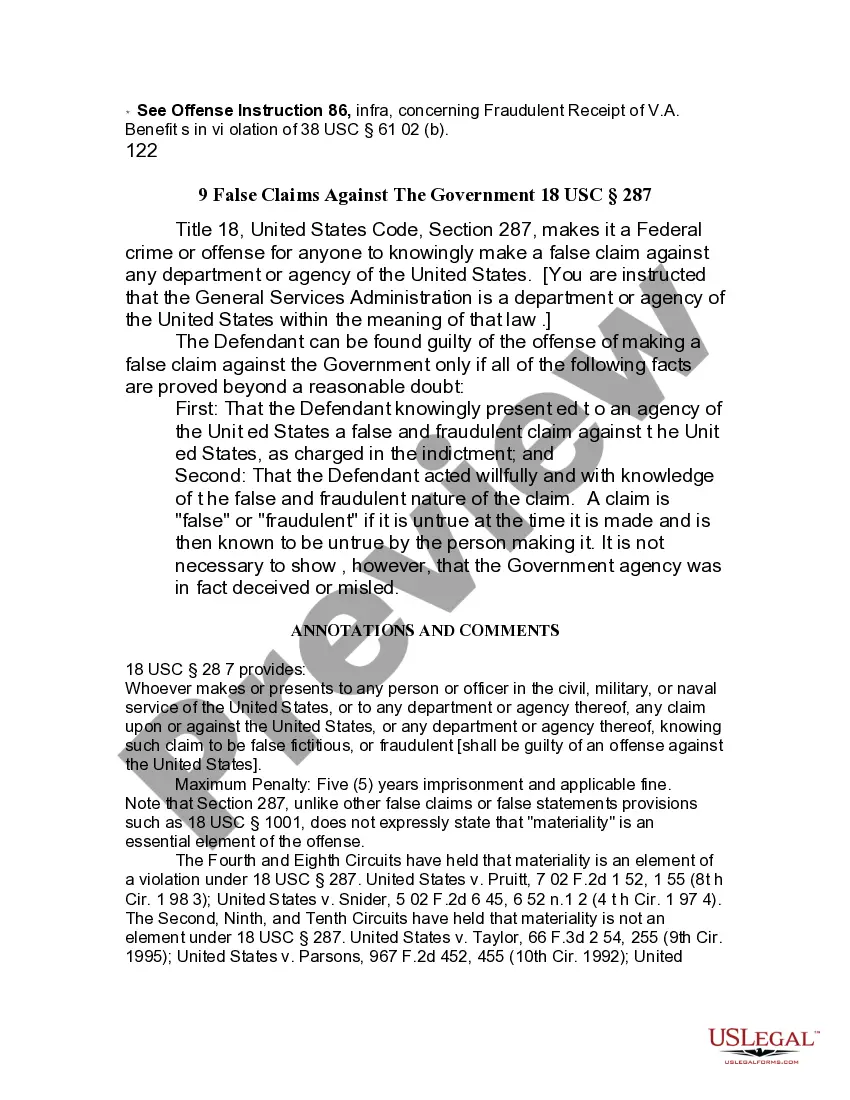
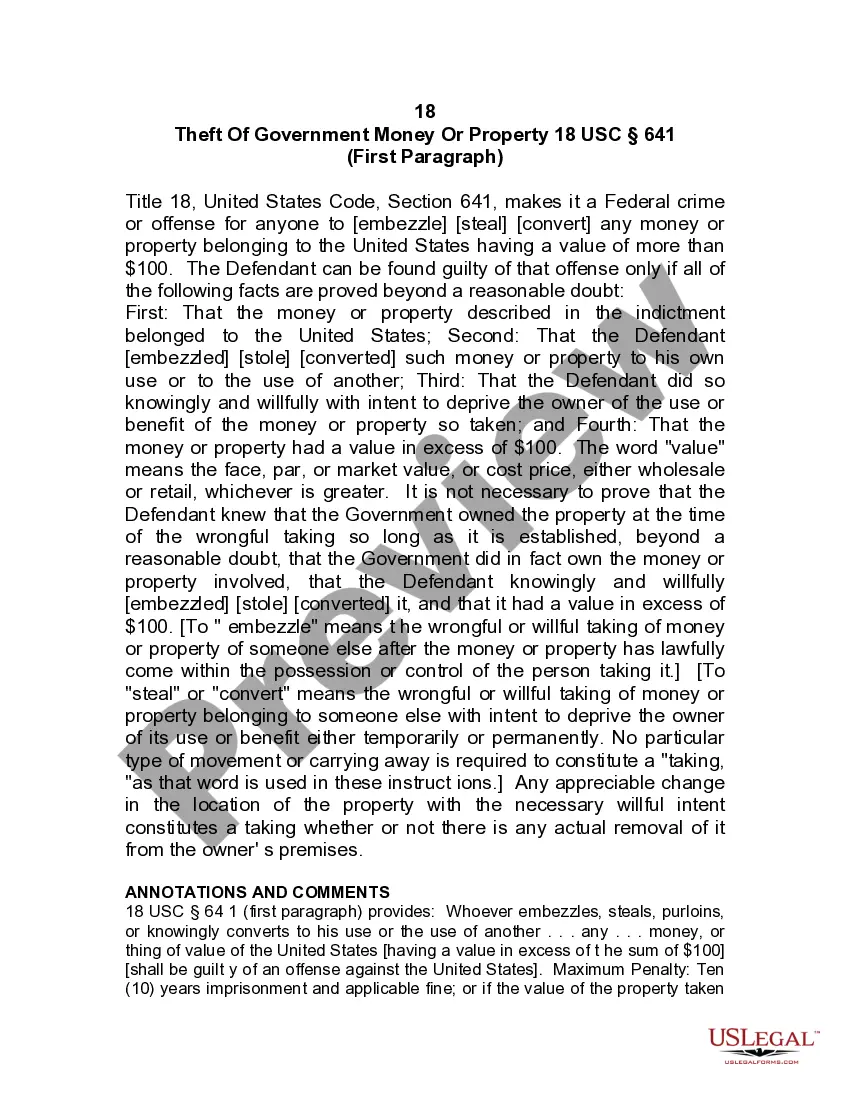
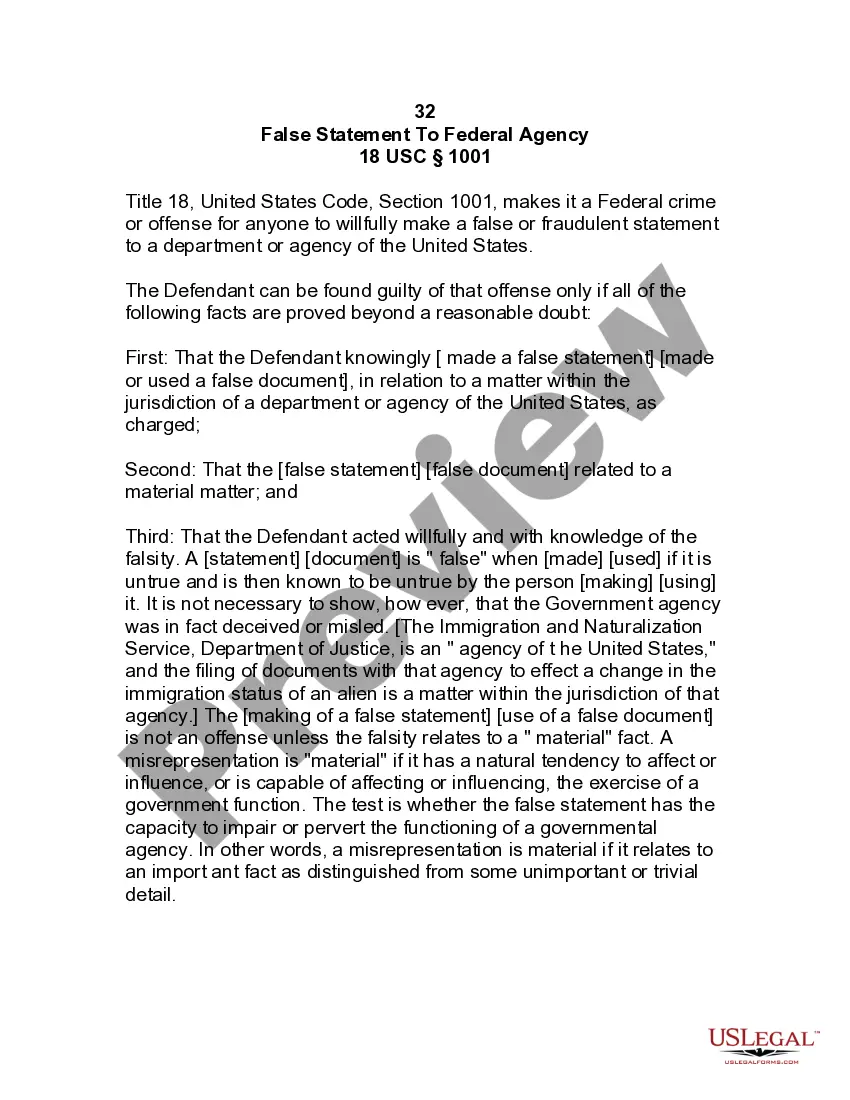
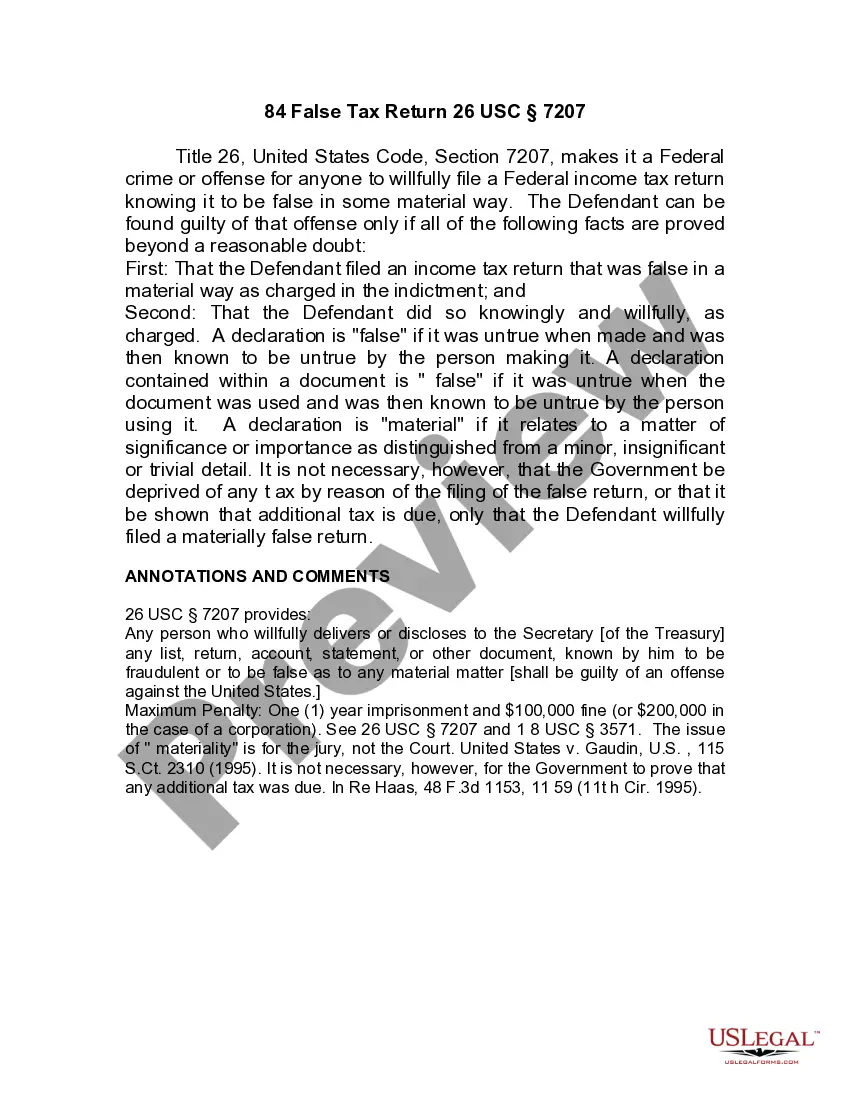
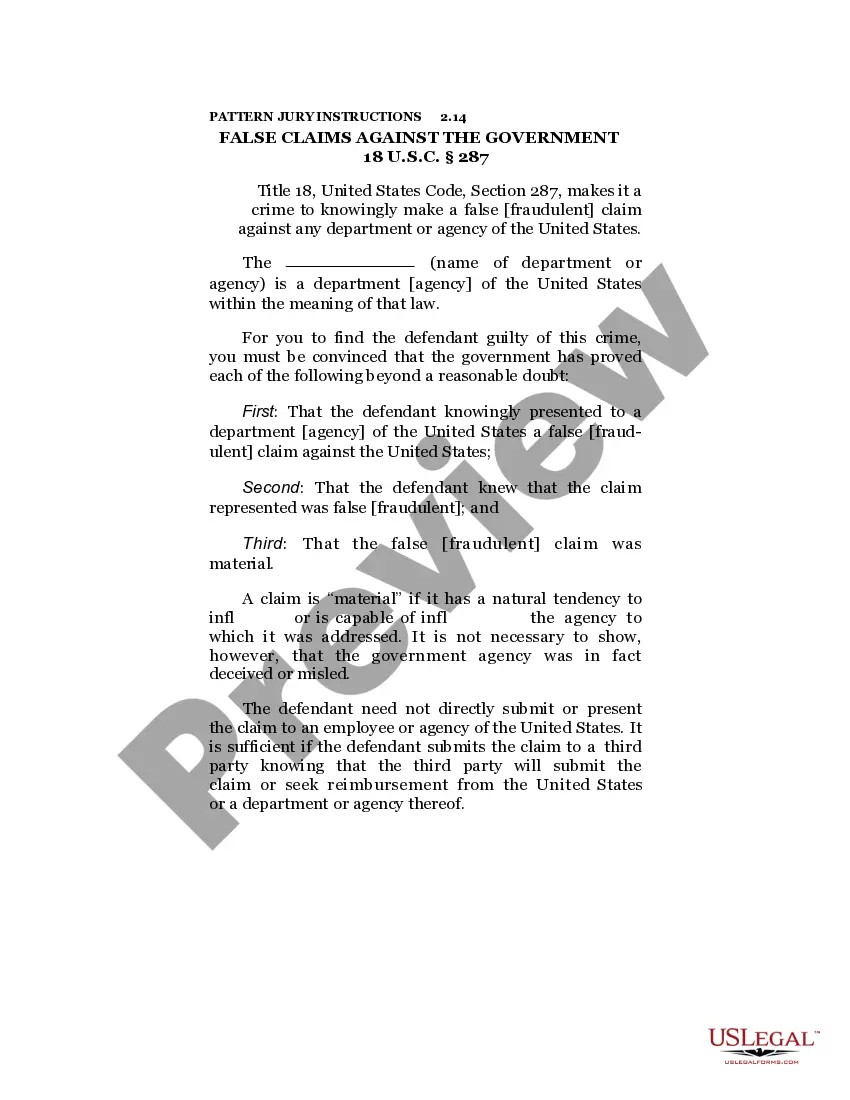
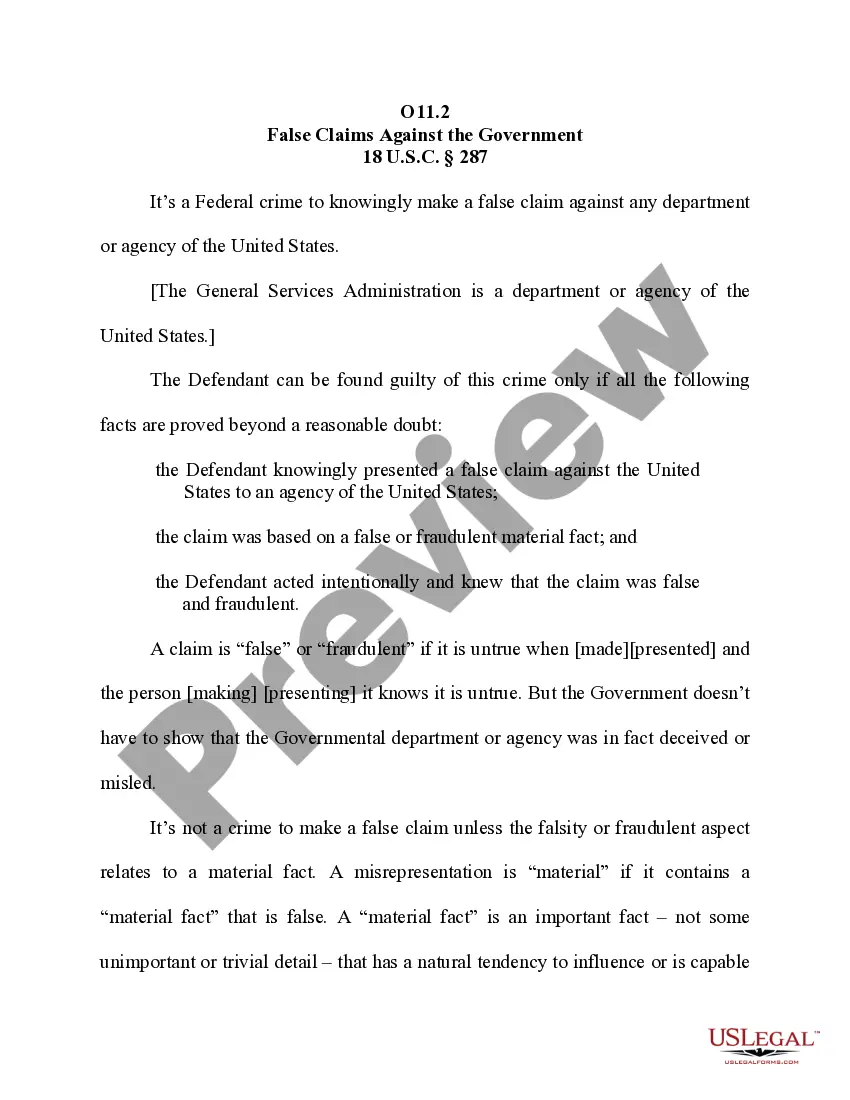
The Jury Instruction - False Claims Against The Government form provides a template of jury instructions relevant to cases involving false claims made against the U.S. government, as outlined under 18 USC 287. This form is designed to ensure accurate and legally sound instructions are presented to juries while differentiating it from other jury instruction forms that may apply to different legal issues or jurisdictions.
Main sections of this form
- Definition of a false claim: A claim that is known to be untrue at the time it is made.
- Legal basis: Refers to 18 USC 287, identifying the law governing false claims against the government.
- Conditions for guilt: Clear outline of the facts needed to prove guilt beyond a reasonable doubt.
- Penalties: Information about the maximum penalty of five years imprisonment and fines.
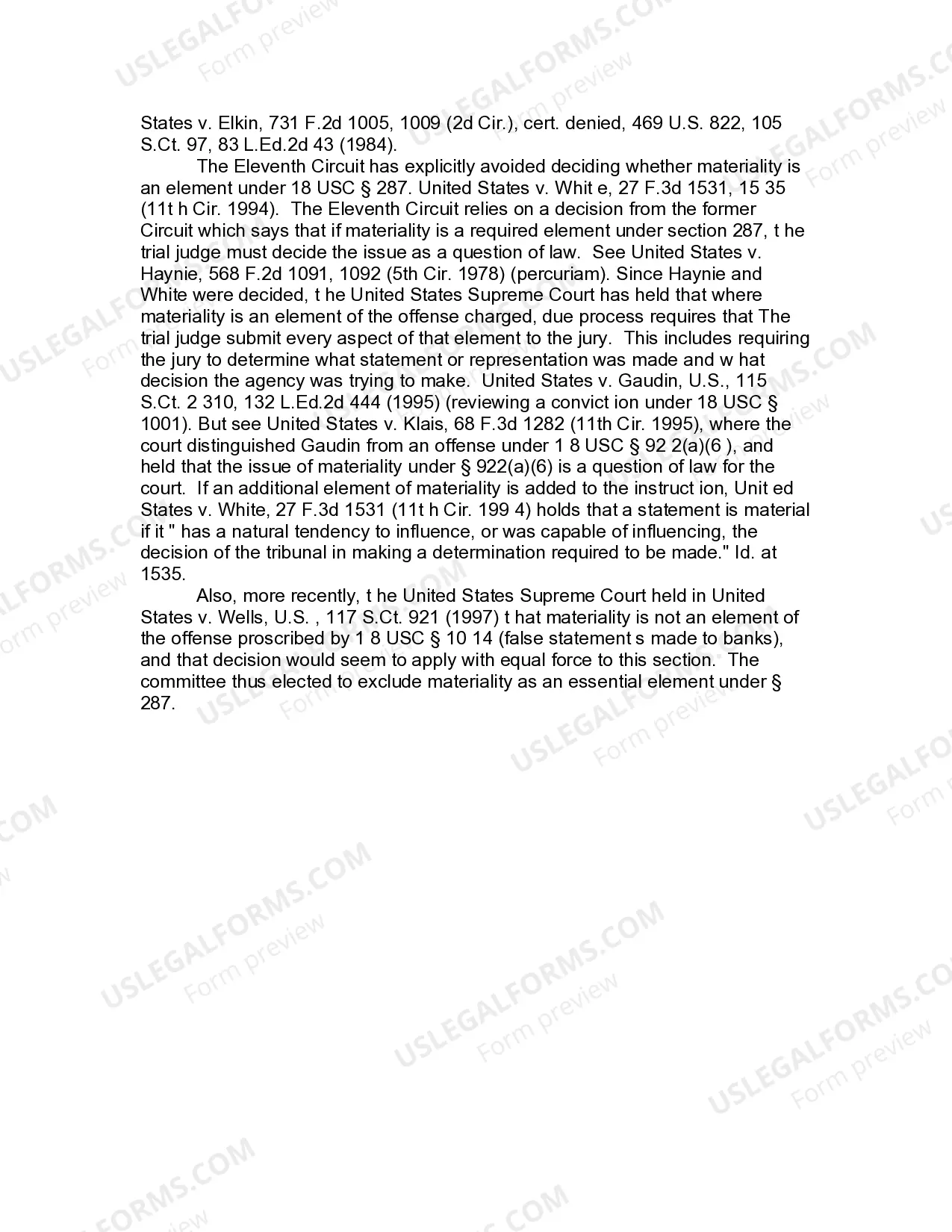
- Materiality considerations: Discussion on whether the materiality of a claim is an essential element of the offense.
When to use this form
This form is applicable in legal proceedings when jury instructions are needed for cases involving allegations of false claims against the government. It is specifically useful when guiding juries on the legal standards defined under 18 USC 287, helping to clarify the elements that must be proven for a conviction, including the requirement that the claim was knowingly false.
Intended users of this form
- Attorneys representing defendants or plaintiffs in cases of false claims against the government.
- Judges preparing jury instructions for trials involving such allegations.
- Legal educators and students studying federal criminal law related to false claims.
Instructions for completing this form
- Review the case details to understand the context of the false claims.
- Identify the specific allegations made against the defendant.
- Modify the sample jury instructions as necessary to fit the unique aspects of your case.
- Present the finalized jury instructions to the court for approval before the trial.
- Ensure that all instructions are clearly articulated and understandable for the jury.
Notarization guidance
This form usually doesn’t need to be notarized. However, local laws or specific transactions may require it. Our online notarization service, powered by Notarize, lets you complete it remotely through a secure video session, available 24/7.
Get your form ready online
Our built-in tools help you complete, sign, share, and store your documents in one place.
Make edits, fill in missing information, and update formatting in US Legal Forms—just like you would in MS Word.
Download a copy, print it, send it by email, or mail it via USPS—whatever works best for your next step.
Sign and collect signatures with our SignNow integration. Send to multiple recipients, set reminders, and more. Go Premium to unlock E-Sign.
If this form requires notarization, complete it online through a secure video call—no need to meet a notary in person or wait for an appointment.
We protect your documents and personal data by following strict security and privacy standards.

Make edits, fill in missing information, and update formatting in US Legal Forms—just like you would in MS Word.

Download a copy, print it, send it by email, or mail it via USPS—whatever works best for your next step.

Sign and collect signatures with our SignNow integration. Send to multiple recipients, set reminders, and more. Go Premium to unlock E-Sign.

If this form requires notarization, complete it online through a secure video call—no need to meet a notary in person or wait for an appointment.

We protect your documents and personal data by following strict security and privacy standards.
Common mistakes
- Using outdated or irrelevant language in jury instructions.
- Failing to customize instructions to fit the specific facts of the case.
- Overcomplicating the language, making it difficult for jurors to understand.
- Neglecting to outline all elements of the offense as required under 18 USC 287.
Advantages of online completion
- Immediate access to professionally drafted legal templates.
- Convenient editing options to tailor instructions to specific cases.
- Time-saving with downloadable formats that can be quickly modified.
- Reliable content prepared by licensed attorneys ensuring legal standing.
Legal use & context
- The instructions must clearly outline the legal standards for proving a false claim under federal law.
- Any revisions should adhere to current legal interpretations and rulings regarding materiality and intent.
- Jurors should be instructed comprehensively to ensure fair trial standards are maintained.
Main things to remember
- Utilize the Jury Instruction - False Claims Against The Government form for clarity in legal proceedings.
- Customize the instructions to align with the specifics of each case.
- Understand the essential elements and how they interact under federal law.
Looking for another form?
Form popularity
FAQ
On June 19, 2020, the Department of Justice (the DOJ) announced its Final Rule1 increasing the penalties assessable under the False Claims Act (FCA). The DOJ raised the minimum penalty for a single false claim from $11,181 to $11,665; the maximum penalty from $22,363 to $23,331.
The False Claims Act, also known as the Lincoln Law, is a whistleblower law that allows private citizens to sue any individuals, companies or other entities that are defrauding the government and recover damages and penalties on the government's behalf.
In addition to allowing the United States to pursue perpetrators of fraud on its own, the FCA allows private citizens to file suits on behalf of the government (called qui tam suits) against those who have defrauded the government.
Examples of practices that may violate the False Claims Act if done knowingly and intentionally, include the following: Billing for services not rendered. Knowingly submitting inaccurate claims for services. Taking or giving a kickback for a referral.
1. Offenders may be liable for penalties ranging between $5,000 and $10,000 for each false claim filed plus three times the amount of damages the government sustains because of the act.
The Attorney General works to protect the state against fraud and other financial misconduct through the enforcement of the California False Claims Act.
The False Claim Act is a federal law that makes it a crime for any person or organization to knowingly make a false record or file a false claim regarding any federal health care program, which includes any plan or program that provides health benefits, whether directly, through insurance or otherwise, which is funded
The term used when a person knowingly makes an untrue statement or claim to gain an benefit or reward. knowingly presents (or causes to be presented) a false or fraudulent claim to the Federal Government for payment.
The False Claims Act is a punitive statute. For civil violations, its penalties provisions authorize fines of three times the amount the government paid for each false claim, plus an additional penalty of up to $11,000 per false claim.