Jury Instruction - Bribery Of Public Official - Or Juror
Overview of this form
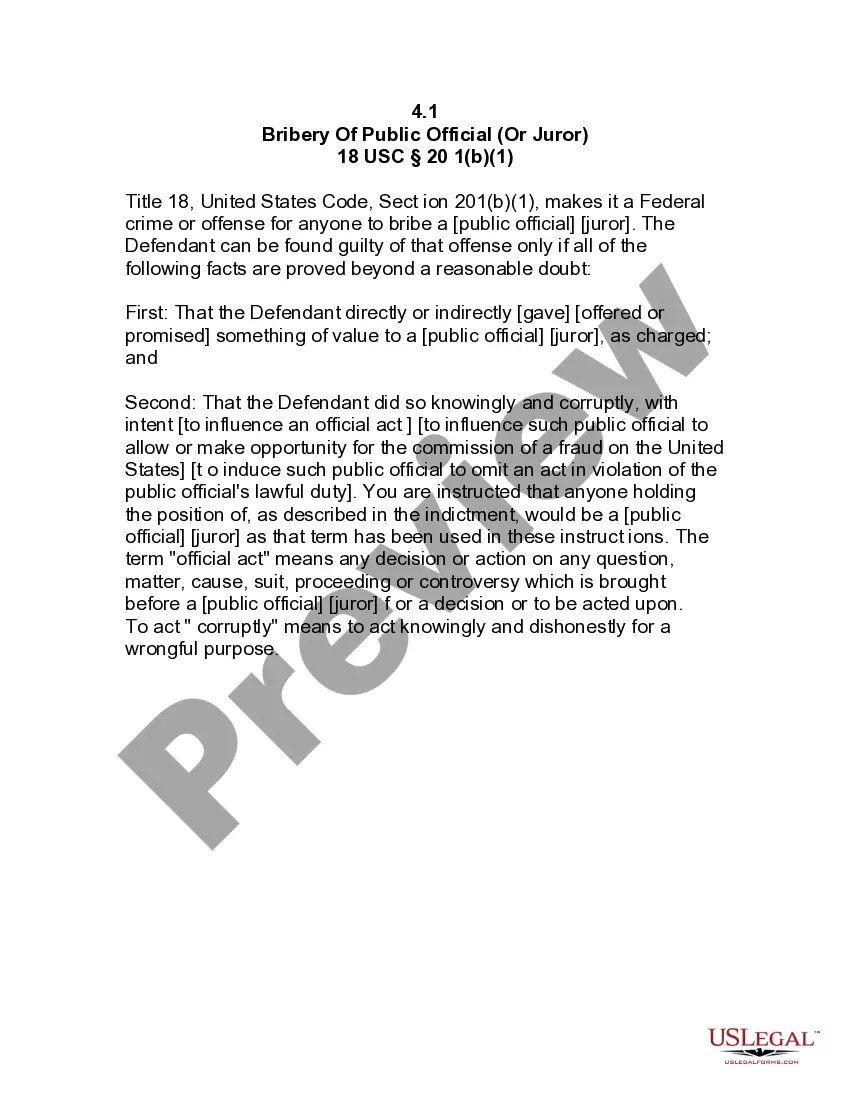
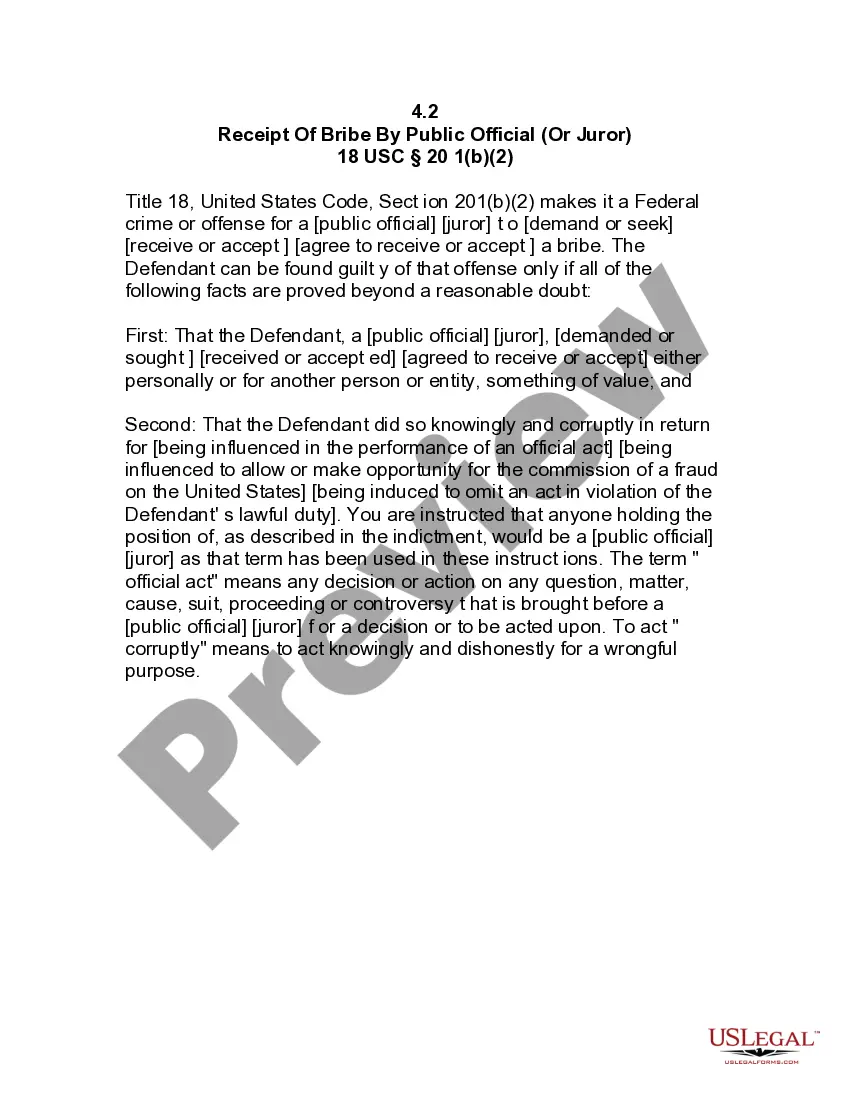
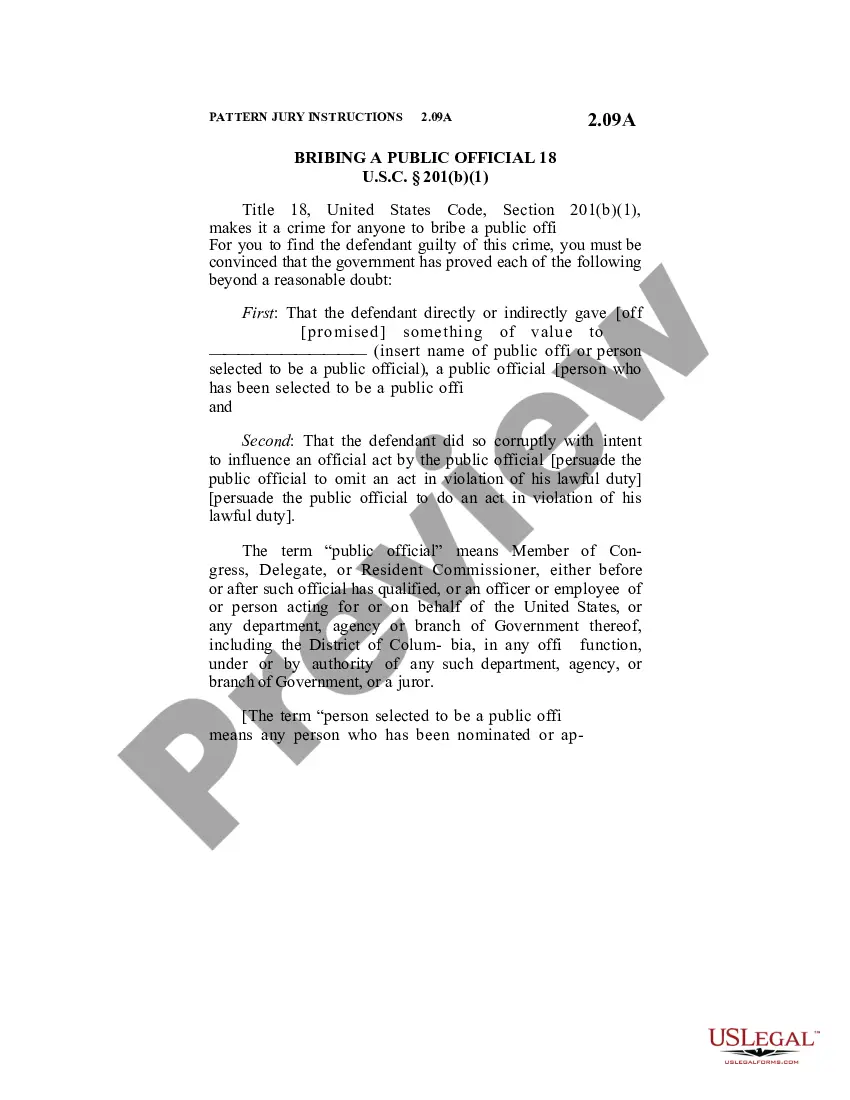
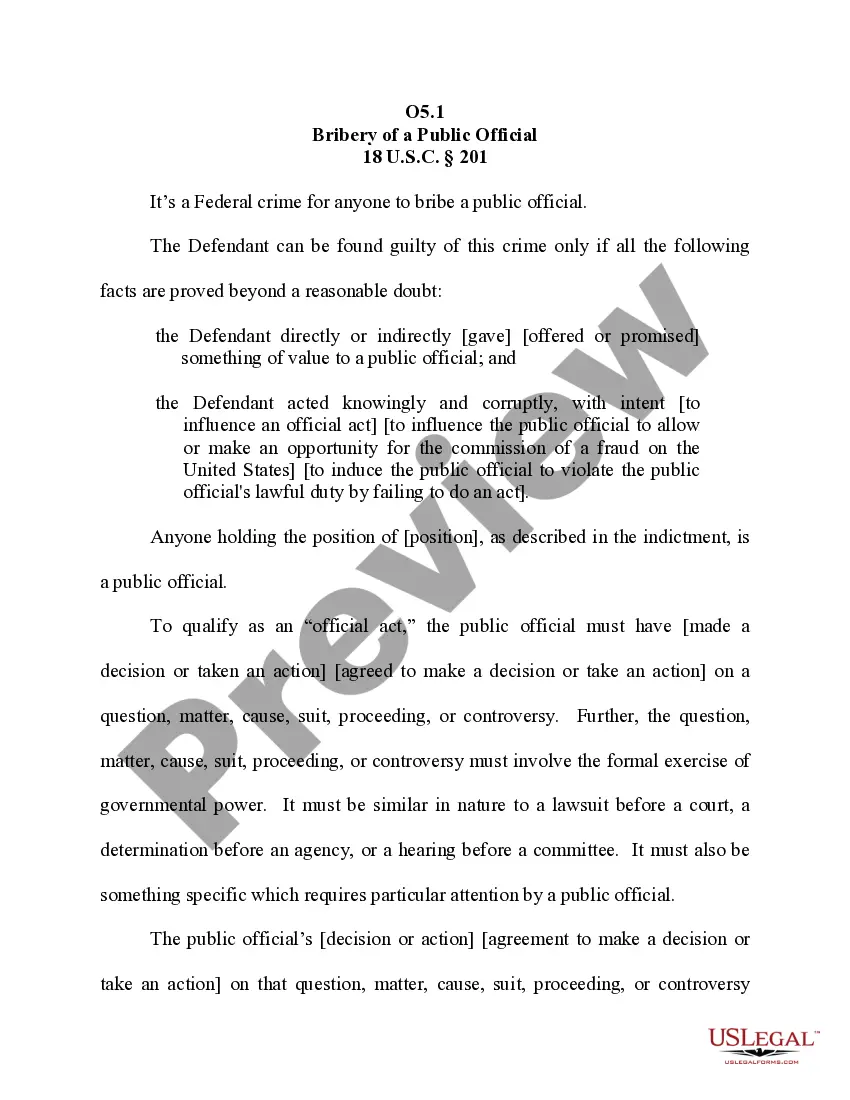
The Jury Instruction regarding Bribery of Public Official or Juror provides essential guidance for jurors in federal cases involving allegations of bribery. This form is crucial for instructing jurors on the legal definitions and requirements surrounding bribery offenses as established by Title 18, United States Code, Section 201. Unlike other jury instructions, this template is specifically tailored to address corrupt acts intended to influence public officials or jurors.
Main sections of this form
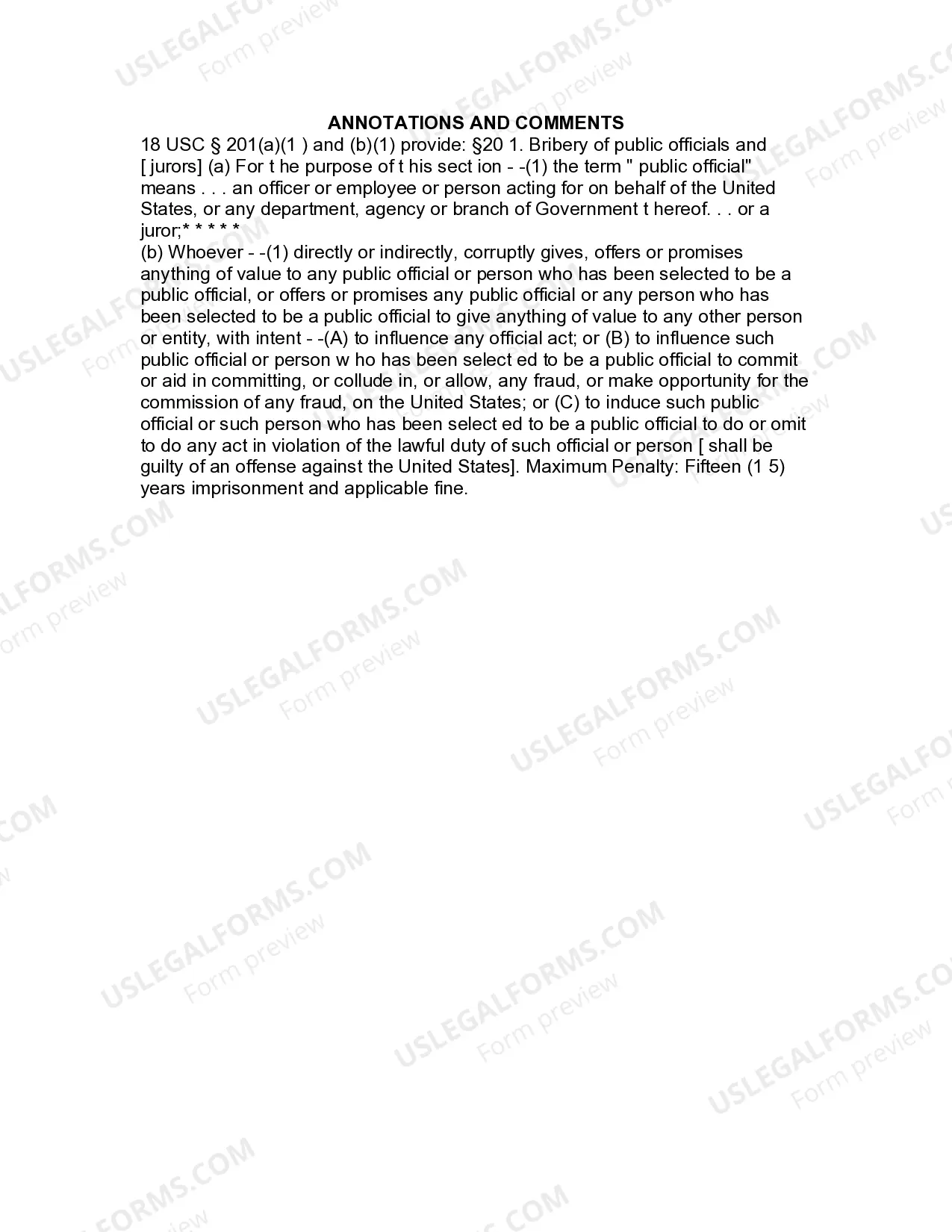
- Definition of a public official or juror.
- Elements required to prove bribery beyond a reasonable doubt.
- Clarification of what constitutes an official act.
- Explanation of "acting corruptly" in the context of bribery.
- Potential penalties for bribery offenses.

When to use this document
This form is utilized in federal court cases where bribery of a public official or juror is involved. It is relevant when jurors need clear instructions on how to evaluate evidence regarding bribery and to ensure that their verdict is based on legal standards set forth in federal law.
Who needs this form
- Jurors serving in federal criminal trials related to bribery.
- Judges issuing jury instructions for cases involving bribery claims.
- Legal professionals seeking a structured template for jury instructions.
Steps to complete this form
- Review the definition of public officials and jurors as per federal law.
- Ensure that all elements of the bribery offense are clearly outlined.
- Discuss the implications of "acting corruptly" in your instructions.
- Confirm the potential penalties associated with bribery are communicated to jurors.
- Finalize and present the instructions to the jury for their consideration.
Does this form need to be notarized?
This form does not typically require notarization to be legally valid. However, some jurisdictions or document types may still require it. US Legal Forms provides secure online notarization powered by Notarize, available 24/7 for added convenience.
Get your form ready online
Our built-in tools help you complete, sign, share, and store your documents in one place.
Make edits, fill in missing information, and update formatting in US Legal Forms—just like you would in MS Word.
Download a copy, print it, send it by email, or mail it via USPS—whatever works best for your next step.
Sign and collect signatures with our SignNow integration. Send to multiple recipients, set reminders, and more. Go Premium to unlock E-Sign.
If this form requires notarization, complete it online through a secure video call—no need to meet a notary in person or wait for an appointment.
We protect your documents and personal data by following strict security and privacy standards.

Make edits, fill in missing information, and update formatting in US Legal Forms—just like you would in MS Word.

Download a copy, print it, send it by email, or mail it via USPS—whatever works best for your next step.

Sign and collect signatures with our SignNow integration. Send to multiple recipients, set reminders, and more. Go Premium to unlock E-Sign.

If this form requires notarization, complete it online through a secure video call—no need to meet a notary in person or wait for an appointment.

We protect your documents and personal data by following strict security and privacy standards.
Common mistakes
- Failing to clarify the definitions of terms such as "public official" or "juror."
- Not specifying the requirements necessary to prove bribery beyond a reasonable doubt.
- Omitting explanations of the consequences for bribery-related offenses.
Benefits of completing this form online
- Convenient access to a standardized jury instruction template.
- Editable to customize according to specific case needs and legal requirements.
- Reliable source drafted by licensed attorneys to ensure legal compliance.
Legal use & context
- The instructions provided are based on federal law, ensuring consistency across jurisdictions.
- Jurors must understand their role in evaluating bribery claims according to the law.
- This form aids in achieving fair trials by clearly stating legal expectations for jurors.
Quick recap
- This form serves as a crucial tool for guiding jurors in bribery cases.
- It outlines legal definitions and standards necessary for making informed decisions.
- Understanding the elements of bribery helps ensure justice in federal trials.
Looking for another form?


Form popularity
FAQ
According to the amended law, any person who gives or promises to give undue advantage to a public servant shall be punishable with imprisonment for a term which may extend to seven years or with fine or with both. Bribe givers were not covered in any of the domestic legislations to check corruption.
These are civil or criminal jury instructions approved by a state court, bench committee, or bar association. They are commonly used by courts in the relevant jurisdiction, as they ease the process of drafting fair jury instructions and theoretically do not have errors.
California law defines the crime of bribery as offering, giving or taking something of value, with corrupt intent, in order unlawfully to influence a person in any public or official capacity. Bribery is typically prosecuted as a felony and is punishable by up to 4 years in jail or prison.
What Are the Legal Defenses to Bribery? There are several defenses available against bribery because it is a specific intent crime.This means that a defendant cannot be convicted of bribery if they did not mean to influence the official through offering something of value.
Generally, a bribe requires that the payment be made with a corrupt intent. Corrupt intent is the intent to receive a specific benefit in return for the paymentii. The existence of a corrupt intent to influence the discharge of official duties is a necessary element of the crime of bribery.
Overview. Bribery refers to the offering, giving, soliciting, or receiving of any item of value as a means of influencing the actions of an individual holding a public or legal duty.Bribery constitutes a crime and both the offeror and the recipient can be criminally charged.
Overview. Bribery refers to the offering, giving, soliciting, or receiving of any item of value as a means of influencing the actions of an individual holding a public or legal duty.Bribery constitutes a crime and both the offeror and the recipient can be criminally charged.
In general, every crime involves three elements: first, the act or conduct (actus reus); second, the individual's mental state at the time of the act (mens rea); and third, the causation between the act and the effect (typically either "proximate causation" or "but-for causation").
Bribing a public official thus requires proof of five essential elements: (1) a public official; (2) the defendant's corrupt intent; (3) a benefit-"anything of value"-given, offered, or promised to the public official; (4) a relationship between the thing of value and some official act (or fraud or omission of duty);