Jury Instruction - Threats Against The President
What is this form?
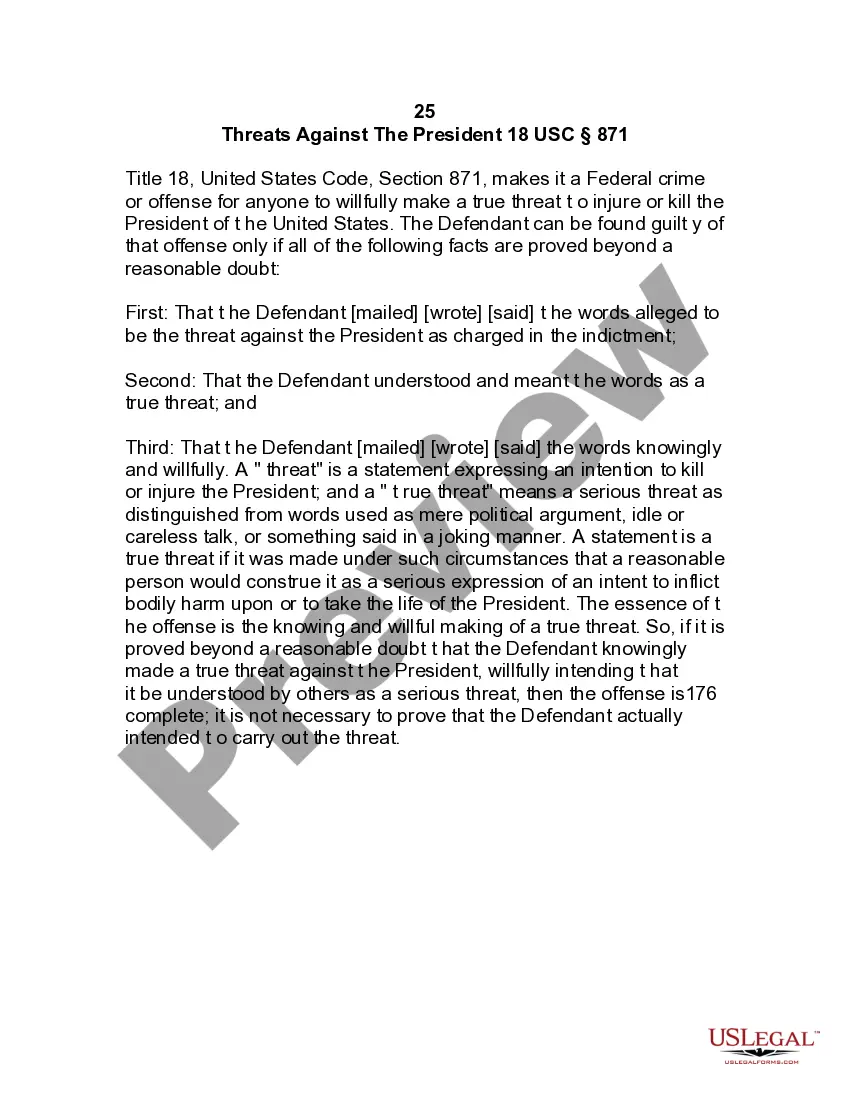
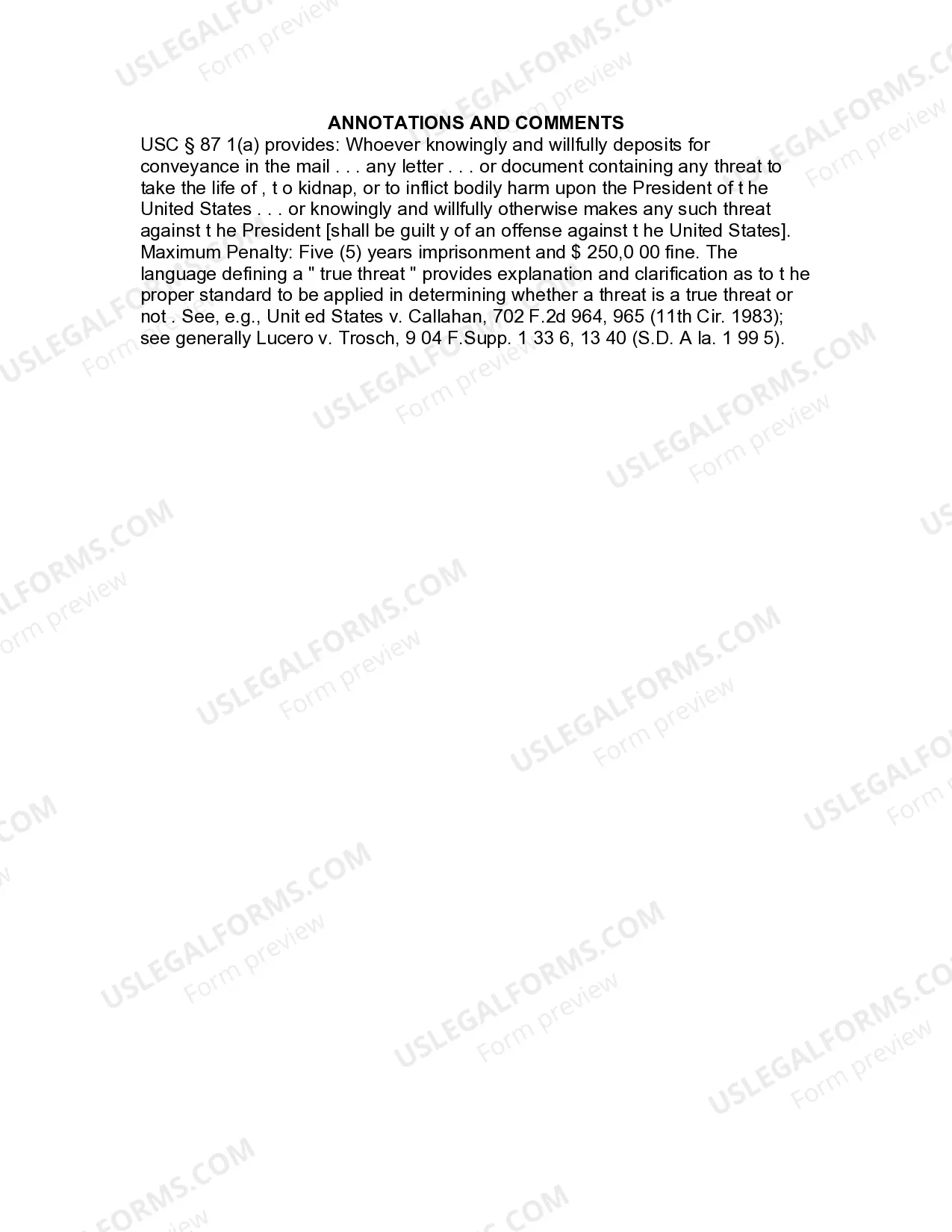
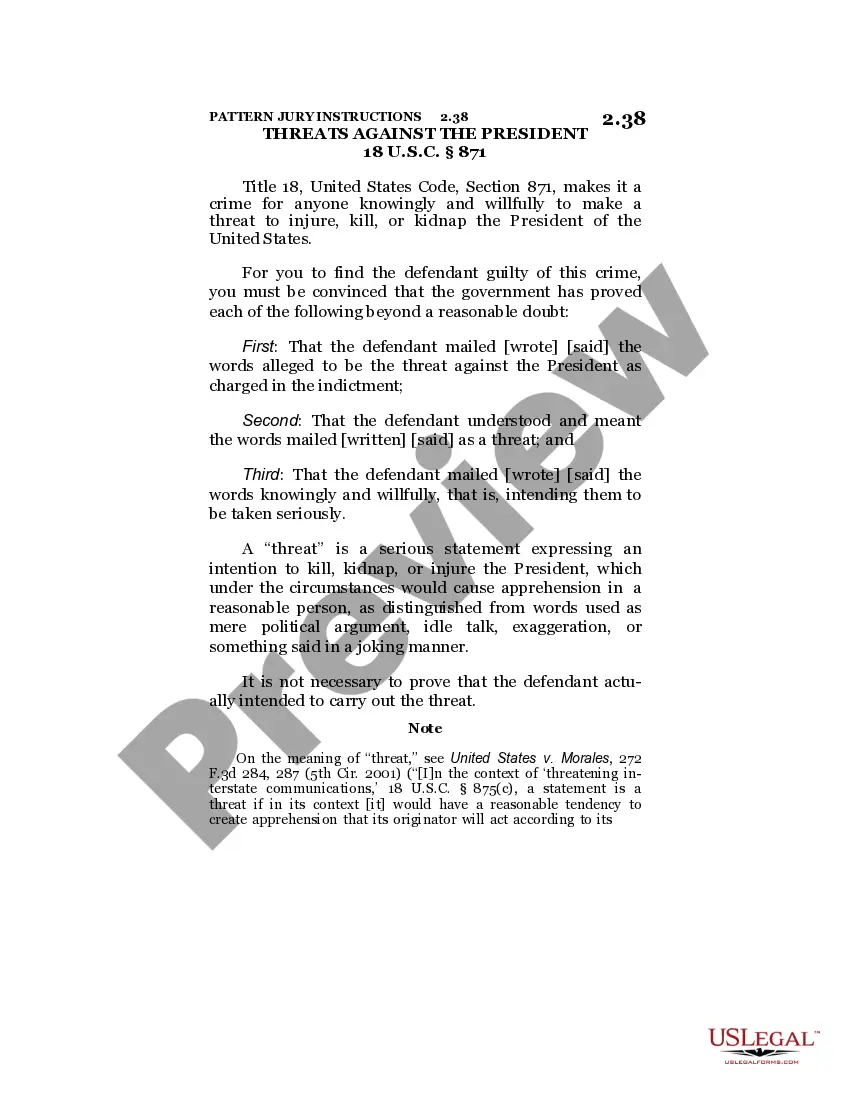
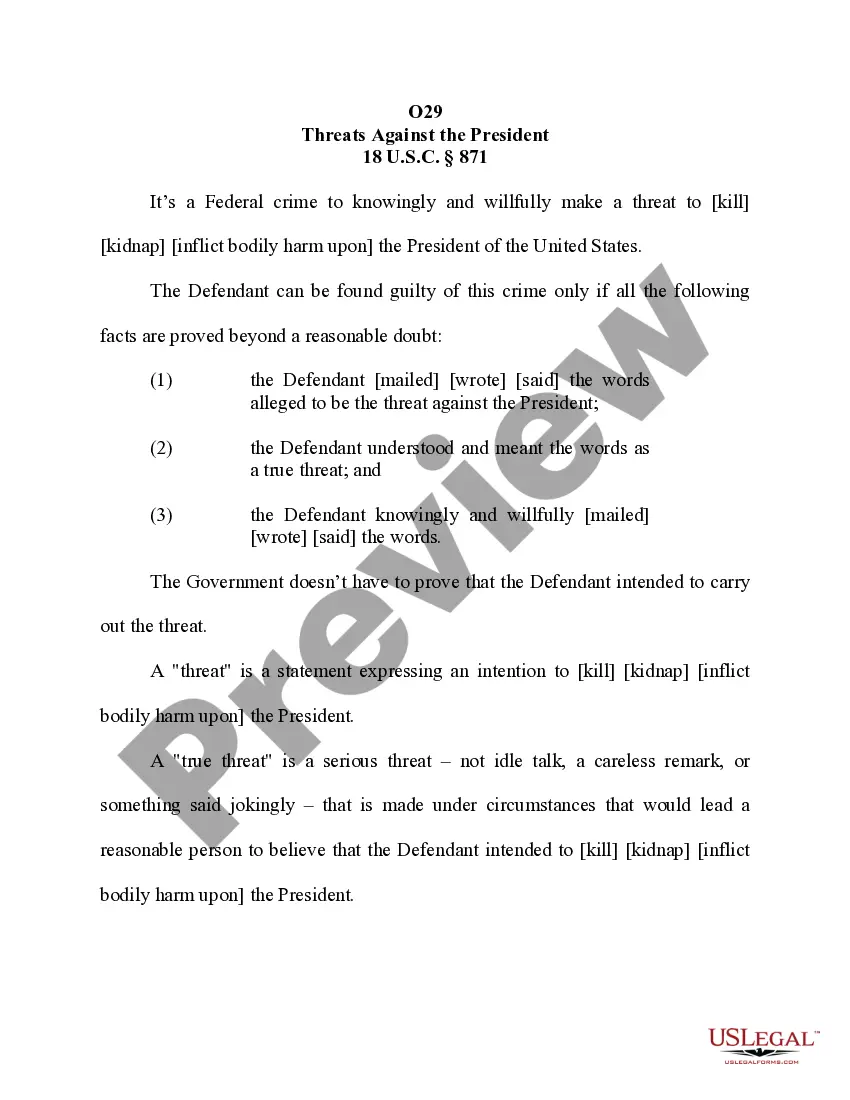
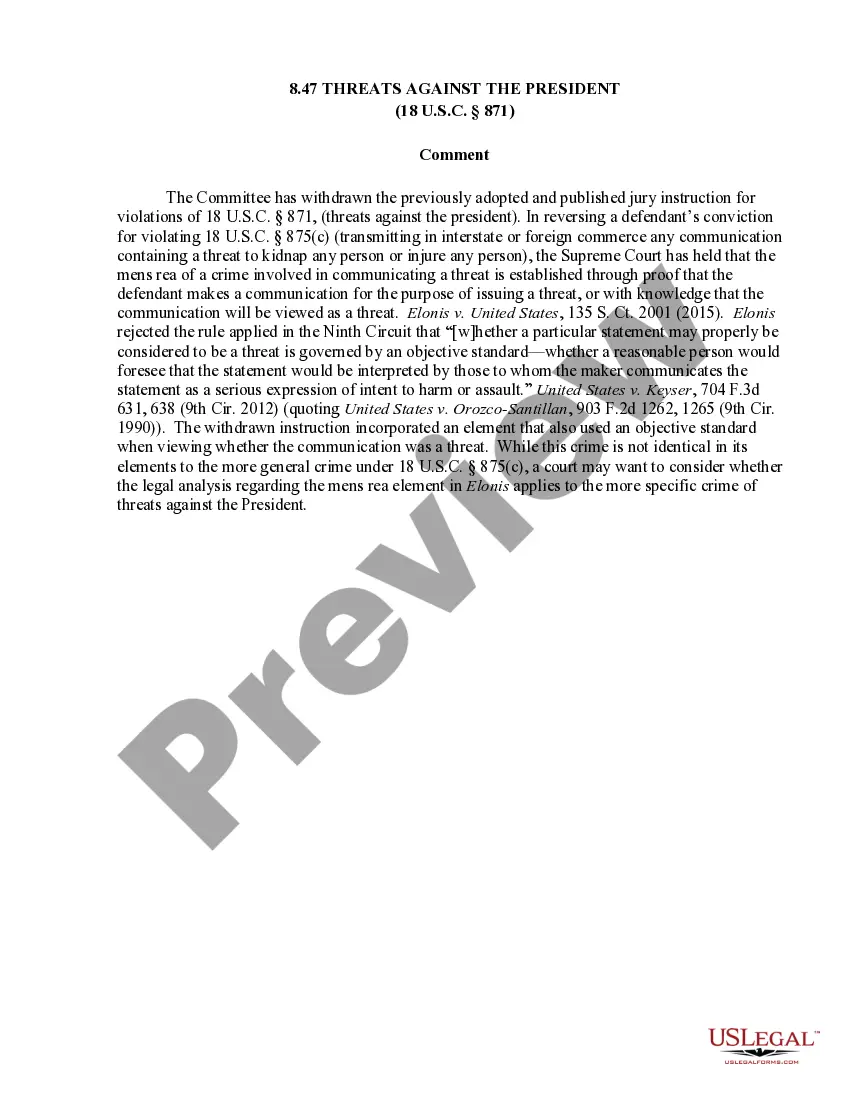
The Jury Instruction - Threats Against The President form provides sample jury instructions that can be used in federal cases related to threats against the U.S. President. This form differs from other jury instructions as it specifically addresses the implications of making a true threat under Title 18, United States Code, Section 871. It serves as a model that can be tailored to fit individual case requirements while ensuring compliance with federal law.
Main sections of this form
- Definitions of "true threat" and legal thresholds for prosecution
- Criteria for proving guilt beyond a reasonable doubt
- Sample jury questions for judges to use during trials
- Explanation of the defendant's understanding and intention regarding threats
- Clarification on the requirements for mailing or making threats
Common use cases
This form should be used in any federal criminal trial involving allegations of threats made against the President of the United States. It provides guidance for jurors to help them understand the legal standards required to evaluate whether a defendant's statements constitute a true threat under federal law.
Who this form is for
- Judges overseeing trials involving threats against the President
- Legal professionals seeking to draft jury instructions
- Jurors needing clarification on legal standards during trials
Completing this form step by step
- Review the sample jury instructions provided in the form.
- Modify the instructions as necessary to fit the specifics of your case.
- Ensure all legal definitions are correctly incorporated and understood.
- Consult with legal counsel to confirm that all required elements are included.
- Distribute the finalized instructions to jurors during trial proceedings.
Does this document require notarization?
Notarization is generally not required for this form. However, certain states or situations might demand it. You can complete notarization online through US Legal Forms, powered by Notarize, using a verified video call available anytime.
Get your form ready online
Our built-in tools help you complete, sign, share, and store your documents in one place.
Make edits, fill in missing information, and update formatting in US Legal Forms—just like you would in MS Word.
Download a copy, print it, send it by email, or mail it via USPS—whatever works best for your next step.
Sign and collect signatures with our SignNow integration. Send to multiple recipients, set reminders, and more. Go Premium to unlock E-Sign.
If this form requires notarization, complete it online through a secure video call—no need to meet a notary in person or wait for an appointment.
We protect your documents and personal data by following strict security and privacy standards.

Make edits, fill in missing information, and update formatting in US Legal Forms—just like you would in MS Word.

Download a copy, print it, send it by email, or mail it via USPS—whatever works best for your next step.

Sign and collect signatures with our SignNow integration. Send to multiple recipients, set reminders, and more. Go Premium to unlock E-Sign.

If this form requires notarization, complete it online through a secure video call—no need to meet a notary in person or wait for an appointment.

We protect your documents and personal data by following strict security and privacy standards.
Typical mistakes to avoid
- Failing to tailor the jury instructions to reflect the nuances of the case.
- Omitting key legal definitions or criteria needed to establish a true threat.
- Using unclear language that may confuse jurors.
Why use this form online
- Quick access to professionally drafted legal content.
- Easy modification to suit specific case needs.
- Convenience of downloading and printing from anywhere.
Legal use & context
- This form reflects federal standards for legal threats against the President.
- It is essential that the judicial process maintains clarity in distinguishing between political speech and true threats.
- Understanding these instructions is vital for jurors to faithfully carry out their duties regarding serious allegations.
Main things to remember
- This form offers crucial jury instructions related to threats against the President.
- It serves as a legal resource for judges and legal professionals in federal cases.
- Careful adaptation to the specific case context is necessary for proper legal application.
Looking for another form?
Form popularity
FAQ
Penal Code section 422 defines criminal threats as willfully threatening to kill or injure someone, unequivocally and with sufficient specificity that the recipient of the threat is placed in a state of reasonably sustained fear for his immediate safety or that of his or her family.
A verbal threat can get you in trouble, even if you didn't mean it. It is a criminal offence, referred to as an utter threat.
C. 275 § 2: Threat to Commit a Crime. The threat was made under circumstances which could reasonably have caused the person to whom it was conveyed to fear that the defendant had both the intention and ability to carry it out.
Courts have ruled that conditional threats such as telling your significant other I'll kill you if you leave me are considered criminal threats when they are made with a sense of purpose and a likelihood that they will be executed.
Studies in humans and rats indicate that predictable threats typically induce phasic fear, a short-lasting apprehension concerning imminent threat, and that unpredictable threats generally induce sustained fear, a longer-lasting apprehension elicited by potential or temporally uncertain threat (Davis et al., 2010b).
Great bodily injury means significant or substantial physical injury. It is. an injury that is greater than minor or moderate harm. Sustained fear means fear for a period of time that is more than.
F116 Threats to kill. A person who without lawful excuse makes to another a threat, intending that that other would fear it would be carried out, to kill that other or a third person shall be guilty of an offence and liable on conviction on indictment to imprisonment for a term not exceeding ten years.
A criminal threat involves one person threatening someone else with physical harm. The threat must be communicated in some way, though it doesn't necessarily have to be verbal. A person can make a threat through email, text message, or even through non-verbal body language such as gestures or movements.
It is unlawful to threaten a person with the intent to obtain a pecuniary advantage or to compel the person to act against her will. This type of threat constitutes the crime of EXTORTION.