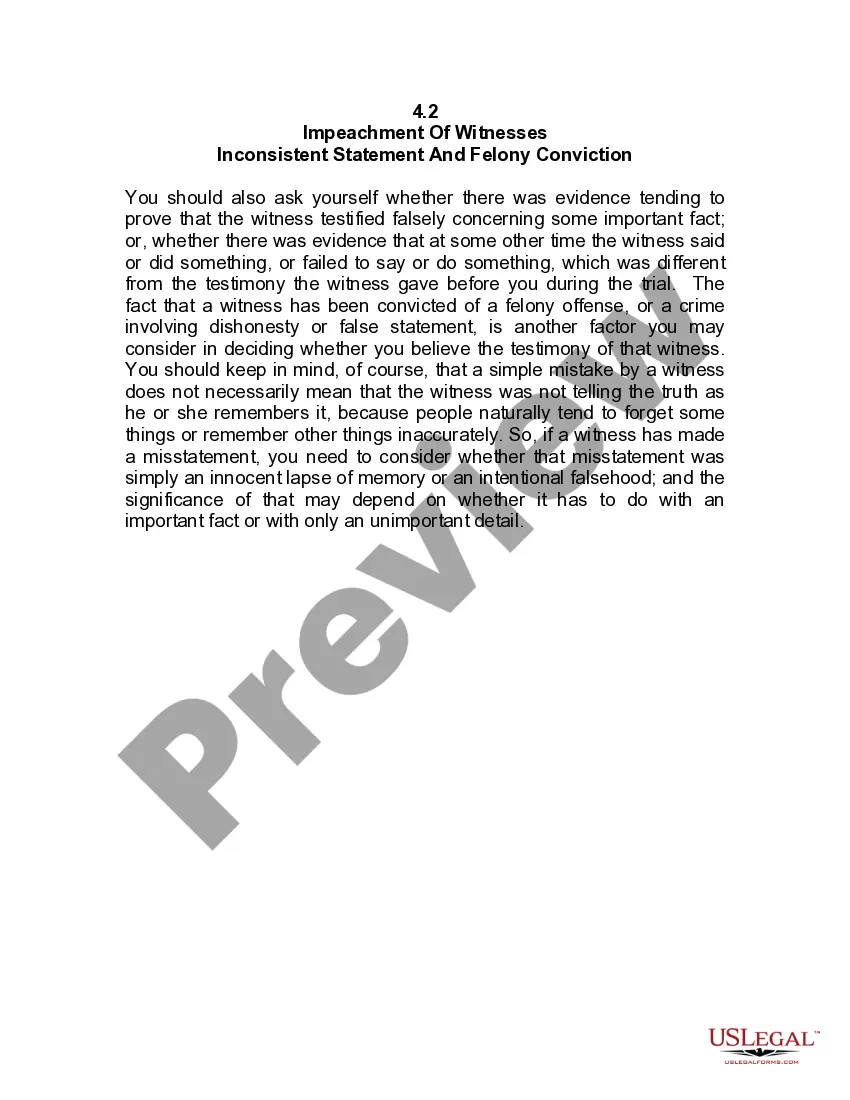
Jury Instruction - 4.2 Impeachment Of Witnesses Inconsistent Statement And Felony Conviction
Understanding this form
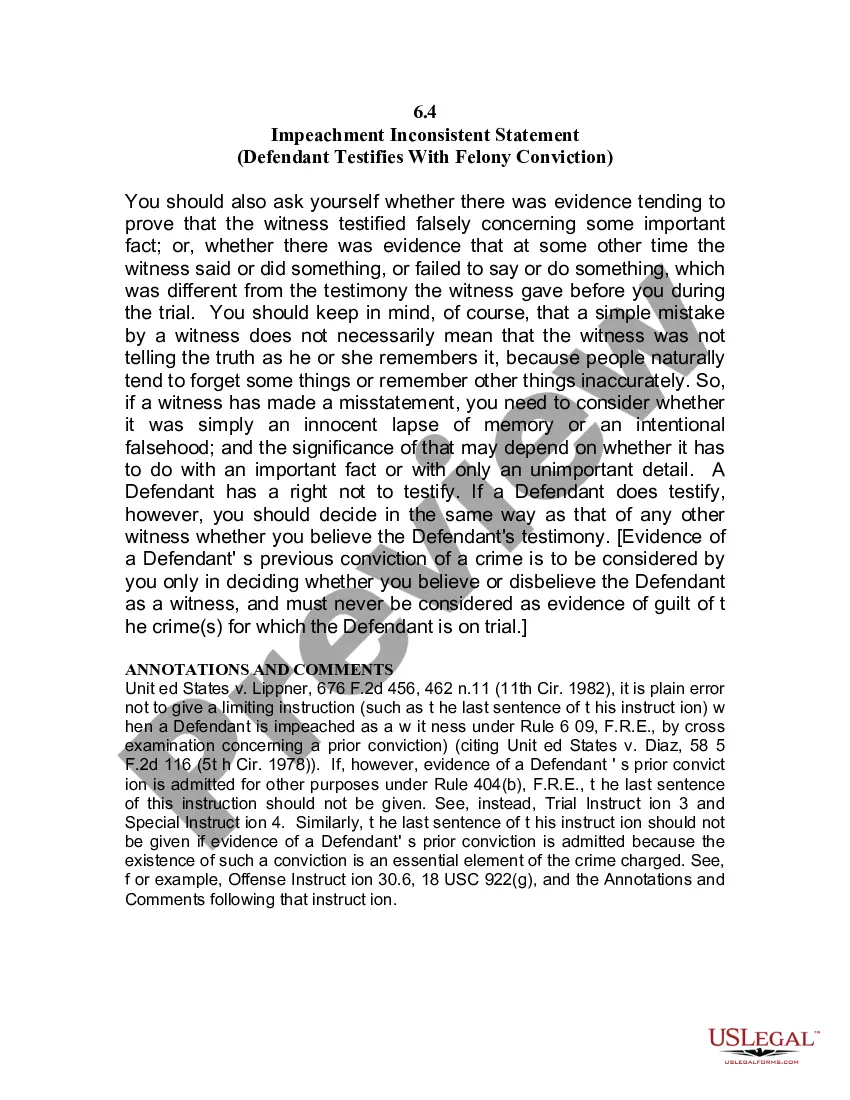
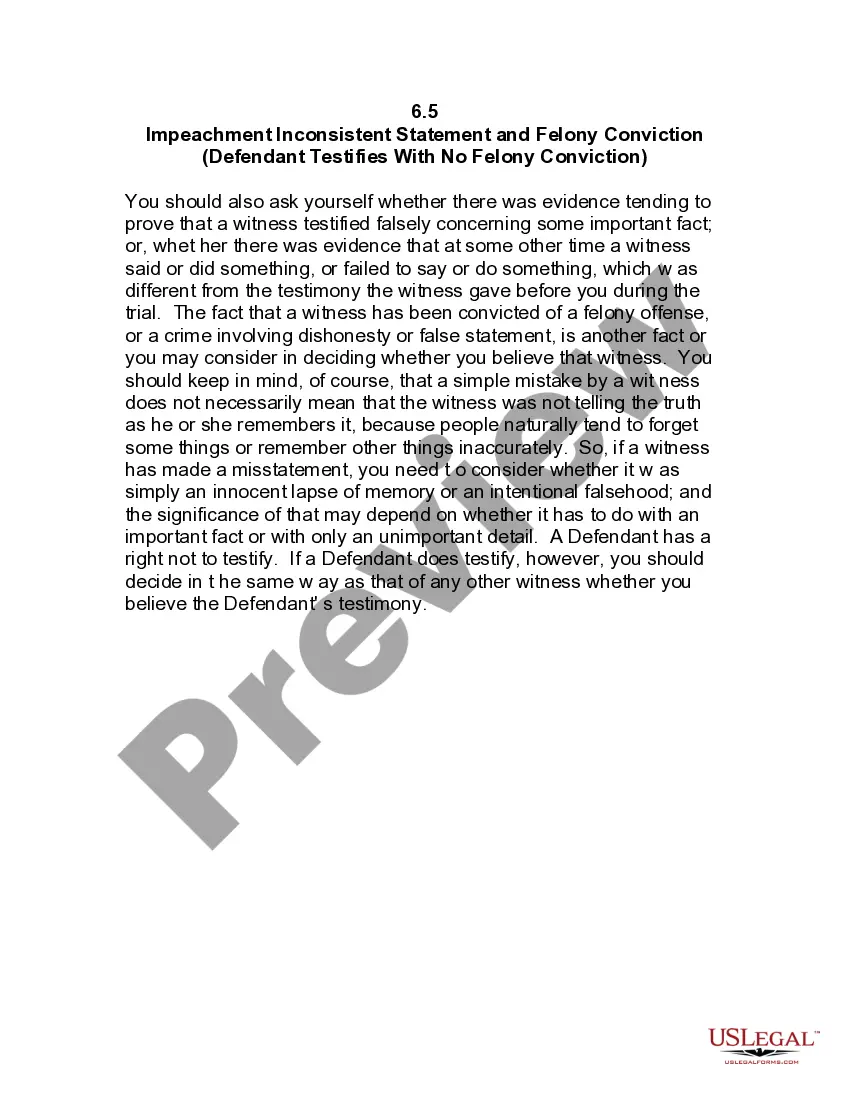
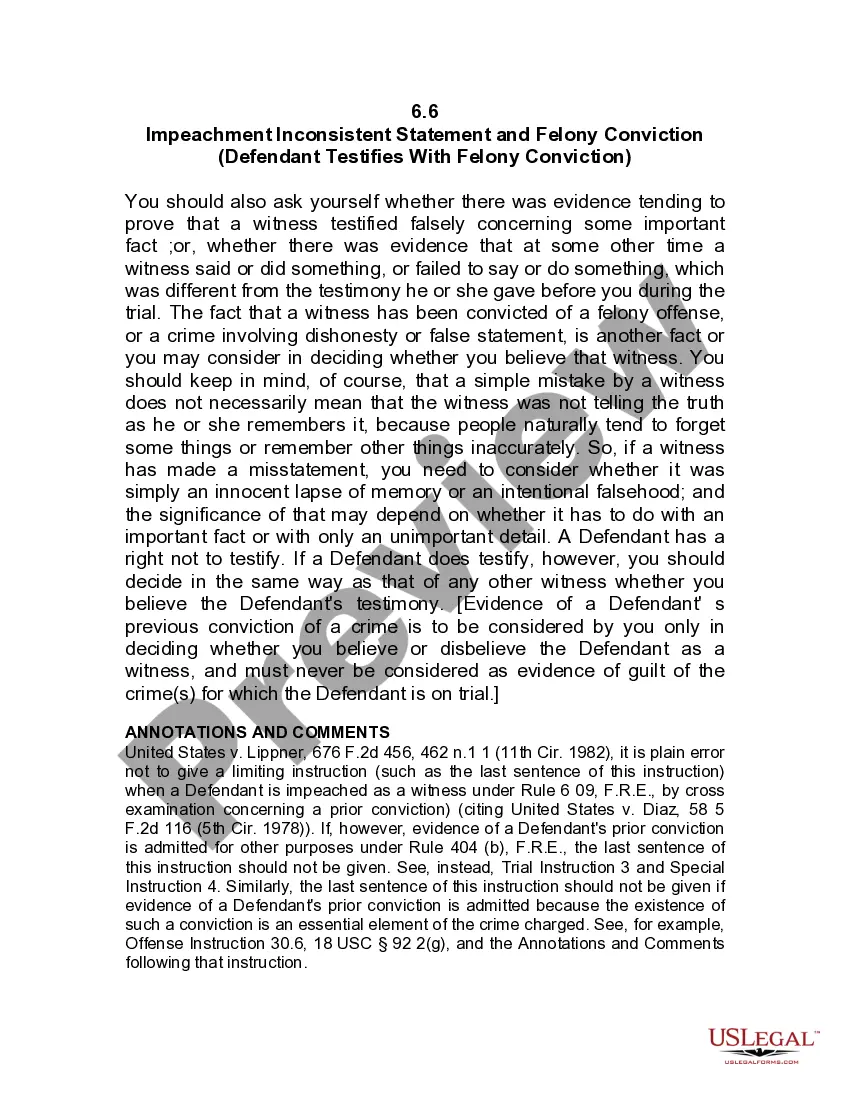
This form is a Jury Instruction on the impeachment of witnesses based on inconsistent statements and felony convictions. It outlines how jurors should evaluate the credibility of witnesses in a trial by considering discrepancies in their statements and any past felony convictions. Unlike other jury instructions, this form specifically addresses how witnesses' credibility may be challenged based on their history and inconsistencies in their testimony, providing a clear framework for jurors to follow.
Form components explained
- Instructions on assessing credibility based on prior inconsistent statements.
- Guidelines for evaluating witness testimony in light of felony convictions.
- Considerations for distinguishing between innocent mistakes and intentional falsehoods.
- Emphasis on the importance of the statements in relation to key facts versus minor details.
When to use this form
This form should be used during a trial when jurors need guidance on how to assess the reliability of witness testimony. Specifically, it is applicable when there is evidence suggesting that a witness has provided inconsistent statements or has a felony conviction that may impact their credibility. Such situations arise in criminal and civil cases where witness reliability is a crucial factor in the jury's deliberation.
Who needs this form
- Judges who need to instruct juries on evaluating witness credibility.
- Attorneys seeking to provide compelling jury instructions during trials.
- Legal professionals involved in cases where witness integrity is challenged.
How to complete this form
- Review the case details and determine the relevant inconsistencies in witness testimonies.
- Assess any felony convictions of the witness and their potential influence on credibility.
- Tailor the instructions to focus on key facts being disputed in the trial.
- Present the completed instructions to the presiding judge for approval.
- Ensure jurors are made aware of these instructions during their deliberation process.
Notarization requirements for this form
This form usually doesn’t need to be notarized. However, local laws or specific transactions may require it. Our online notarization service, powered by Notarize, lets you complete it remotely through a secure video session, available 24/7.
Get your form ready online
Our built-in tools help you complete, sign, share, and store your documents in one place.
Make edits, fill in missing information, and update formatting in US Legal Forms—just like you would in MS Word.
Download a copy, print it, send it by email, or mail it via USPS—whatever works best for your next step.
Sign and collect signatures with our SignNow integration. Send to multiple recipients, set reminders, and more. Go Premium to unlock E-Sign.
If this form requires notarization, complete it online through a secure video call—no need to meet a notary in person or wait for an appointment.
We protect your documents and personal data by following strict security and privacy standards.

Make edits, fill in missing information, and update formatting in US Legal Forms—just like you would in MS Word.

Download a copy, print it, send it by email, or mail it via USPS—whatever works best for your next step.

Sign and collect signatures with our SignNow integration. Send to multiple recipients, set reminders, and more. Go Premium to unlock E-Sign.

If this form requires notarization, complete it online through a secure video call—no need to meet a notary in person or wait for an appointment.

We protect your documents and personal data by following strict security and privacy standards.
Typical mistakes to avoid
- Failing to clarify the importance of distinguishing between minor mistakes and significant inconsistencies.
- Overlooking the impact of felony convictions on witness credibility.
- Using vague language that does not provide clear guidance to jurors.
Benefits of completing this form online
- Convenience of accessing professionally drafted jury instructions anytime.
- Editable content that can be tailored to fit specific trial needs.
- Reliable forms created by licensed attorneys knowledgeable about legal standards.
Quick recap
- This form provides essential jury instructions for evaluating witness credibility.
- It is crucial in legal cases where the reliability of witness testimony is contested.
- It allows for customization to ensure relevance to specific legal contexts and jurisdictions.
Looking for another form?
Form popularity
FAQ
So, again, the way to discredit a witness is to bring up prior inconsistent statements that they made. The way to discredit a witness is to call other witness or cross-examine other witnesses and bring up key points about your main witness's testimony and impeach them through over witness statements.
In the US, a party has the option of discrediting a witness through impeachment by cross-examining the witness about facts that reflect poorly on the witness's credibility or, in some cases, by introducing extrinsic evidence that reflects negatively on the witness's truthfulness or knowledge.
The declarant of a hearsay statement which is admitted in evidence is in effect a witness. His credibility should in fairness be subject to impeachment and support as though he had in fact testified.
The five basic methods are: use of contradiction, proof of bad character, proof of inconsistency, proof of bias, or proof of diminished capacity.
All Impeachment Evidence is Discoverable in Response to a Specific Request Under Federal Rule of Civil Procedure 26(b). A party must disclose impeachment evidence in response to a specific discovery request.
First, impeach with only one fact at a time. Second, when impeaching with prior sworn testimony, you must read the questions and answers verbatim. Third, be mindful of your tone. Fourth, do not impeach with facts taken out of context.
Under the U.S. Constitution, the prosecution must disclose to the defendant all evidence that proves guilt as well as all evidence that proves innocence. Evidence generally falls into three categories, inculpatory, exculpatory, and impeachment.
Impeaching a Witness by Showing Bias or Personal Interest A traditional and common-sense way to impeach a witness is to show that he or she is biased against one of the parties or has a personal interest in the outcome of the case. The relationship between the parties may be good or bad.
In the US, a party has the option of discrediting a witness through impeachment by cross-examining the witness about facts that reflect poorly on the witness's credibility or, in some cases, by introducing extrinsic evidence that reflects negatively on the witness's truthfulness or knowledge.