Joint Letter Announcing to Clients Partner Withdrawal from the Firm
Understanding this form
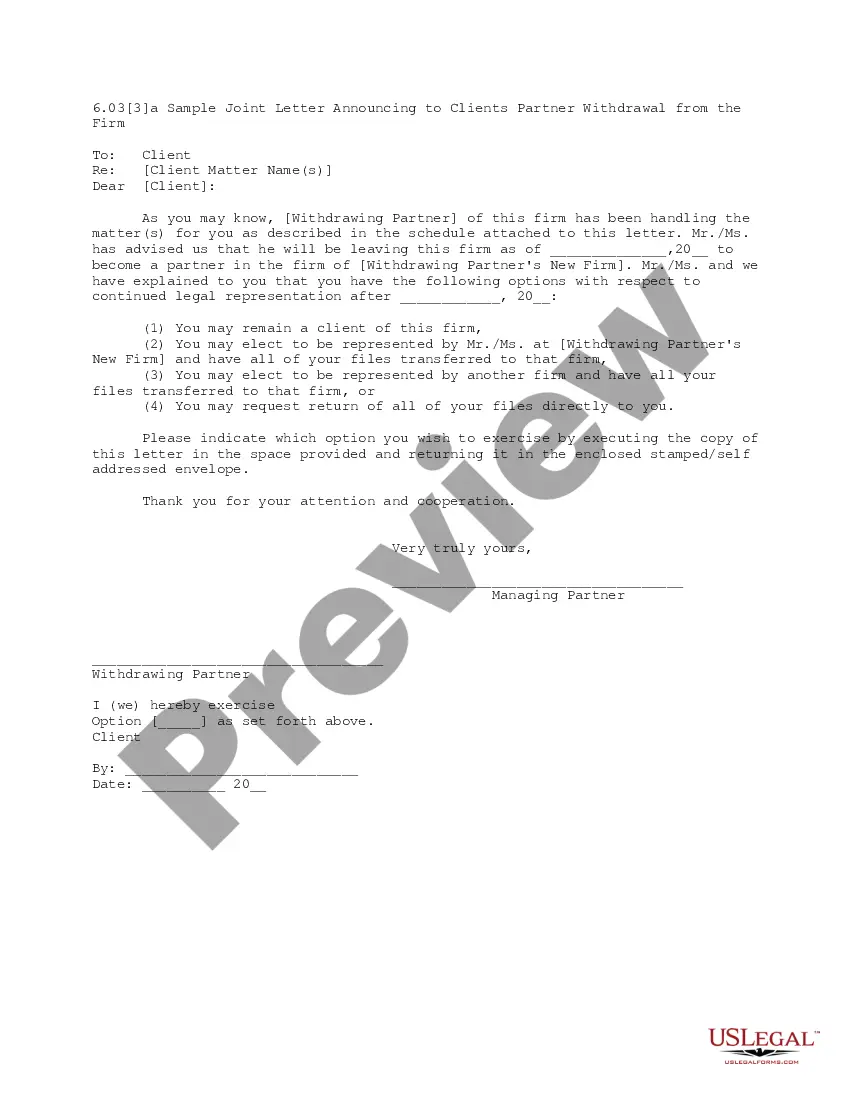
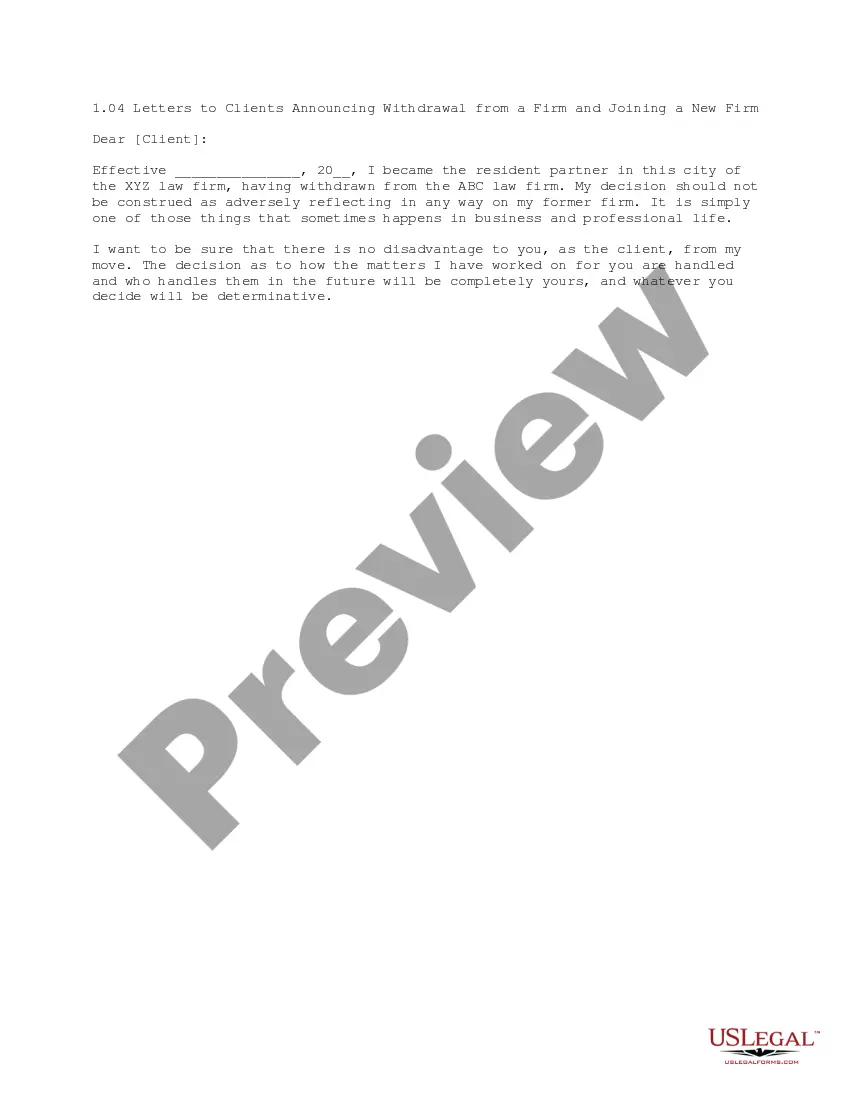
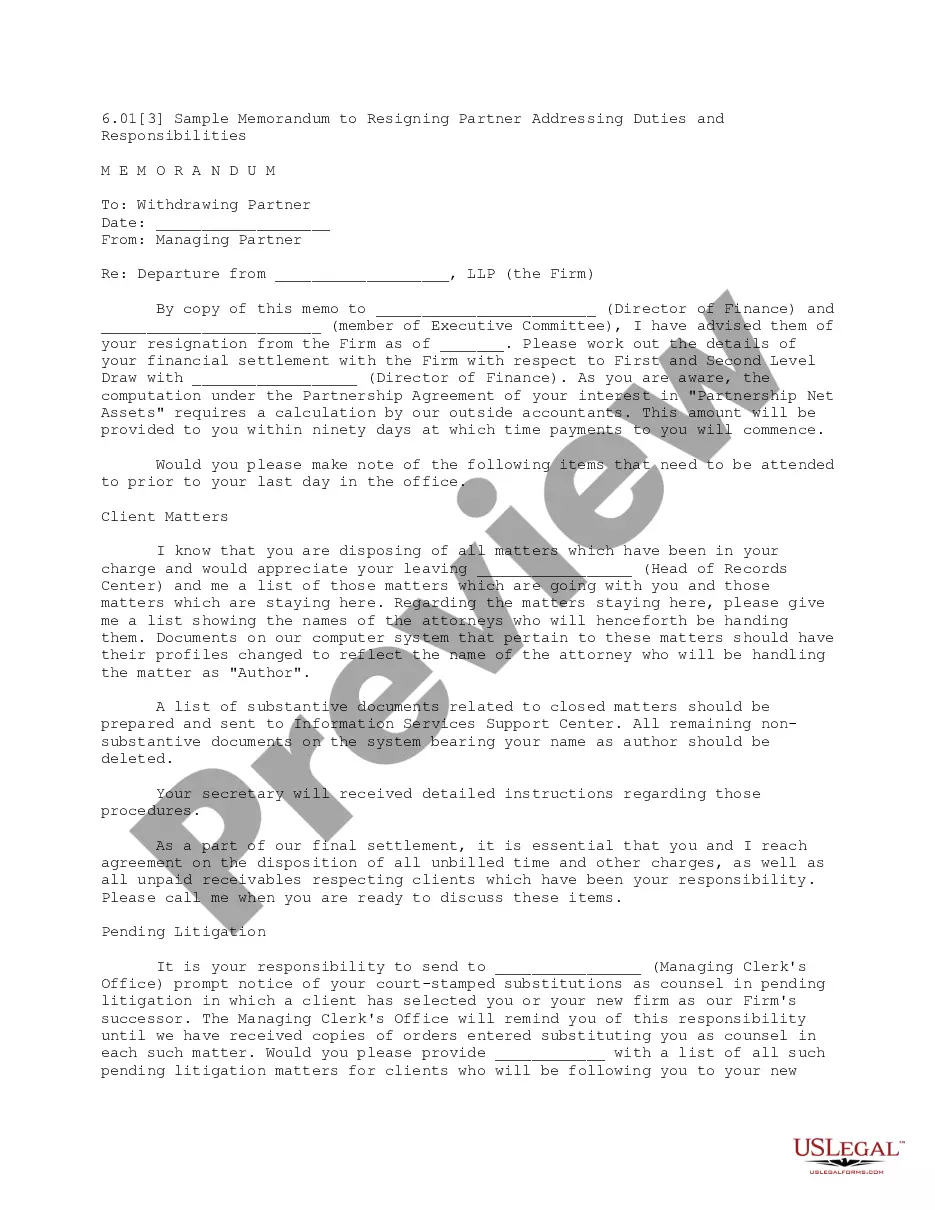
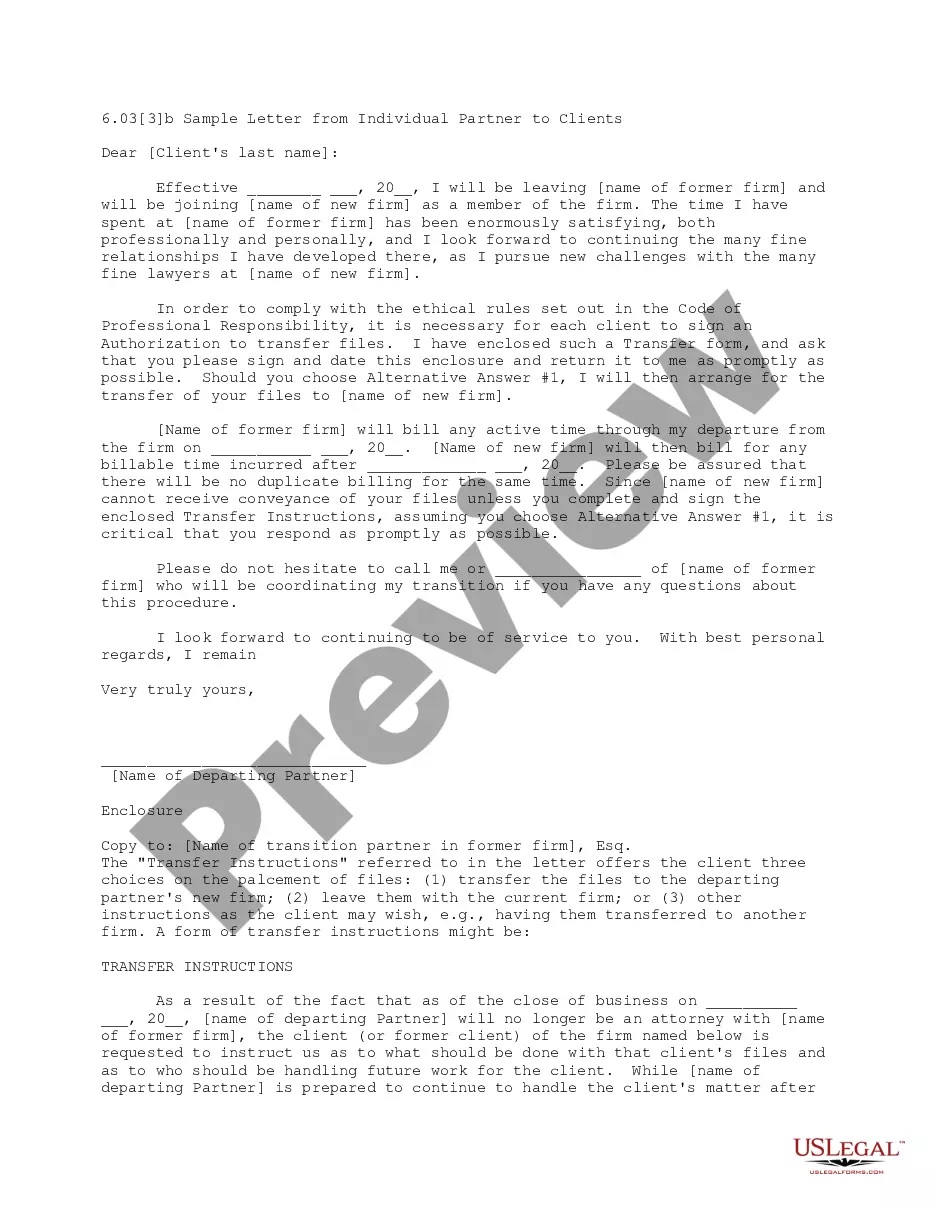
This Joint Letter Announcing to Clients Partner Withdrawal from the Firm is used to formally notify clients that an attorney who has been managing their legal matters is leaving the firm. This letter outlines options for clients regarding their continued representation, ensuring clarity in the transition. It emphasizes the importance of client choice in legal representation, setting it apart from other correspondence regarding attorney changes.
Main sections of this form
- Address to the client, identifying the withdrawing partner and the matters they handled.
- Notification of the partnerâs withdrawal date and new firm affiliation.
- Options for client representation, including remaining with the firm or transferring files.
- Instructions for clients to indicate their choice and return the signed letter.
- Signature lines for both the managing partner and the withdrawing partner.
Common use cases
This form should be used when a partner at a law firm is withdrawing and has been directly involved with clients' cases. It is essential to provide this notice to ensure that clients are fully informed about the changes in their legal representation and can make an informed decision on how to proceed.
Intended users of this form
This form is intended for:
- Law firms announcing a partner's departure to their clients.
- Partners who are transitioning to a new legal practice.
- Clients of the firm who need clarity on their legal representation options.
How to complete this form
- Identify the client: Fill in the name of the client at the start of the letter.
- Specify the withdrawing partner: Include the name of the attorney who is leaving the firm.
- Enter the withdrawal date: Clearly state the last date the partner will be representing the client.
- Outline the options available: List the choices clients have regarding their legal representation.
- Provide instructions for response: Include details on how clients should return their decision.
Notarization requirements for this form
This form does not typically require notarization unless specified by local law. It is sufficient for the managing partner and the withdrawing partner to sign the letter.
Get your form ready online
Our built-in tools help you complete, sign, share, and store your documents in one place.
Make edits, fill in missing information, and update formatting in US Legal Forms—just like you would in MS Word.
Download a copy, print it, send it by email, or mail it via USPS—whatever works best for your next step.
Sign and collect signatures with our SignNow integration. Send to multiple recipients, set reminders, and more. Go Premium to unlock E-Sign.
If this form requires notarization, complete it online through a secure video call—no need to meet a notary in person or wait for an appointment.
We protect your documents and personal data by following strict security and privacy standards.

Make edits, fill in missing information, and update formatting in US Legal Forms—just like you would in MS Word.

Download a copy, print it, send it by email, or mail it via USPS—whatever works best for your next step.

Sign and collect signatures with our SignNow integration. Send to multiple recipients, set reminders, and more. Go Premium to unlock E-Sign.

If this form requires notarization, complete it online through a secure video call—no need to meet a notary in person or wait for an appointment.

We protect your documents and personal data by following strict security and privacy standards.
Avoid these common issues
- Forgetting to include the withdrawal date can lead to confusion for clients.
- Not clearly outlining all client options may result in clients feeling uninformed.
- Neglecting to provide sufficient space for client signatures can hinder proper completion.
Benefits of completing this form online
- Convenience: Easily download and customize the form at any time.
- Editability: Make necessary adjustments to fit specific client circumstances.
- Reliability: Ensure that the letter is created using templates drafted by licensed attorneys.
Summary of main points
- This form provides a structured method for notifying clients about a partner withdrawal.
- Clients are presented with clear options regarding their legal representation following the transition.
- Completing this form accurately ensures effective communication and client understanding.
Looking for another form?

Form popularity
FAQ
Voluntary and Non-Voluntary. A voluntary withdrawal means the partner merely wants to move on for personal reasons, such as they are retiring or they feel they can't remain dedicated to the partnership. Planning an Exit. Partnership Agreement. Dissolution. Peaceful Exit.
Prepare a withdrawal letter or notice In such a business, you can simply write a withdrawal from partnership letter, if you want to withdraw your partnership. This letter will serve as a notice of intimation to your other partner (s) regarding your impending exit.
The top reason, cited by 44.2% of lateral partners, is lack of confidence in firm management and strategy, according to the 2020 Lateral Partner Satisfaction Survey, released Tuesday by legal search firm Major, Lindsey & Africa. The survey, developed with legal market researcher Acritas, is available here.
When a partner wants to leave a partnership, that partner gives notice to the other partners. This is called a voluntary withdrawal. An example would be selling one's partnership interest to another party in order to retire.
In those cases, retiring partners receive a return of capital and any other retirement-type benefits are usually limited to funded pension plans. Most law firms require new partners to pay for shares and retiring partners receive value for selling their ownership interest in the firm.
General partnership. A general partnership is a company owned by two or more individuals who agree to run the business as partners or co-owners. Limited partnership. Limited partnerships are more structured than general partnerships and have both general and limited partners. Limited liability partnership. LLC partnership.
Once a lawyer decides to leave a firm, the lawyer should contemporaneously inform both the firm and his or her clients.The clients must be given the option of remaining with the firm, going with the departing attorney, or choosing another attorney. It is important to understand that clients are not property.
A departing partner must notify other partners and clients in a timely fashion. To do otherwise would be to risk lawsuit by the firm for breach of fiduciary duty.It is technically illegal to solicit current or former clients when leaving a law firm and heading to another but it happens anyway.
In a General Partnership, all partners are financially obligated to any debts incurred by the partnership. When a partner leaves, the partnership dissolves and the partners equally split debts and assets.