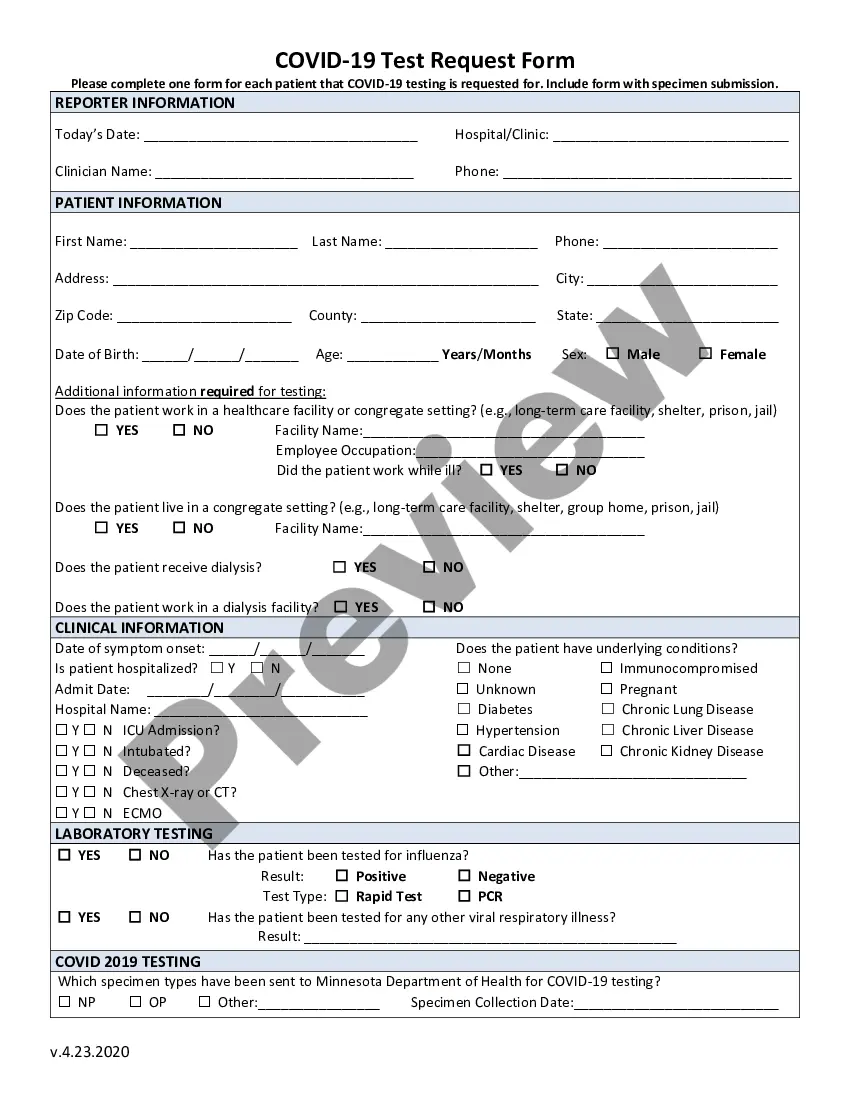
Intake form for COVID-19 Coronavirus Testing
Understanding this form
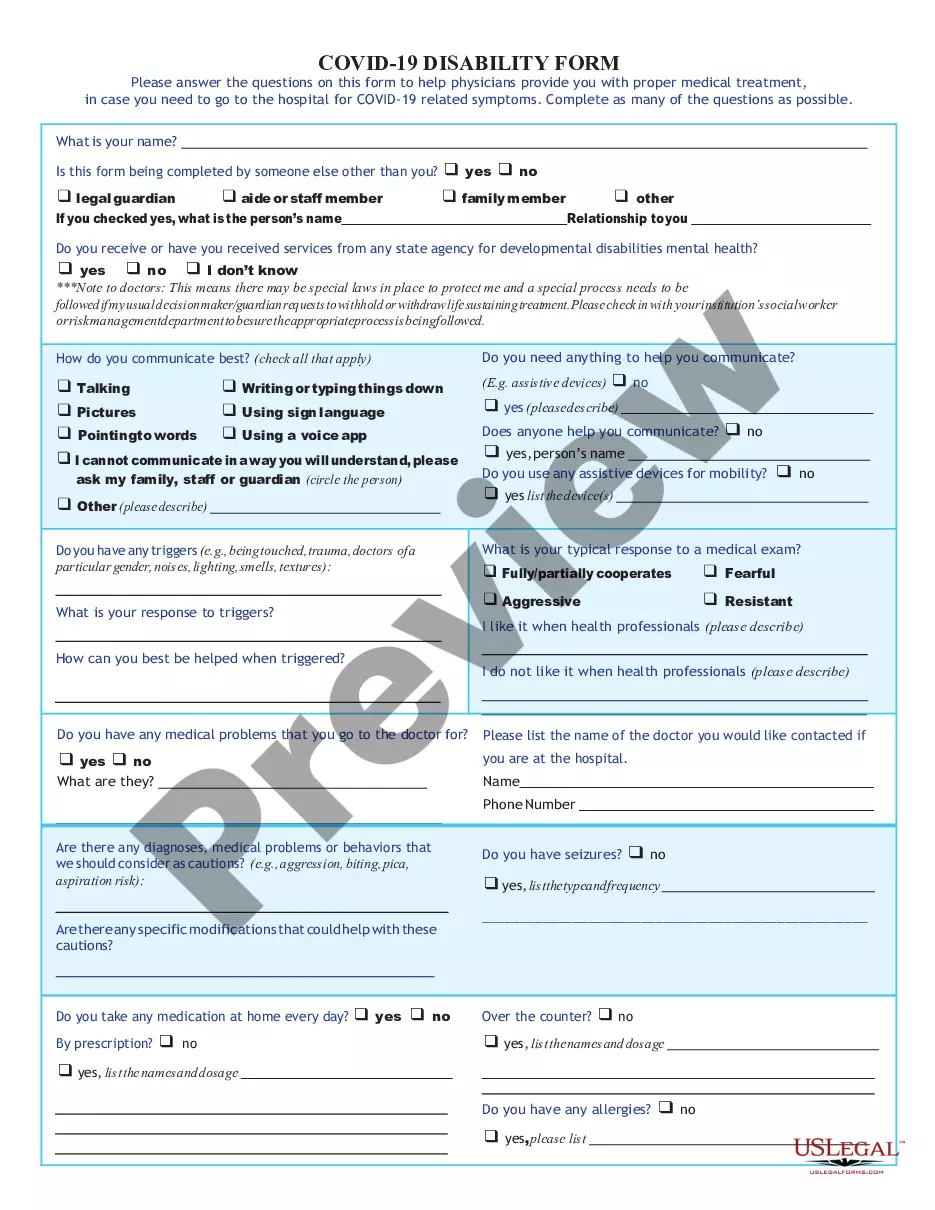
The Intake Form for COVID-19 Coronavirus Testing is a document used to collect essential patient information when a COVID-19 test is requested. This form is crucial for healthcare providers to ensure accurate and efficient testing and reporting, particularly in managing the spread of the virus. It differs from other health intake forms by focusing specifically on COVID-19-related data and compliance with public health guidelines.
Form components explained
- Reporter information including the date, hospital or clinic name, clinician's name, and phone number.
- Patient information such as first and last names, contact details, address, date of birth, age, and sex.
- Sections for healthcare-related work and living situations, including exposure risk and underlying conditions.
- Clinical data including symptom onset date, hospitalization status, and testing history.
- Laboratory testing information, detailing any tests conducted and results.
- Specimen type sent for COVID-19 testing and collection date.
Common use cases
This form should be used when a healthcare provider requests COVID-19 testing for a patient. It is essential for collecting all relevant information to facilitate the testing process, particularly in healthcare settings or instances where patients show symptoms of the virus. Using this form ensures that all necessary data is gathered accurately for effective testing and record-keeping.
Who can use this document
- Healthcare providers requesting COVID-19 testing for patients.
- Clinicians working in hospitals or clinics handling potential COVID-19 cases.
- Testing facilities that need to document patient information and clinical history for accurate results.
Steps to complete this form
- Fill in the reporter information at the top, including the date and clinician details.
- Provide complete patient information; ensure accuracy in names, contact, and demographic data.
- Answer the questions regarding the patientâs healthcare-related work and living situations accurately.
- Document clinical information such as symptom onset and hospitalization status as needed.
- Indicate any laboratory testing results relevant to the patient's condition.
- Specify the specimen type sent for testing and include the date of collection.
Does this document require notarization?
This form does not typically require notarization unless specified by local law. Make sure to check your stateâs regulations concerning notarization requirements for health-related documentation.
Get your form ready online
Our built-in tools help you complete, sign, share, and store your documents in one place.
Make edits, fill in missing information, and update formatting in US Legal Forms—just like you would in MS Word.
Download a copy, print it, send it by email, or mail it via USPS—whatever works best for your next step.
Sign and collect signatures with our SignNow integration. Send to multiple recipients, set reminders, and more. Go Premium to unlock E-Sign.
If this form requires notarization, complete it online through a secure video call—no need to meet a notary in person or wait for an appointment.
We protect your documents and personal data by following strict security and privacy standards.

Make edits, fill in missing information, and update formatting in US Legal Forms—just like you would in MS Word.

Download a copy, print it, send it by email, or mail it via USPS—whatever works best for your next step.

Sign and collect signatures with our SignNow integration. Send to multiple recipients, set reminders, and more. Go Premium to unlock E-Sign.

If this form requires notarization, complete it online through a secure video call—no need to meet a notary in person or wait for an appointment.

We protect your documents and personal data by following strict security and privacy standards.
Typical mistakes to avoid
- Leaving sections incomplete or unanswered, particularly critical clinical information.
- Incorrectly stating the patientâs demographic data, which can lead to miscommunication.
- Failing to include the form with the specimen submission.
Why use this form online
- Convenient access and download options for immediate use in a clinical setting.
- Editable fields allow for accurate and customized patient information entry.
- Reliable templates drafted by licensed attorneys ensure legal compliance and efficacy.
Looking for another form?
Form popularity
FAQ
A molecular test using a deep nasal swab is usually the best option, because it will have fewer false negative results than other diagnostic tests or samples from throat swabs or saliva. People who are in the hospital, though, may have other types of samples taken.
Testing is free of charge regardless of insurance or immigration status. All COVID-19 testing and related services must be free of charge to Illinois residents, regardless of insurance or immigration status.
Most tests to diagnose COVID-19 require a swab of your nose, or the part of the throat behind the nose, by a health care provider. A few tests use saliva (spit) or other types of collection methods. For most tests, the swab or sample must be sent to a lab for analysis.
Serology tests look for antibodies in blood. If antibodies are found, that means there has been a previous infection. Antibodies are proteins that can fight off infections.
Yes, the FDA has issued Emergency Use Authorizations (EUAs) for different types of COVID-19 tests. Some tests are used to diagnose the virus that causes COVID-19 infection whereas other tests are used to detect a recent or prior COVID-19 infection.
For a COVID-19 diagnostic test, a health care professional takes a sample of mucus from your nose or throat, or a sample of saliva. The sample needed for diagnostic testing may be collected at your doctor's office, a health care facility or a drive-up testing center.
In general, these lab tests fall into two categories: Molecular tests, which look for evidence of active infection; and Serology tests, which look for previous infection by detecting antibodies. Serology tests are for surveillance or investigational purposes and not for diagnostic purposes.
Ohio State offers multiple testing locations. If you have an Ohio State provider, call that office directly to assess your symptoms or order a test.
There are two different types of tests diagnostic tests and antibody tests.