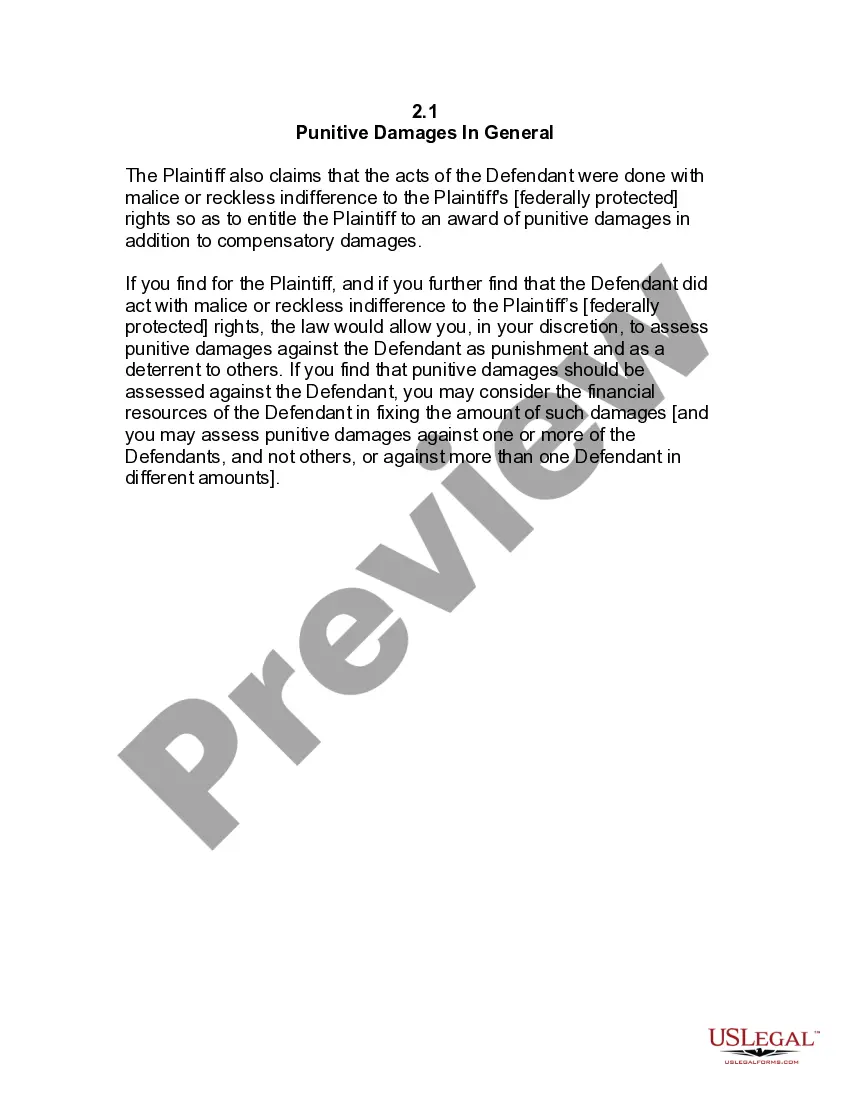
Jury Instruction - 2.1 Punitive Damages In General
What this document covers
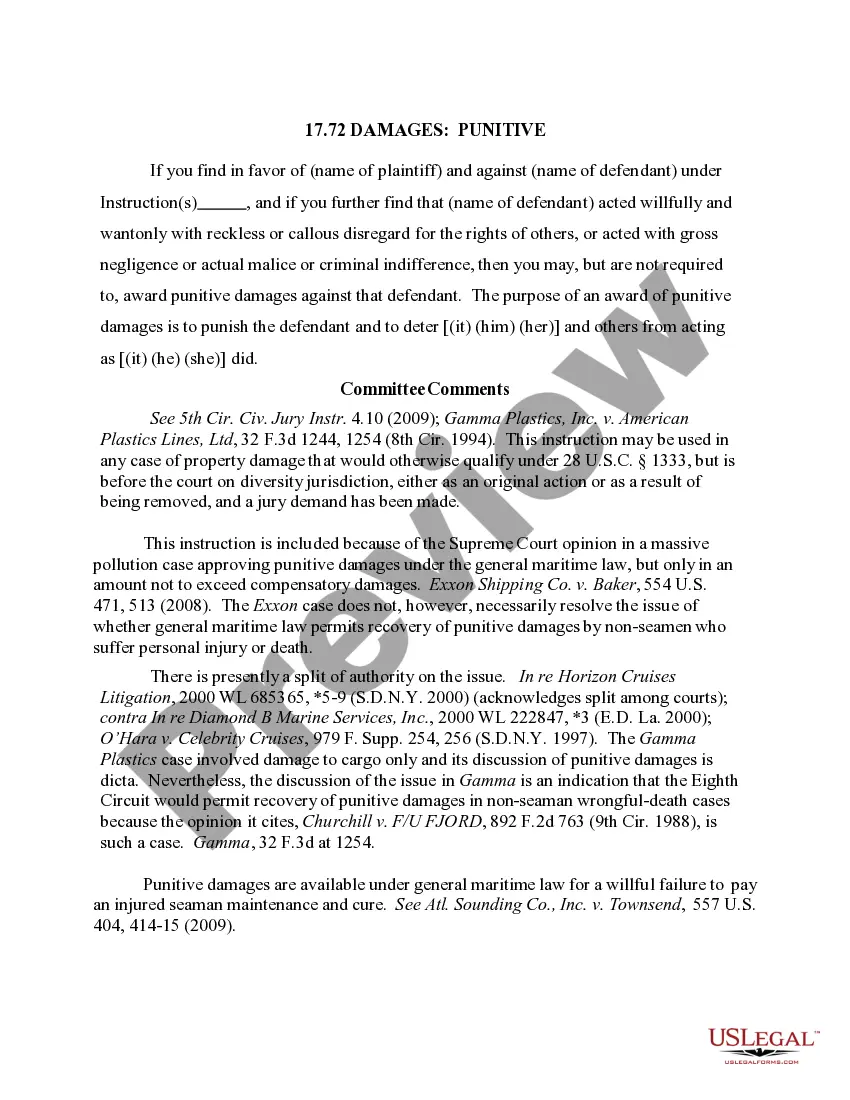
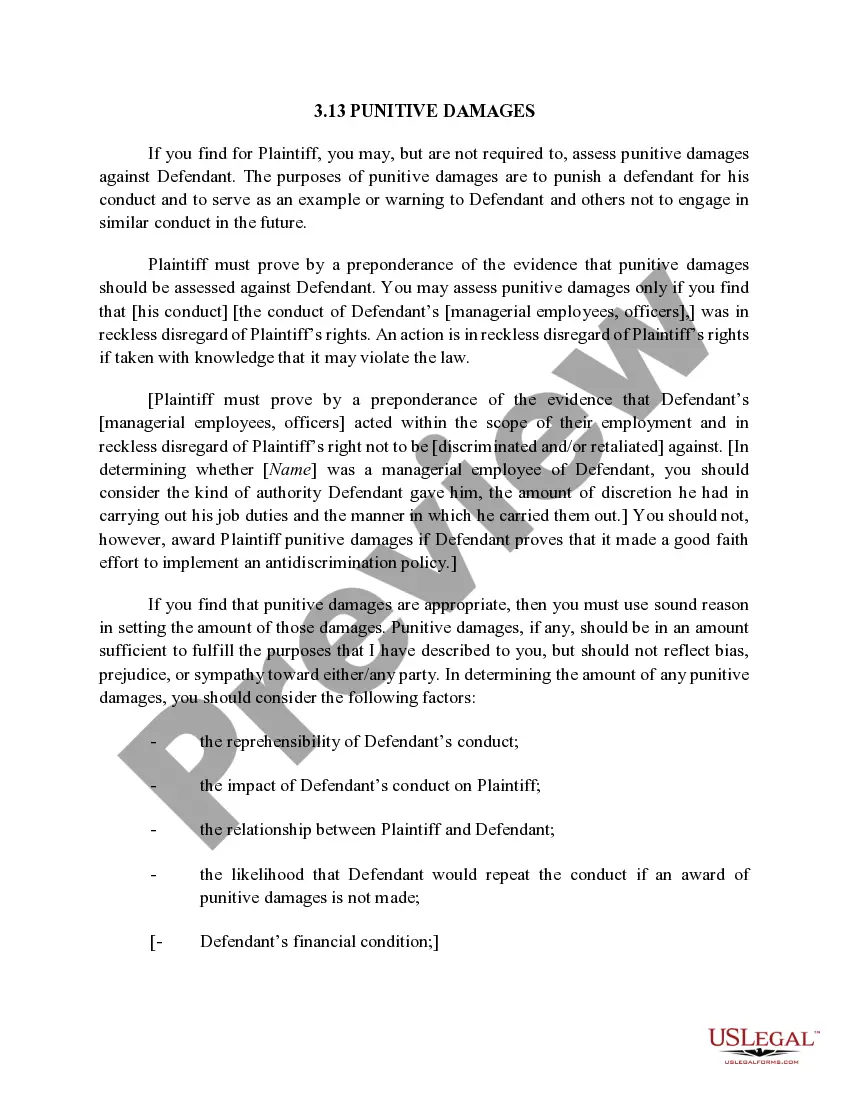
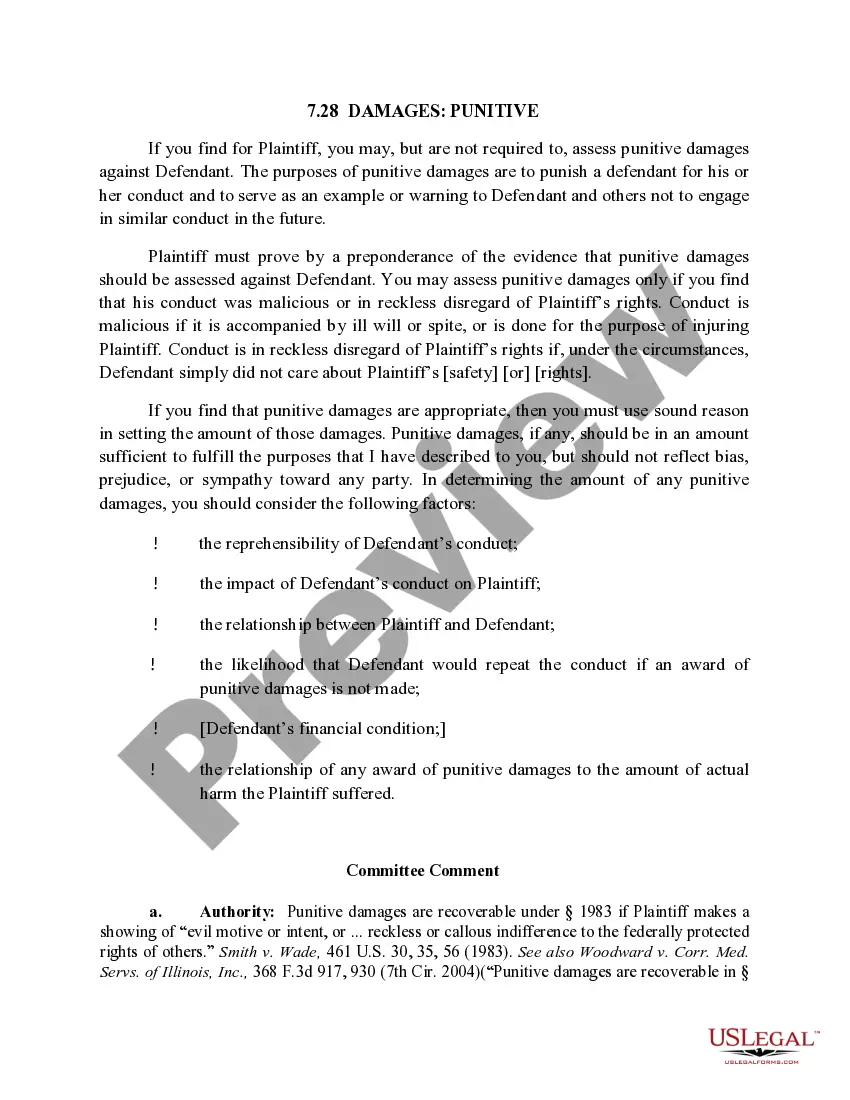
The Jury Instruction - 2.1 Punitive Damages In General form provides a template for jury instructions regarding punitive damages in civil cases. This form guides jurors on assessing punitive damages against a defendant who acts with malice or reckless indifference to the rights of others. It differentiates punitive damages from compensatory damages and outlines the discretionary nature of the award based on the defendant's conduct.
What’s included in this form
- Definition of punitive damages and their purpose.
- Criteria for determining malice or reckless indifference by the defendant.
- Guidance for jurors on considering the financial resources of the defendant.
- Instructions for assessing punitive damages against multiple defendants.
- Acknowledgment that these instructions serve as a model and should be tailored to the specifics of each case.

When this form is needed
This form should be used in civil litigation cases where the plaintiff is seeking punitive damages in addition to compensatory damages. It is applicable when the plaintiff alleges that the defendant's actions demonstrated malice or a reckless disregard for the plaintiff's federally protected rights. The template offers a structured way for jurors to understand their role in evaluating such claims during trial.
Intended users of this form
- Attorneys representing plaintiffs in civil cases involving claims for punitive damages.
- Legal professionals preparing jury instructions for cases involving allegations of malice or reckless indifference.
- Judges seeking clear instructions to provide juries in relevant cases.
- Parties to civil litigation who need to understand the implications of punitive damages.
Steps to complete this form
- Review the definition of punitive damages provided in the form.
- Determine the criteria for malice or reckless indifference applicable to your case.
- Adjust the wording of the model jury instructions to fit your specific case needs.
- Include any relevant details about the financial resources of the defendant as necessary.
- Finalize the instructions for clarity and submit them for use in court.
Notarization requirements for this form
This form does not typically require notarization to be legally valid. However, some jurisdictions or document types may still require it. US Legal Forms provides secure online notarization powered by Notarize, available 24/7 for added convenience.
Get your form ready online
Our built-in tools help you complete, sign, share, and store your documents in one place.
Make edits, fill in missing information, and update formatting in US Legal Forms—just like you would in MS Word.
Download a copy, print it, send it by email, or mail it via USPS—whatever works best for your next step.
Sign and collect signatures with our SignNow integration. Send to multiple recipients, set reminders, and more. Go Premium to unlock E-Sign.
If this form requires notarization, complete it online through a secure video call—no need to meet a notary in person or wait for an appointment.
We protect your documents and personal data by following strict security and privacy standards.

Make edits, fill in missing information, and update formatting in US Legal Forms—just like you would in MS Word.

Download a copy, print it, send it by email, or mail it via USPS—whatever works best for your next step.

Sign and collect signatures with our SignNow integration. Send to multiple recipients, set reminders, and more. Go Premium to unlock E-Sign.

If this form requires notarization, complete it online through a secure video call—no need to meet a notary in person or wait for an appointment.

We protect your documents and personal data by following strict security and privacy standards.
Mistakes to watch out for
- Failing to customize the sample instructions to reflect the specific case facts.
- Not clearly defining what constitutes malice or reckless indifference.
- Overlooking the importance of including instructions regarding the defendant's financial resources.
- Using outdated terminology that does not comply with current legal standards.
- Assuming that all jury instructions must be the same without considering case nuances.
Benefits of completing this form online
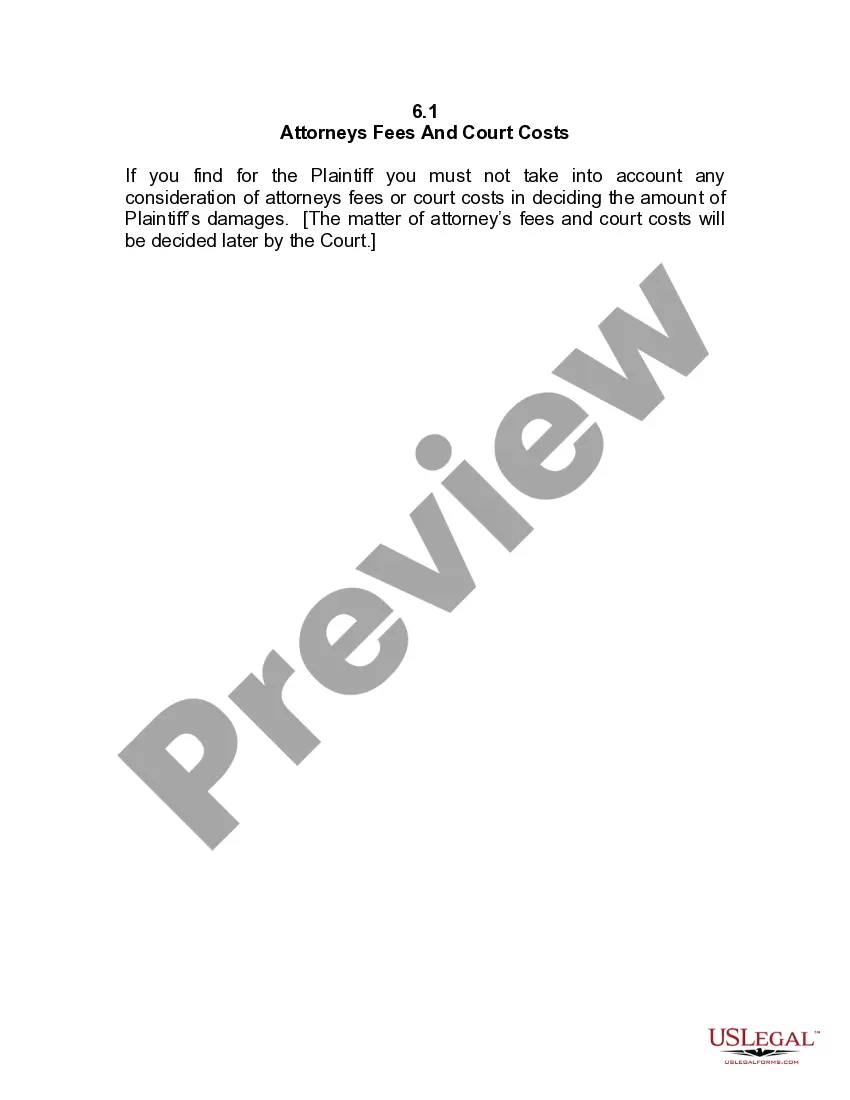
- Immediate access to professionally drafted jury instructions.
- Editability allows customization to fit specific case details.
- Convenient download options for use in various jurisdictions.
- Reliability, knowing the instructions are based on established legal principles.
- Time-saving as it simplifies the process of preparing court materials.
Main things to remember
- The Jury Instruction - 2.1 Punitive Damages In General form is essential for guiding jurors in assessing punitive damages.
- This form must be tailored to fit the unique aspects of each case to be effective.
- Understanding the difference between punitive and compensatory damages is critical.
- The inclusion of the defendant's financial situation can influence the amount of punitive damages assessed.
- Using an online form can streamline the preparation process, ensuring clarity and compliance.
Looking for another form?








Form popularity
FAQ
While mandated percentage "limits" on a punitive damage award have drawn criticism, awards in excess of these limits have also drawn objection. Again, using California as an example, courts have generally found punitive damages greater than 15 percent of a defendant's net worth to be excessive.
These three "guideposts" include (1) the degree of reprehensibility of the defendants conduct; (2) the reasonableness of the ratio between punitive damages awarded and the actual harm inflicted; and (3) the degree of comparability between the punitive damages awarded and authorized civil and criminal penalties.
Jurisdictions employ one of three standards of proof in decisions concerning punitive damages: (1) beyond a reasonable doubt, (2) by clear and convincing evidence, and (3) by a preponderance of evidence.
If juries award greater compensatory damages than do judges for any given case type, then that higher award will boost punitive damages as well. This analysis indicates that juries generate higher compensatory damages as well as higher punitive damages controlling for compensatory damages.
To determine the amount of punitive damages to award, the Book of Approved Jury Instructions (BAJI) states that the jury should consider: (1) The reprehensibility of the conduct of the defendant.The other twodefendant's financial condition and the relationship to actual damagesare objective measurements.
Finally, the United States Supreme Court has set a limit on punitive damages. Punitive damages cannot exceed a 10:1 ratio. In other words, punitive damages cannot be more than 10 times the initial award given.
Although there is no maximum sum, punitive damages typically do not exceed four times the amount of compensatory damages. For example, if a plaintiff recovers $100,000 in compensatory damages and is awarded punitive damages, they most likely will receive up to $400,000 in punitive damages.
The amount of punitive damages is left to the jury's discretion. In most states, the jury is instructed to consider both objective and subjective factors.However, in most states, punitive damages are awarded when a defendant's actions are willful, malicious, oppressive, fraudulent, or reckless.