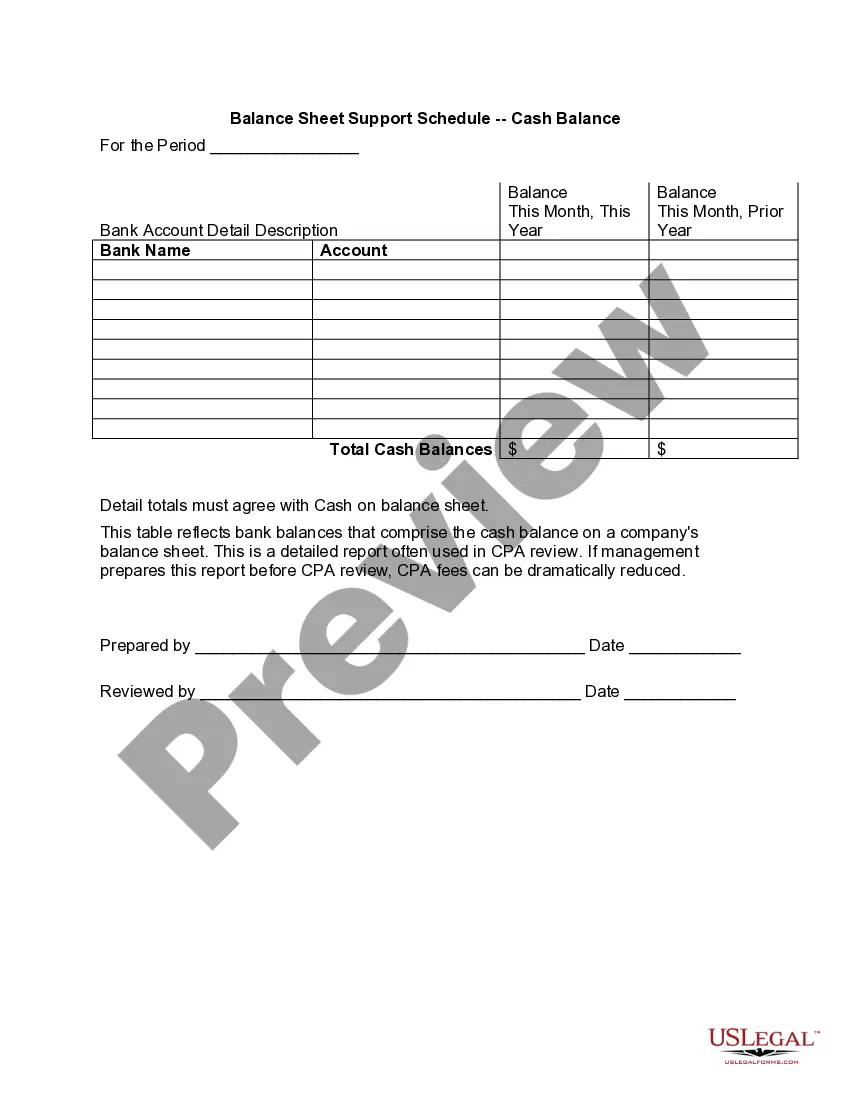
Balance Sheet Support Schedule - Cash Balance
About this form
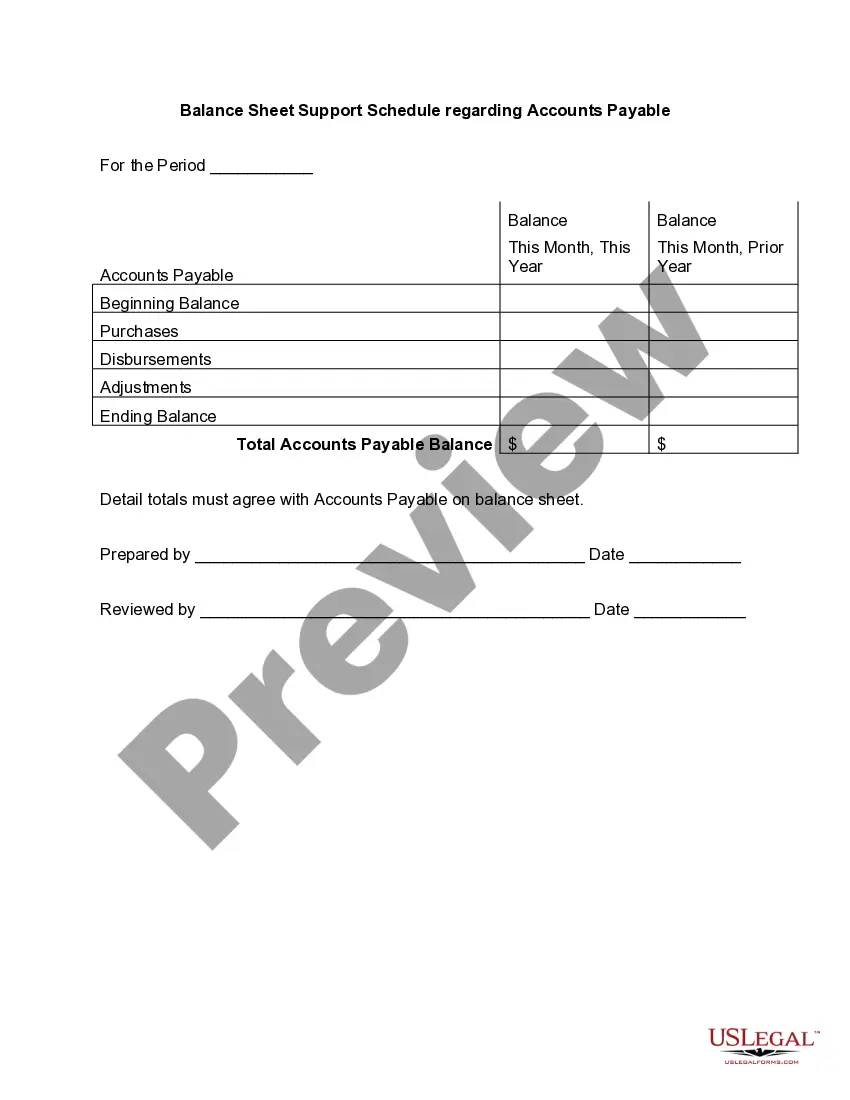
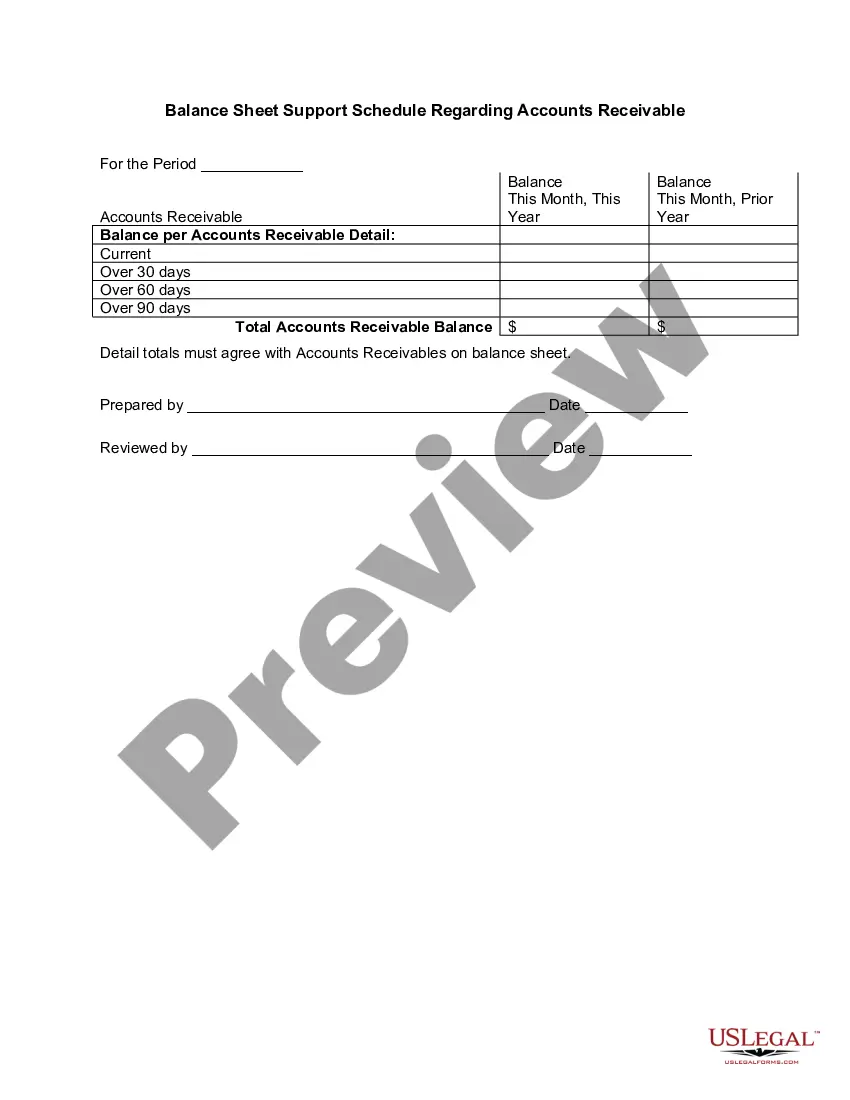
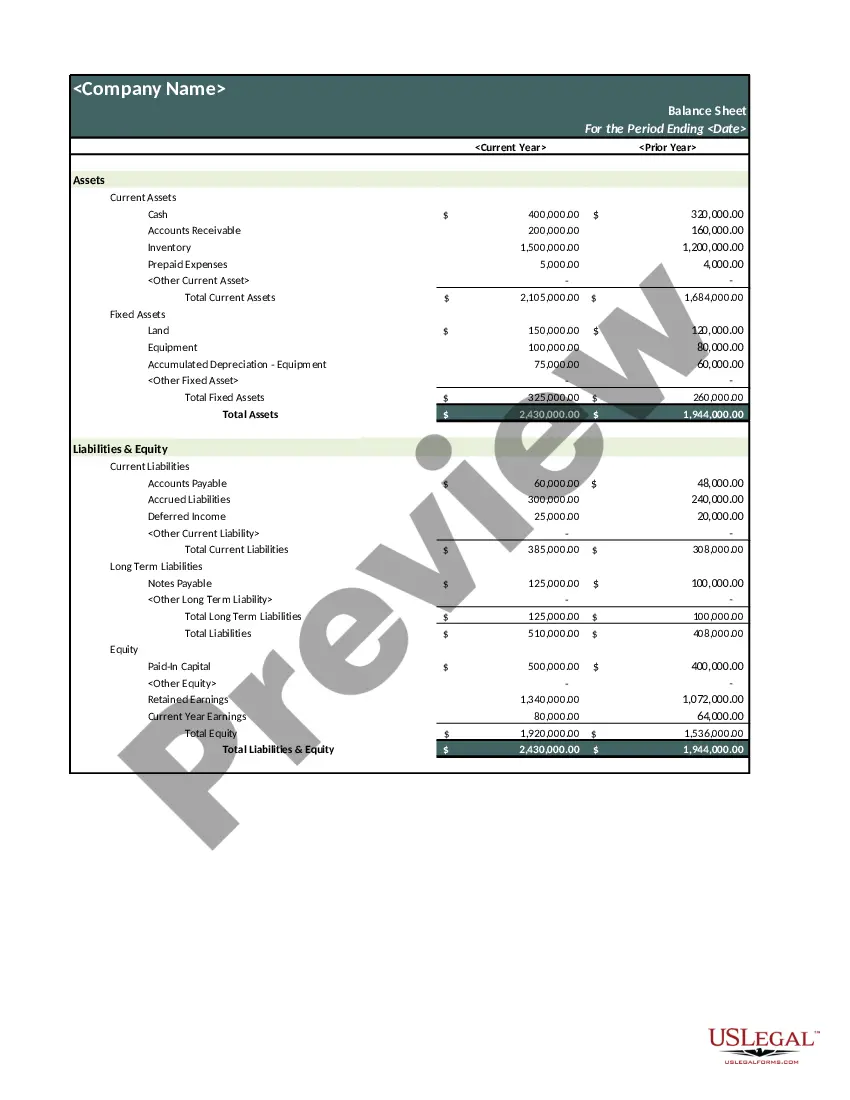
The Balance Sheet Support Schedule - Cash Balance is a financial document that helps summarize the cash position of a business. It details various cash accounts, including checking accounts and government securities, and is essential for maintaining accurate financial records. Unlike other financial forms, this schedule specifically focuses on cash balances, making it easier for management and accountants to review cash-related health on the balance sheet.
Key parts of this document
- Period for which the cash balance is reported.
- Details of bank accounts held by the business.
- Current and prior year's cash balances, facilitating year-over-year comparison.
- Bank account name and balance, ensuring clarity on each account's contribution.
- Summary that must agree with the overall cash balance on the balance sheet.
When this form is needed
This form is typically used during monthly, quarterly, or annual financial reviews to summarize and verify cash balances. It is essential when preparing for audits or CPA reviews as it provides a clear overview of cash available in business accounts. Companies should consider using it prior to significant transactions, such as business sales, to demonstrate financial health.
Who should use this form
- Business owners who need to monitor their cash position accurately.
- Accountants responsible for preparing financial statements.
- Financial analysts evaluating the liquidity of a business.
- Management teams assessing financial performance for internal reviews.
Steps to complete this form
- Identify the reporting period for cash balances.
- List bank account names and details in the designated fields.
- Enter the balance for the current month as well as the prior year for comparison.
- Ensure total cash balances reflect correctly against the cash balance on your overall balance sheet.
- Include signatures of the preparer and reviewer with appropriate dates.
Does this document require notarization?
Notarization is generally not required for this form. However, certain states or situations might demand it. You can complete notarization online through US Legal Forms, powered by Notarize, using a verified video call available anytime.
Get your form ready online
Our built-in tools help you complete, sign, share, and store your documents in one place.
Make edits, fill in missing information, and update formatting in US Legal Forms—just like you would in MS Word.
Download a copy, print it, send it by email, or mail it via USPS—whatever works best for your next step.
Sign and collect signatures with our SignNow integration. Send to multiple recipients, set reminders, and more. Go Premium to unlock E-Sign.
If this form requires notarization, complete it online through a secure video call—no need to meet a notary in person or wait for an appointment.
We protect your documents and personal data by following strict security and privacy standards.

Make edits, fill in missing information, and update formatting in US Legal Forms—just like you would in MS Word.

Download a copy, print it, send it by email, or mail it via USPS—whatever works best for your next step.

Sign and collect signatures with our SignNow integration. Send to multiple recipients, set reminders, and more. Go Premium to unlock E-Sign.

If this form requires notarization, complete it online through a secure video call—no need to meet a notary in person or wait for an appointment.

We protect your documents and personal data by following strict security and privacy standards.
Typical mistakes to avoid
- Failing to update previous year's balances, leading to inaccurate comparisons.
- Omitting any cash accounts, which can skew the overall cash position.
- Not matching total cash balances with the balance sheet totals.
- Incorrectly calculating cash disbursements and receipts.
Benefits of using this form online
- Convenient download and digital management of your financial documents.
- Edit and customize form details easily before finalizing.
- Reliable templates drafted by licensed attorneys ensure legal soundness.
Legal use & context
- This form serves as a part of financial reporting and is essential for accurate bookkeeping.
- A well-prepared balance sheet support schedule can enhance financial credibility to stakeholders and investors.
- It is not a legal document in itself but supports filings that may require formal review.
Key takeaways
- The Balance Sheet Support Schedule focuses on summarizing cash positions of a business.
- Accuracy in this form is crucial for financial evaluations and CPA reviews.
- Proper preparation can lead to reduced costs associated with financial assessments.
Looking for another form?

Form popularity
FAQ
While it is arrived at through from the bottom of the income statement links to the balance sheet and cash flow statement. On the balance sheet, it feeds into retained earnings and on the cash flow statement, it is the starting point for the cash from operations section.
The cash flow statement shows the cash inflows and outflows for a company during a period. In other words, the balance sheet shows the assets and liabilities that result, in part, from the activities on the cash flow statement.
Balance Sheet: A balance sheet lists a company's assets, liabilities and shareholders equity at a specific point in time. It's usually thought of as the second most important financial statement, since it shows the liquidity and the theoretical value of the business.
Cash and cash equivalents refers to the line item on the balance sheet that reports the value of a company's assets that are cash or can be converted into cash immediately. Cash equivalents include bank accounts and marketable securities such as commercial paper and short-term government bonds.
Download both the PDF file and the Excel file by clicking the links as indicated in the above image. After downloading Excel file clean the data for P&L account and Balance sheet and make it in a presentable format as below.
The most liquid of all assets, cash, appears on the first line of the balance sheet. Cash Equivalents are also lumped under this line item and include assets that have short-term maturities under three months or assets that the company can liquidate on short notice, such as marketable securities.
Building a cash flow statement: The indirect method To construct an indirect cash flow statement, you first need to focus on operating activities. To do that, determine net income and remove non-cash expenses (e.g. depreciation and amortization) from that number.
Schedule I Capital: Schedule II Reserves and Surplus: Schedule III Deposits: Schedule IV Borrowings: Schedule V Other Liabilities & Provisions: Schedule VI Cash and Balance with RBI: Schedule VII Balance with Banks and Money at Call & Short Notice: Schedule VIII Investments:
The ending balance of a cash-flow statement will always equal the cash amount shown on the company's balance sheet. Cash flow is, by definition, the change in a company's cash from one period to the next. Therefore, the cash-flow statement must always balance with the cash account from the balance sheet.