Domestic Partnership Agreement regarding Disposition of Real and Personal Property if Partnership is Dissolved - Unmarried
Overview of this form
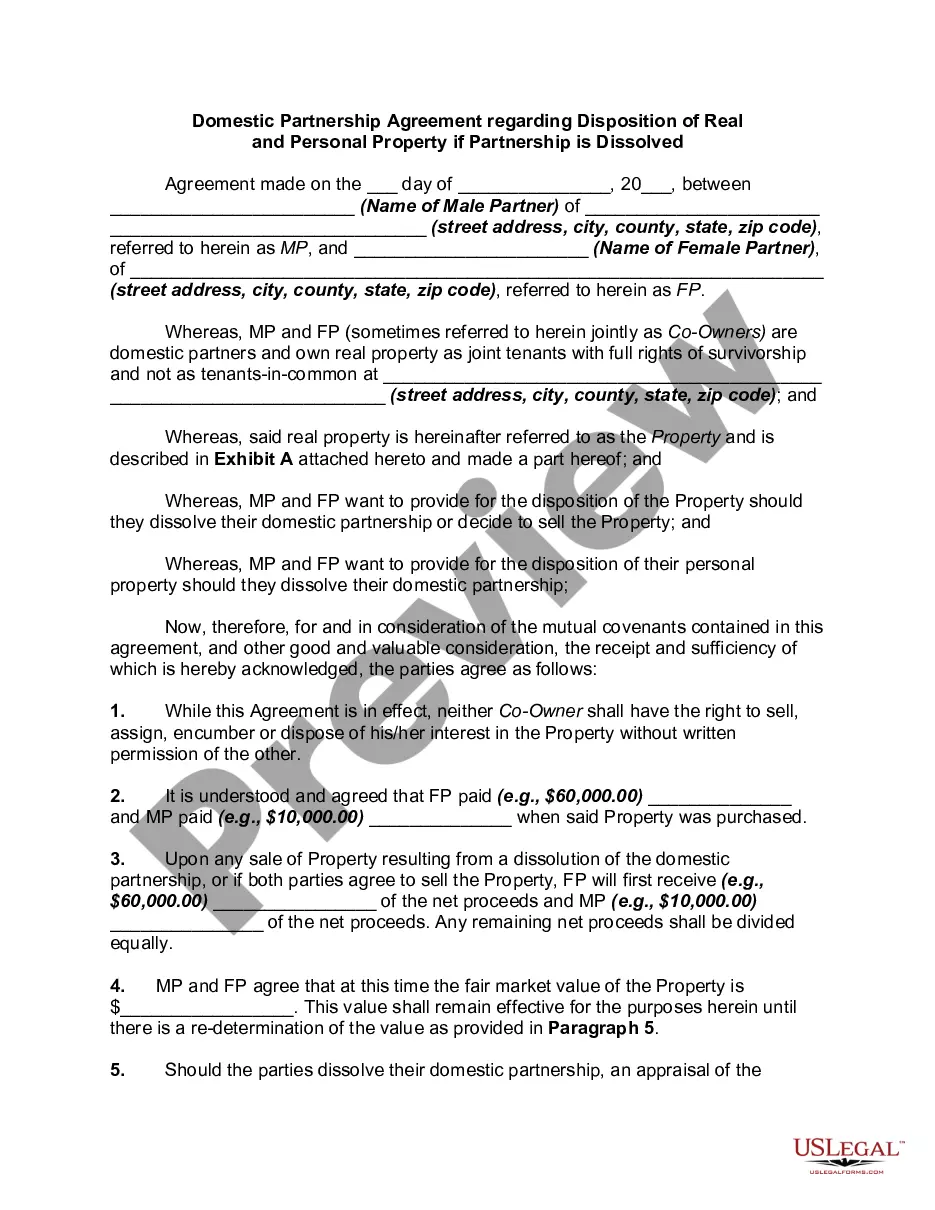
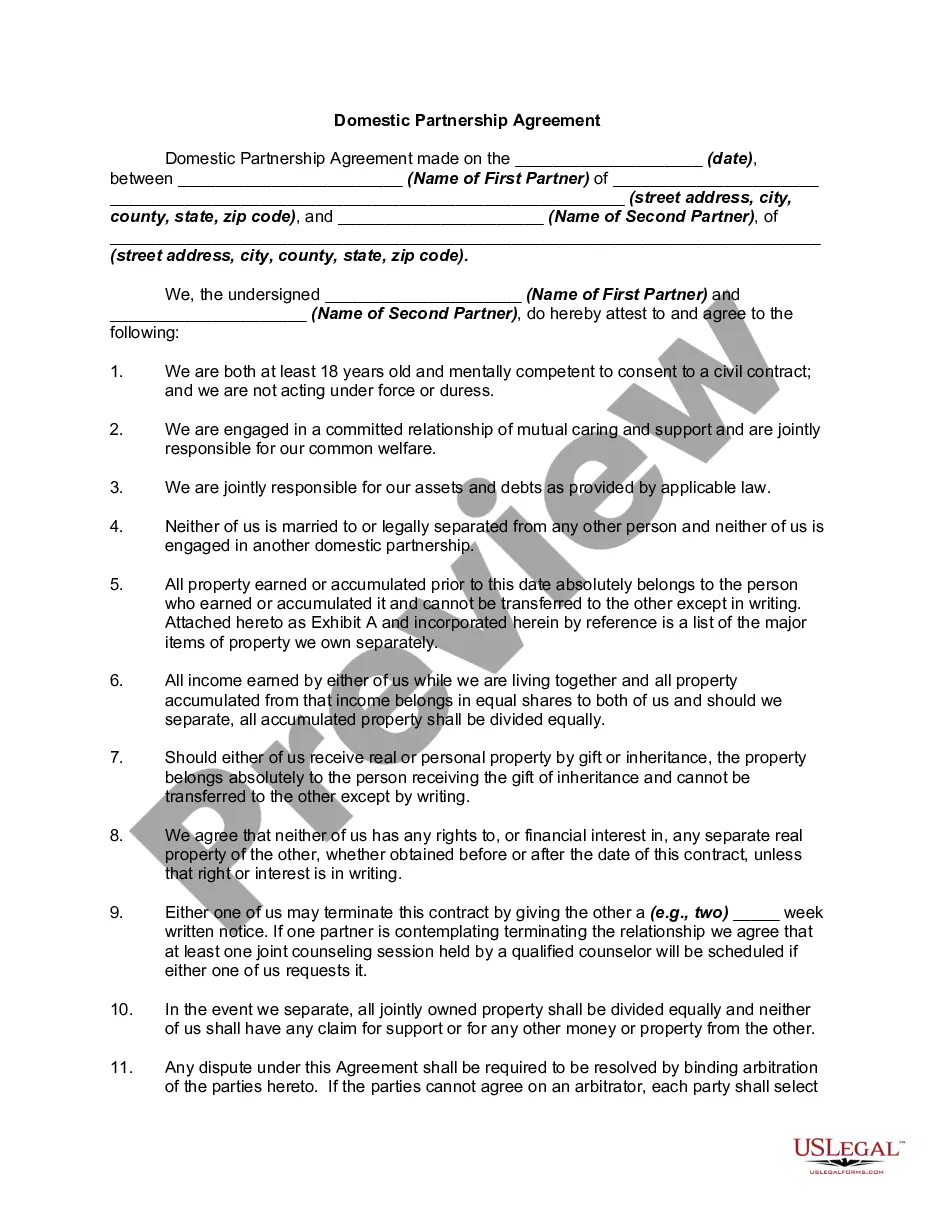
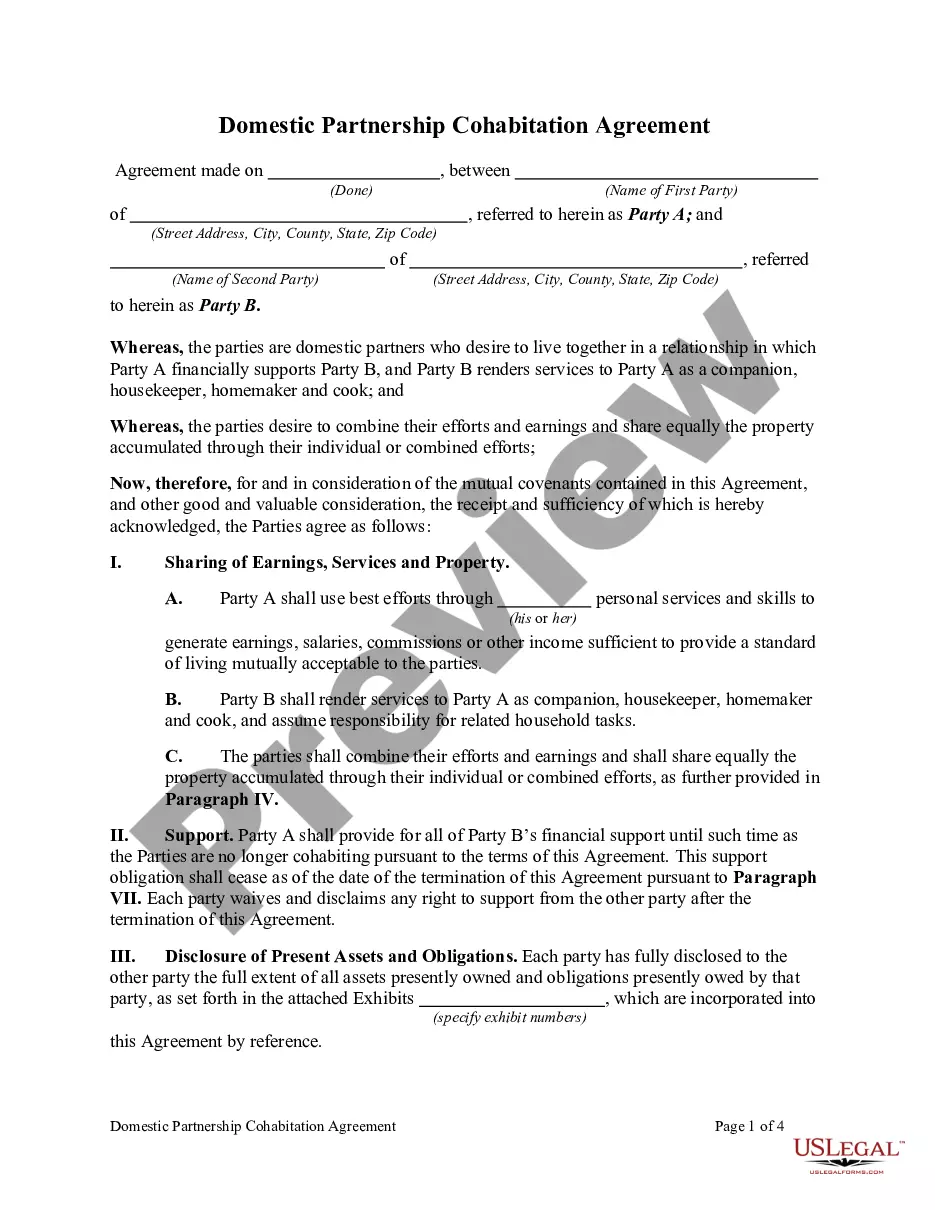
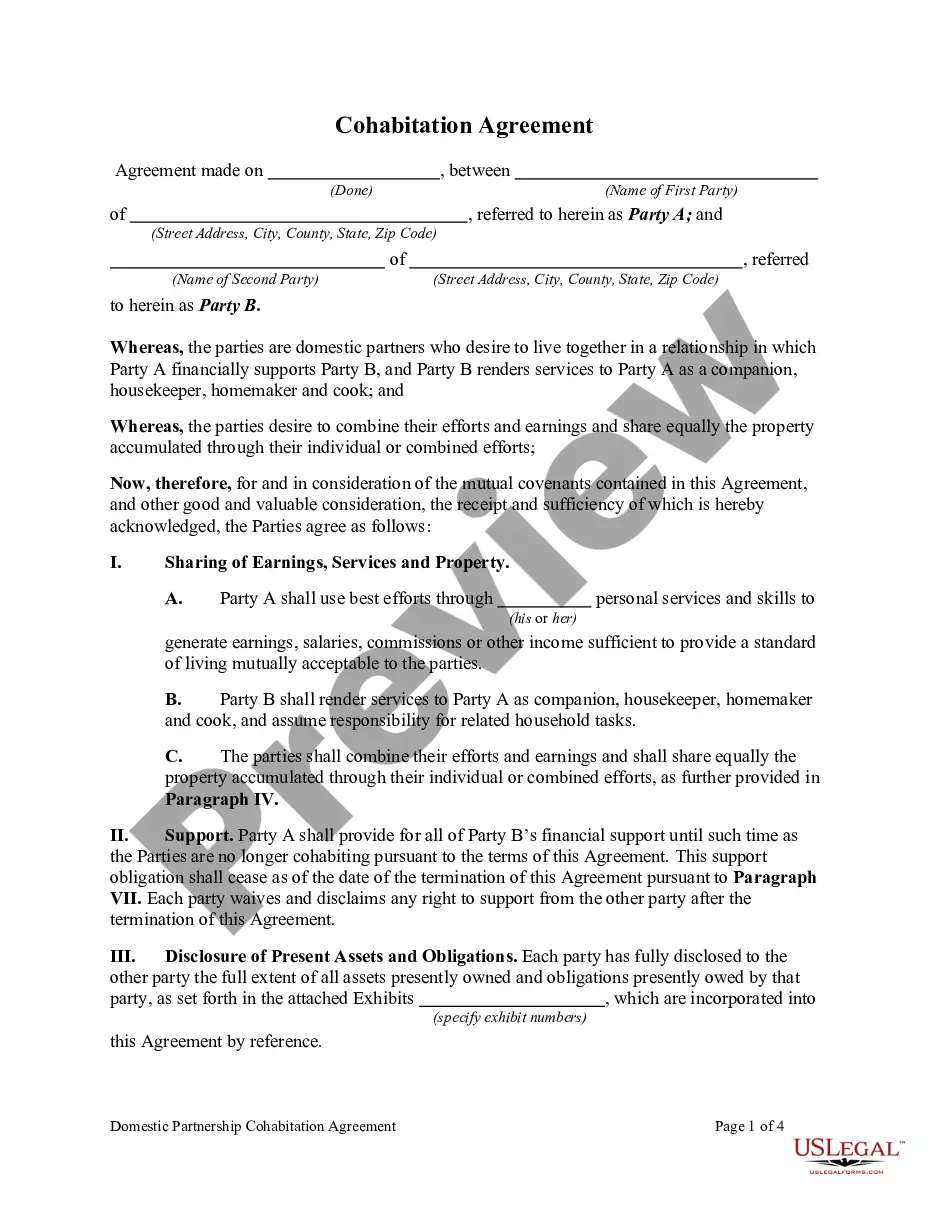
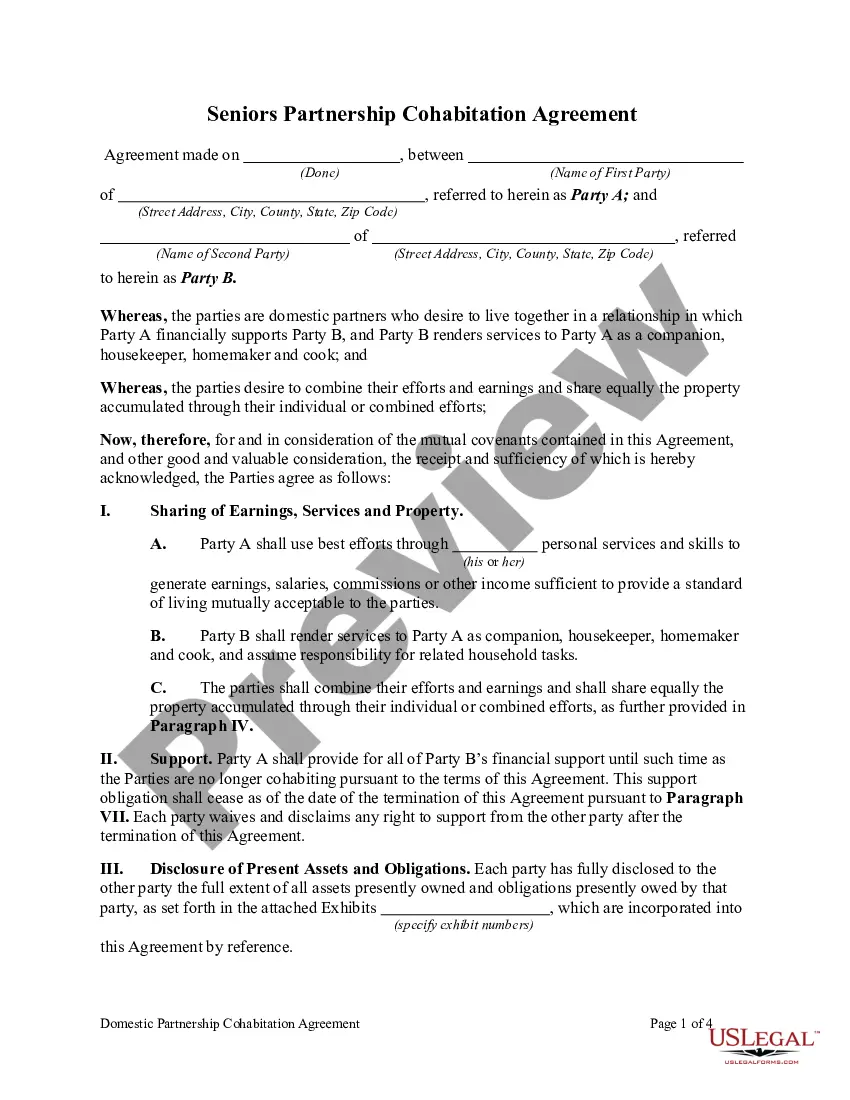
This Domestic Partnership Agreement regarding Disposition of Real and Personal Property if Partnership is Dissolved - Unmarried is a legal document designed for unmarried couples who want to set clear terms for the distribution of their property in the event of a separation or before marriage. By specifying how real and personal property will be managed and disposed of, this agreement helps prevent disputes and misunderstandings in the future.
Main sections of this form
- Identification of both partners, including names and addresses.
- Details about the jointly owned property, including its address and valuation.
- Stipulations on the sale or transfer of property without mutual consent.
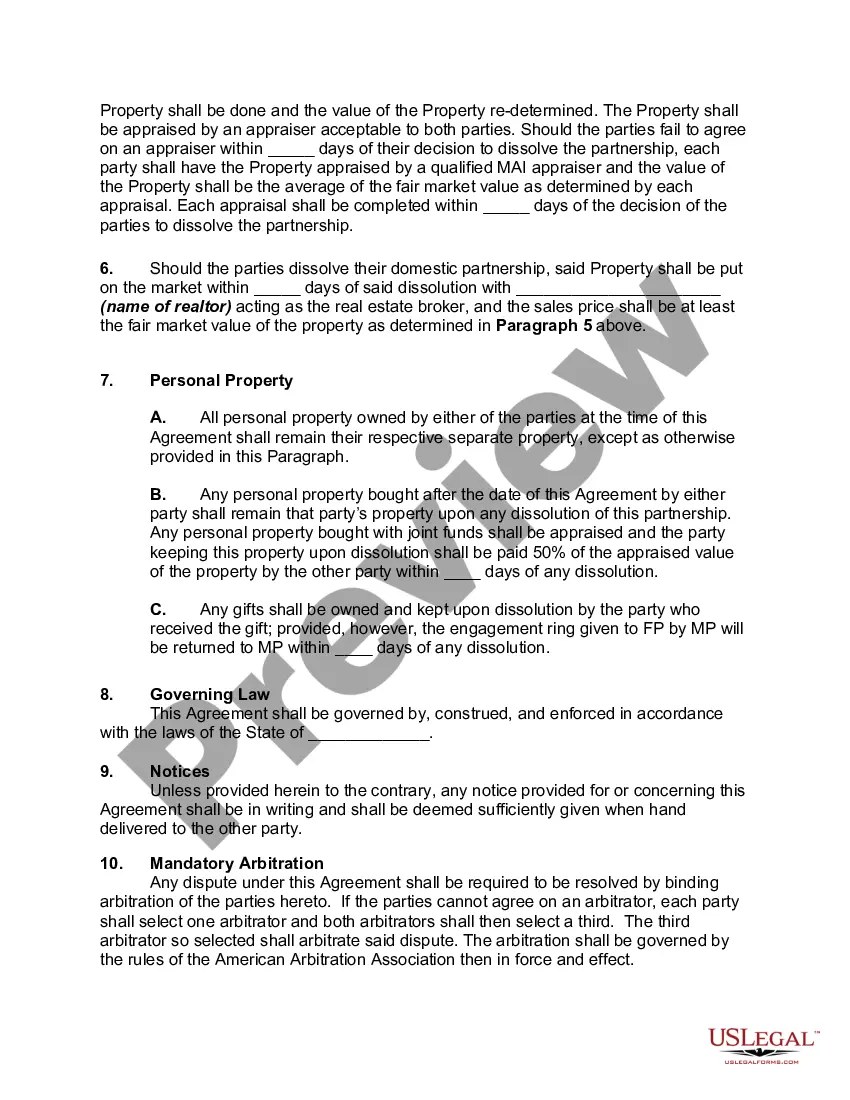
- Procedures for appraising and dividing personal property upon dissolution.
- Governing laws and dispute resolution process through mandatory arbitration.
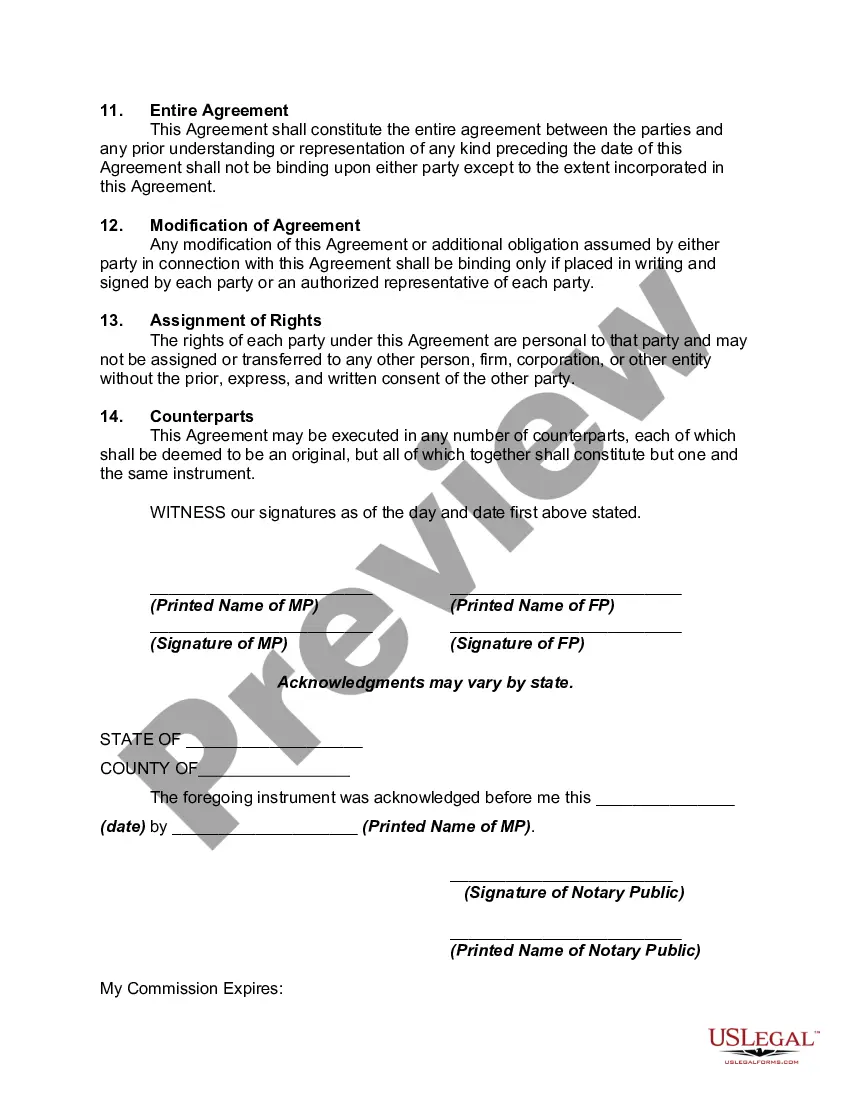
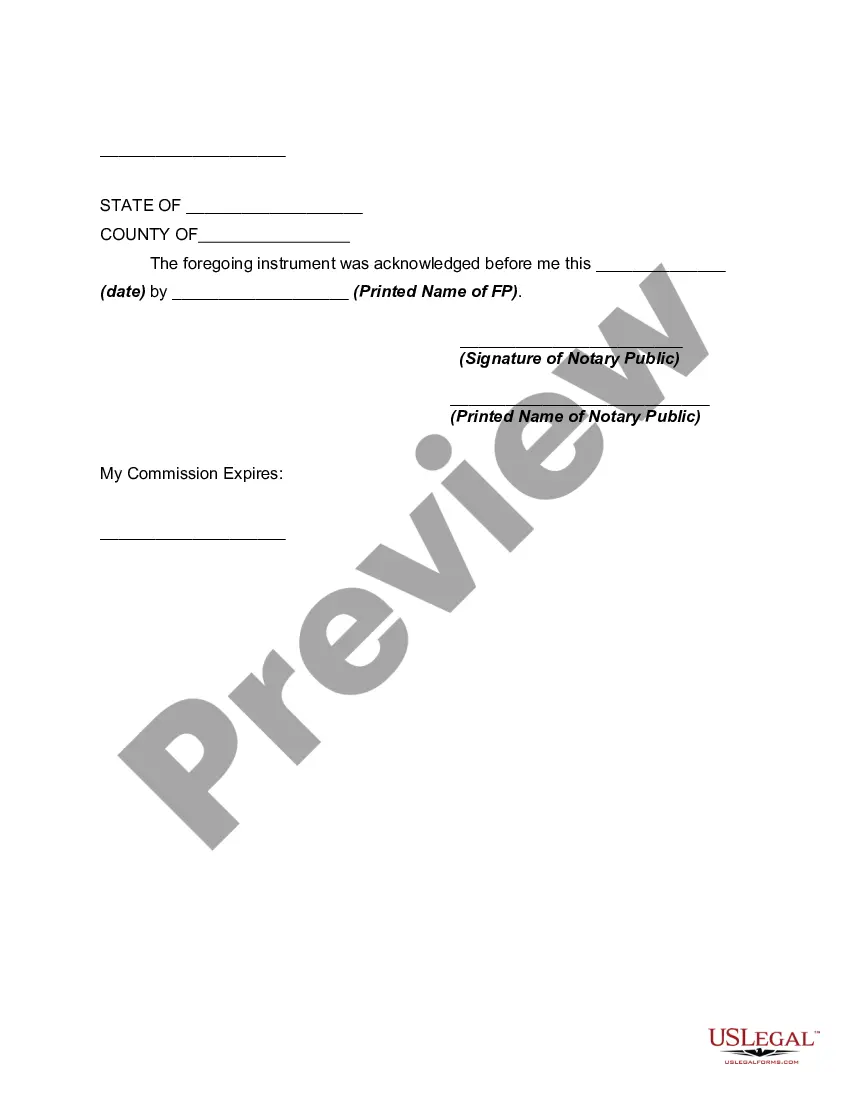
- Notary acknowledgments for legal validity.
Common use cases
This form should be used when an unmarried couple wishes to establish a legal framework regarding their property ownership before marriage. It is especially useful when acquiring significant assets, such as a home, to ensure both partners understand their respective rights and obligations should the partnership end.
Who needs this form
- Unmarried couples planning to live together and purchase property.
- Couples who wish to outline property rights and responsibilities explicitly.
- Partners looking for a clear agreement to avoid future disputes about property.
Steps to complete this form
- Identify and include the full names and addresses of both partners.
- Specify the property in question, including its address and current market value.
- Outline how the property will be divided upon dissolution, including any appraising processes.
- Include provisions for personal property ownership and valuation.
- Obtain signatures from both parties and have the document notarized for validity.
Notarization requirements for this form
Yes, this form must be notarized to be legally valid. When you complete this agreement, it is recommended to use a notary public to acknowledge the signatures of both partners, ensuring that the document meets legal standards. US Legal Forms provides integrated online notarization for your convenience.
Get your form ready online
Our built-in tools help you complete, sign, share, and store your documents in one place.
Make edits, fill in missing information, and update formatting in US Legal Forms—just like you would in MS Word.
Download a copy, print it, send it by email, or mail it via USPS—whatever works best for your next step.
Sign and collect signatures with our SignNow integration. Send to multiple recipients, set reminders, and more. Go Premium to unlock E-Sign.
If this form requires notarization, complete it online through a secure video call—no need to meet a notary in person or wait for an appointment.
We protect your documents and personal data by following strict security and privacy standards.

Make edits, fill in missing information, and update formatting in US Legal Forms—just like you would in MS Word.

Download a copy, print it, send it by email, or mail it via USPS—whatever works best for your next step.

Sign and collect signatures with our SignNow integration. Send to multiple recipients, set reminders, and more. Go Premium to unlock E-Sign.

If this form requires notarization, complete it online through a secure video call—no need to meet a notary in person or wait for an appointment.

We protect your documents and personal data by following strict security and privacy standards.
Typical mistakes to avoid
- Failing to address all personal property owned by either partner.
- Not specifying terms clearly, leading to confusion during dissolution.
- Neglecting to include a method for property appraisal.
Advantages of online completion
- Convenience of downloading and printing at your own time.
- Editable form to suit your specific relationship and property circumstances.
- Reliability of professionally drafted content created by legal experts.
Looking for another form?

Form popularity
FAQ
A domestic partnership agreement is a legal agreement but it is not a marriage, a common-law marriage, or a civil union.
1You must be at least 18 years old;2Neither partner may be married to, or the domestic partner of, anyone else;3You must reside together, and intend to do so permanently;4You must not be so closely related by blood (or marriage) as to bar marriage in the state;How To Register A Domestic Partnership Bankrate - Bankrate.com\nwww.bankrate.com > investing > how-to-register-a-domestic-partnership
Couples of the same and opposite sex are able to share insurance under a domestic partner insurance coverage just as a married couple would. The biggest benefit being a reduced insurance rate and the ability to be eligible for the employee benefits package."
Some states, such as Massachusetts, New York, Iowa, Vermont, and New Hampshire, tax benefits provided to domestic partners under the theory that they could get married, regardless of whether they are opposite- or same-sex domestic partners.
Live together. Not currently in a domestic partnership, civil union or marriage with a different person. Mutually responsible (fiscally and legally) for each other. In an intimate, committed relationship of at least six months' duration
The definition of a domestic partnership is when two people live together and are involved in an interpersonal relationship sharing their domestic life as if married, however they are not legally married. Domestic partner (DP) is a term that refers to an unmarried partner of the same or opposite sex.
The definition of a domestic partnership is when two people live together and are involved in an interpersonal relationship sharing their domestic life as if married, however they are not legally married. Domestic partner (DP) is a term that refers to an unmarried partner of the same or opposite sex.
Currently, there are no federal laws which require employers to include domestic partners in their benefits plans. Furthermore, employers are not required to offer federal COBRA benefits to domestic partners since the law defines a qualified beneficiary as being a spouse or a dependent under both federal and state law.
There are more requirements than just living together to be considered common-law, but they are different depending on the state. A domestic partnership is an unmarried couple who live together and are interested in receiving many of same benefits that a married couple enjoys, such as health benefits.
Domestic Partners are two adults who have chosen to share one another's lives in an intimate and committed relationship of mutual caring. The requirements to be domestic partners are: the two must live together;the two must sign a Declaration of Domestic Partnership.