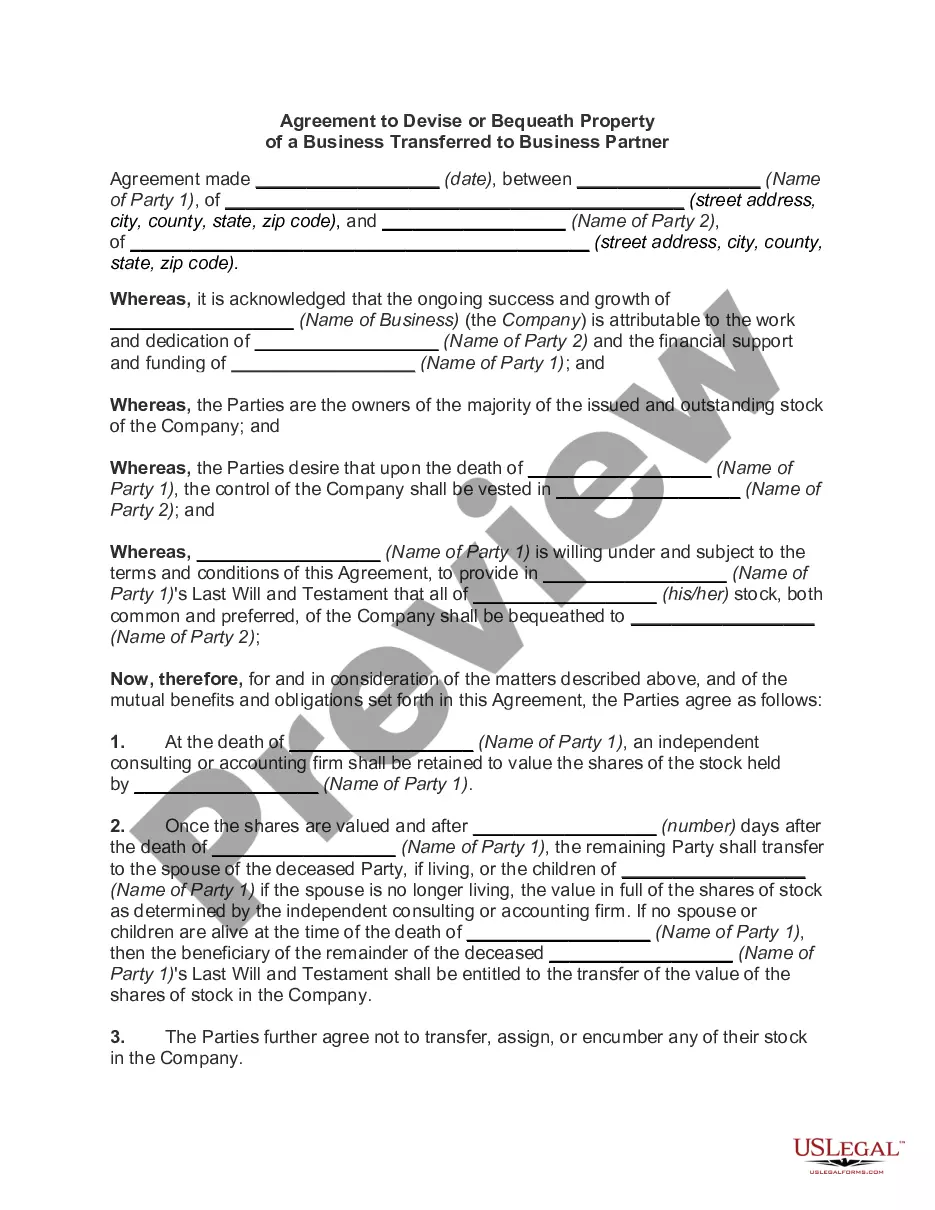
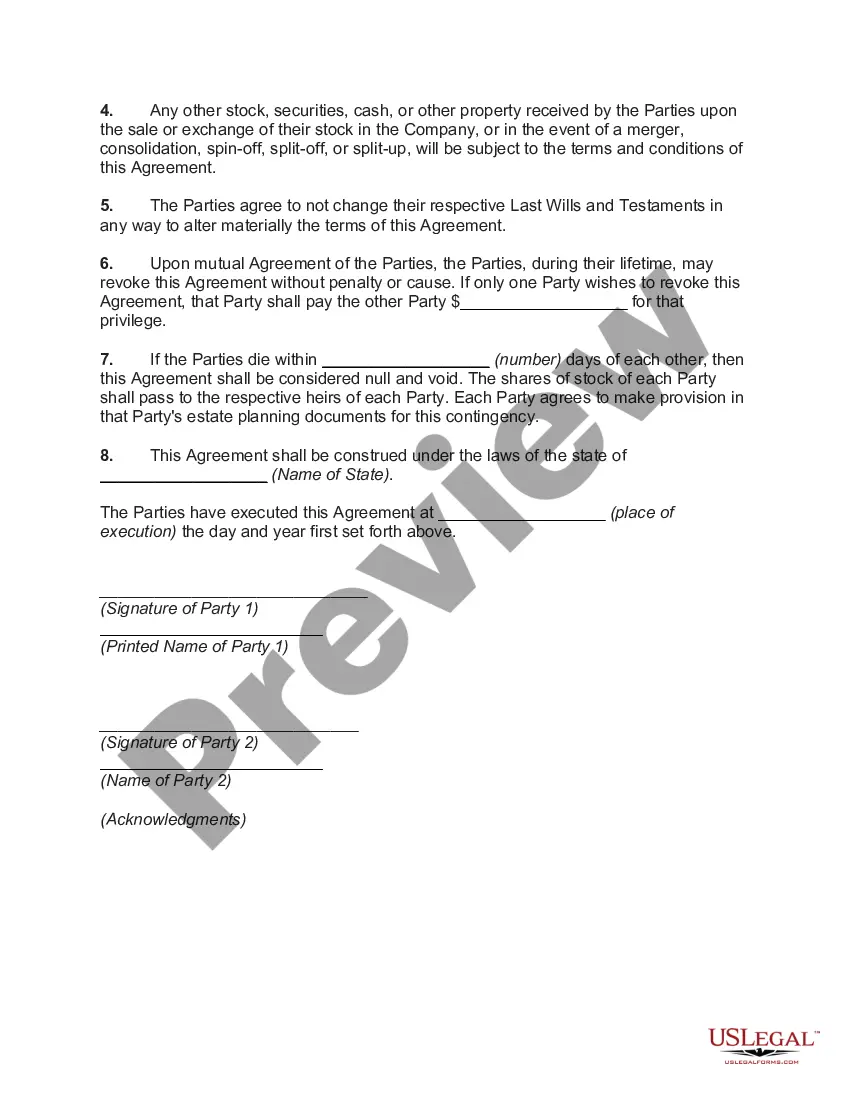
Agreement to Devise or Bequeath Property of a Business Transferred to Business Partner
Understanding this form
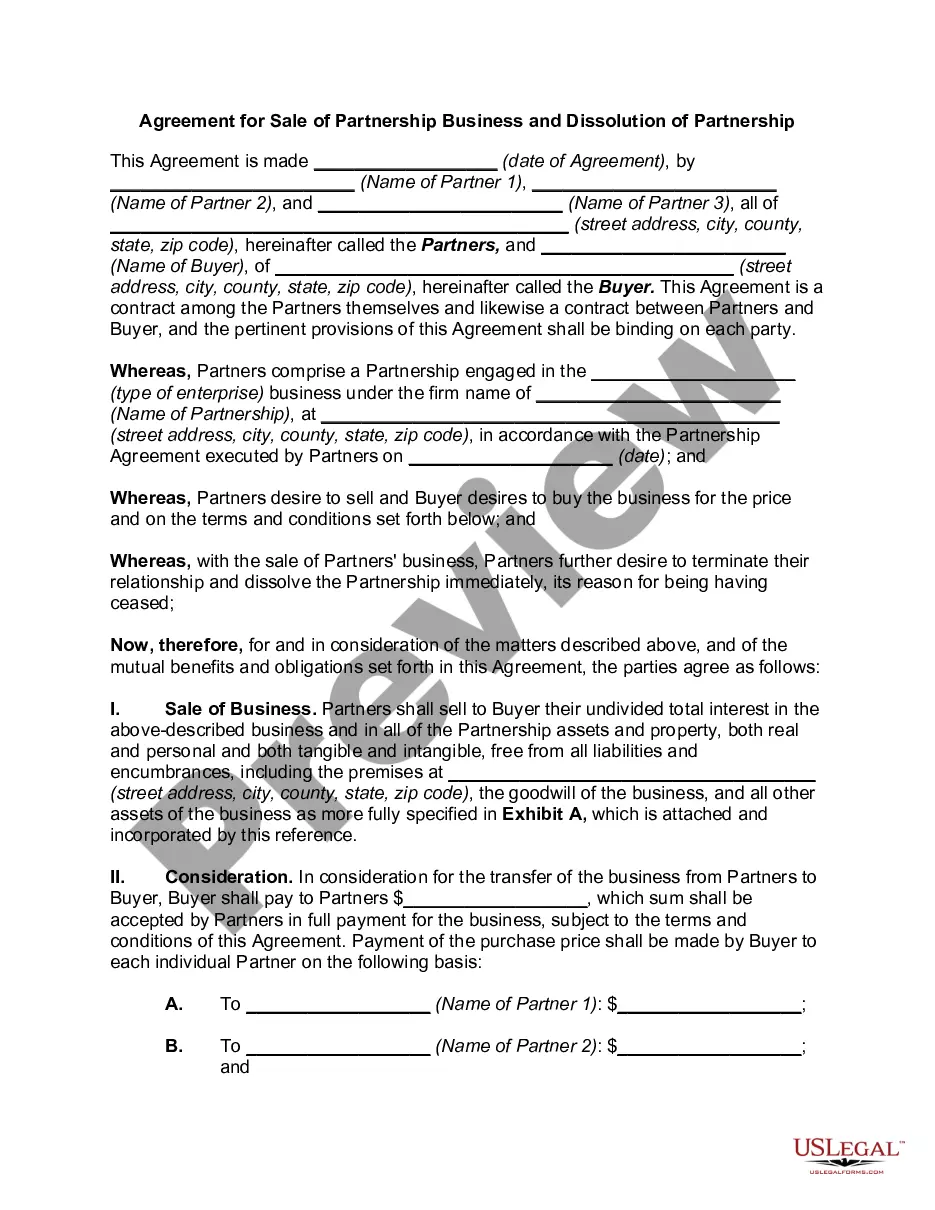
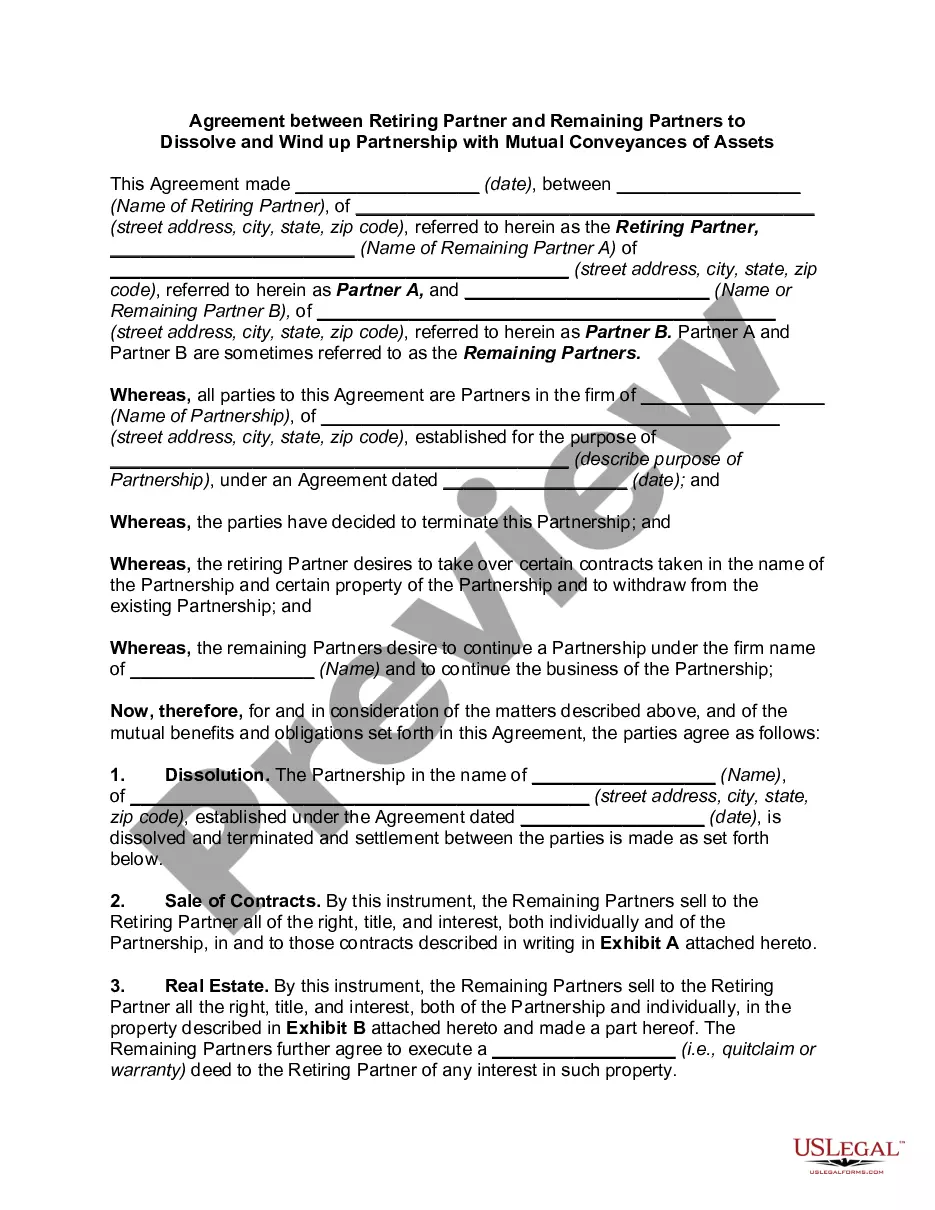
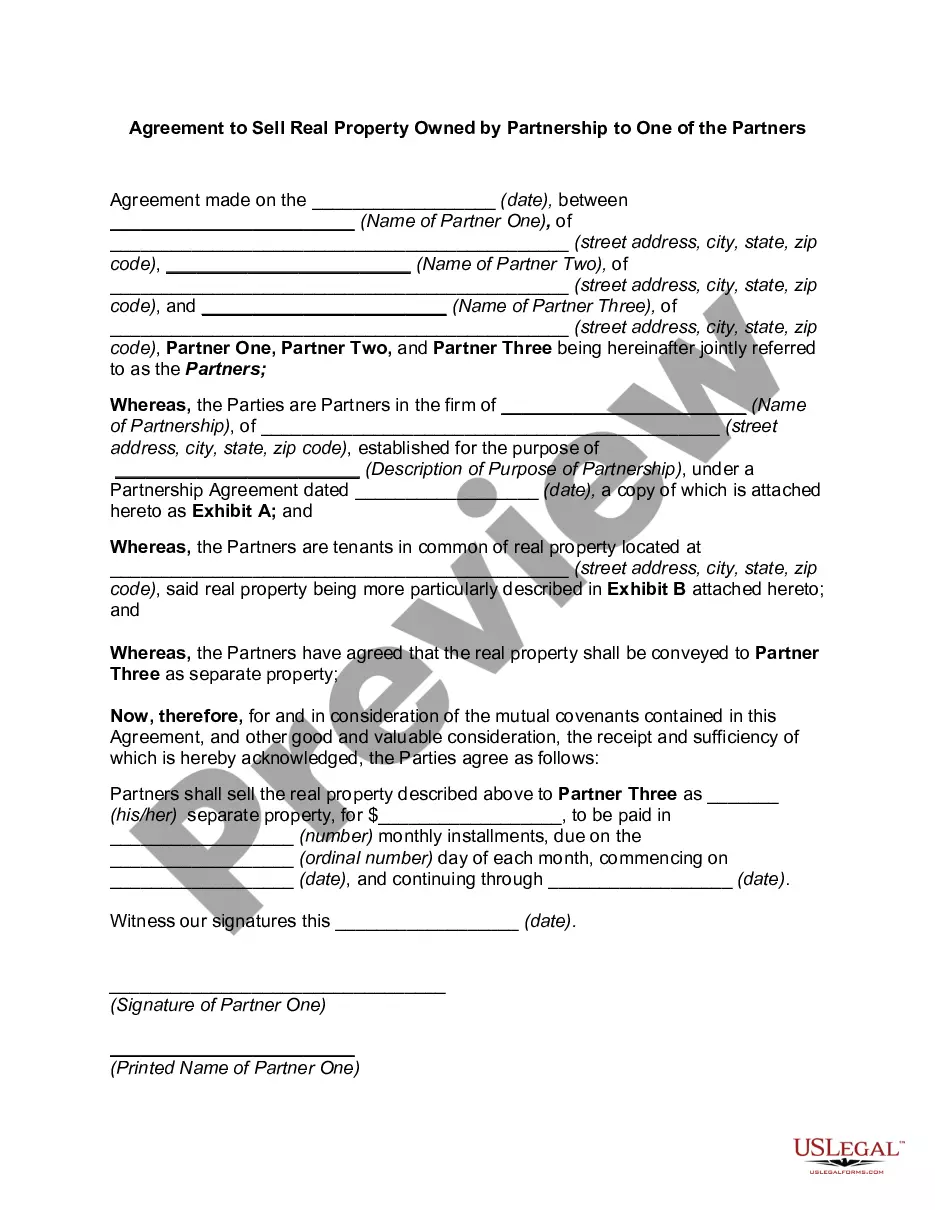
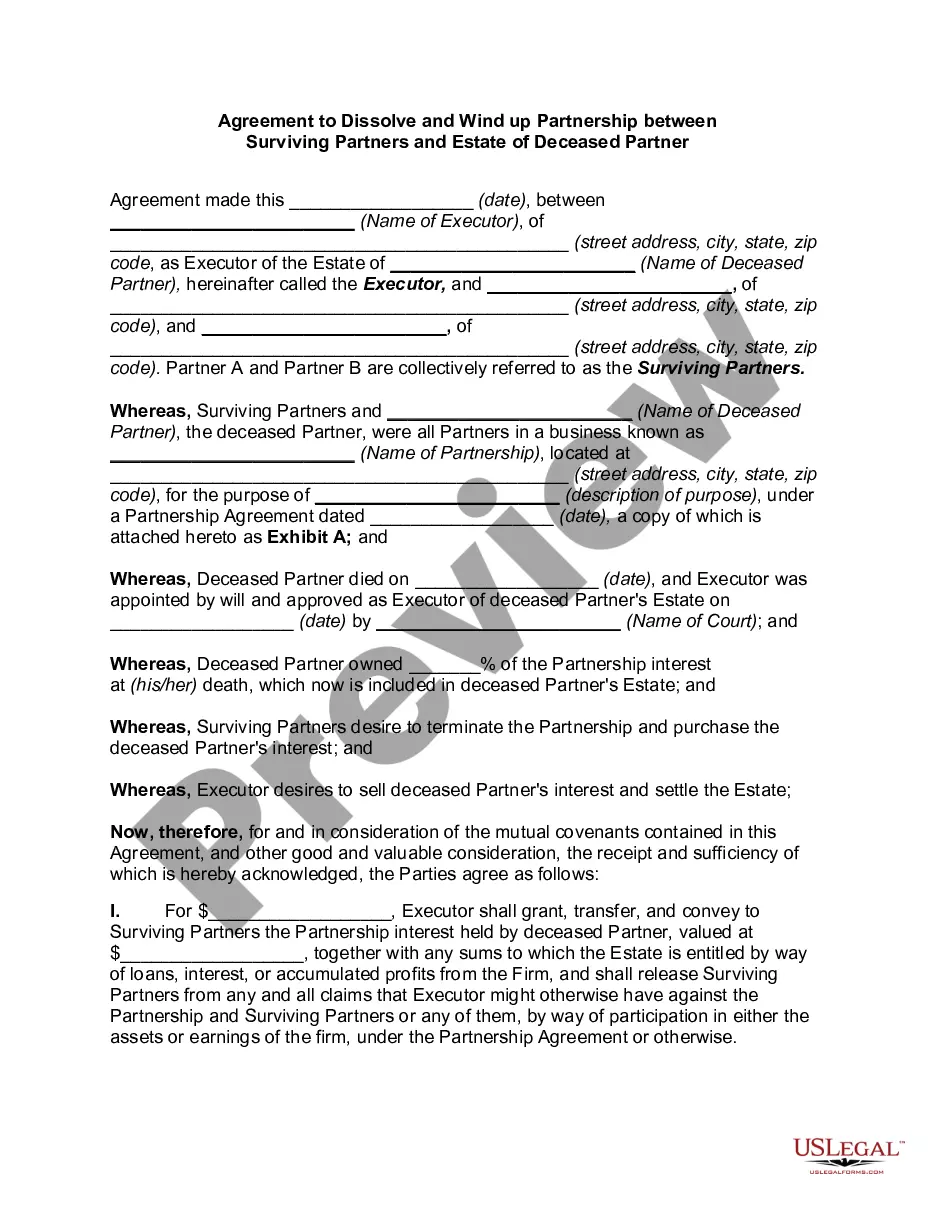
The Agreement to Devise or Bequeath Property of a Business Transferred to Business Partner is a legal document that outlines the distribution of a business's assets upon the death of an owner. This form ensures that control of the business remains with a partner while allowing the deceased owner's beneficiaries to receive the value of their shares. This agreement is particularly useful when family members of the deceased do not wish to take on the business operations, providing a clear legal framework for asset disposition and transition of control.
Main sections of this form
- Date of agreement and identification of the parties involved.
- Clauses detailing the transfer of business control and asset valuation upon death.
- Provisions for beneficiary entitlements and payment terms.
- Restrictions on stock transfers and amendments to wills.
- Conditions for revoking the agreement and handling simultaneous deaths.
When to use this form
This form is needed when business partners want to ensure that upon the death of one partner, the remaining partner retains control of the business while the deceased partner's shares go to designated beneficiaries. It is particularly applicable in situations where family members of the deceased partner are not interested in managing the business, allowing for a smooth transition of both assets and management without complications.
Who this form is for
- Business partners who wish to outline the succession plan for their enterprise.
- Owners of closely-held businesses wanting to protect their intended beneficiaries.
- Individuals who are considering estate planning and require a clear directive for business assets.
- Partners whose family members do not want to manage or inherit the business.
Steps to complete this form
- Identify the date and all parties involved in the agreement.
- Clearly state the business name and the roles of each party.
- Specify the terms regarding asset valuation and transfer of shares upon the death of a partner.
- Complete sections regarding beneficiary details and any conditions for revoking the agreement.
- Ensure all parties sign and date the agreement in the designated areas.
Is notarization required?
This form does not typically require notarization unless specified by local law. It is advisable to check state requirements to ensure compliance with any notarization rules that may apply.
Get your form ready online
Our built-in tools help you complete, sign, share, and store your documents in one place.
Make edits, fill in missing information, and update formatting in US Legal Forms—just like you would in MS Word.
Download a copy, print it, send it by email, or mail it via USPS—whatever works best for your next step.
Sign and collect signatures with our SignNow integration. Send to multiple recipients, set reminders, and more. Go Premium to unlock E-Sign.
If this form requires notarization, complete it online through a secure video call—no need to meet a notary in person or wait for an appointment.
We protect your documents and personal data by following strict security and privacy standards.

Make edits, fill in missing information, and update formatting in US Legal Forms—just like you would in MS Word.

Download a copy, print it, send it by email, or mail it via USPS—whatever works best for your next step.

Sign and collect signatures with our SignNow integration. Send to multiple recipients, set reminders, and more. Go Premium to unlock E-Sign.

If this form requires notarization, complete it online through a secure video call—no need to meet a notary in person or wait for an appointment.

We protect your documents and personal data by following strict security and privacy standards.
Mistakes to watch out for
- Failing to clearly define the terms for asset valuation and distribution.
- Not including provisions for amendments or revocation of the agreement.
- Omitting signatures or signatures from all involved parties.
- Neglecting to discuss the agreement with beneficiaries, leading to misunderstandings.
Benefits of completing this form online
- Convenience of completing the form quickly from any location.
- Easy access to downloadable and editable templates tailored by licensed attorneys.
- Reduction of legal costs associated with drafting custom agreements.
- Ability to store and retrieve documents securely online.
Legal use & context
- This agreement is enforceable under state law, provided it meets local legal standards.
- The terms should be clear and mutually agreed upon to avoid disputes later.
What to keep in mind
- The Agreement to Devise or Bequeath Property is essential for business partners planning for future contingencies.
- This legal form helps maintain business continuity and clarifies ownership transfer after death.
- Using this form can prevent misunderstandings and disputes among heirs and partners.
Looking for another form?
Form popularity
FAQ
To dispose of Personal Property owned by a decedent at the time of death as a gift under the provisions of the decedent's will. The term bequeath applies only to personal property. A testator, to give real property to someone in a testamentary provision, devises it.
You can bequeath property, or transfer it upon death, by writing a will. In the will, you'll name the beneficiary for your property, which is the person who will receive it when you die. Drafting a will is easy, and you can do it yourself.
Bank accounts. Brokerage or investment accounts. Retirement accounts and pension plans. A life insurance policy.
To devise is to dispose of real property by will. A bequest is a gift by will of property other than land. To bequeath is to dispose by will of property other than land.
A legal way to get business funds to your beneficiary quickly is to deposit them in a payable-on-death account. Being a sole proprietor doesn't affect the POD option, as the money is still your personal cash. Fill out a form at your bank naming your account beneficiary.
The terms bequest and devise both describe gifting in a Last Will, but their meanings differ slightly. While bequest often describes any type of gift given to a beneficiary after a person passes away, devise only applies when the gift is real property.
In most cases, the surviving owner or heir obtains the title to the home, the former owner's death certificate, a notarized affidavit of death, and a preliminary change of ownership report form. When all these are gathered, the transfer gets recorded, the fees are paid, and the county issues a new title deed.
Create a section of the LLC operating agreement that names the beneficiaries of all LLC members or, if you are the sole LLC owner, a beneficiary to take over all business operations after you pass away. Ask all LLC members to submit the names of their beneficiaries for the official record.
As the recipient of an inherited property, you'll benefit from a step-up tax basis, meaning you'll inherit the home at the fair market value on the date of inheritance, and you'll only be taxed on any gains between the time you inherit the home and when you sell it.