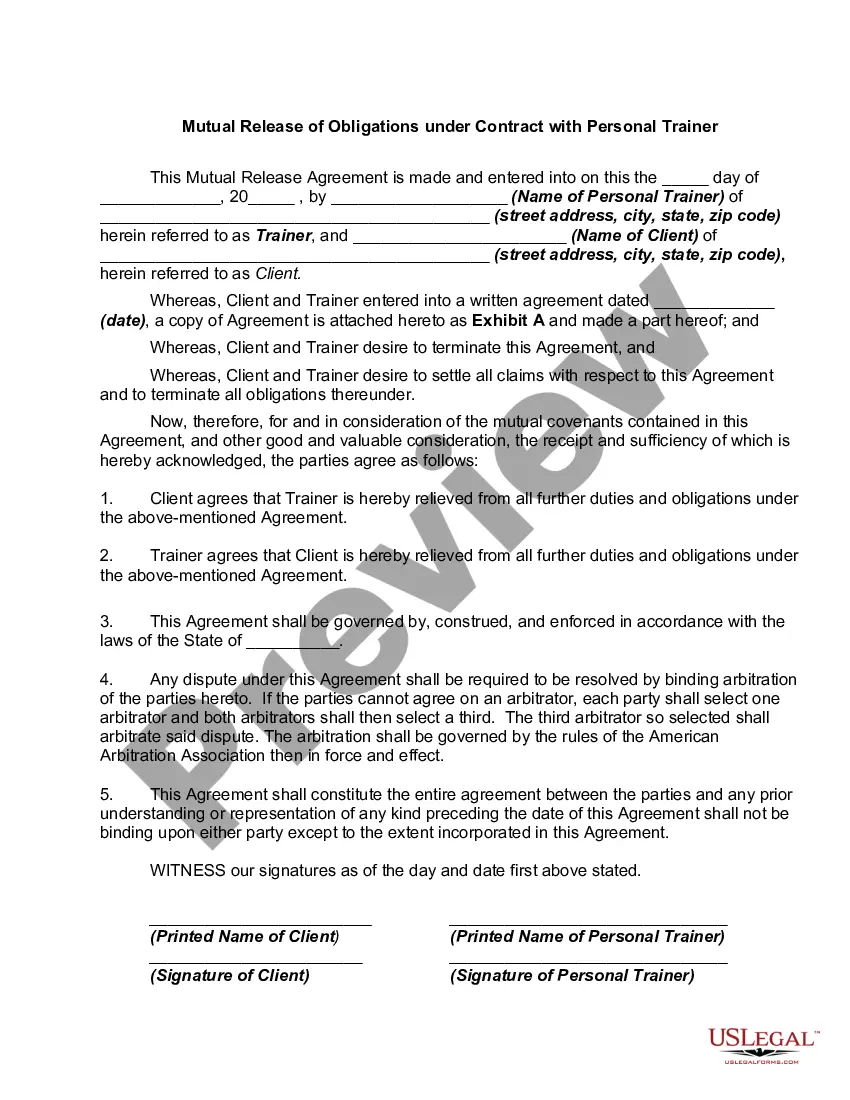
Mutual Release of Obligations under Contract with Personal Trainer
Understanding this form
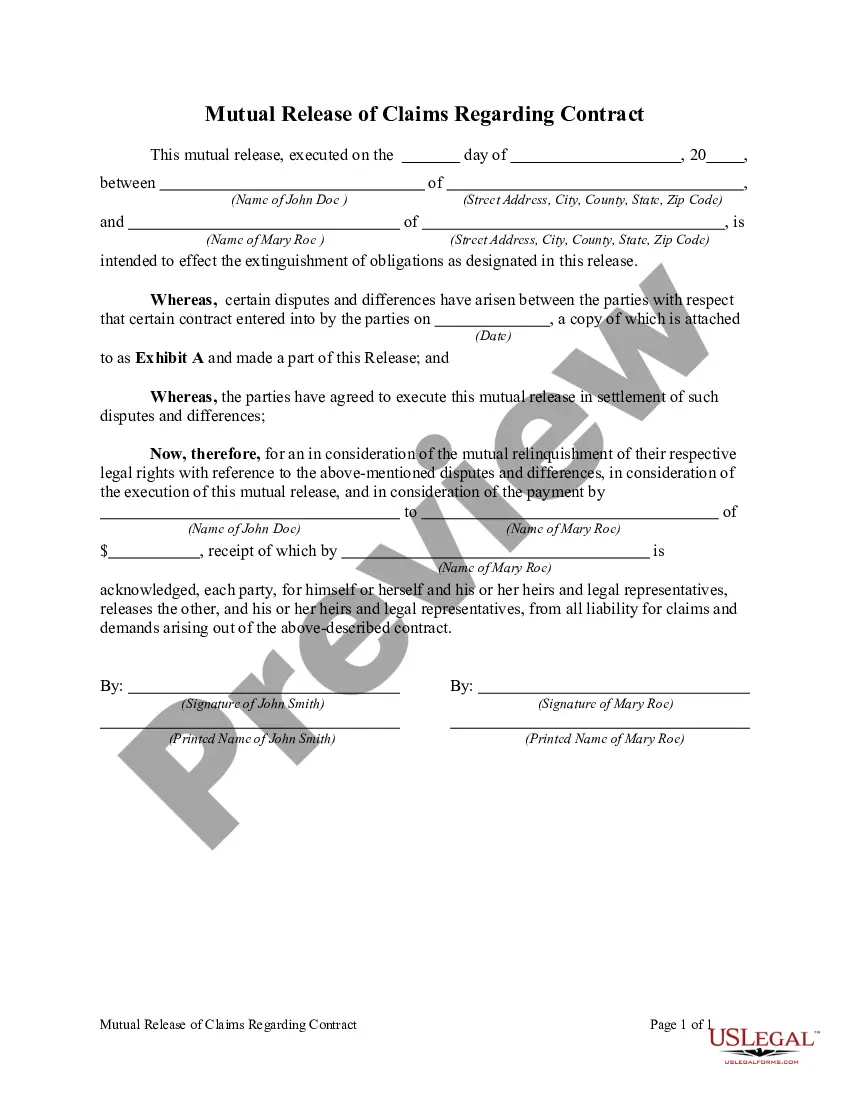
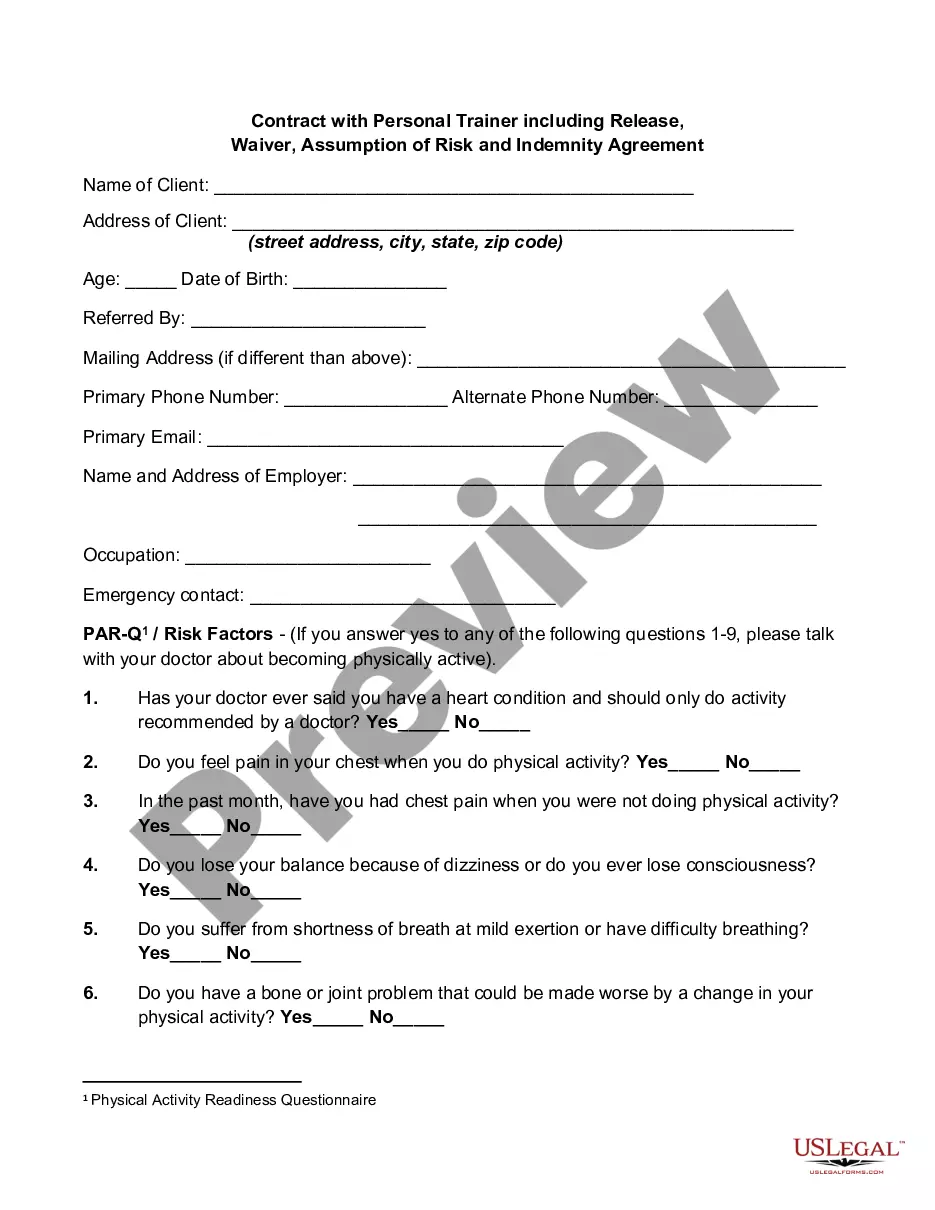
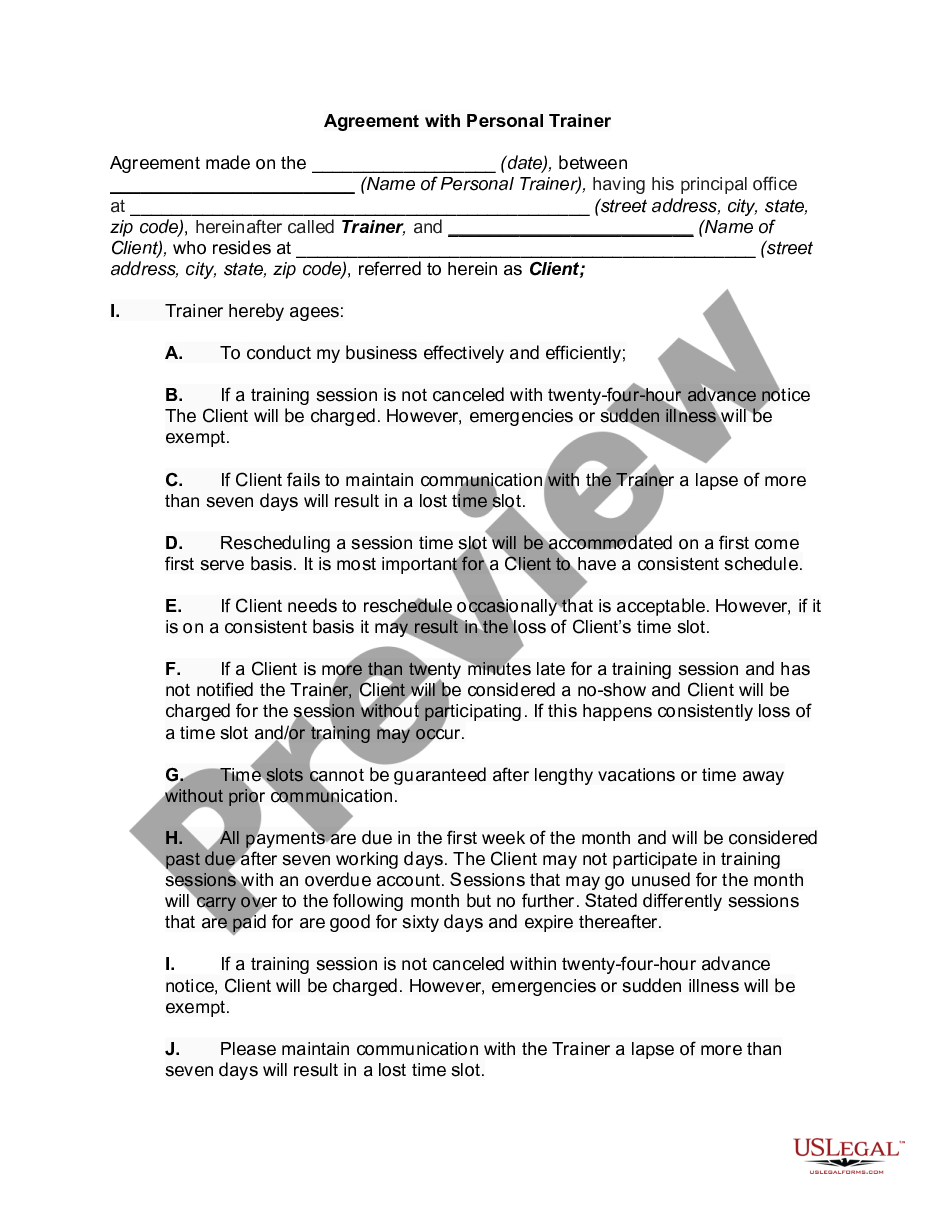
This Mutual Release of Obligations under Contract with Personal Trainer is a legal document that releases both a personal trainer and a client from any past or future obligations under their existing contract. It serves to settle any claims between the parties and is crucial for terminating their professional relationship legally. Unlike similar forms, this release involves no financial compensation, making it a straightforward solution for both parties looking to end their agreement amicably.
Form components explained
- Identifying information for both the Trainer and Client, including names and addresses.
- Date of the original agreement and reference to its attachment as Exhibit A.
- Terms that relieve both parties from any further obligations under the original agreement.
- Governing law clause specifying the applicable state law.
- Arbitration clause outlining how disputes will be resolved.
- Signature lines for both parties to finalize the agreement.
When to use this form
This form should be used when a client and a personal trainer mutually agree to end their professional relationship without any outstanding obligations or payments. Typical scenarios include the completion of a training program, changes in personal circumstances, or if either party wishes to pursue new opportunities. It ensures that both individuals have clarity regarding their rights and obligations moving forward.
Who this form is for
- Clients who want to terminate their contract with a personal trainer.
- Personal trainers needing to legally absolve themselves from obligations to their clients.
- Individuals with prior agreements that they wish to officially dissolve.
Steps to complete this form
- Identify the parties: Fill in the names and addresses of both the Trainer and Client.
- Specify the original agreementâs date and attach it as Exhibit A.
- Enter the date of signing the mutual release.
- Both parties should review the terms carefully before signing.
- Each party signs and prints their name to finalize the agreement.
Notarization requirements for this form
This form does not typically require notarization unless specified by local law. It's essential to check your state's requirements to ensure the release is legally valid in your jurisdiction.
Get your form ready online
Our built-in tools help you complete, sign, share, and store your documents in one place.
Make edits, fill in missing information, and update formatting in US Legal Forms—just like you would in MS Word.
Download a copy, print it, send it by email, or mail it via USPS—whatever works best for your next step.
Sign and collect signatures with our SignNow integration. Send to multiple recipients, set reminders, and more. Go Premium to unlock E-Sign.
If this form requires notarization, complete it online through a secure video call—no need to meet a notary in person or wait for an appointment.
We protect your documents and personal data by following strict security and privacy standards.

Make edits, fill in missing information, and update formatting in US Legal Forms—just like you would in MS Word.

Download a copy, print it, send it by email, or mail it via USPS—whatever works best for your next step.

Sign and collect signatures with our SignNow integration. Send to multiple recipients, set reminders, and more. Go Premium to unlock E-Sign.

If this form requires notarization, complete it online through a secure video call—no need to meet a notary in person or wait for an appointment.

We protect your documents and personal data by following strict security and privacy standards.
Mistakes to watch out for
- Failing to attach the original agreement as Exhibit A.
- Not including the appropriate dates when referencing prior agreements.
- Omitting required signatures from either party.
Why complete this form online
- Convenience: Easily fill out, download, and print from anywhere.
- Editability: Customize the form to fit your specific needs before finalizing.
- Reliability: Access forms drafted by licensed attorneys, ensuring legal compliance.
Legal use & context
- This release effectively terminates the contractual relationship and limits future claims.
- Proper completion safeguards both parties from potential future disputes.
- Ensures mutual understanding and agreement on the termination terms.
What to keep in mind
- This form is essential for both personal trainers and clients to formally end their engagement.
- Review the document carefully to ensure all information is correct before signing.
- Keep a copy of the signed agreement for your records.
Looking for another form?




Form popularity
FAQ
A personal fitness trainer falls under the business code of NAICS 812990. The code does not strictly refer to health and fitness professions. Rather, the code refers to all personal services. In addition to personal trainers, house sitters, wedding planners, and the like would use this category.
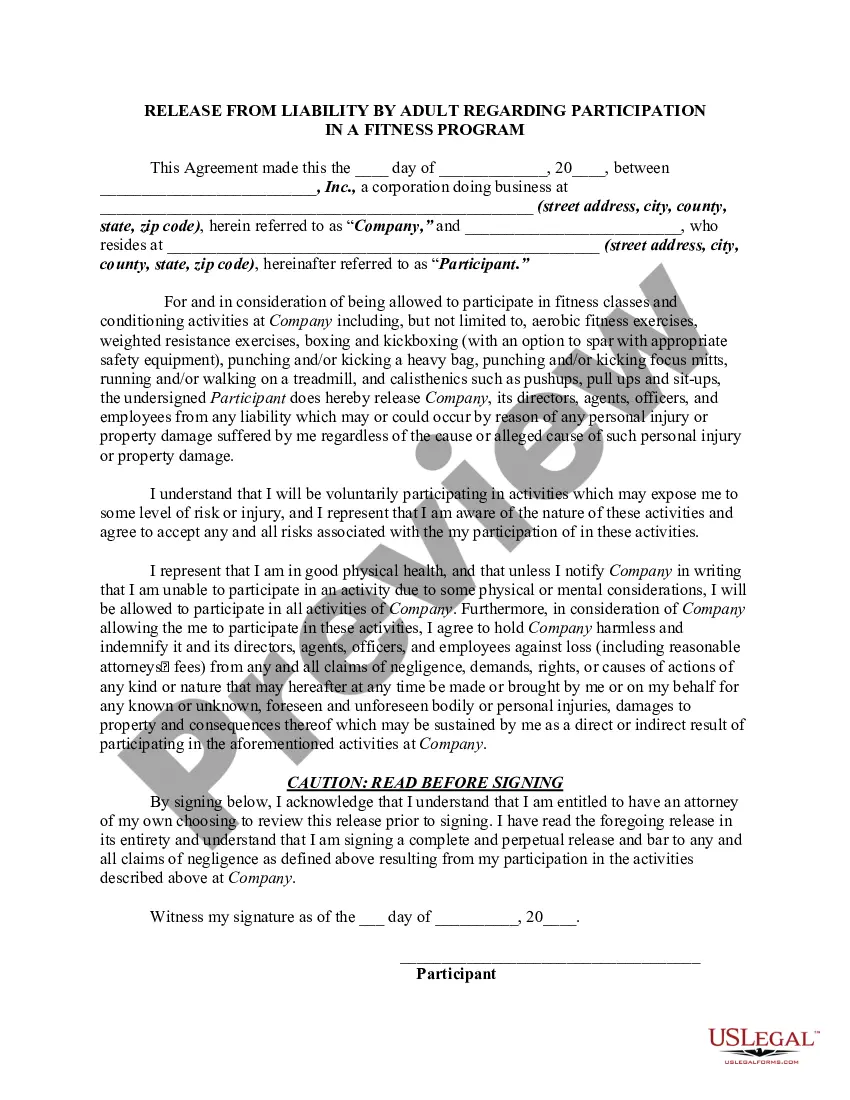
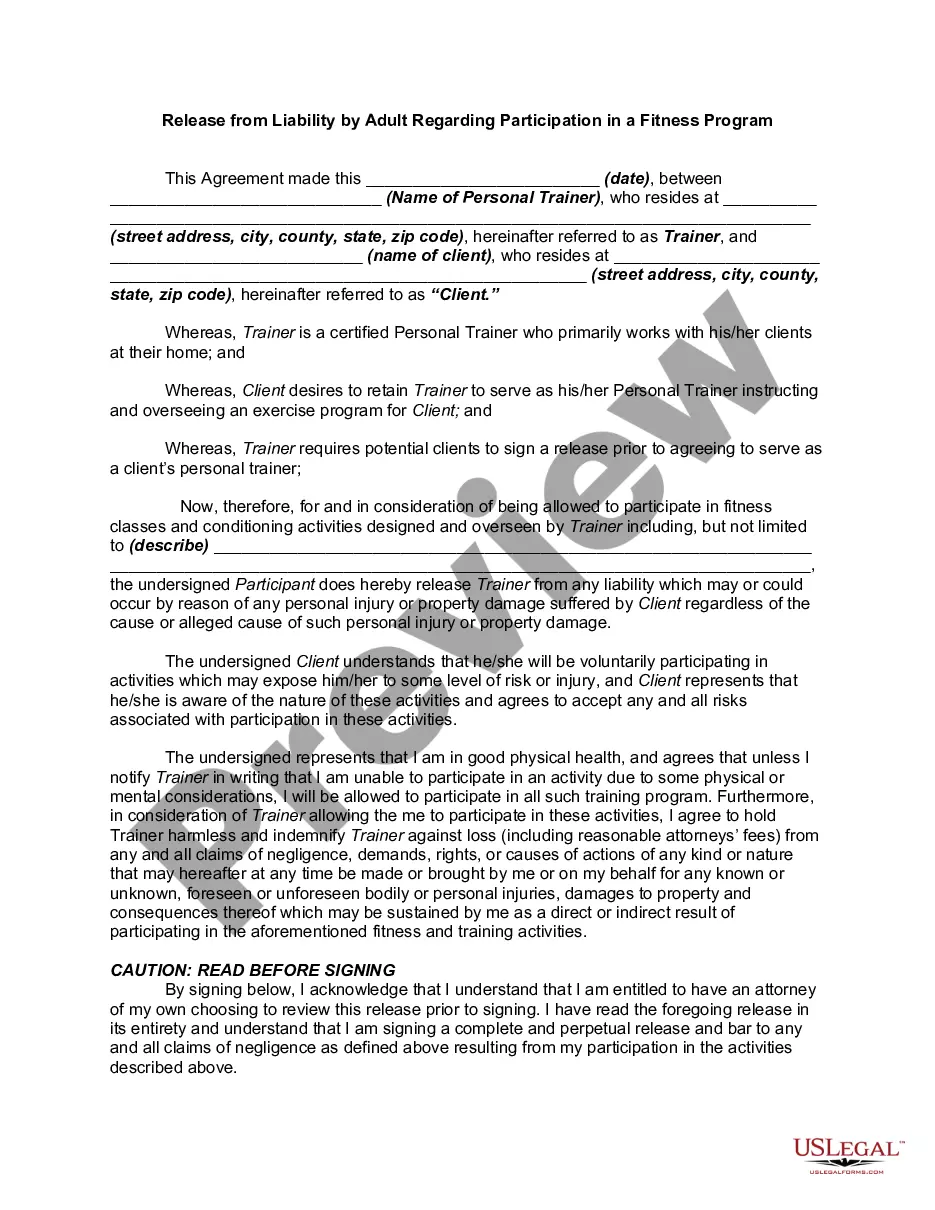
A personal training waiver form or release form means that your client gives up the option of suing you if they get injured during training. It's also called a personal training liability form, because the client agrees not to hold you liable, meaning legally responsible, for accidental injuries.
A typical rate is around $60 to $70 for a one-hour training session. But outliers can make anywhere from $40 to $400 and beyond. Some may even offer weeks- or months-long packages for four or five figures. Finding the right rate for you starts with the annual take-home you want.
A waiver is a legal agreement the primary purpose of which is to let you or another party modify or relinquish a right, privilege, or claim. The agreement can be a separate document on its own, such as if you sign a waiver form, or added to a contract as a waiver clause.
CIMSPA is also responsible for setting the standards for professionals to become chartered in the fitness industry. As the governing body, it determines what personal trainers and other fitness professionals need to do to achieve chartered status.
As a business owner, you can claim a lot of deductions. As a personal training client, you can write off your training sessions if they are deemed a medical necessity.
Being a self-employed personal trainer Being self-employed means that the reins are off and you are free to forge your own path.Tax If you want to be considered as self-employed then you must register with HM Revenue and Customs (HMRC).
As a personal trainer, you can work as an employee, a 1099 independent contractor or be self-employed. You can work as all three if you work in multiple settings. An independent contractor is sort of the middle between an employee and being self-employed.