Investment Letter regarding Intrastate Offering
What is this form?
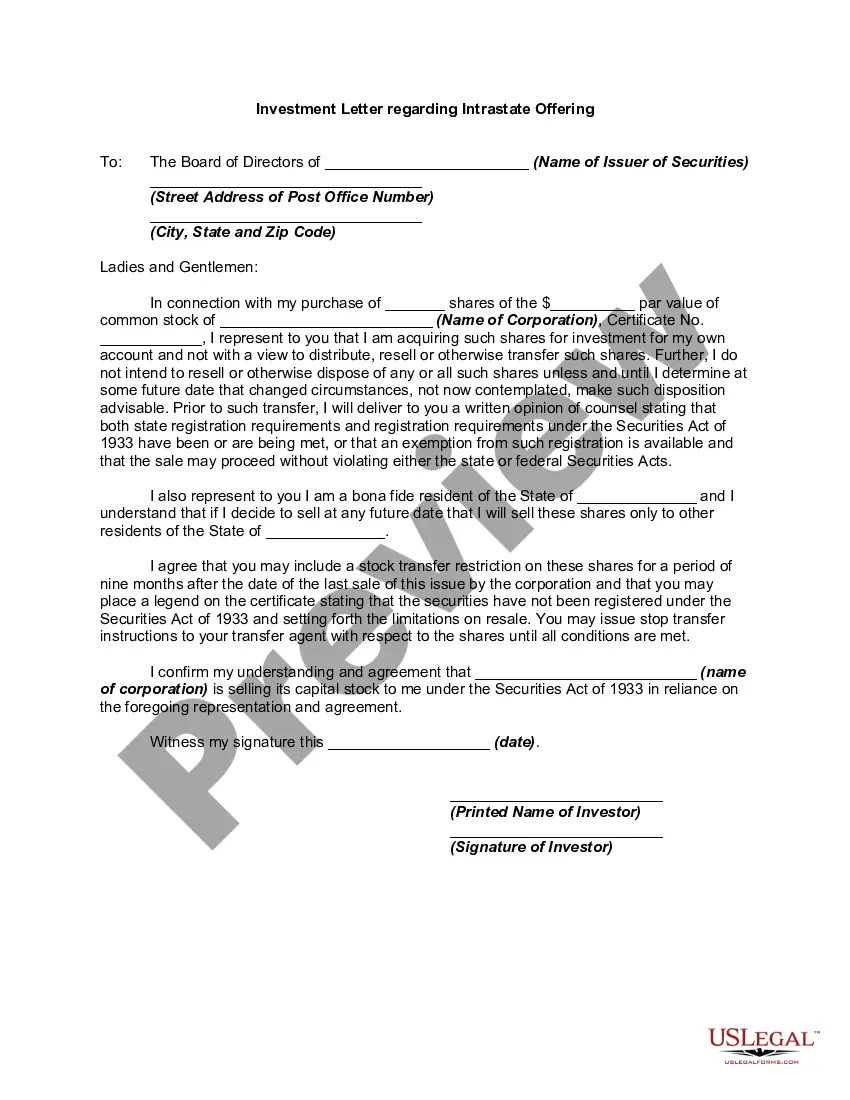
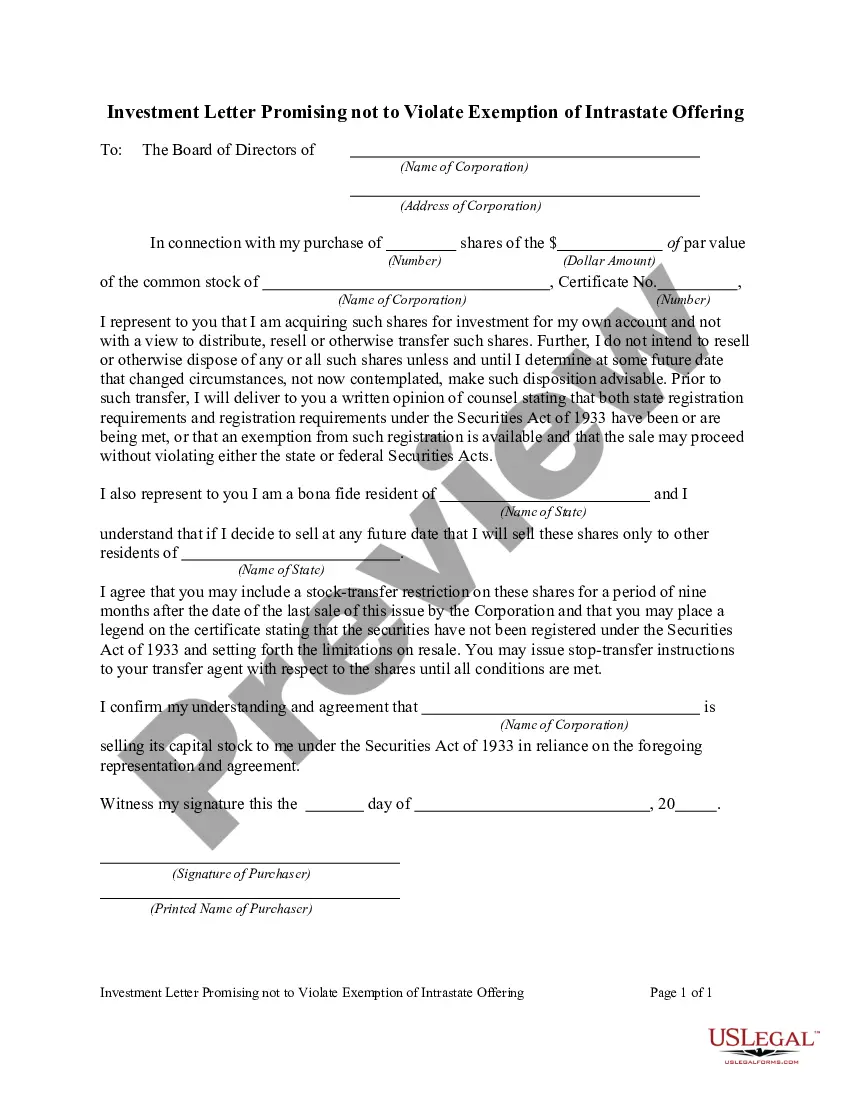
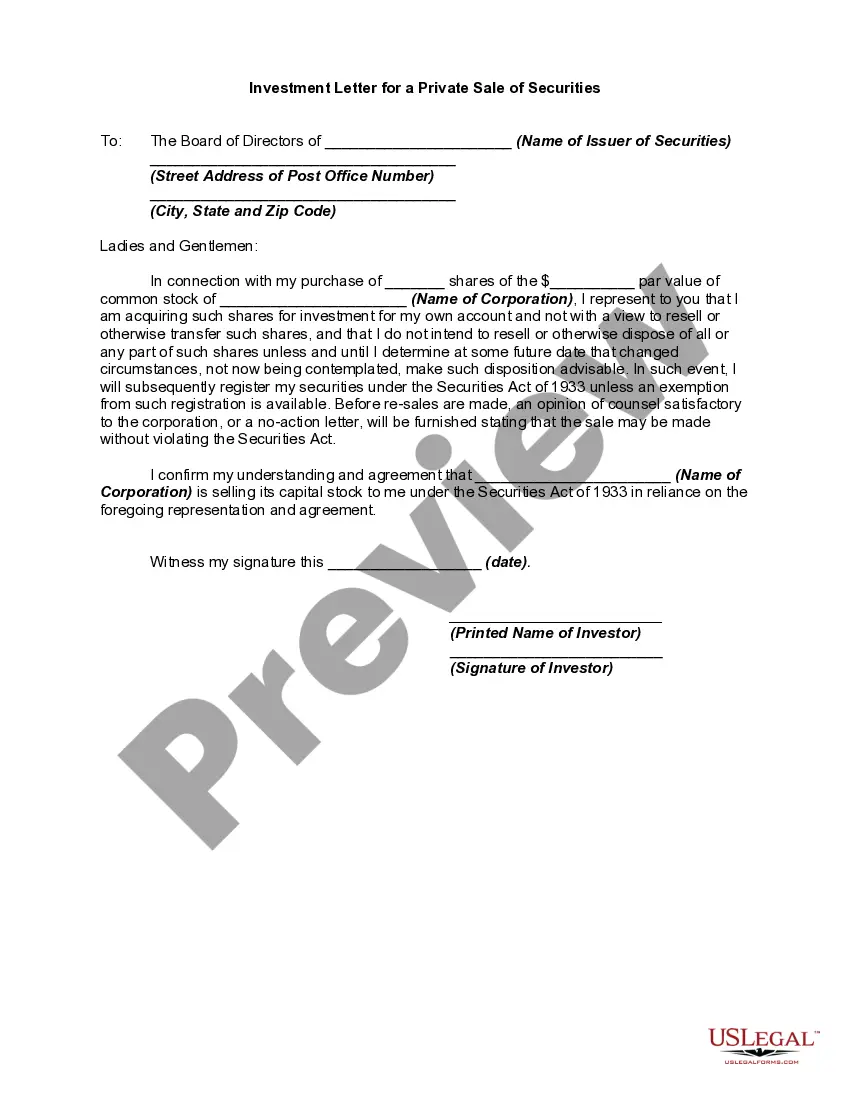
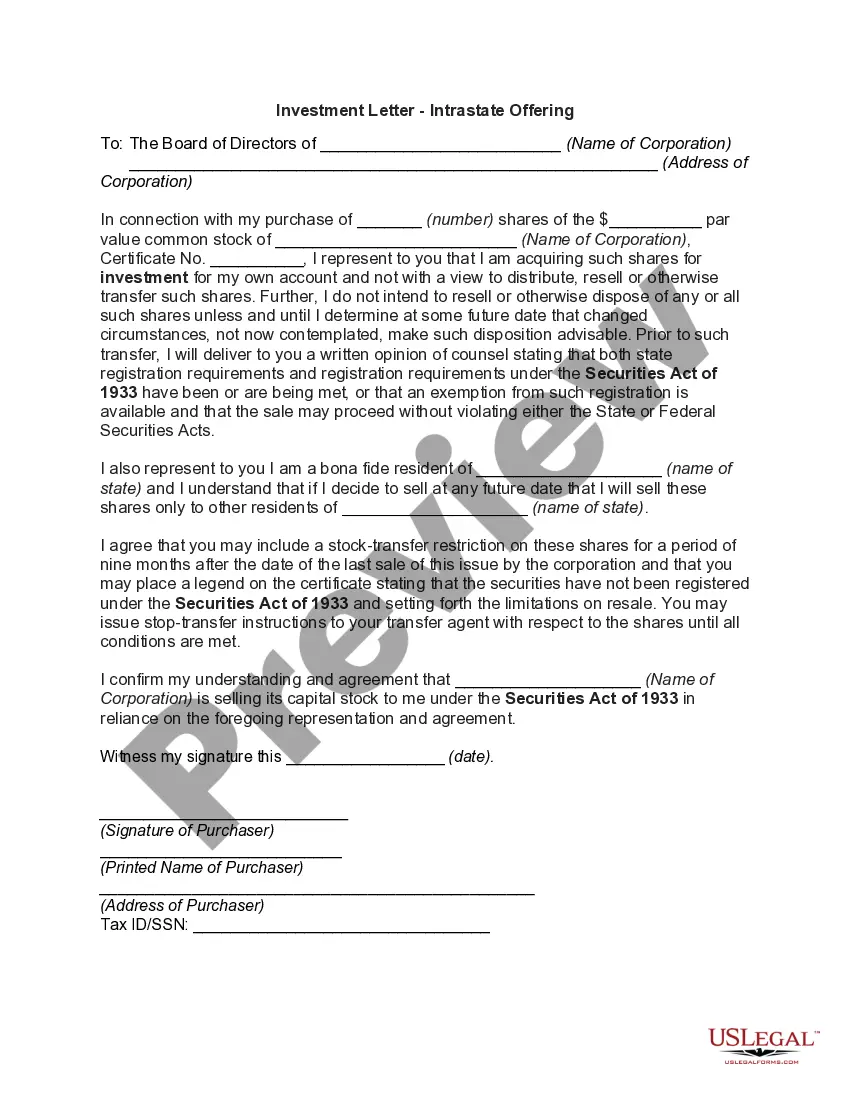
The Investment Letter regarding Intrastate Offering is a legal document used in the context of exempt stock transactions, specifically intrastate offerings. This form facilitates the purchase of shares in a corporation by confirming that the buyer is acquiring the shares solely for investment purposes, without the intention of resale. It is distinct from other securities forms as it emphasizes compliance with state-specific regulations and aims to protect both the investor and the issuer within the same jurisdiction.
Form components explained
- Statement of the number of shares being purchased.
- Confirmation that the investor is acquiring shares for personal investment, not for distribution.
- Representation of the investor's residency in the state of issuance.
- Acknowledgment of sales restrictions and the potential for stock transfer restrictions.
- Agreement to provide legal counsel's opinion on compliance with state and federal regulations.
- Investor's signature and printed name along with the date of the agreement.
When to use this form
This form should be used when an individual is purchasing shares in a close corporation that is conducting an intrastate offering. It is applicable when both the investor and the corporation issuing the shares are based in the same state. This form helps ensure compliance with regulatory requirements and protects the parties involved during the transaction.
Intended users of this form
- Individuals seeking to invest in a close corporation through an intrastate offering.
- Corporations conducting stock offerings exclusively to state residents.
- Investors unfamiliar with the legal requirements for securities transactions.
Completing this form step by step
- Identify the name of the issuer of the securities and provide its address.
- Enter the number of shares being purchased and their par value.
- Confirm your status as a bona fide resident of the state indicated.
- Sign and print your name, along with the date of signature.
- Ensure you understand the implications of stock transfer restrictions that may apply for a set duration.
Is notarization required?
This form does not typically require notarization to be legally valid. However, some jurisdictions or document types may still require it. US Legal Forms provides secure online notarization powered by Notarize, available 24/7 for added convenience.
Get your form ready online
Our built-in tools help you complete, sign, share, and store your documents in one place.
Make edits, fill in missing information, and update formatting in US Legal Forms—just like you would in MS Word.
Download a copy, print it, send it by email, or mail it via USPS—whatever works best for your next step.
Sign and collect signatures with our SignNow integration. Send to multiple recipients, set reminders, and more. Go Premium to unlock E-Sign.
If this form requires notarization, complete it online through a secure video call—no need to meet a notary in person or wait for an appointment.
We protect your documents and personal data by following strict security and privacy standards.

Make edits, fill in missing information, and update formatting in US Legal Forms—just like you would in MS Word.

Download a copy, print it, send it by email, or mail it via USPS—whatever works best for your next step.

Sign and collect signatures with our SignNow integration. Send to multiple recipients, set reminders, and more. Go Premium to unlock E-Sign.

If this form requires notarization, complete it online through a secure video call—no need to meet a notary in person or wait for an appointment.

We protect your documents and personal data by following strict security and privacy standards.
Common mistakes to avoid
- Failing to accurately state the number of shares being purchased.
- Omitting to confirm residency, which is crucial for compliance.
- Not including the necessary legal counsel opinion if required.
- Overlooking signature or date, which invalidates the form.
Why complete this form online
- Convenient access to essential legal documents for immediate use.
- Editable templates that allow personalization without legal expertise.
- Reliable resources drafted by licensed attorneys, ensuring legality and compliance.
Legal use & context
- This form is used in transactions involving state-resident investors purchasing stock within the same state.
- It helps establish the legitimacy of the transaction by confirming the investor's intention and residency.
- Compliance with both state and federal laws is critical to avoid penalties or invalidation of the transaction.
What to keep in mind
- The Investment Letter is vital for intrastate stock offerings.
- Both issuer and investor must reside in the same state.
- Accurate completion ensures legal compliance and protection for all parties involved.
Looking for another form?










Form popularity
FAQ
Regulation D (Reg D) is a Securities and Exchange Commission (SEC) regulation governing private placement exemptions.The regulation allows capital to be raised through the sale of equity or debt securities without the need to register those securities with the SEC.
Regulation D (Reg D) is a Securities and Exchange Commission (SEC) regulation governing private placement exemptions.The regulation allows capital to be raised through the sale of equity or debt securities without the need to register those securities with the SEC.
In the U.S, the definition of an accredited investor is put forth by SEC in Rule 501 of Regulation D. To be an accredited investor, a person must have an annual income exceeding $200,000 ($300,000 for joint income) for the last two years with the expectation of earning the same or a higher income in the current year.
In the United States, an intrastate offering is a securities offering that can only be purchased in the state in which it is being issued. Because the offering only includes one state, it does not fall under the jurisdiction of the Securities and Exchange Commission (SEC).
(a) Regulation D relates to transactions exempted from the registration requirements of section 5 of the Securities Act of 1933 (the Act) (15 U.S.C. 77a et seq., as amended). Such transactions are not exempt from the antifraud, civil liability, or other provisions of the federal securities laws.
You must file Form D within 15 days of beginning to sell securities. Qualifying for an exemption under Regulation D isn't enough if you don't file on time. Your first sale only occurs when an investor is completely under contract to provide funding.
The legal citation is 17 C.F.R. §230.501 et seq. On July 10, 2013, the SEC issued new final regulations allowing public advertising and solicitation of Regulation D offers to accredited investors.
Regulation S often referred to as 'Reg S', are bonds or stocks that may not be offered,sold or delivered within the U.S.. Additionally, they may not be on behalf or for the account or benefit of U.S. citizens, unless pursuant to an exemption from, or in a transaction not subject to the registration requirements of
Rule 147 is a safe harbor that exists under Section 3(a)(11) of the Securities Act of 1933, and can be used by companies to raise funds without federal registration. More specifically, it provides an exemption for a securities offering that takes place entirely within one state.