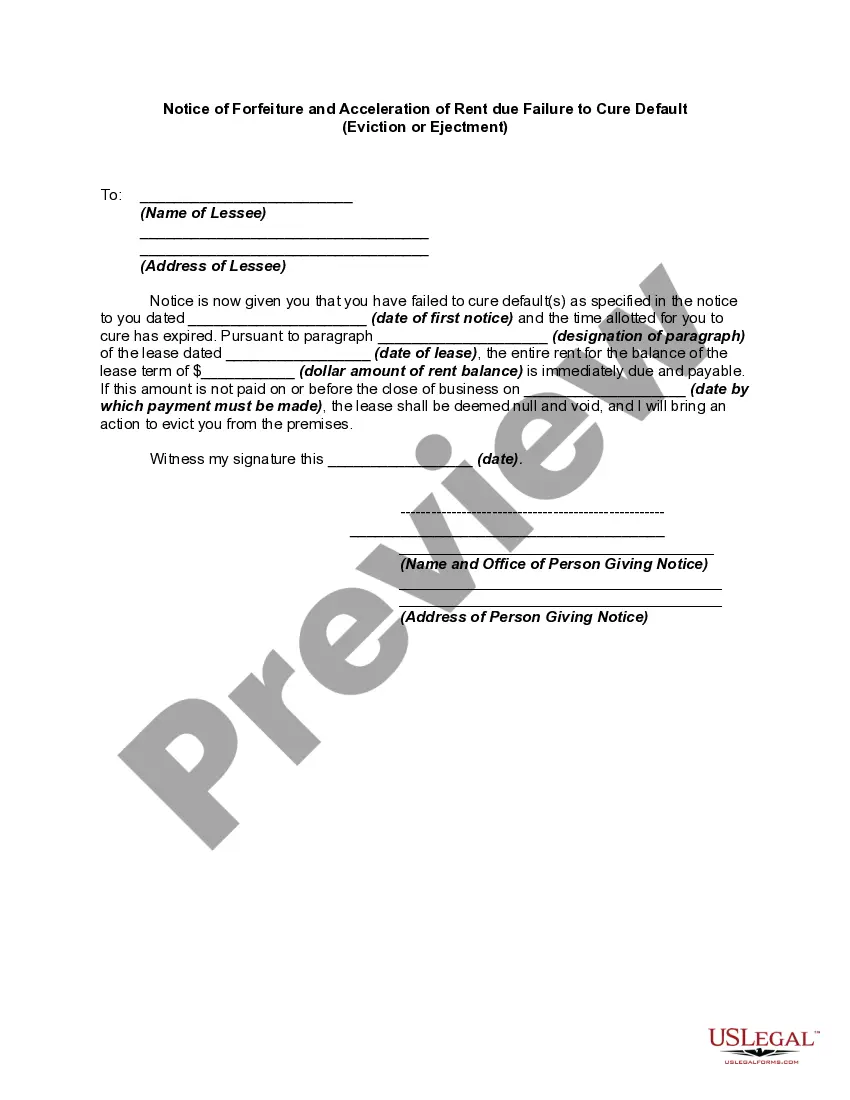
Notice of Forfeiture and Acceleration of Rent due Failure to Cure Default - Eviction or Ejectment
What is this form?
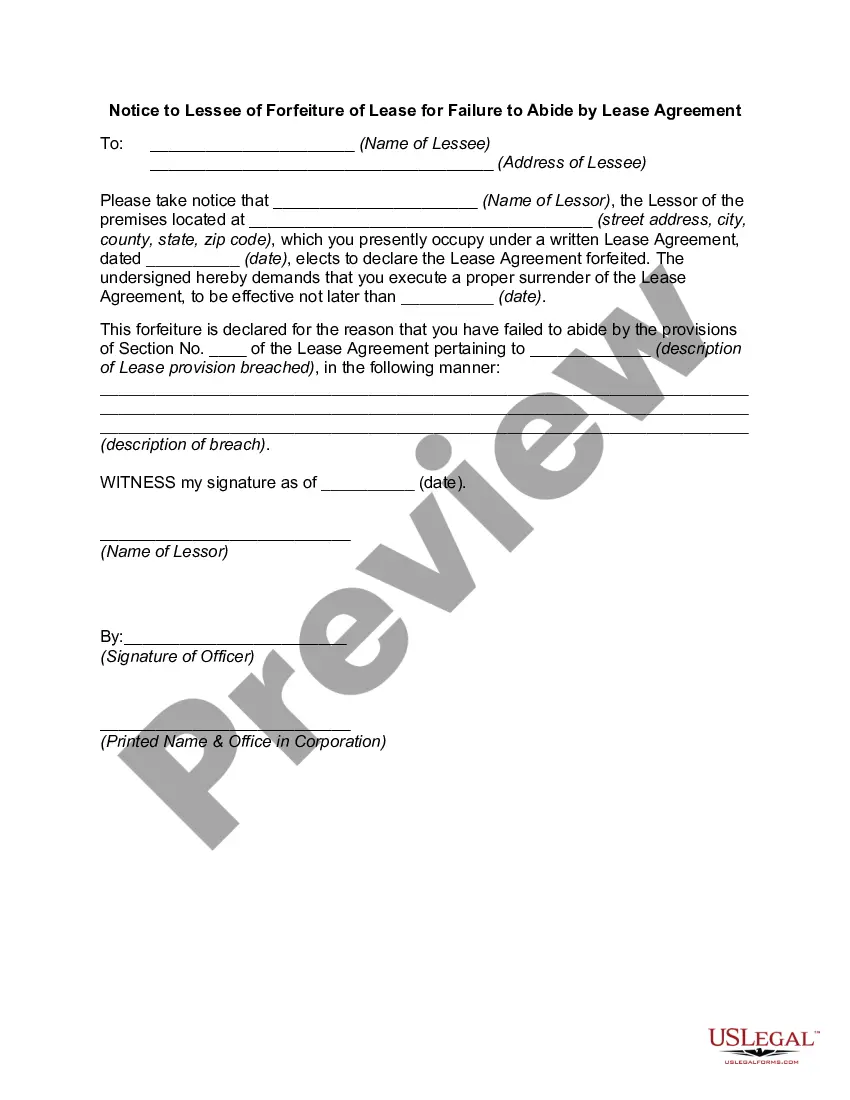
The Notice of Forfeiture and Acceleration of Rent due Failure to Cure Default is a legal document used by landlords to formally notify tenants that they have failed to resolve a default as specified in previous communications. This form serves as a crucial step in the eviction process, signifying that rent is due immediately and that failure to pay could result in eviction. Unlike other eviction notices, this specific notice emphasizes the immediate payment of rent as a condition to prevent further legal action.
Main sections of this form
- Name and address of the tenant (lessee)
- Date of the first notice regarding default
- Designation of the lease paragraph related to the default
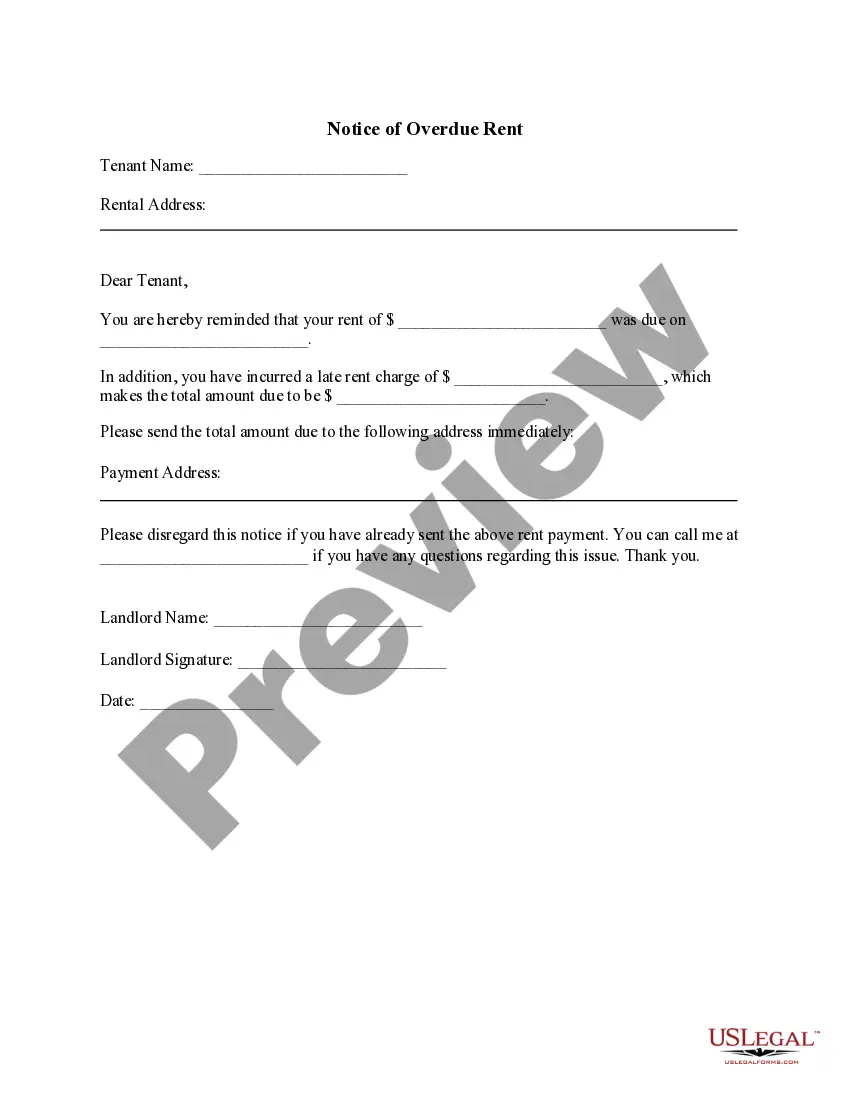
- Total amount of rent balance due
- Date by which payment must be made
- Signature of the person giving the notice and their contact information
When this form is needed
This form should be used when a tenant has failed to remedy a default as previously notified and the landlord is seeking to enforce the terms of the lease. It is essential to utilize this form to officially demand that the tenant pay the outstanding rent. This notice is a required step before proceeding with eviction to ensure compliance with legal protocols and to maintain a lawful eviction process.
Who can use this document
- Landlords or property managers seeking to recover rent from tenants
- Property owners looking to initiate eviction proceedings
- Legal representatives acting on behalf of landlords
Completing this form step by step
- Identify the tenant's name and address at the top of the form.
- Enter the date of the first notice regarding the tenant's default.
- Specify the relevant paragraph of the lease that outlines the default.
- Indicate the total outstanding rent balance that is due.
- Set the deadline for rent payment, clearly stating the date.
- Provide your signature, name, and contact information to validate the notice.
Is notarization required?
This form does not typically require notarization unless specified by local law. However, it is important to verify local regulations to ensure compliance with any additional requirements.
Get your form ready online
Our built-in tools help you complete, sign, share, and store your documents in one place.
Make edits, fill in missing information, and update formatting in US Legal Forms—just like you would in MS Word.
Download a copy, print it, send it by email, or mail it via USPS—whatever works best for your next step.
Sign and collect signatures with our SignNow integration. Send to multiple recipients, set reminders, and more. Go Premium to unlock E-Sign.
If this form requires notarization, complete it online through a secure video call—no need to meet a notary in person or wait for an appointment.
We protect your documents and personal data by following strict security and privacy standards.

Make edits, fill in missing information, and update formatting in US Legal Forms—just like you would in MS Word.

Download a copy, print it, send it by email, or mail it via USPS—whatever works best for your next step.

Sign and collect signatures with our SignNow integration. Send to multiple recipients, set reminders, and more. Go Premium to unlock E-Sign.

If this form requires notarization, complete it online through a secure video call—no need to meet a notary in person or wait for an appointment.

We protect your documents and personal data by following strict security and privacy standards.
Common mistakes to avoid
- Failing to include the correct name and address of the tenant.
- Not referencing the specific lease paragraph related to the default.
- Setting an unreasonable deadline for payment without adhering to local laws.
- Not signing the notice or providing accurate contact information.
Benefits of completing this form online
- Convenient access to legal templates drafted by licensed attorneys.
- Edit the form to tailor it to specific circumstances before downloading.
- Immediate availability, ensuring timely action in rent recovery and eviction processes.
Legal use & context
- The form establishes a legal basis for eviction proceedings.
- It lays out the obligations of the tenant under the lease agreement.
- Failure to use this form correctly may delay legal actions or invalidate the notice.
Summary of main points
- The form is essential for landlords to formally communicate a lease default and seek immediate payment of rent.
- It sets the stage for potential eviction if the tenant does not comply.
- Complete the form carefully to prevent common mistakes that could delay legal proceedings.
Looking for another form?
Form popularity
FAQ
1 : the act or an instance of ejecting : dispossession. 2 : an action for the recovery of possession of real property and damages and costs.
Definition from Nolo's Plain-English Law Dictionary A lawsuit brought to remove a party who is occupying real property. This is not the same as an unlawful detainer (eviction) suit, because it is against someone who has wrongfully tried to claim title to the property, not a tenant who only has a right of possession.
Writ of ejectment is the name of a process issued by a party claiming land or other real estate, against one who is alleged to be unlawfully in possession of it.Ejectment is a legal action by which a person wrongfully ejected from property seeks to recover possession, damages, and costs.
Most small claims actions in North Carolina are for summary ejectment: an action by a landlord asking the court to terminate the lease of a breaching tenant and award possession to the landlord.The magistrate's role in summary ejectment ends when the magistrate makes a decision (enters judgment).
Writ of ejectment is the name of a process issued by a party claiming land or other real estate, against one who is alleged to be unlawfully in possession of it.Ejectment is a legal action by which a person wrongfully ejected from property seeks to recover possession, damages, and costs.
Ejectment in American English 1. an ejecting or ousting; eviction. 2. Law. an action to secure or recover possession of real property by the true owner.
Ejectment is a common law term for civil action to recover the possession of or title to land. It replaced the old real actions and the various possessory assizes (denoting county-based pleas to local sittings of the courts) where boundary disputes often featured.
Eviction is the legal method of removing a tenant. A tenant is someone who is paying rent and/or who has a lease. Ejectment is the legal method of removing someone who is not a tenant, in other words, usually someone who is staying without a...