Consent to Neurointegration Therapy and Release of Physician and Clinic from Liability - Patient Consent
About this form
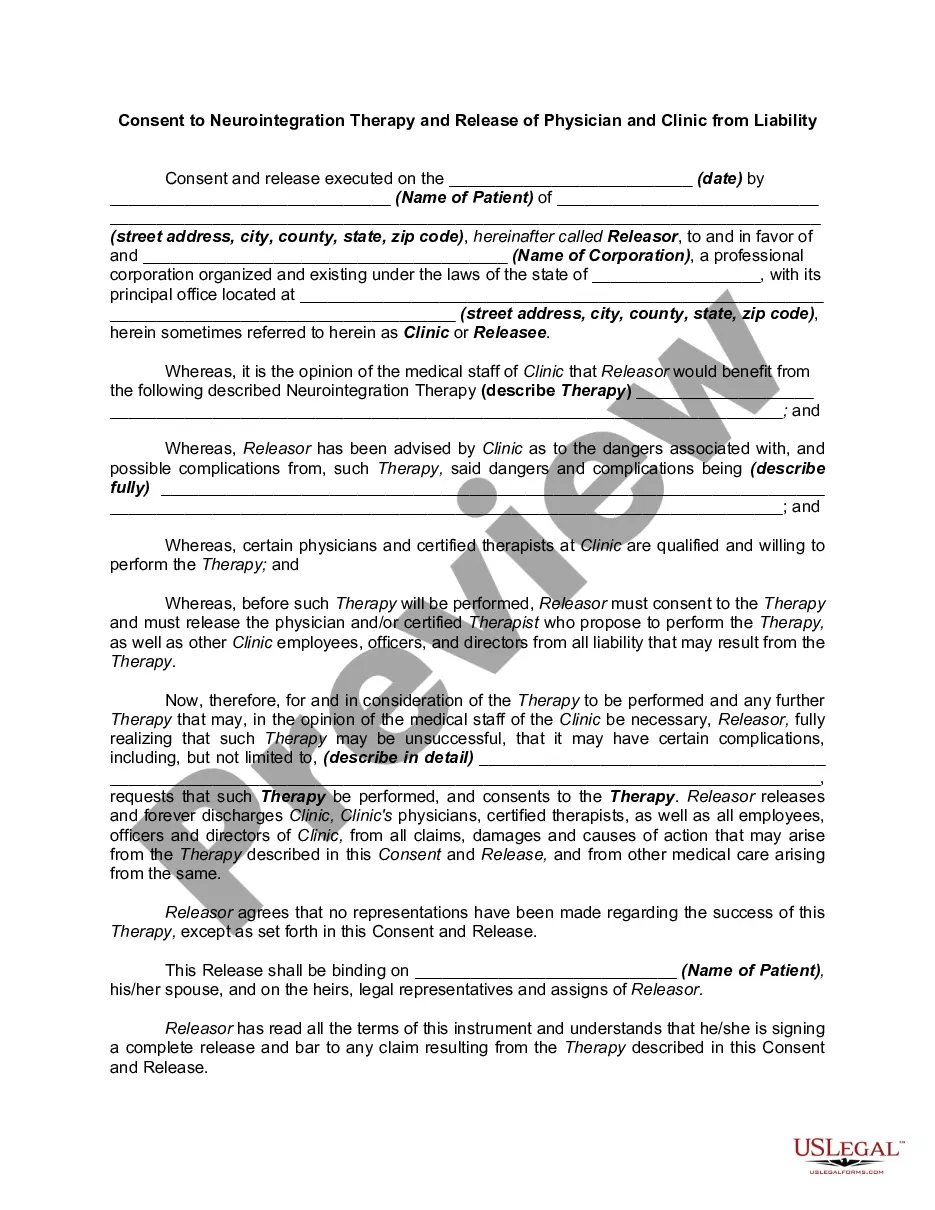
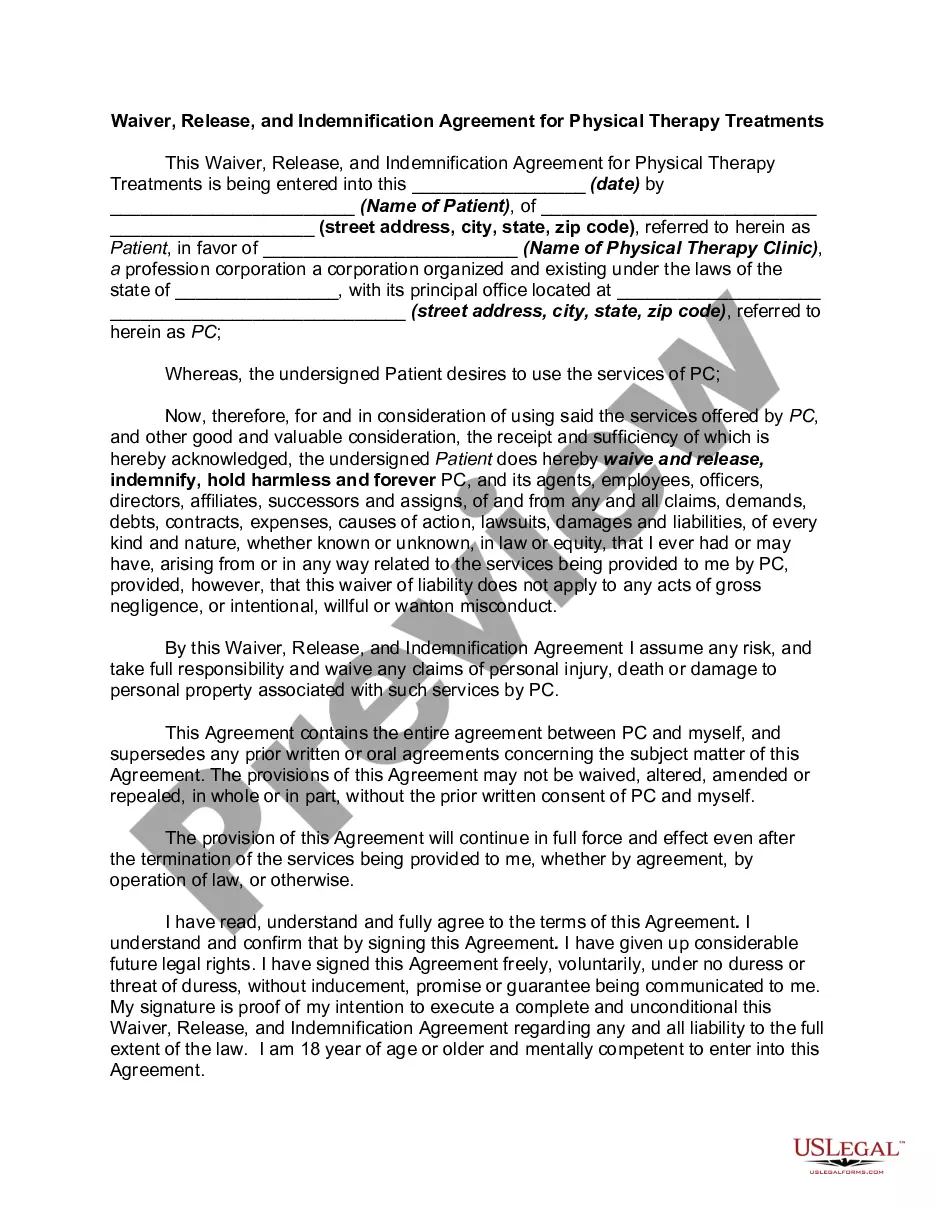
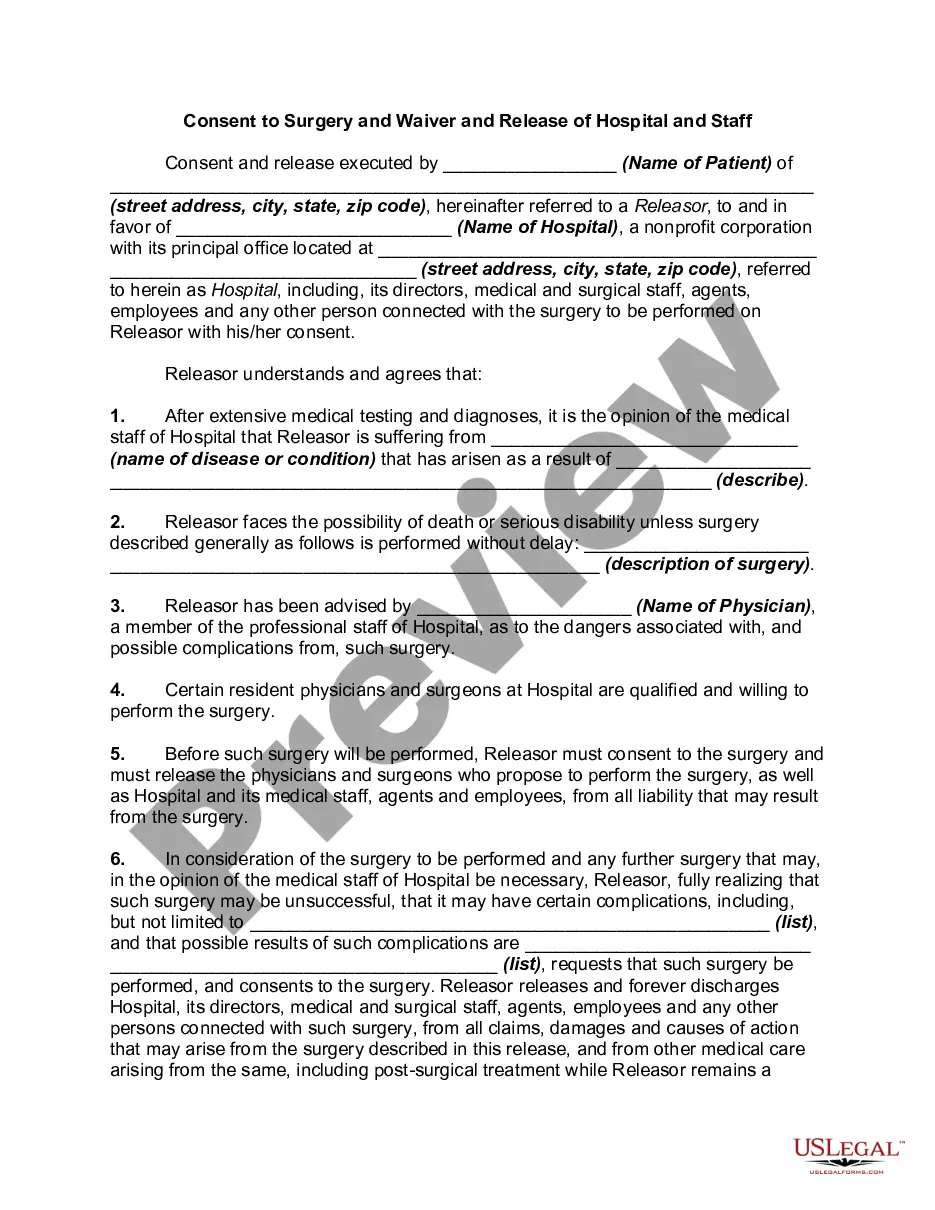
The Consent to Neurointegration Therapy and Release of Physician and Clinic from Liability is a legal document that permits a patient to authorize medical professionals to perform neurointegration therapy. By signing this form, the patient voluntarily relinquishes their right to sue the physicians and clinic for any potential injuries that may result from the therapy. Unlike other consent forms, this document also explicitly outlines the risks associated with the procedure and ensures that the patient is fully informed before consenting to treatment.
Key parts of this document
- Date of consent execution.
- Name and details of the patient (Releasor).
- Clinic and physician details (Releasee).
- Description of the neurointegration therapy to be performed.
- Detailed risks and potential complications associated with the therapy.
- Patient's agreement to release the clinic, physicians, and staff from liability.

Situations where this form applies
This form should be used when a patient is considering neurointegration therapy and needs to provide informed consent. It is essential in situations where the therapy involves known risks and potential complications. Using this form ensures that the patient acknowledges and accepts these risks while also protecting the healthcare provider from liability claims related to the procedure.
Who needs this form
- Patients seeking neurointegration therapy.
- Health clinics and providers offering neurointegration services.
- Legal guardians of minor patients undergoing neurointegration therapy.
Completing this form step by step
- Enter the date when the consent is being executed.
- Fill in the patient's name and contact information.
- Provide the name and details of the clinic performing the therapy.
- Describe the neurointegration therapy in detail, including its purpose.
- List any risks or complications the patient may face during the therapy.
- Have the patient sign and date the form, along with a witness signature.
Notarization guidance
This form does not typically require notarization to be legally valid. However, some jurisdictions or document types may still require it. US Legal Forms provides secure online notarization powered by Notarize, available 24/7 for added convenience.
Get your form ready online
Our built-in tools help you complete, sign, share, and store your documents in one place.
Make edits, fill in missing information, and update formatting in US Legal Forms—just like you would in MS Word.
Download a copy, print it, send it by email, or mail it via USPS—whatever works best for your next step.
Sign and collect signatures with our SignNow integration. Send to multiple recipients, set reminders, and more. Go Premium to unlock E-Sign.
If this form requires notarization, complete it online through a secure video call—no need to meet a notary in person or wait for an appointment.
We protect your documents and personal data by following strict security and privacy standards.

Make edits, fill in missing information, and update formatting in US Legal Forms—just like you would in MS Word.

Download a copy, print it, send it by email, or mail it via USPS—whatever works best for your next step.

Sign and collect signatures with our SignNow integration. Send to multiple recipients, set reminders, and more. Go Premium to unlock E-Sign.

If this form requires notarization, complete it online through a secure video call—no need to meet a notary in person or wait for an appointment.

We protect your documents and personal data by following strict security and privacy standards.
Common mistakes
- Not fully describing the therapy or its risks.
- Failing to include a witness signature.
- Not dating the form at the time of signing.
- Omitting the clinic's details or the therapist's names.
Benefits of using this form online
- Instant download and access to the latest legal forms.
- Editable fields that allow for customization according to specific situations.
- Reliable templates drafted by licensed attorneys to ensure compliance.
Legal use & context
- This consent form is legally binding and intended to protect both the patient and healthcare providers.
- It is crucial for patients to understand that signing the form releases the clinic and its staff from future claims related to the therapy.
- In many jurisdictions, courts will not enforce releases if found to contain gross negligence or if signed by minors without parental consent.
What to keep in mind
- The form allows patients to consent to neurointegration therapy and release clinics from liability.
- It's vital for patients to understand the risks involved before signing.
- Proper completion of this form can prevent future legal issues.
Looking for another form?
Form popularity
FAQ
It often involves a process, dialogue or discussion between a therapist and a client. Generally, the process of informed consent involves three parts: Providing the client with information, evaluating the client's capacity to understand the information and, finally, obtaining consent from the client.
What Is Informed Consent? Components of Informed Consent. Decision-Making Capacity. Disclosure. Documentation of Consent. Competency. Informed Consent, The Right to Refuse Treatment. Clinical Trials and Research.
The Joint Commission requires documentation of all the elements of informed consent "in a form, progress notes or elsewhere in the record." The following are the required elements for documentation of the informed consent discussion: (1) the nature of the procedure, (2) the risks and benefits and the procedure, (3)
Ensure that the formal letter/ email has a clear heading regarding the consent. Explain the requirements (if any) from the respondents. Mention the duration of the program or participation.
Use the second (you) or third person (he/she) to present the study details. Include a statement of agreement at the conclusion of the informed consent document.
In current clinical practice, these four elements translate into five components that should be included in a discussion seeking to obtain informed consent: the diagnosis, the proposed treatment, the attendant risks and benefits of the treatment, alternative treatments and their risks and benefits, and the risks and
I have read and I understand the provided information and have had the opportunity to ask questions. I understand that my participation is voluntary and that I am free to withdraw at any time, without giving a reason and without cost. I understand that I will be given a copy of this consent form.
Use the second (you) or third person (he/she) to present the study details. Include a statement of agreement at the conclusion of the informed consent document.
Obtaining informed consent in medicine is process that should include: (1) describing the proposed intervention, (2) emphasizing the patient's role in decision-making, (3) discussing alternatives to the proposed intervention, (4) discussing the risks of the proposed intervention and (5) eliciting the patient's