Motion for Partial Summary Judgment on the Issue of Liability
Overview of this form
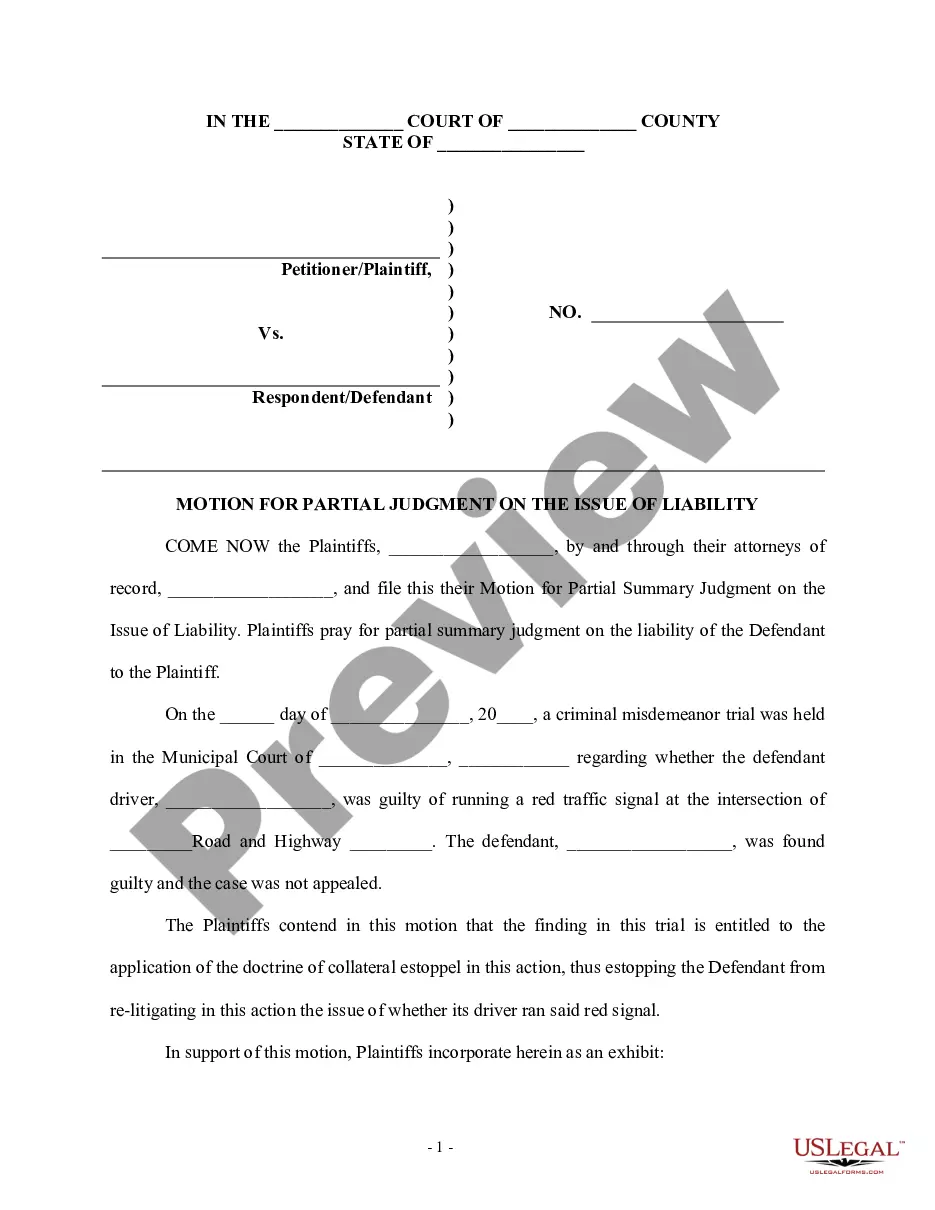
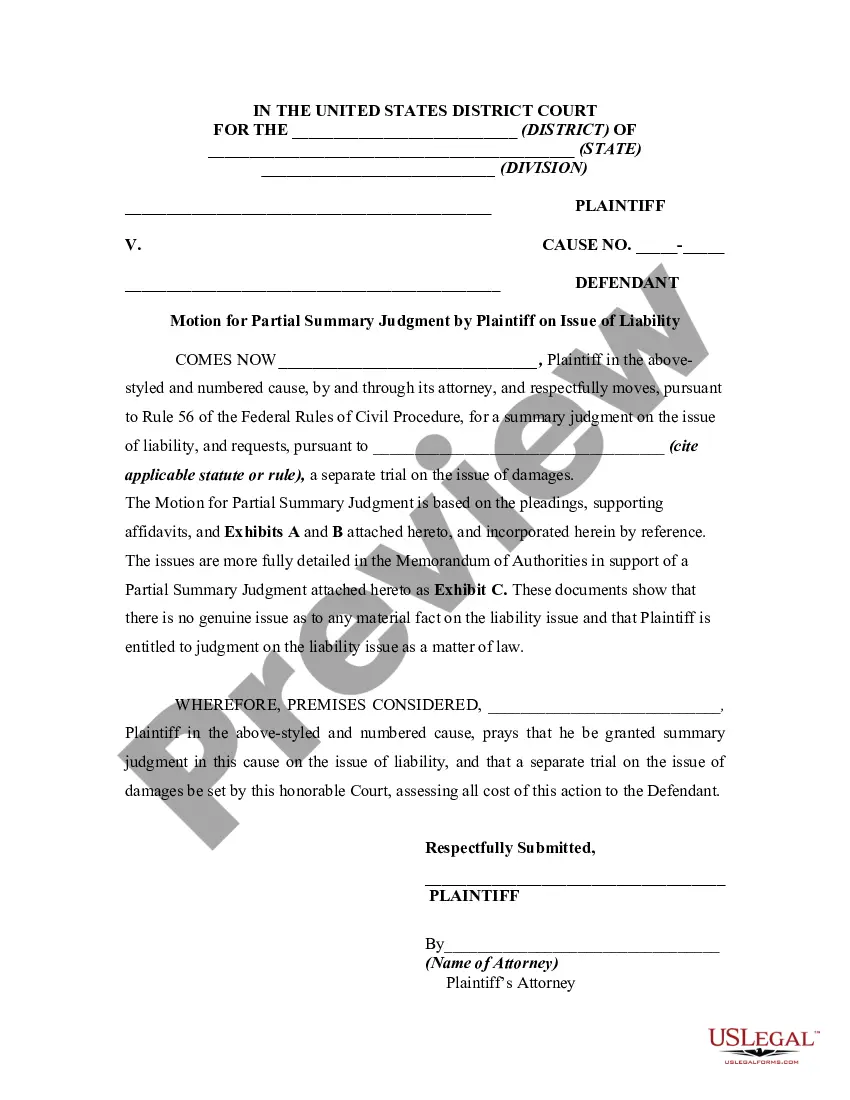
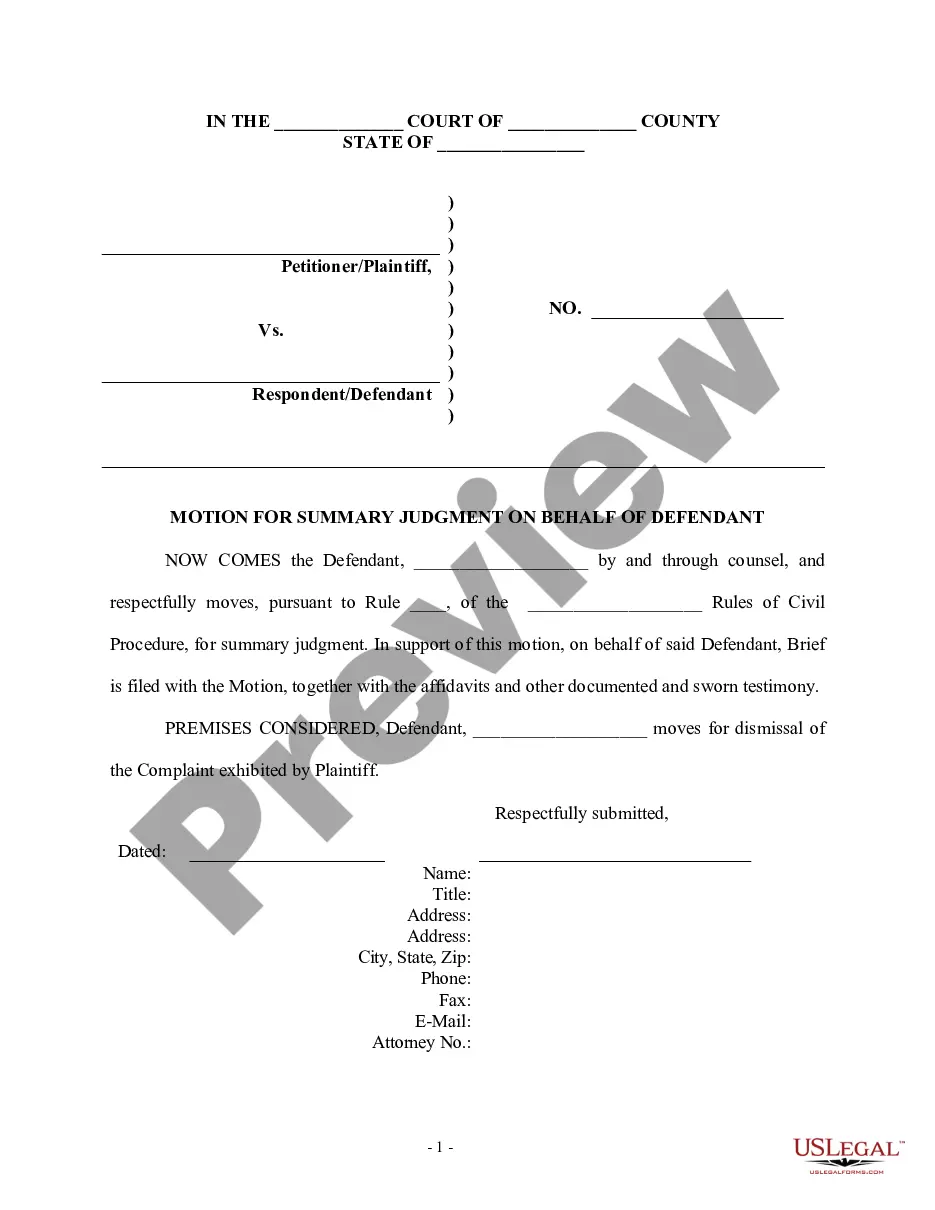
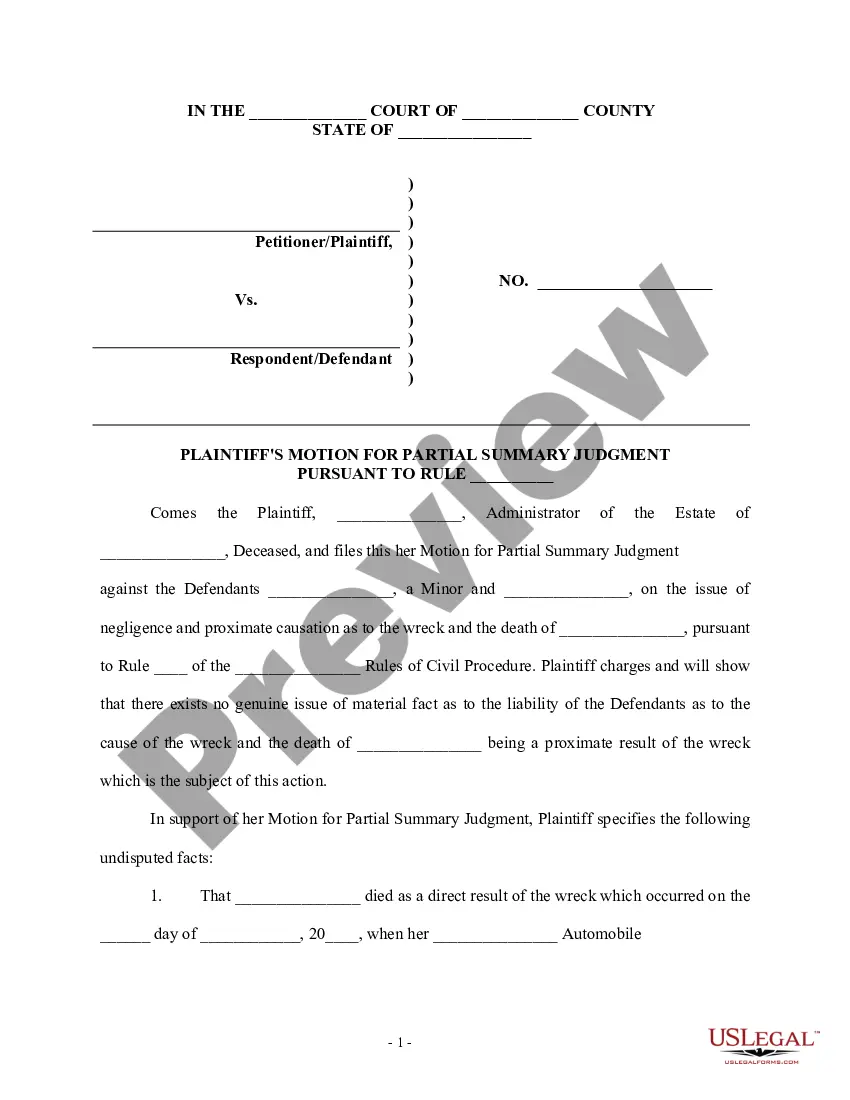
The Motion for Partial Summary Judgment on the Issue of Liability is a legal document that requests the court to grant a partial summary judgment in favor of the plaintiff. This form is primarily used in personal injury cases, particularly those involving automobile accidents, to establish liability based on prior verdicts in related criminal cases. Unlike traditional summary judgment motions, this form specifically addresses the aspect of liability, allowing plaintiffs to avoid relitigation of facts already determined by a court.
Form components explained
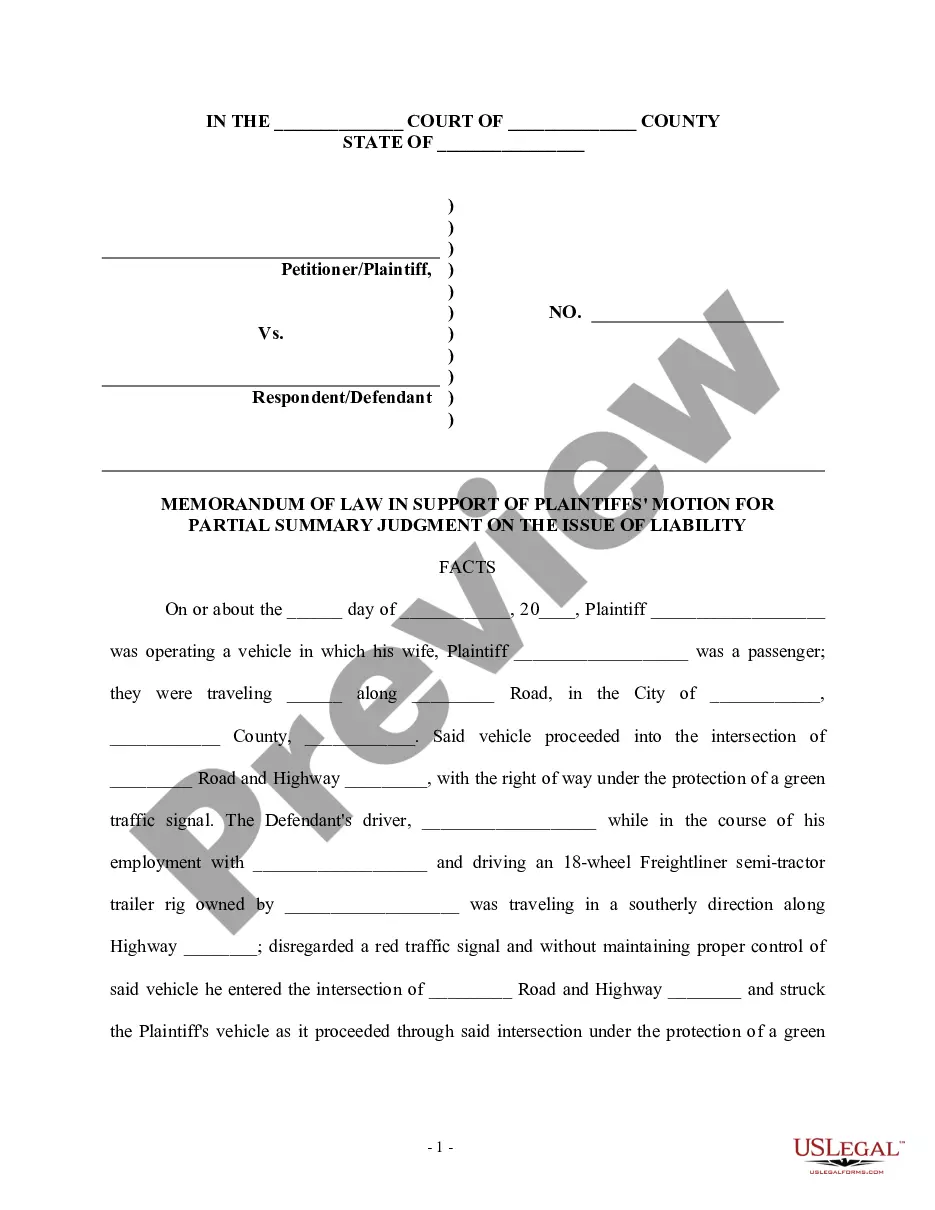
- The date and location of the criminal trial.
- The specific details of the defendant driver and the traffic violation.
- The claim regarding collateral estoppel based on prior trial outcomes.
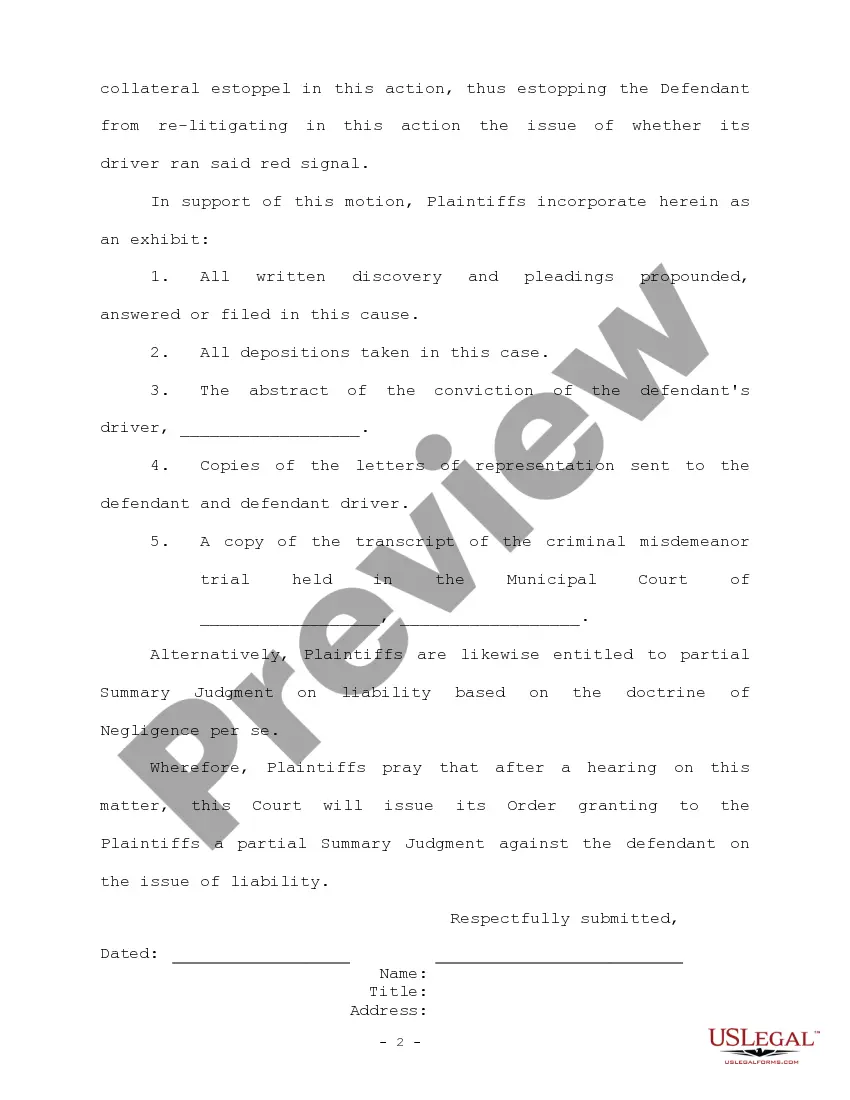
- A comprehensive list of exhibits supporting the motion.
- The option for a motion based on the doctrine of Negligence per se.
When to use this document
This form should be used when the plaintiff has a solid basis for claiming liability against a defendant in a personal injury case, particularly after a criminal trial has found the defendant guilty of actions related to the injury, such as running a red light. It is relevant when the plaintiff seeks to streamline legal proceedings by having the court recognize previous findings to establish liability without the need for further evidence or testimony.
Who needs this form
- Plaintiffs seeking to establish liability in personal injury cases.
- Attorneys representing clients in automobile accident cases.
- Anyone involved in a legal matter where liability has been previously determined in a related case.
How to prepare this document
- Fill in the date and location of the criminal trial.
- Provide the names and details of the defendant driver and the specific traffic violation.
- Cite the criminal conviction and explain how it applies to the current motion.
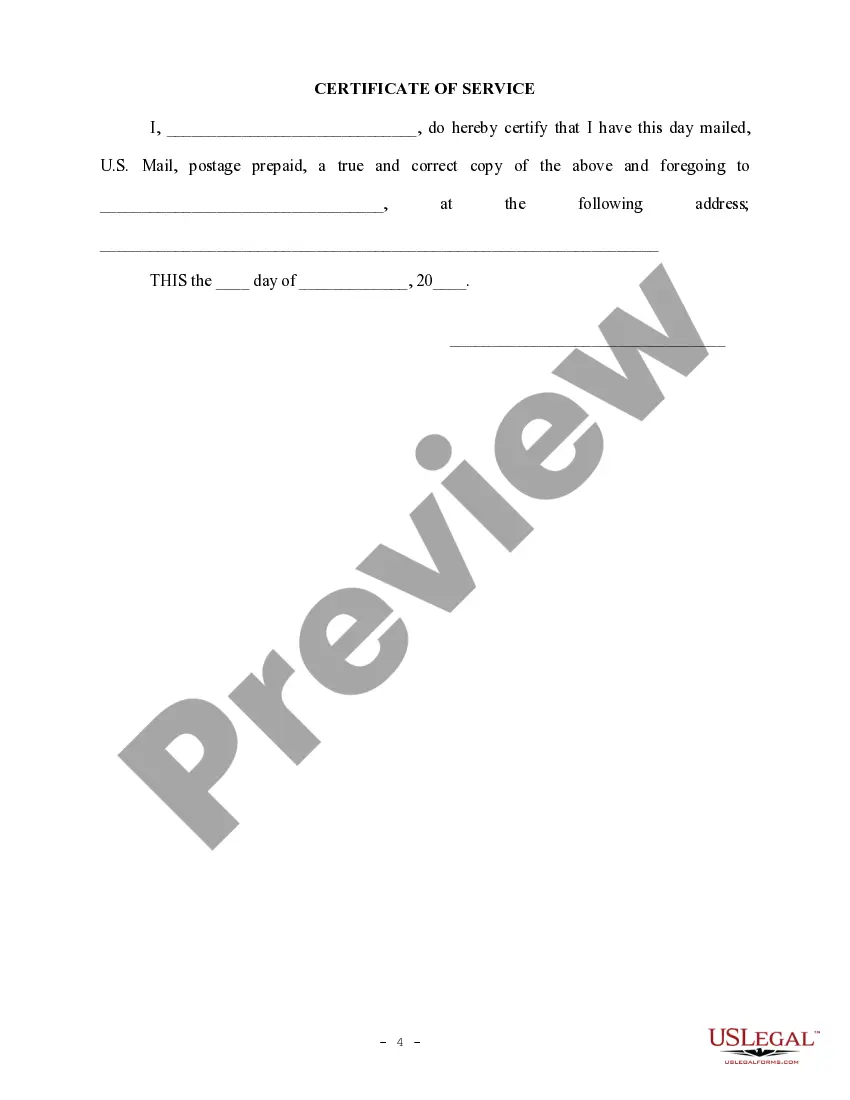
- Attach necessary exhibits that support your motion, including written discovery and trial transcripts.
- Sign and date the form before submitting it to the court.
Notarization guidance
This form usually doesn’t need to be notarized. However, local laws or specific transactions may require it. Our online notarization service, powered by Notarize, lets you complete it remotely through a secure video session, available 24/7.
Get your form ready online
Our built-in tools help you complete, sign, share, and store your documents in one place.
Make edits, fill in missing information, and update formatting in US Legal Forms—just like you would in MS Word.
Download a copy, print it, send it by email, or mail it via USPS—whatever works best for your next step.
Sign and collect signatures with our SignNow integration. Send to multiple recipients, set reminders, and more. Go Premium to unlock E-Sign.
If this form requires notarization, complete it online through a secure video call—no need to meet a notary in person or wait for an appointment.
We protect your documents and personal data by following strict security and privacy standards.

Make edits, fill in missing information, and update formatting in US Legal Forms—just like you would in MS Word.

Download a copy, print it, send it by email, or mail it via USPS—whatever works best for your next step.

Sign and collect signatures with our SignNow integration. Send to multiple recipients, set reminders, and more. Go Premium to unlock E-Sign.

If this form requires notarization, complete it online through a secure video call—no need to meet a notary in person or wait for an appointment.

We protect your documents and personal data by following strict security and privacy standards.
Avoid these common issues
- Failing to include all necessary exhibits or supporting documents.
- Providing incomplete or incorrect information about the criminal trial.
- Not clearly stating how collateral estoppel applies in this case.
- Submitting the motion without proper legal representation or advice.
Why use this form online
- Quick and convenient access to legally compliant templates.
- Editable forms that allow for personalization to fit specific circumstances.
- Reliable information drafted by licensed attorneys, ensuring accuracy.
- Eliminates the need for travel to obtain physical paperwork.
Looking for another form?

Form popularity
FAQ
A motion for summary judgment is a request made by a party asking the court to decide all or part of a lawsuit without going to trial because there's no dispute about the key facts of the case. The party making the motion (called the movant) can be the plaintiff or the defendant.
An issue or case which is decided by summary judgment is not allowed to be presented to a judge or jury at trial.In other words, the motion for summary judgment is a method to decide an issue (or the whole case), without the need for a trial.
N. a court order ruling that no factual issues remain to be tried and therefore a cause of action or all causes of action in a complaint can be decided upon certain facts without trial.
The purpose of a trial is to have somebody the judge or the jury decide what the facts are. If the facts are not in dispute, there is no need for a trial. Instead the party who believes that the undisputed facts compel a ruling in his or her favor will file a motion for summary judgment.
A motion for summary judgment filed by an opposing party claims that you cannot prevail in the case because there is no legal dispute or your claim is without merit or a defense. Failure to respond to a motion for summary judgment can result in your case being dismissed or a judgment being rendered against you.
If the motion is granted, the judgment on the issue or case is deemed to be a final judgment from which a party may seek an appeal. The court of appeal can reverse the grant of summary judgment and reinstate the claim in the lower court. However, this is rarely done and most summary judgments are upheld on appeal.
A procedural device used during civil litigation to promptly and expeditiously dispose of a case without a trial.For example, a court might grant partial summary judgment in a personal injury case on the issue of liability. A trial would still be necessary to determine the amount of damages.
When a motion for summary judgement is granted, it indicates there is sufficient evidence to declare one party the clear winner.The judge will then rule on the case based on the facts and evidence. A summary judgement can often be beneficial as it potentially skips a lengthy (and costly) court trial.
Partial summary judgment," as used in' this comment, refers to the granting of judgment on a portion of a single claim. It is not used to refer to the granting of judgment on a single claim where more than one claim is presented in a case.