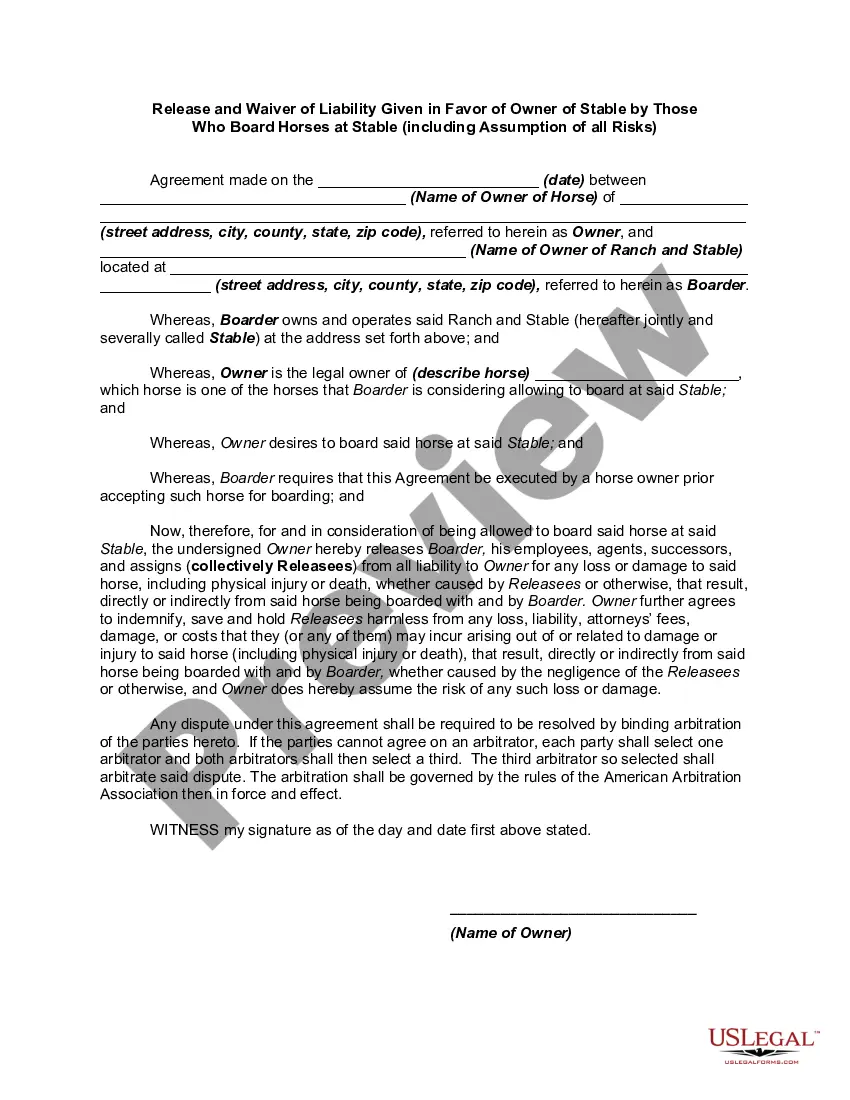
Release and Waiver of Liability Given in Favor of Owner of Stable by Those Who Board Horses at Stable including Assumption of all Risks
Understanding this form
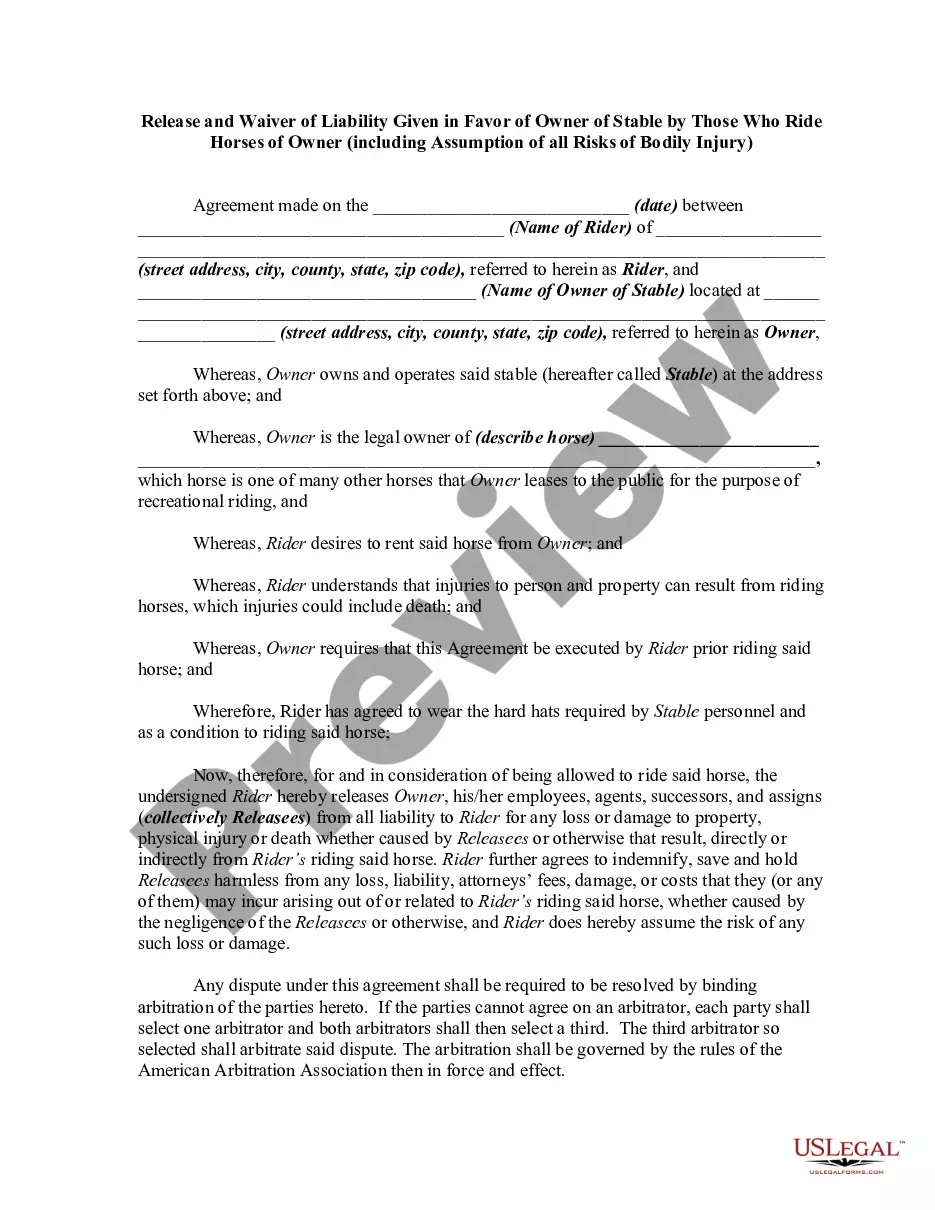
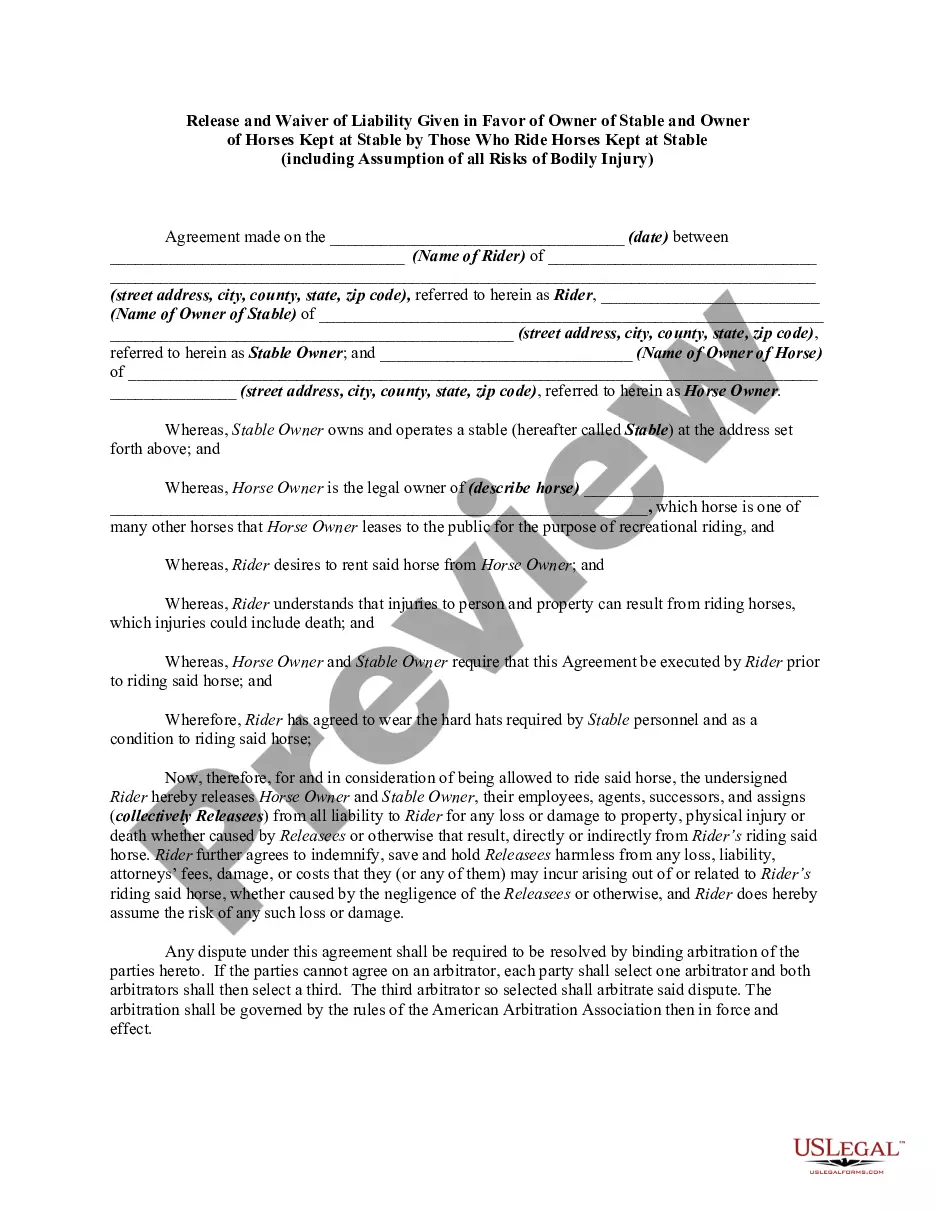
This Release and Waiver of Liability form is a legal document used by horse owners who wish to board their horses at a stable. The form is designed to protect the stable owner from claims arising from injuries or damages that may occur to the horse while it is in their care. By signing this waiver, the horse owner acknowledges the inherent risks associated with boarding and agrees to assume those risks, thereby releasing the stable owner and their employees from liability. This form is crucial in distinguishing responsibilities and limitations in the boarding arrangement, setting it apart from other general liability waivers.
Main sections of this form
- Identification of the horse owner and stable owner
- Detailed description of the horse being boarded
- Release of liability clause protecting the stable owner from claims
- Agreement to indemnify the stable owner for any damages or injuries
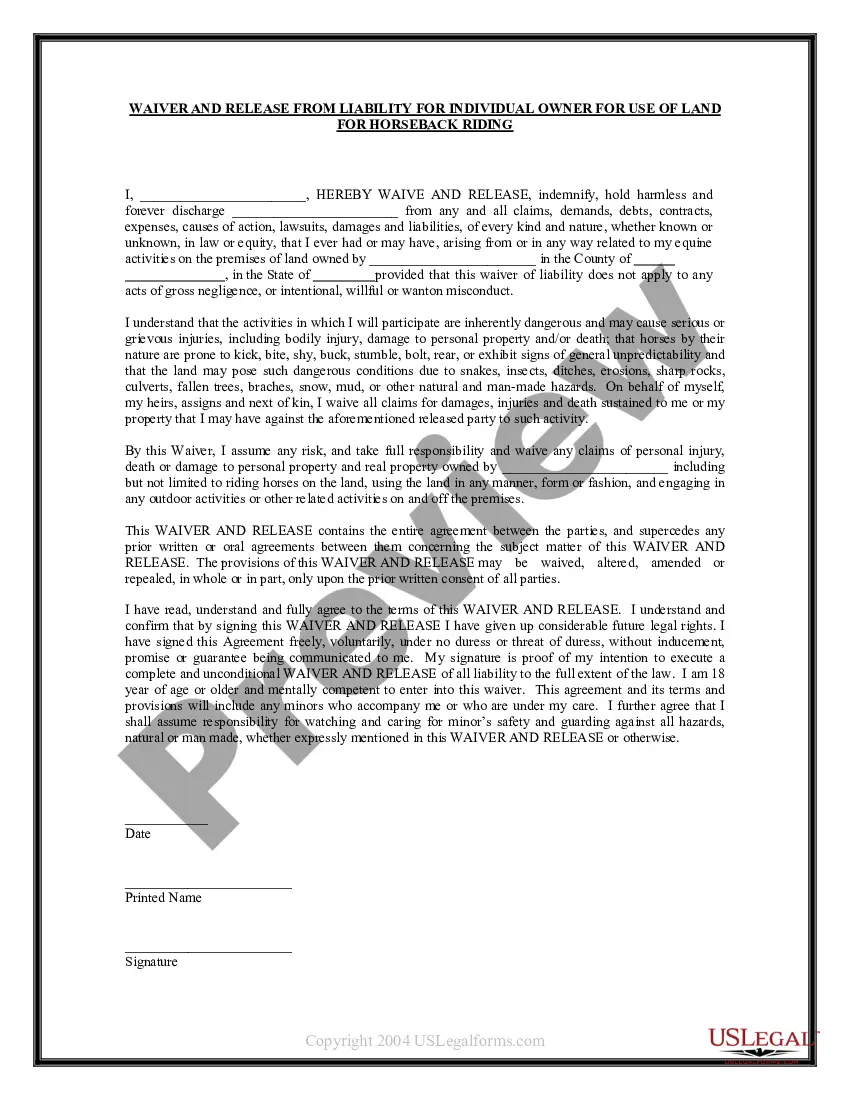
- Assumption of risk clause acknowledging potential hazards
- Dispute resolution procedure via binding arbitration
Common use cases
This form should be used when a horse owner wants to board their horse at a stable and the stable owner requires a legal release from liability. It is essential for situations where there are risks of injury to horses, as it protects the stable from potential lawsuits related to accidents or injuries that may occur while the horse is being boarded. If you are an owner looking to ensure that both you and the stable are clear about liability, this waiver is necessary.
Who needs this form
- Horse owners seeking to board their horses at a stable
- Stable owners needing legal protection from liability claims
- Equine businesses that require documented agreements for boarding services
Instructions for completing this form
- Identify and enter the names and contact information of both the horse owner and stable owner
- Provide a detailed description of the horse being boarded
- Read and acknowledge the terms of liability release and assumption of risk
- Sign and date the form to finalize the agreement
- Consider having the form reviewed by a legal professional if you have questions
Does this document require notarization?
This form usually doesn’t need to be notarized. However, local laws or specific transactions may require it. Our online notarization service, powered by Notarize, lets you complete it remotely through a secure video session, available 24/7.
Get your form ready online
Our built-in tools help you complete, sign, share, and store your documents in one place.
Make edits, fill in missing information, and update formatting in US Legal Forms—just like you would in MS Word.
Download a copy, print it, send it by email, or mail it via USPS—whatever works best for your next step.
Sign and collect signatures with our SignNow integration. Send to multiple recipients, set reminders, and more. Go Premium to unlock E-Sign.
If this form requires notarization, complete it online through a secure video call—no need to meet a notary in person or wait for an appointment.
We protect your documents and personal data by following strict security and privacy standards.

Make edits, fill in missing information, and update formatting in US Legal Forms—just like you would in MS Word.

Download a copy, print it, send it by email, or mail it via USPS—whatever works best for your next step.

Sign and collect signatures with our SignNow integration. Send to multiple recipients, set reminders, and more. Go Premium to unlock E-Sign.

If this form requires notarization, complete it online through a secure video call—no need to meet a notary in person or wait for an appointment.

We protect your documents and personal data by following strict security and privacy standards.
Common mistakes
- Failing to accurately describe the horse being boarded
- Not reading the terms of the waiver thoroughly
- Omitting signatures or dates, which renders the form invalid
- Using outdated or incorrect versions of the form
Advantages of online completion
- Convenient downloading and printing from home
- Editability allows customization for specific needs
- Access to forms drafted by licensed attorneys for reliability
- Quick turnaround time compared to traditional legal processes
Legal use & context
- The waiver helps mitigate the risk of lawsuits related to horse injuries
- Courts often uphold liability waivers as long as they are clear and voluntary
- Specific clauses may be subject to state-specific legal interpretations and requirements
Main things to remember
- This Release and Waiver of Liability is essential for horse boarding agreements
- It protects stable owners from potential legal claims
- Thoroughly complete and understand the form before signing
Looking for another form?






Form popularity
FAQ
If you set up an LLC for yourself and conduct all your business through it, the LLC will be liable in a lawsuit but you won't.Conducting your personal business through an LLC provides no protection against a tort verdict, the type of liability that most people are worried about.
The main reason people form LLCs is to avoid personal liability for the debts of a business they own or are involved in. By forming an LLC, only the LLC is liable for the debts and liabilities incurred by the businessnot the owners or managers.
One of the key benefits of an LLC versus the sole proprietorship is that a member's liability is limited to the amount of their investment in the LLC. Therefore, a member is not personally liable for the debts of the LLC. A sole proprietor would be liable for the debts incurred by the business.
The limited liability feature protects the partner's personal assets from the risk of being seized to satisfy creditor claims in the event of the company's or partnership's insolvency while the general partner's personal property would remain at risk.
You have unlimited liability for debts as there's no legal distinction between private and business assets. your capacity to raise capital is limited. all the responsibility for making day-to-day business decisions is yours. retaining high-calibre employees can be difficult.
Similar to a corporation, the LLC owners, also referred to as members, are generally not personally liable for the debts and obligations of the business. Therefore, if a legal suit is brought against the LLC, the personal assets of the owners are protected.
In a sole proprietorship, the owner is personally liable for any debts or obligations of the business. This means that lawsuit claimants or creditors may have access to the owner's personal accounts, assets, or property if any business accounts cannot cover his debt.
A limited liability company (LLC) offers protection from personal liability for business debts, just like a corporation. While setting up an LLC is more difficult than creating a partnership or sole proprietorship, running one is significantly easier than running a corporation.
Sole proprietors have unlimited personal liability. There is no legal distinction between the owner and the business. This means that creditors of the business and individuals who have other claims against the owner can reach both the owner's business and personal assets.