Lost Deed Affidavit
What is this form?
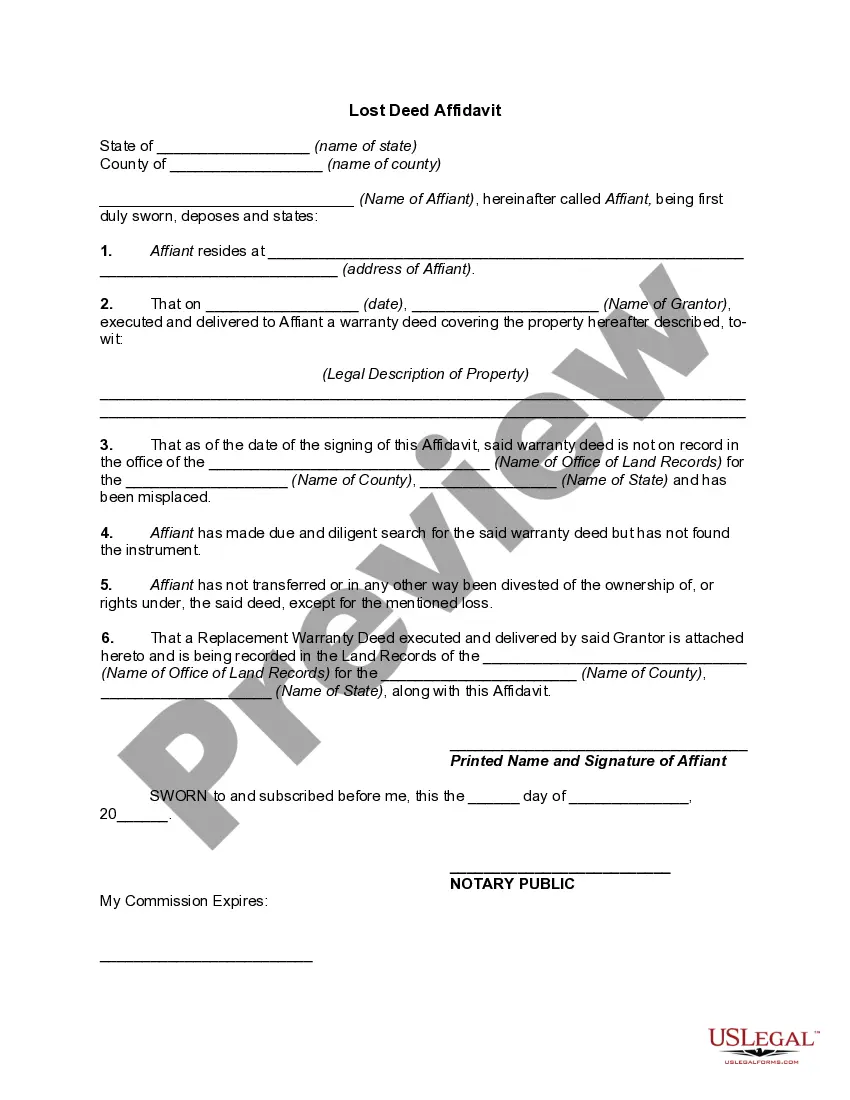
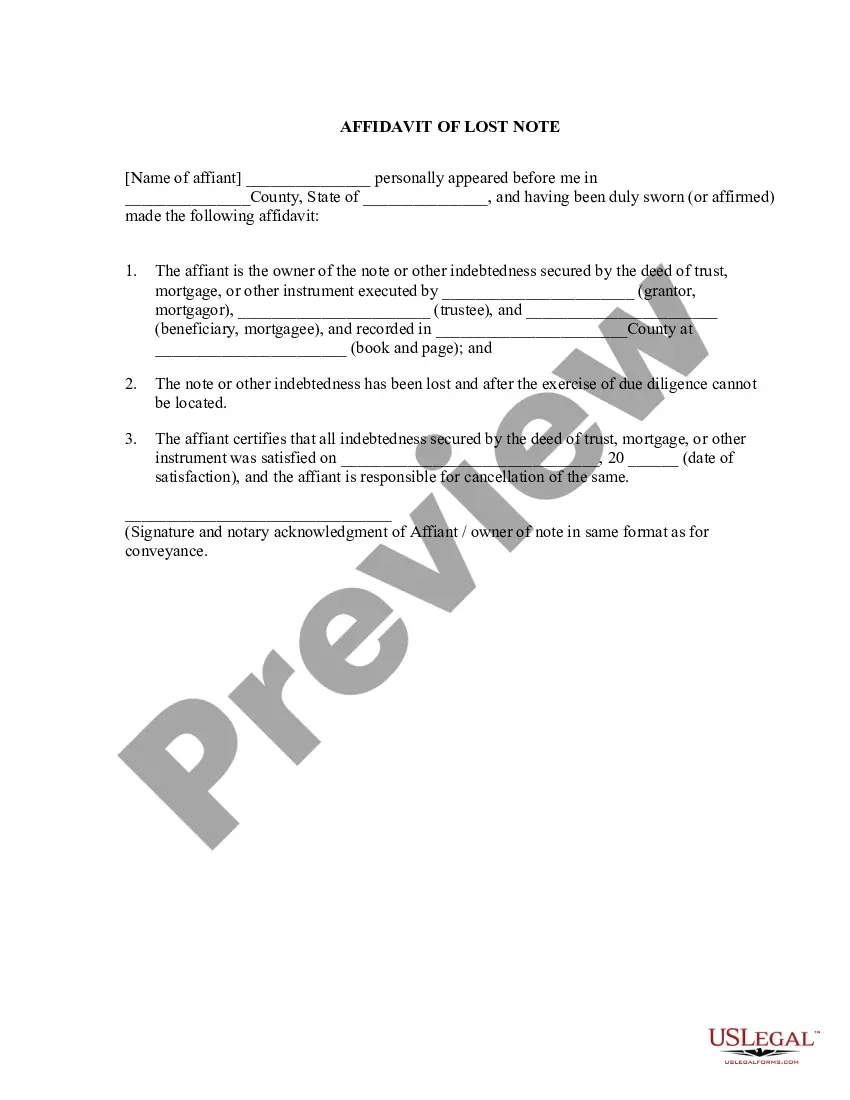
The Lost Deed Affidavit is a legal document used to formally declare that a deed has been lost or misplaced. This affidavit serves as a statement of facts regarding the deed's loss and aims to assist in the process of recording a replacement deed. It differs from other legal forms by focusing specifically on the loss of a property deed and the accompanying declaration necessary to affirm the ownership and intent to replace the document.
Key components of this form
- Name of the affiant and their address.
- Date and identification of the original grantor who executed the deed.
- Legal description of the property in question.
- Statement confirming the deed is not recorded and the efforts made to locate it.
- Affirmation that ownership rights have not been transferred except for the loss.
- Attachment of a replacement warranty deed for recording.
When this form is needed
This form is needed when an individual or entity has lost a deed to their property and requires a formal declaration for legal purposes. It can be used in situations where the owner wishes to replace a lost deed to ensure clear title to the property, especially when needing to sell, transfer, or refinance the property. This affidavit can be crucial when local land records indicate no existing record of the deed.
Who needs this form
- Property owners who have lost their deed and need a replacement.
- Individuals seeking to resolve issues related to property title or ownership.
- Real estate professionals assisting clients in similar situations.
- Legal representatives preparing documents for clients who require a Lost Deed Affidavit.
Steps to complete this form
- Identify the affiant and provide their complete address.
- Specify the date the original deed was executed and the name of the grantor.
- Include the legal description of the property related to the deed.
- State that the deed is not recorded and describe the search efforts made to locate it.
- Acknowledge that ownership rights remain intact while attaching the replacement warranty deed.
- Sign and date the affidavit in the presence of a notary public, if required.
Notarization requirements for this form
This document requires notarization to meet legal standards. US Legal Forms provides secure online notarization powered by Notarize, allowing you to complete the process through a verified video call, available 24/7.
Get your form ready online
Our built-in tools help you complete, sign, share, and store your documents in one place.
Make edits, fill in missing information, and update formatting in US Legal Forms—just like you would in MS Word.
Download a copy, print it, send it by email, or mail it via USPS—whatever works best for your next step.
Sign and collect signatures with our SignNow integration. Send to multiple recipients, set reminders, and more. Go Premium to unlock E-Sign.
If this form requires notarization, complete it online through a secure video call—no need to meet a notary in person or wait for an appointment.
We protect your documents and personal data by following strict security and privacy standards.

Make edits, fill in missing information, and update formatting in US Legal Forms—just like you would in MS Word.

Download a copy, print it, send it by email, or mail it via USPS—whatever works best for your next step.

Sign and collect signatures with our SignNow integration. Send to multiple recipients, set reminders, and more. Go Premium to unlock E-Sign.

If this form requires notarization, complete it online through a secure video call—no need to meet a notary in person or wait for an appointment.

We protect your documents and personal data by following strict security and privacy standards.
Common mistakes to avoid
- Failing to provide a complete legal description of the property.
- Not including the date when the original deed was executed.
- Neglecting to sign the affidavit in the presence of a notary, if necessary.
- Overlooking the fact that all ownership rights must be stated clearly.
Benefits of completing this form online
- Convenience of accessing legal forms from anywhere at any time.
- Easy customization to meet specific state requirements.
- Reliable templates drafted by licensed attorneys ensuring legal validity.
Looking for another form?
Form popularity
FAQ
An affidavit is a sworn statement, made in front of a notary or other officer authorized to administer oaths. An affidavit of deed confirms delivery and acceptance of a deed by the grantee, and thereby its validity.If the grantor is protected by an affidavit of deed, these issues are generally easier to resolve.
After your affidavit has been filed, the court clerk will give your case file to the judge for review.The judgment will state that it is a default judgment and it will be signed and dated by the judge. The court clerk will mail copies of the judgment to you and the defendant.
Begin by filling out the Affidavit of Loss/Release of Interest (Form TD-420-040). There is a fee of $31 when applying for a duplicate title.
An affidavit of loss can be filed for other types of document, such as those related to ownership of a house, a passport, a diploma or even an ATM card.Some require an affidavit of loss to be notarized.
An affidavit of loss can be filed for other types of document, such as those related to ownership of a house, a passport, a diploma or even an ATM card.Some require an affidavit of loss to be notarized.
The affidavit is a sworn statement of fact that specifies the seller of a property holds the title to it. In other words, it's proof that the seller owns the property. It also attests that certain other facts about the property are correctas sworn to by the seller and duly notarized.
Affidavits are mainly used in Court proceedings. They are a written alternative to a person attending Court to give oral evidence in the witness box. Affidavits can be used to evidence, or prove, a number of things. For example, they are often used for people to tell their 'story' to the Court.
An affidavit is used for the purpose of proving in court that a claim is true, and is typically used in conjunction with witness statements and other corroborating evidence. Through an affidavit, an individual swears that the information contained within is true to the best of their knowledge.
A narration of the circumstances of the loss, which includes (i) description of the item or document lost; (ii) description of how it got lost; (iii) the effort exerted to find it; and (iv) your request for a replacement of the item or document lost. The signature of the affiant.