Noncompetition Covenant by Seller in Sale of Business
Understanding this form
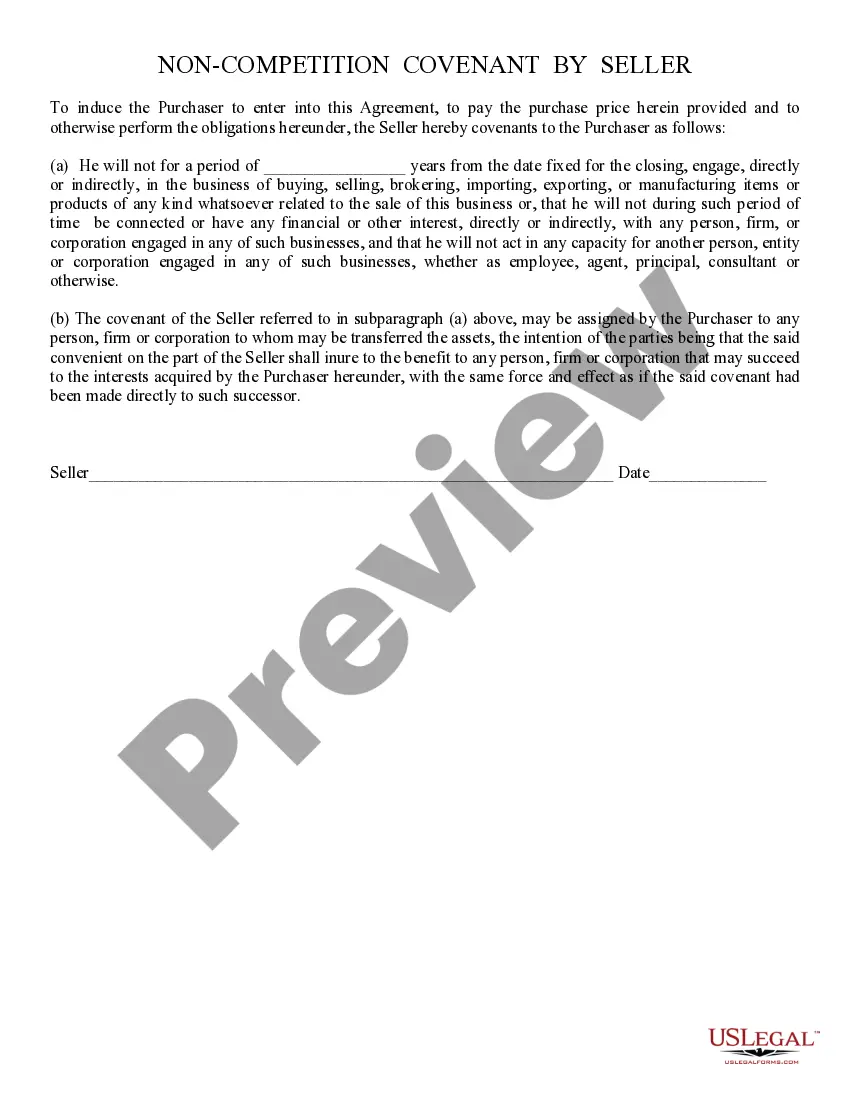
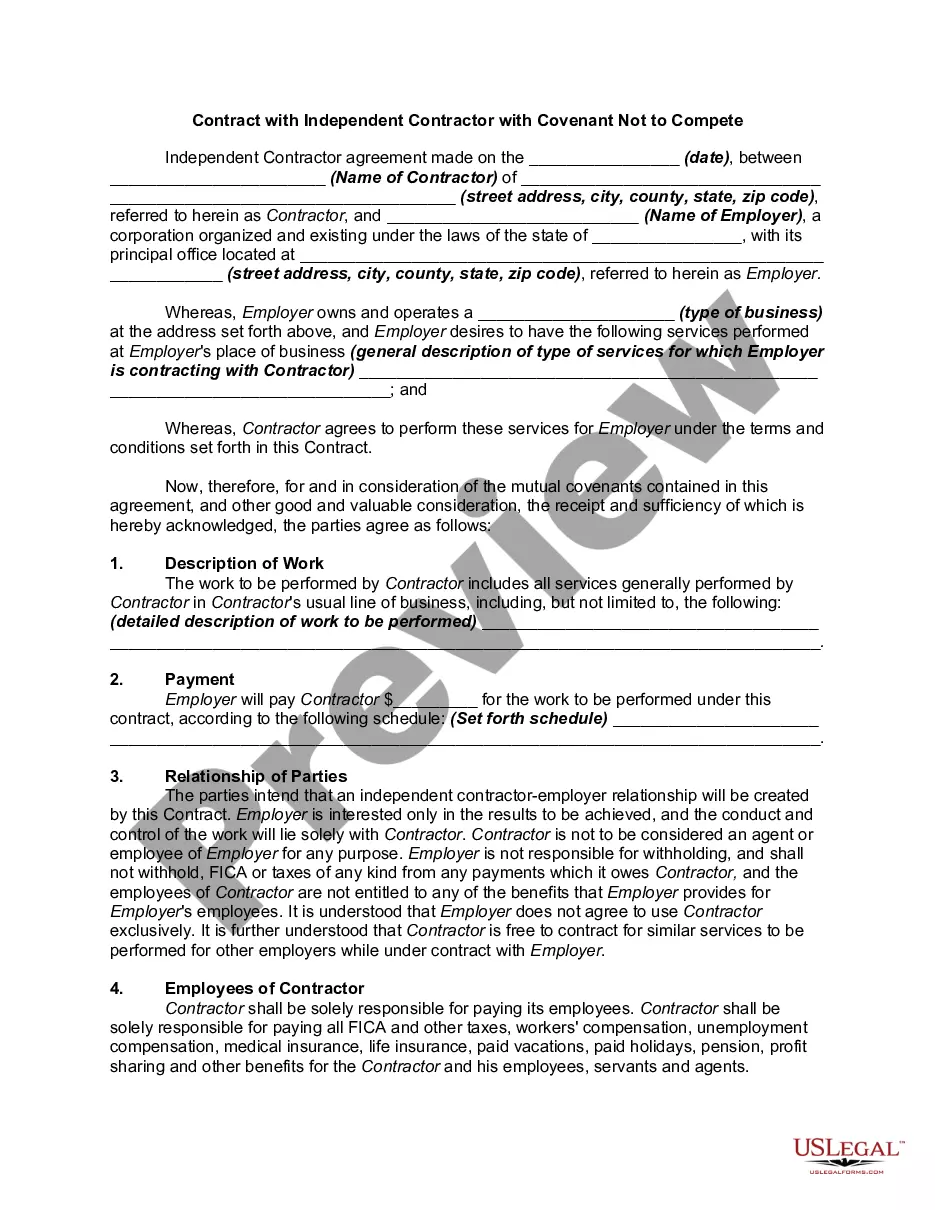
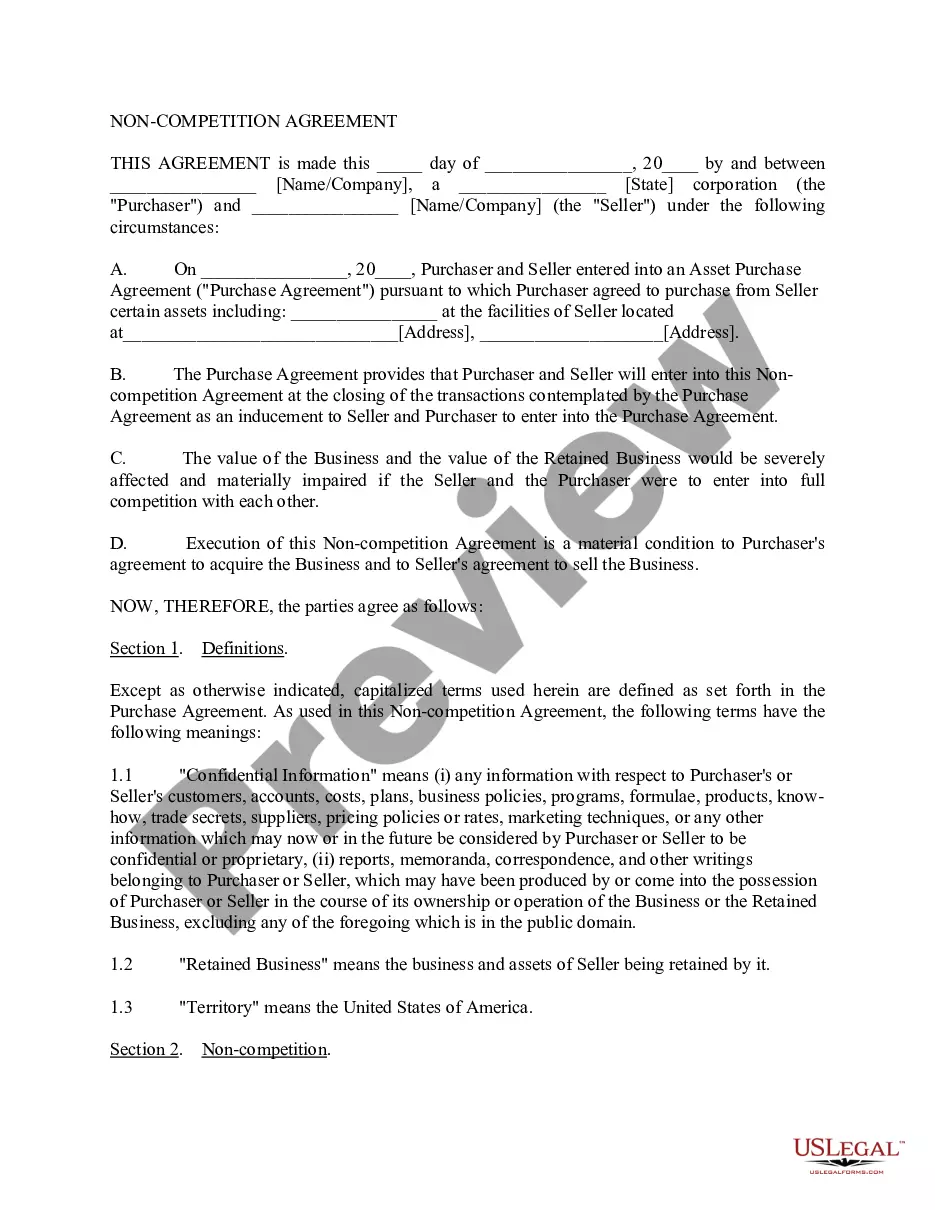
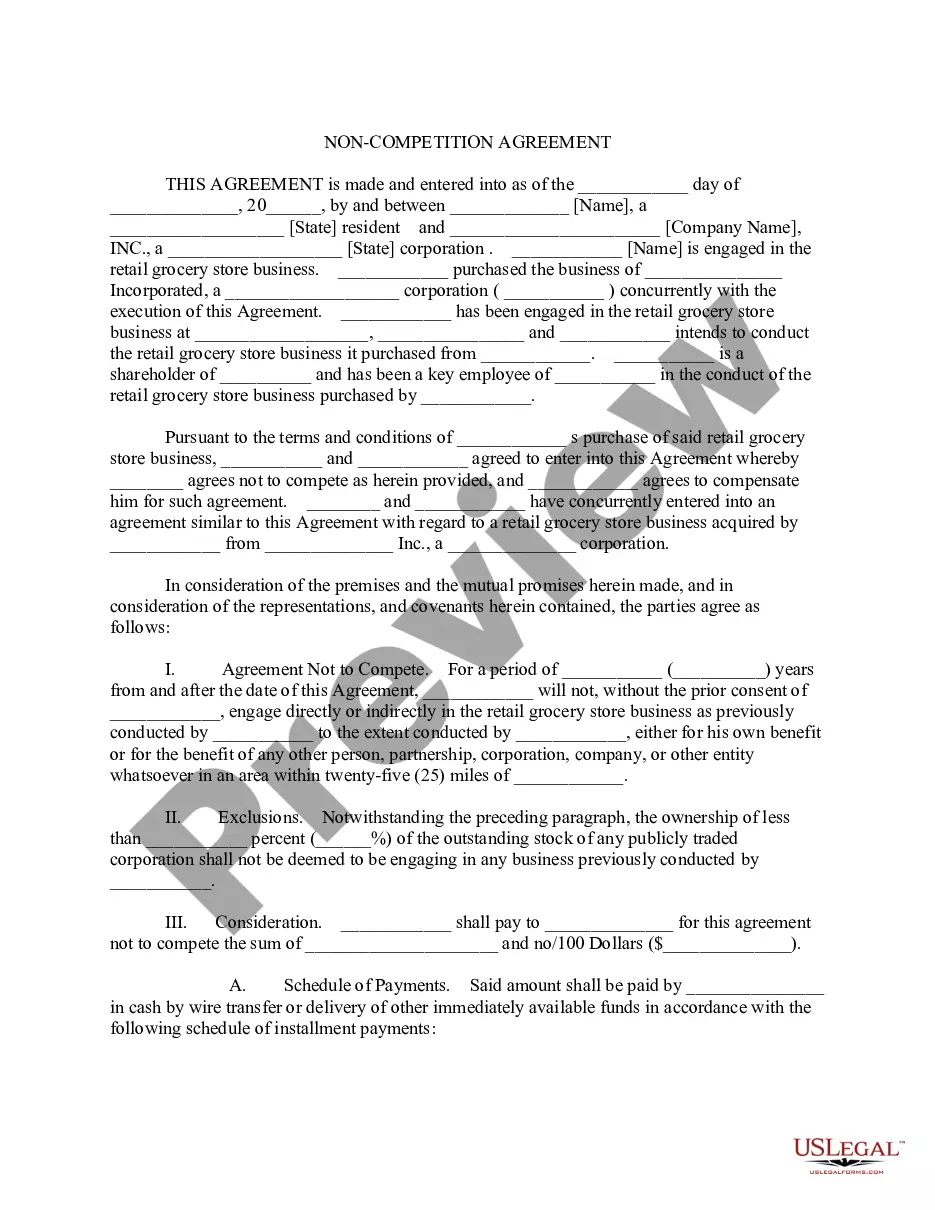
The Noncompetition Covenant by Seller in Sale of Business is a legal agreement designed to protect a purchaser's investment in a business sale. This form establishes terms under which the seller agrees not to engage in similar business activities that could compete with the purchased business, ensuring that the buyer can operate without fear of direct competition. It is an essential document in business transactions to maintain confidentiality and prevent the seller from undermining the value of the business sold.
Main sections of this form
- Noncompetition Clause: Specifies the duration during which the seller agrees not to compete in the same industry.
- Scope of Activities: Defines the specific activities the seller is prohibited from engaging in, such as buying, selling, or manufacturing related products.
- Assignment Clause: Allows the purchaser to transfer the noncompetition agreement to another party if the business assets are sold or transferred.
- Seller's Signature and Date: Required to validate the agreement and establish the commencement of the noncompetition period.
When to use this document
This form is typically used during the sale of a business when a seller is required to protect the buyer's investment by refraining from engaging in competitive activities. It is relevant in situations where the seller possesses sensitive business knowledge or resources that could negatively impact the buyer if utilized elsewhere. Using this form helps establish clear legal boundaries for potential competition after the sale.
Intended users of this form
This form is intended for:
- Business owners selling their enterprise.
- Purchasers acquiring a business and seeking protection against competition from the seller.
- Attorneys assisting clients with business sale agreements.
Instructions for completing this form
- Identify the parties involved: clearly state the seller's and purchaser's names.
- Specify the duration of the noncompetition agreement.
- Detail the prohibited business activities of the seller.
- Include the seller's signature and date to finalize the agreement.
- Consider assigning the covenant to any future purchasers of the business, if applicable.
Does this form need to be notarized?
This form does not typically require notarization unless specified by local law. However, notarizing the agreement can help strengthen its enforceability in some cases.
Get your form ready online
Our built-in tools help you complete, sign, share, and store your documents in one place.
Make edits, fill in missing information, and update formatting in US Legal Forms—just like you would in MS Word.
Download a copy, print it, send it by email, or mail it via USPS—whatever works best for your next step.
Sign and collect signatures with our SignNow integration. Send to multiple recipients, set reminders, and more. Go Premium to unlock E-Sign.
If this form requires notarization, complete it online through a secure video call—no need to meet a notary in person or wait for an appointment.
We protect your documents and personal data by following strict security and privacy standards.

Make edits, fill in missing information, and update formatting in US Legal Forms—just like you would in MS Word.

Download a copy, print it, send it by email, or mail it via USPS—whatever works best for your next step.

Sign and collect signatures with our SignNow integration. Send to multiple recipients, set reminders, and more. Go Premium to unlock E-Sign.

If this form requires notarization, complete it online through a secure video call—no need to meet a notary in person or wait for an appointment.

We protect your documents and personal data by following strict security and privacy standards.
Mistakes to watch out for
- Failing to clearly define the scope of prohibited activities.
- Not specifying the duration of the noncompetition period.
- Omitting the seller's signature or date, which can invalidate the agreement.
- Neglecting to check state laws on enforceability of noncompetition clauses.
Benefits of completing this form online
- Convenient access to legally vetted templates at any time.
- Editable fields that allow for customization to fit specific business needs.
- Reliable updates to ensure compliance with current laws.
Legal use & context
- This form is used to legally bind the seller to refrain from competing against the purchaser after the sale.
- Covenants not to compete must be reasonable in duration and geographical scope to be enforceable.
- A poorly drafted noncompetition agreement may lead to legal challenges regarding its validity.
Looking for another form?







Form popularity
FAQ
Examples in U.S. Palos Verdes, Los Angeles, California covenants forbade an owner to sell or rent a house to anyone not of the white or Caucasian race or to permit African Americans on their property with the exception of chauffeurs, gardeners, and domestic servants.
There are several covenants in the Bible, but five covenants are crucial for understanding the story of the Bible and God's redemptive plan: the Noahic Covenant, the Abrahamic Covenant, The Mosaic Covenant, the Davidic Covenant and the New Covenant.
A formal agreement or promise, usually included in a contract or deed, to do or not do a particular act; a compact or stipulation made in writing or by parol.
In legal and financial terminology, a covenant is a promise in an indenture, or any other formal debt agreement, that certain activities will or will not be carried out or that certain thresholds will be met.
Noun. an agreement, usually formal, between two or more persons to do or not do something specified. Law. an incidental clause in such an agreement.a solemn agreement between the members of a church to act together in harmony with the precepts of the gospel.
A covenant is a provision, or promise, contained in a deed to land. Land may be subject to a covenant which affects or limits its use. This is known as the burden of a covenant. A covenant may give a landowner some say over what is permissible on neighbouring property.
2.1 Number of biblical covenants. 2.2 Edenic covenant. 2.3 Noahic covenant. 2.4 Abrahamic covenant. 2.5 Mosaic covenant. 2.6 Priestly covenant. 2.7 Davidic covenant. 2.7.1 Christian view of Davidic covenant. 2.8 New covenant (Christian)
Maintaining a certain debt to equity ratio. Maintaining a certain interest coverage ratio. Maintaining a certain level of cash flow. Maintaining a minimum level of earnings before interest, tax, and depreciation (EBITD) Maintaining a minimum level of earnings before interest and tax (EBIT)