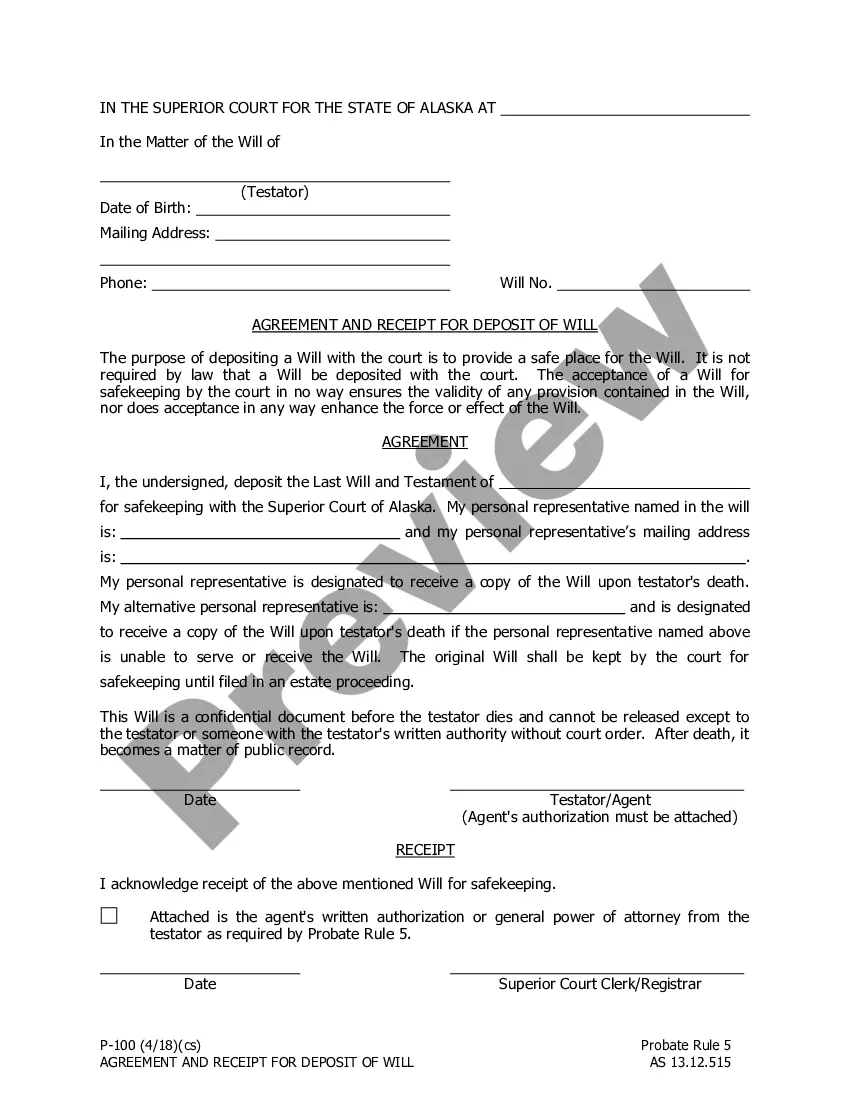
Motion to Set Cause for Trial in Federal Court
Overview of this form
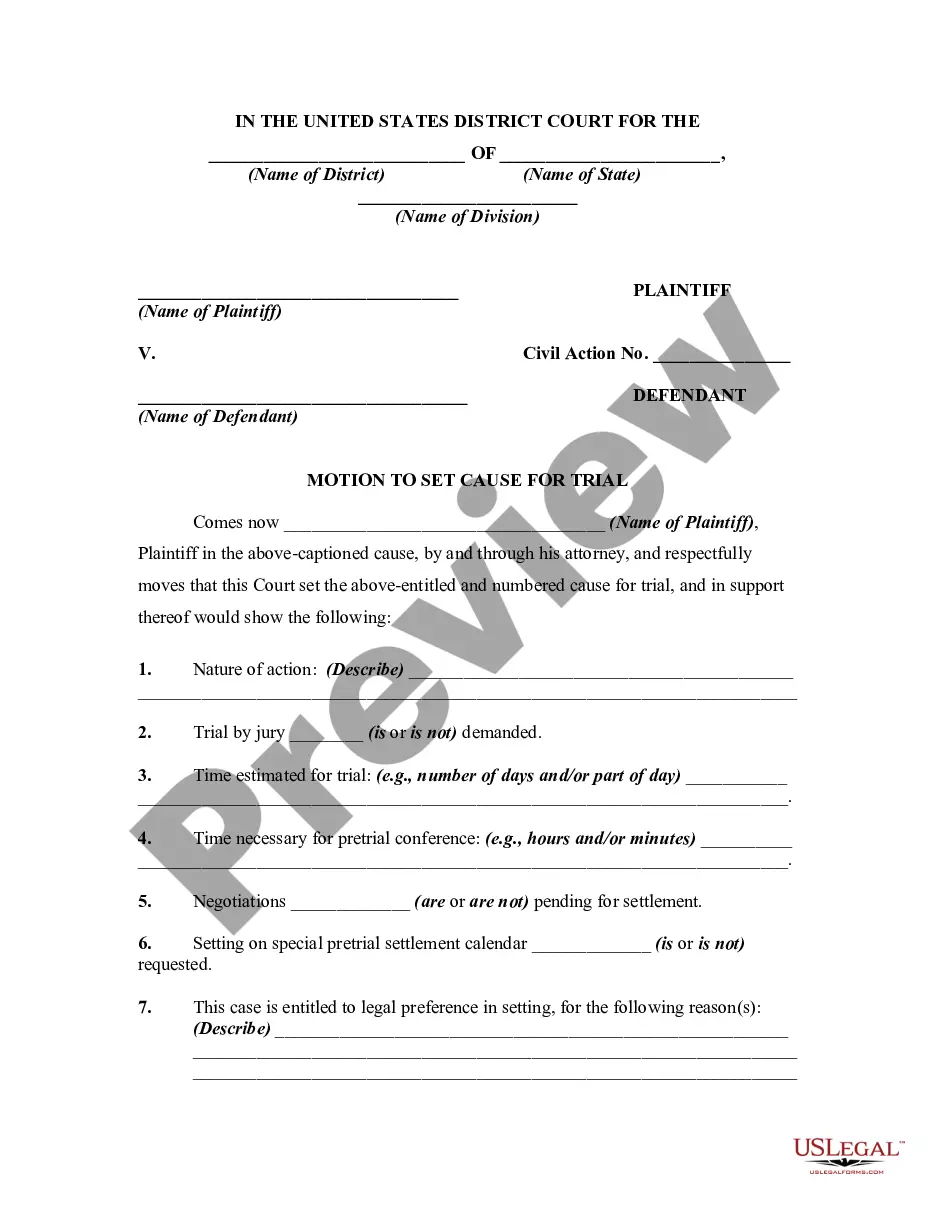
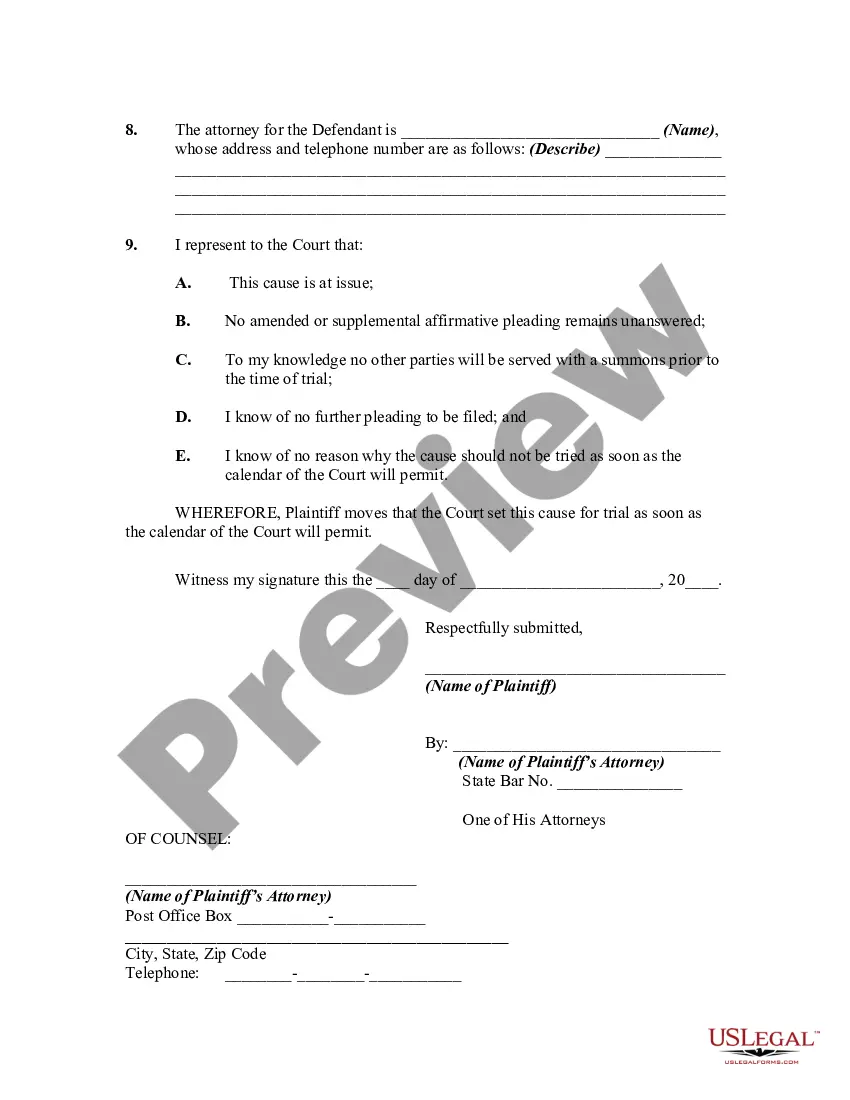
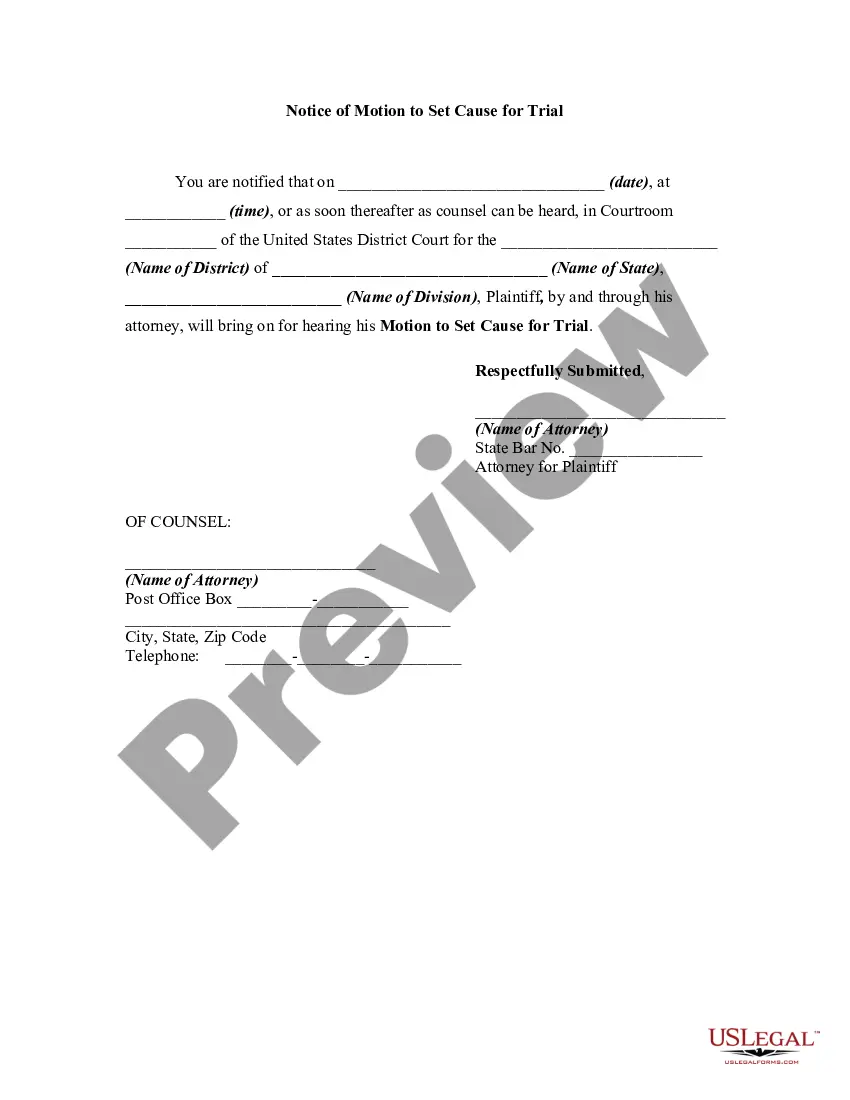
The Motion to Set Cause for Trial in Federal Court is a legal document filed by the plaintiff to request the court to schedule a trial date for their case. This motion is essential for moving a civil case forward in a federal court setting. Unlike other motions, this form specifically addresses the need for a court to establish a trial date and outlines the responsibilities of the parties involved in the litigation process.
Key parts of this document
- Name of the plaintiff and defendant.
- Details about the nature of the action being taken.
- Indication of whether a jury trial is requested.
- Estimated time required for the trial and pretrial conference.
- Information on ongoing settlement negotiations.
- Legal preferences for trial setting.
- Signature of the plaintiff or their attorney.


When this form is needed
This form is used when a plaintiff is prepared to go to trial and wants to formally request a trial date from the court. It is applicable in situations where the plaintiff believes that the case is ready for trial, and there are no outstanding issues that would delay proceedings. This motion is a critical step in the litigation process to ensure the case is addressed in a timely manner.
Who this form is for
This form is intended for:
- Plaintiffs in federal civil litigation who wish to advance their case to trial.
- Attorneys representing plaintiffs in federal court to streamline the trial scheduling process.
- Individuals or entities involved in legal disputes where a trial needs to be established.
How to complete this form
- Identify and fill in the names of the parties involved in the case.
- Provide a detailed description of the nature of the legal action.
- Specify whether a jury trial is demanded.
- Estimate the time necessary for the trial and any pretrial conference.
- Indicate if negotiations for settlement are pending.
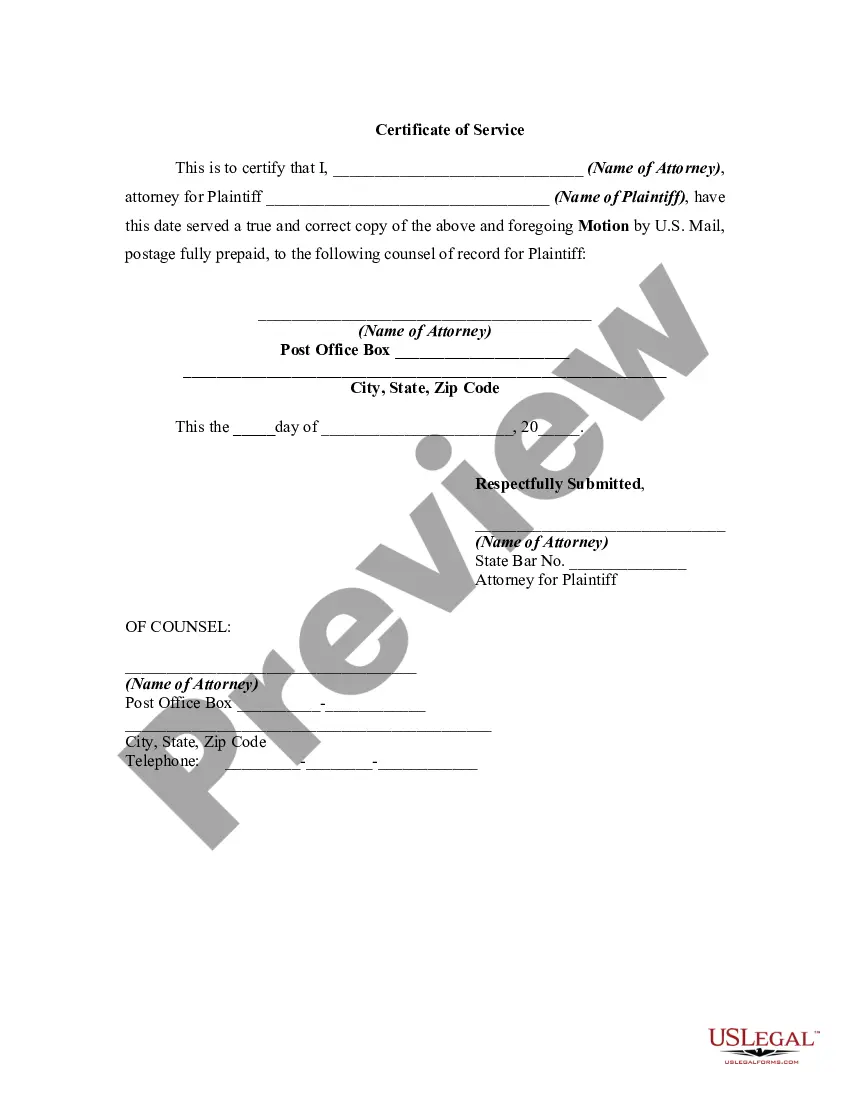
- Sign and date the form, ensuring all required parties are included in the certificate of service.
Does this document require notarization?
Notarization is generally not required for this form. However, certain states or situations might demand it. You can complete notarization online through US Legal Forms, powered by Notarize, using a verified video call available anytime.
Get your form ready online
Our built-in tools help you complete, sign, share, and store your documents in one place.
Make edits, fill in missing information, and update formatting in US Legal Forms—just like you would in MS Word.
Download a copy, print it, send it by email, or mail it via USPS—whatever works best for your next step.
Sign and collect signatures with our SignNow integration. Send to multiple recipients, set reminders, and more. Go Premium to unlock E-Sign.
If this form requires notarization, complete it online through a secure video call—no need to meet a notary in person or wait for an appointment.
We protect your documents and personal data by following strict security and privacy standards.

Make edits, fill in missing information, and update formatting in US Legal Forms—just like you would in MS Word.

Download a copy, print it, send it by email, or mail it via USPS—whatever works best for your next step.

Sign and collect signatures with our SignNow integration. Send to multiple recipients, set reminders, and more. Go Premium to unlock E-Sign.

If this form requires notarization, complete it online through a secure video call—no need to meet a notary in person or wait for an appointment.

We protect your documents and personal data by following strict security and privacy standards.
Common mistakes
- Failing to provide a clear description of the nature of the action.
- Not indicating whether a jury trial is requested, which can cause delays.
- Omitting necessary details about the estimated time for trial.
- Neglecting to notify the other parties or their attorneys appropriately.
Why use this form online
- Convenience of filling out and customizing the form from any location.
- Access to templates that are drafted by licensed attorneys for accuracy and legality.
- Ability to download and store the completed forms securely for future reference.
Legal use & context
- This form is a necessary step in the litigation process, enabling plaintiffs to move their cases forward.
- It reflects the federal court's guidelines on trial scheduling, helping to maintain an efficient court calendar.
- The motion must be properly served to the defendant's counsel under local court rules.
What to keep in mind
- The Motion to Set Cause for Trial is essential for plaintiffs seeking to advance their cases in federal court.
- Accurate completion and timely filing of this motion can significantly affect trial scheduling.
- Understanding the key components will aid in avoiding common mistakes.
Looking for another form?







Form popularity
FAQ
A "motion" is simply a formal request to a court that it do something or decide an issue in favor of the party that asks for it. "Granted" means the court agreed with the request, and did or decided in favor of the requester.
A hearing for the purpose of asking a judge to issue a ruling or order. The motion is typically filed by one side and a notice is sent to the opposing attorney who responds in writing.
What Happens at a Trial Setting Conference? The judge will ask questions about the case to ascertain whether it is ready for trial and how long the trial is likely to take. If the case is indeed ready to proceed to trial, the court will set a Mandatory Settlement Conference (or MSC) as well as a trial date.
After you complete your motion, you must file it with the court.You must then serve (mail) a copy of your filed motion (including all exhibits and the date, time, and place of hearing) to all other parties in the case. If a party is represented by an attorney, mail the motion directly to the attorney's office.
General format - each motion generally consists of a case caption, a title that briefly identifies the relief sought, a series of numbered paragraphs that explains -- in a logical way -- why you are entitled to that relief, a prayer for relief, a signature block, a certification that a copy of the motion was sent to
Ask the court for a motion date. Identify and fill out your motion forms. Serve and file your motion forms. Confirm that you will attend the motion. Go to your motion hearing. Receive the judge's decision.
1 Every California judge is familiar with the requirement to issue timely decisions under a constitu- tional provision (Article VI, Section 19) that sets a deadline for judicial decisions: 90 days after the matter is submitted for decision.
You write your motion. You file your motion with the court clerk. The court clerk inserts the date and time your motion will be heard by the judge. You serve (mail) your motion to the other side. The other side files a written opposition to your motion with the court.
A motion is an application to the court made by the prosecutor or defense attorney, requesting that the court make a decision on a certain issue before the trial begins. The motion can affect the trial, courtroom, defendants, evidence, or testimony.