Alaska Public Use Easement
Understanding this form
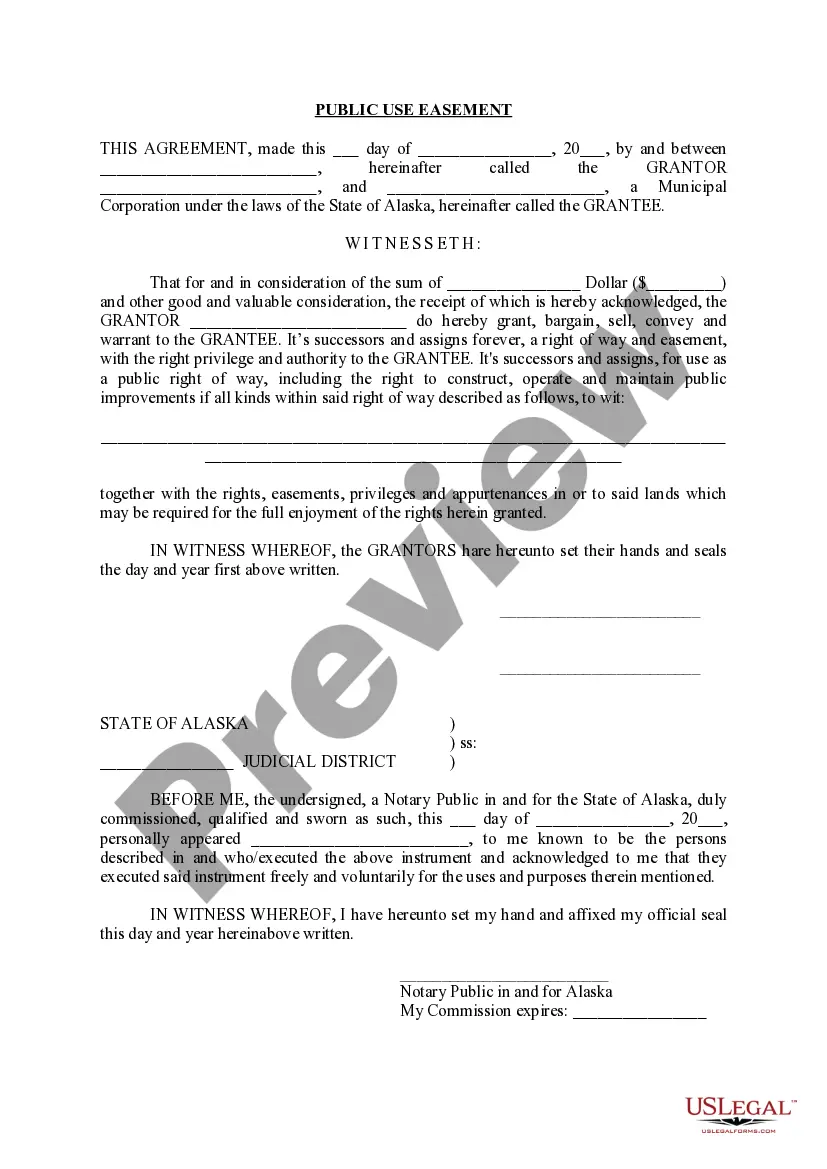
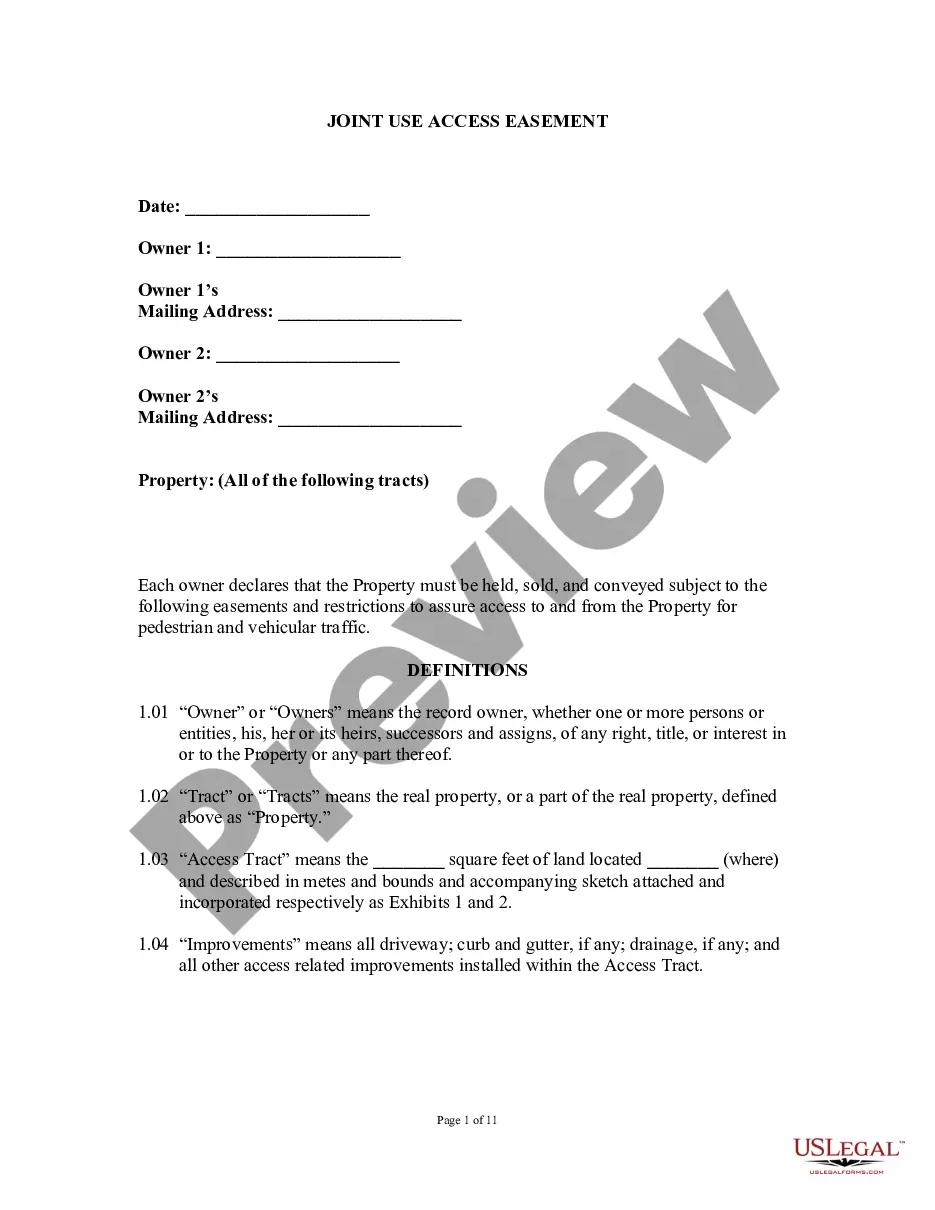
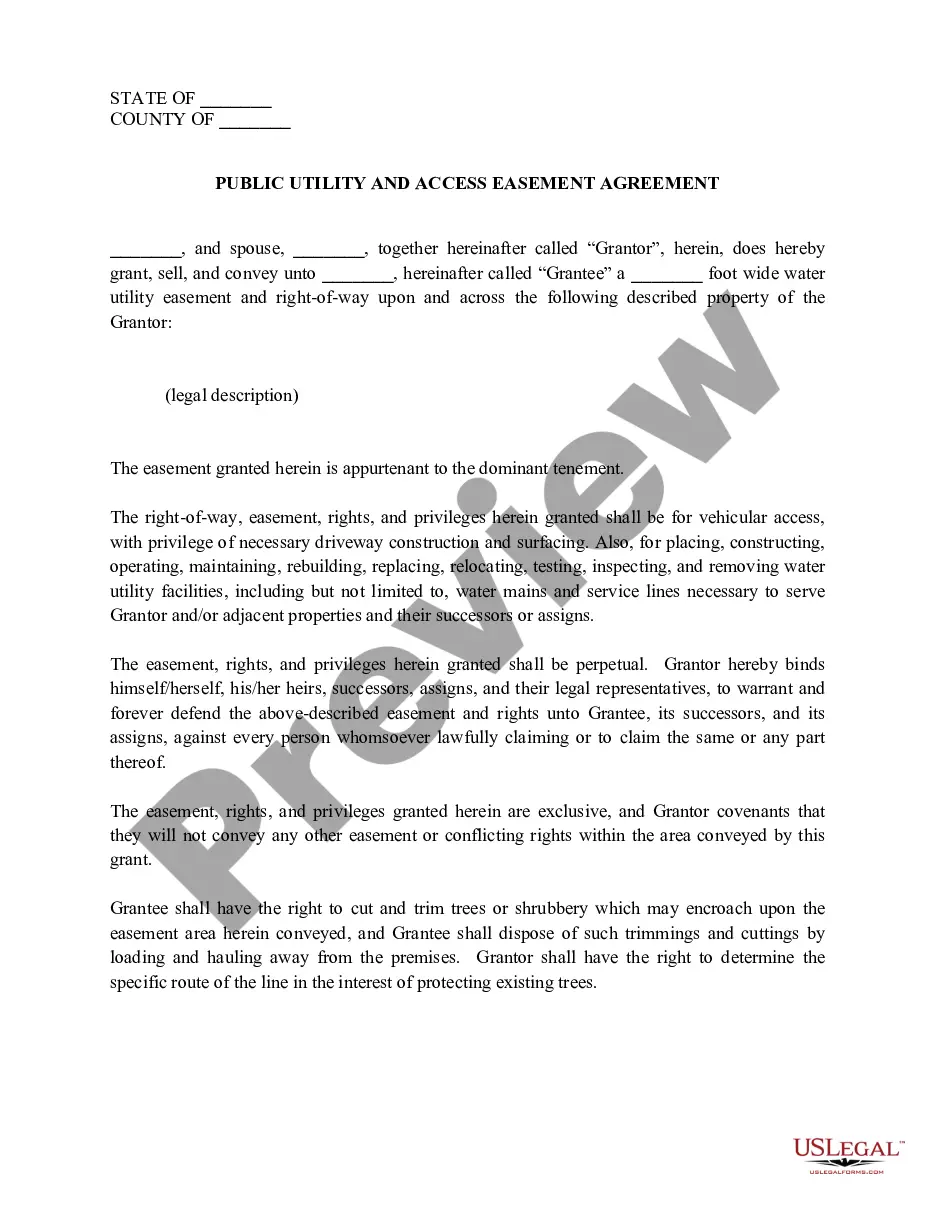
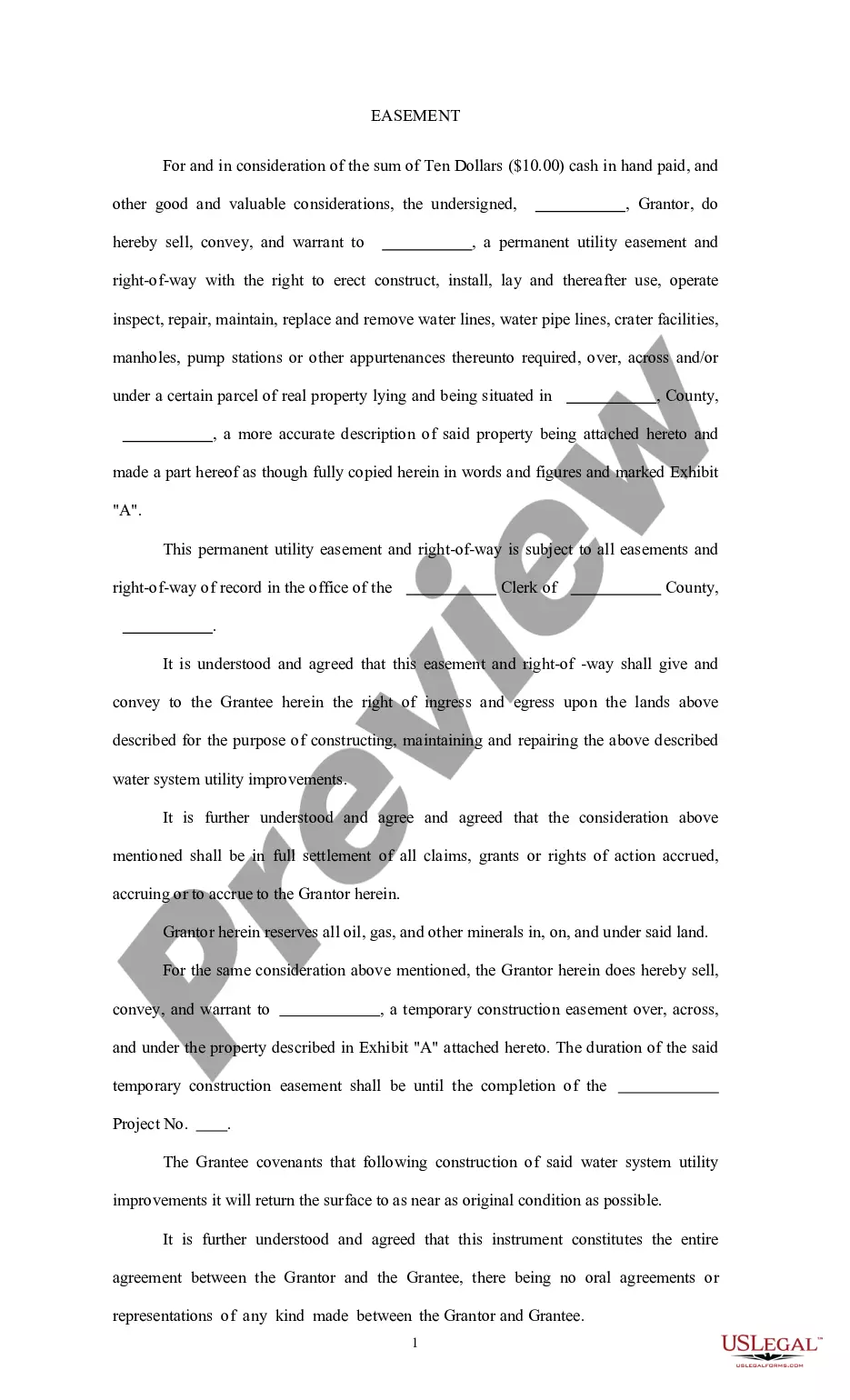
The Public Use Easement is a legal document that grants the general public the right to use a specific portion of someone's land for public purposes. Unlike private easements, which are limited to certain individuals, public easements allow unrestricted access to structures such as roads, parks, and pathways. This form is essential for municipalities that need to formalize the usage of land for public benefit.
Key parts of this document
- Parties involved: Identifies the GRANTOR (property owner) and the GRANTEE (municipal corporation).
- Consideration: Indicates the amount of compensation for granting the easement.
- Defined right of way: Specifies the exact area being designated for public use.
- Rights and privileges: Details the rights granted for maintenance and other activities within the easement.
- Notarization: Requires notarization to validate the agreement.
When to use this document
This form should be used when a property owner wishes to allow public access to a portion of their property for specific public uses. Common scenarios include allowing access for utilities, enabling public right-of-ways for roads or trails, or establishing walkways in parks. It can be necessary during urban development, infrastructure projects, or other situations where public access is essential.
Who needs this form
- Property owners looking to grant public easement rights on their land.
- Municipal corporations or local governments needing formal authorization to use private land for public projects.
- Developers involved in urban planning needing to establish rights of way for public access.
Instructions for completing this form
- Identify the parties: Enter the names of the GRANTOR and GRANTEE accurately.
- Specify the date: Fill in the date when the agreement is made.
- Enter the consideration amount: Write the sum being offered for the easement.
- Describe the right of way: Clearly outline the area being designated for public use.
- Sign and date: Both parties must sign the document in the presence of a notary public.
Is notarization required?
Yes, this form must be notarized to be legally valid. Using US Legal Formsâ integrated online notarization allows you to complete this step conveniently through a secure video call, ensuring your easement agreement is properly executed.
Get your form ready online
Our built-in tools help you complete, sign, share, and store your documents in one place.
Make edits, fill in missing information, and update formatting in US Legal Forms—just like you would in MS Word.
Download a copy, print it, send it by email, or mail it via USPS—whatever works best for your next step.
Sign and collect signatures with our SignNow integration. Send to multiple recipients, set reminders, and more. Go Premium to unlock E-Sign.
If this form requires notarization, complete it online through a secure video call—no need to meet a notary in person or wait for an appointment.
We protect your documents and personal data by following strict security and privacy standards.

Make edits, fill in missing information, and update formatting in US Legal Forms—just like you would in MS Word.

Download a copy, print it, send it by email, or mail it via USPS—whatever works best for your next step.

Sign and collect signatures with our SignNow integration. Send to multiple recipients, set reminders, and more. Go Premium to unlock E-Sign.

If this form requires notarization, complete it online through a secure video call—no need to meet a notary in person or wait for an appointment.

We protect your documents and personal data by following strict security and privacy standards.
Common mistakes to avoid
- Failing to accurately describe the area of the easement.
- Not obtaining the necessary notarization before finalizing the agreement.
- Leaving out critical information regarding compensation or rights.
Why use this form online
- Convenience: Access and fill out the form from any location at any time.
- Editability: Modify fields as needed before finalizing the document.
- Reliability: Forms are drafted by licensed attorneys, ensuring legal compliance.
Looking for another form?
Form popularity
FAQ
An easement is a "nonpossessory" property interest that allows the holder of the easement to have a right of way or use property that they do not own or possess.If the easement only benefits an individual personally, not as an owner of a particular piece of land, the easement is known as "in gross."
A private right of way is an easement, which is the right to use part of another's property in a particular way even though they do not own it.
Easements are usually but not always registered on the Title to the property. Registration takes place with Land and Property Information in NSW and the Office of Regulatory Services in the ACT. The purpose of registering an easement over land is to show on the public record that an easement exists.
A property easement is a legal situation in which the title to a specific piece land remains with the landowner, but another person or organization is given the right to use that land for a distinct purpose.
An easement appurtenant is an easement that benefits one parcel of land, known as the dominant tenement, to the detriment of another parcel of land, known as the servient tenement.Similarly, if Landowner B sells his property to another landowner, that landowner will be able to use the easement. Easement in Gross.
When you're buying a house, you might find out that the property has an easement on it. Essentially this means that someone other than you could have access to the land. This isn't necessarily a bad thing. For example, utility companies typically hold easements in case they need to access pipes or cables.
The party gaining the benefit of the easement is the dominant estate (or dominant tenement), while the party granting the benefit or suffering the burden is the servient estate (or servient tenement). For example, the owner of parcel A holds an easement to use a driveway on parcel B to gain access to A's house.
When one of the owners of either the dominant estate which an easement benefits or the servient estate over which the easement runs becomes the owner of both properties, then there is a unity of the two titles, and since an owner does not need an easement over the owner's own property, according to Florida law, the