Alaska Quitclaim Deed, Assignment and Release
Overview of this form
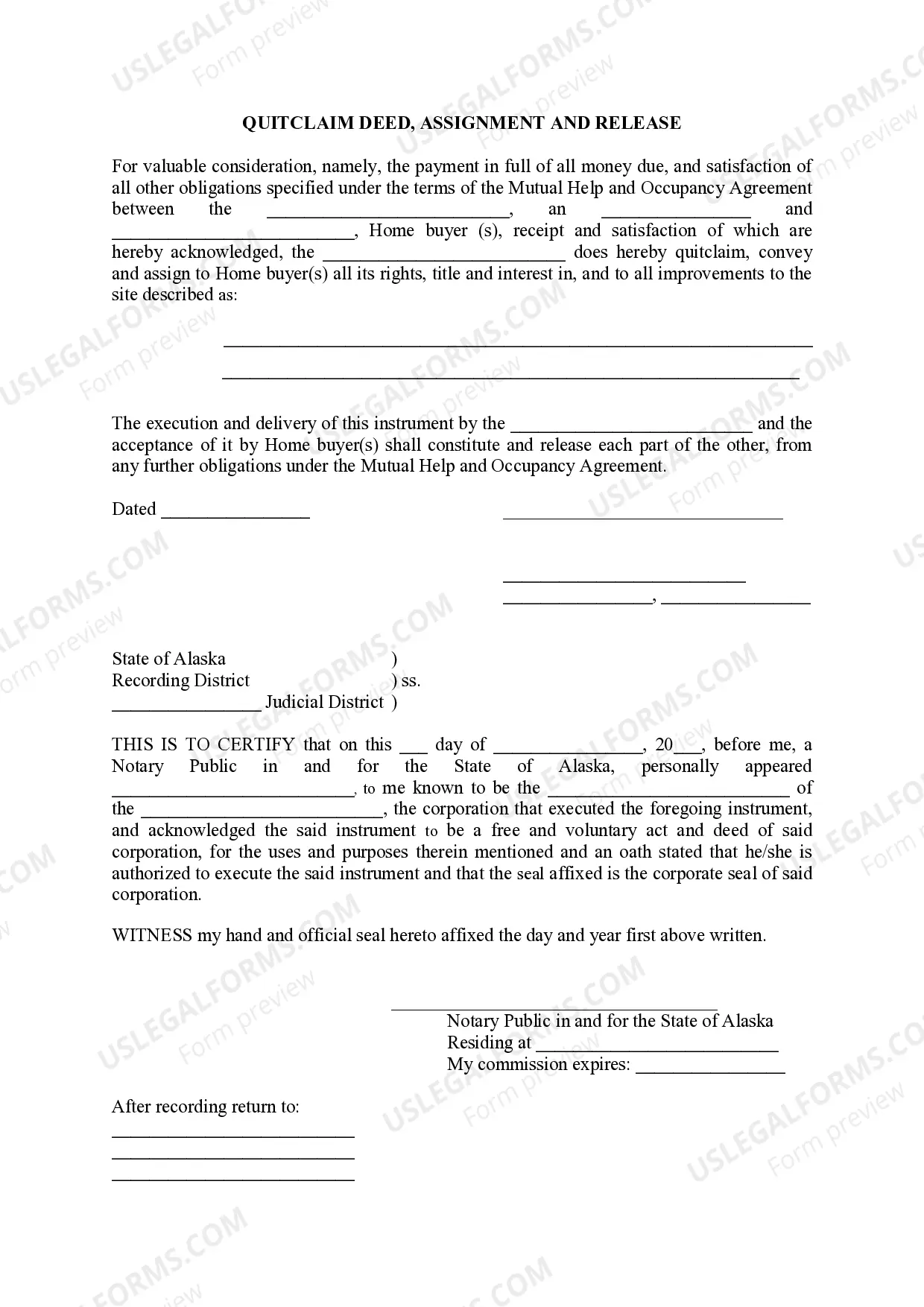
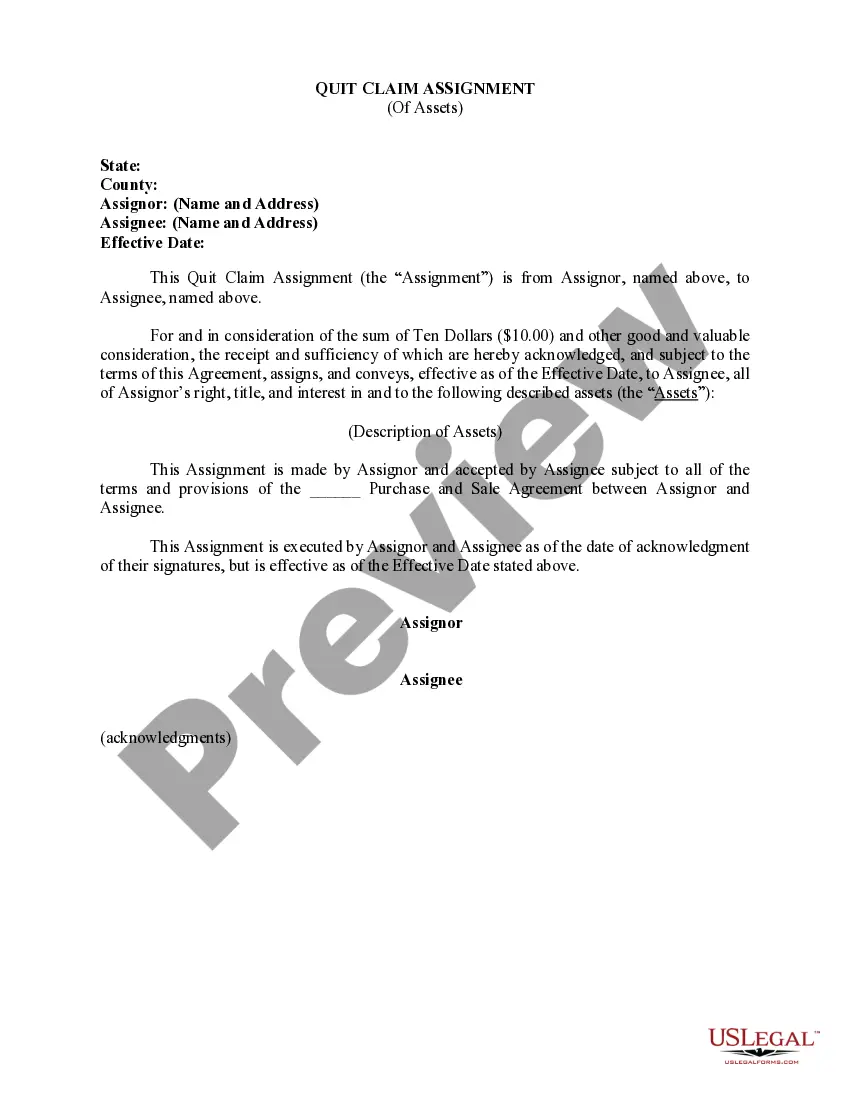
The Quitclaim Deed, Assignment and Release is a legal document used to transfer ownership rights in real property. This form is specifically for situations where all financial obligations under a Mutual Help and Occupancy Agreement have been fulfilled. Unlike other deeds, a quitclaim deed conveys whatever interest the grantor has in the property without any warranties regarding the title. This means it is particularly useful for individuals looking to clarify ownership without the need for extensive legal verification of the property's title status.
What’s included in this form
- Parties involved: Identification of the grantor and the home buyer(s).
- Property description: Clear details regarding the site being conveyed.
- Consideration clause: Acknowledgment of payment in full and satisfaction of obligations.
- Release clause: Release of all parties from further obligations under the Mutual Help and Occupancy Agreement.
- Notarization statement: Certification by a Notary Public to validate the document.


When this form is needed
This form should be used when the grantor has completed all requirements set forth in a Mutual Help and Occupancy Agreement and wishes to transfer their interest in the property to the home buyer(s). Typical scenarios include completing the purchase of a property where the seller needs to finalize the transfer of rights or during the settlement of an estate where properties are distributed among heirs.
Intended users of this form
- Home buyers who are receiving property through a Mutual Help and Occupancy Agreement.
- Grantors who have fulfilled their financial and legal obligations under the agreement.
- Real estate professionals or attorneys facilitating the transaction.
How to prepare this document
- Identify the parties: Fill out the names of the grantor and the home buyer(s).
- Specify the property: Describe the property location and details clearly.
- Enter the date: Fill in the date the form is executed.
- Provide the Notary Public details: Include the name and location of the Notary Public who will authenticate the form.
- Sign the form: Ensure all necessary parties sign where indicated.
Notarization guidance
Yes, this form must be notarized to be legally valid in Alaska. Users can benefit from US Legal Formsâ integrated online notarization services, available 24/7 via secure video calls. This ensures convenience without the need for physical travel while maintaining legal equivalence.
Get your form ready online
Our built-in tools help you complete, sign, share, and store your documents in one place.
Make edits, fill in missing information, and update formatting in US Legal Forms—just like you would in MS Word.
Download a copy, print it, send it by email, or mail it via USPS—whatever works best for your next step.
Sign and collect signatures with our SignNow integration. Send to multiple recipients, set reminders, and more. Go Premium to unlock E-Sign.
If this form requires notarization, complete it online through a secure video call—no need to meet a notary in person or wait for an appointment.
We protect your documents and personal data by following strict security and privacy standards.

Make edits, fill in missing information, and update formatting in US Legal Forms—just like you would in MS Word.

Download a copy, print it, send it by email, or mail it via USPS—whatever works best for your next step.

Sign and collect signatures with our SignNow integration. Send to multiple recipients, set reminders, and more. Go Premium to unlock E-Sign.

If this form requires notarization, complete it online through a secure video call—no need to meet a notary in person or wait for an appointment.

We protect your documents and personal data by following strict security and privacy standards.
Common mistakes
- Failing to clearly describe the property being transferred.
- Not including all required partiesâ names and signatures.
- Neglecting to date the document, which can affect its legality.
- Overlooking the notarization requirement, especially in states where it is mandatory.
Advantages of online completion
- Convenient access to downloadable templates anytime.
- Editable forms that allow customization to meet specific needs.
- Reliable legal language drafted by licensed attorneys.
- Time-saving option to fulfill legal documentation without a physical appointment.
Looking for another form?
Form popularity
FAQ
Alaska quit claim deeds must be submitted to the recording district that is local to the property. They must also be accompanied by the applicable recording fee set by regulation; if the document is to be recorded for multiple purposes, it must be accompanied by the applicable fee for each of the multiple purposes.
The drawback, quite simply, is that quitclaim deeds offer the grantee/recipient no protection or guarantees whatsoever about the property or their ownership of it. Maybe the grantor did not own the property at all, or maybe they only had partial ownership.
Quitclaim Does Not Release Debts Signing a quitclaim deed and giving up all rights to the property doesn't release you from any financial obligations you may have. It only removes you from the title, not from the mortgage, and you are still responsible for making payments.
The only way to forcibly change the ownership status is through a legal action and the resultant court order. However, if an owner chooses to be removed from the deed, it is simply a matter of preparing a new deed transferring that owner's interest in the property.
Once the quitclaim deed is signed and notarized, it is a valid legal document. But the grantee must also have the quitclaim deed recorded in the county recorder's office, or with the county clerk -- whoever has the authority to record deeds and property transfers.
It's usually a very straightforward transaction, but it's possible for a quitclaim deed to be challenged. If a quitclaim deed is challenged in court, the issue becomes whether the property was legally transferred and if the grantor had the legal right to transfer the property.
It will depend what state the property is in. For example, the minimum fee payable when changing the title to have someone removed from a property title in NSW is $133.48. This fee must be paid to the NSW Government Land & Property Information Department.
A quitclaim deed affects ownership and the name on the deed, not the mortgage. Because quitclaim deeds expose the grantee to certain risks, they are most often used between family members and where there is no exchange of money.Quitclaim deeds transfer title but do not affect mortgages.
Even if you sign a quitclaim deed, the mortgage balance will continue to show up on your credit report. This will hurt what is called your debt utilization ratio. This may mean you have too much debt to be qualified for your next mortgage when you want to buy a new home.